Science · Space
At 5:16:07 a.m. Eastern on Wednesday, November 18, the Voyager 1 one light-day milestone arrives: NASA’s 1977 probe will be 16,094,799,096 miles from Earth, so far that its radio signals — travelling at the speed of light itself — need a full 24 hours to make the trip home. It is the first time anything built by human hands has been a full light-day away, and the spacecraft, as NASA is careful to point out, will not notice a thing.
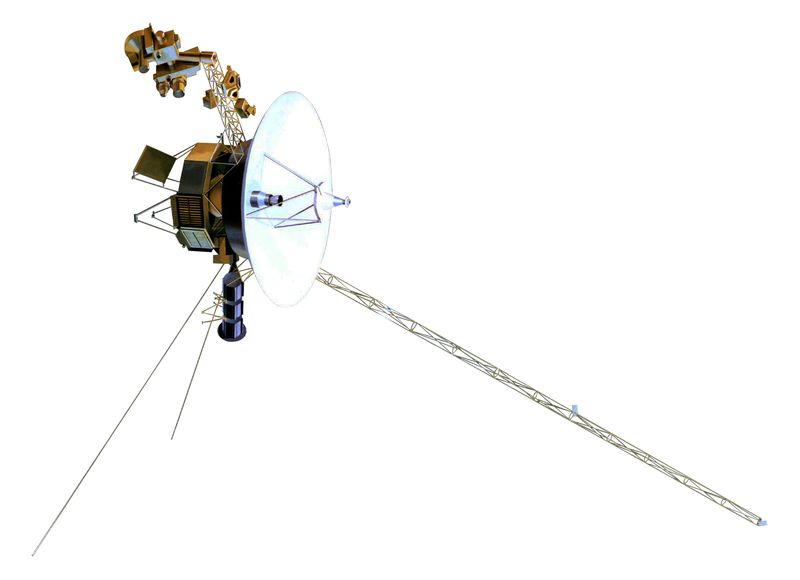
PASADENA, California, November 16, 2026 — The Voyager 1 one light-day crossing has an appointment, and it is precise to the second. At 5:16:07 a.m. EST on Wednesday, November 18 — 2:16 a.m. on the Pacific coast, 10:16:07 UTC — the straight-line distance between Earth and NASA’s Voyager 1 spacecraft will equal one light-day: 16,094,799,096 miles, or 25,902,068,356 kilometres, roughly 173.14 times the distance from Earth to the Sun. No human-made object has ever been that far away, for the simple reason that Voyager 1 has been the farthest human-made object for decades and it has never stopped moving. At the moment of the crossing it will have been flying for 49 years, 2 months and 11 days, still receding at nearly 38,000 miles per hour.
Nothing will happen aboard the spacecraft at 5:16:07 a.m. NASA is explicit about this, and the point is worth absorbing rather than glossing: the crossing is a mile marker, not an event, not a boundary, not a threshold the probe can feel. There is no line in interstellar space with a light-day painted on it. The milestone exists entirely in the relationship between the spacecraft and us — in what its distance does to the conversation between a machine launched in the era of Jimmy Carter and the engineers, most of them not yet born when it left, who still talk to it every week from the Jet Propulsion Laboratory in Pasadena.
What we know
- The crossing: Wednesday, November 18, 2026 at 5:16:07 a.m. EST (2:16 a.m. PST), Voyager 1 becomes the first human-made object one light-day from Earth — 16,094,799,096 miles (25,902,068,356 km), about 173.14 AU, per NASA and the JPL ephemeris. It is upcoming, not yet reached.
- What it means operationally: a radio command now takes 24 hours to arrive, and the reply takes another 24 — a 48-hour round trip for the simplest exchange.
- Nothing changes aboard: NASA stresses the spacecraft will notice no change. It is a mile marker, not an event or a boundary.
- The flight so far: launched September 5, 1977; at the crossing, 49 years, 2 months and 11 days in flight at nearly 38,000 mph (61,000 kph); it crossed the heliopause into interstellar space on August 25, 2012, and remains the farthest human-made object ever.
- The October scare: NASA’s Deep Space Network heard nothing on scheduled contacts on October 18 and 19; the signal returned on its own on October 20, before any troubleshooting command was sent; one thruster group had gone offline and the spacecraft’s fault protection had switched to backup thrusters automatically. The cause is still under investigation.
- How to join in: after sunset on Tuesday, November 17, NASA’s “Shine Bright” event invites the public to flash Voyager’s call sign, VGR, in Morse code toward the sky — a symbolic wave the spacecraft cannot detect. On Thursday, November 19, JPL hosts a public discussion of the milestone at noon EST.
What a light-day actually is
A light-day is not a unit of time. It is a distance — the distance light travels in one day, at 186,282 miles per second, through the vacuum of space. Astronomers reach for light-based units because ordinary ones collapse under the numbers: nobody can feel the difference between 16 billion miles and 15 billion, but everyone knows what a day is. Saying Voyager 1 is one light-day away converts an abstraction into a schedule. It means the news from the spacecraft is always a day old when it arrives, and that anything Earth says to it today will not be heard until tomorrow.
NASA frames the milestone with a ladder of comparisons, and the ladder is worth climbing slowly, because each rung is a place human beings have actually been or sent something. The Moon is 1.3 light-seconds away — a conversational pause, short enough that Apollo astronauts and Mission Control could nearly talk in real time. The Sun is about 8.3 light-minutes away: the sunlight warming your face left its surface roughly eight minutes ago. Mars swings between about 3 and 22 light-minutes depending on where the two planets are in their orbits, which is why rover drivers plan a day’s driving in advance rather than steering. Neptune, the most distant planet, sits about 4 light-hours and 10 minutes out — and even that, NASA notes, took Voyager 2 twelve years to reach. Beyond the planets, the scale breaks open: Proxima Centauri, the nearest star, is 4.24 light-years away. Voyager 1’s one light-day, enormous as it is, is roughly one 1,550th of the distance to the nearest star. The spacecraft has travelled farther than anything else we have ever built, and it has barely left the neighbourhood. Both of those things are true at once, and holding them together is most of what this milestone is about.
The 48-hour conversation
The practical consequence of one light-day is a conversation conducted at the speed of archaeology. A command sent from the Deep Space Network — the great dish antennas in California, Spain and Australia that take turns listening as Earth rotates — now travels for a full day before it reaches the spacecraft. Voyager’s answer, whispered home by a transmitter less powerful than a refrigerator light bulb and received as a signal of almost inconceivable faintness, takes another full day to arrive. Project manager Suzanne Dodd of JPL puts it in the plainest possible terms: “If you want to say ‘hello’ to Voyager, you send your message and then you go home and you wait two days before you finally get a response.”
That delay rewrites the engineering of survival. When something goes wrong aboard Voyager 1, Earth cannot help in anything resembling real time: by the time engineers see the symptom, a day has passed; by the time their fix arrives, another day has passed; and the spacecraft has spent both days alone with the problem. The first responder to every Voyager emergency is therefore not a person but the spacecraft’s own fault-protection software — 1970s logic, written for 1970s hardware, that watches over the probe’s systems and swaps in backups when something fails. Mission teams design command sequences knowing each instruction is a letter posted to the past, and they build in margins for a machine that must, in every meaningful sense, look after itself. That is not a metaphor the mission uses lightly. In October, it is exactly what happened.
Two days of silence in October
The milestone arrives a month after the mission’s most anxious week in years — and Signal Post News reports that week strictly within the limits of what NASA’s Jet Propulsion Laboratory has confirmed, because the rest is not known. The confirmed facts, from JPL’s October 29 news release, are these. The Deep Space Network heard nothing from Voyager 1 on two scheduled contacts, on October 18 and October 19. Before any troubleshooting commands were sent, the signal returned on its own on October 20. Engineers subsequently established that one group of the spacecraft’s thrusters — the small jets that keep its antenna pointed at Earth — had gone offline, and that Voyager’s fault protection had switched to a set of backup thrusters automatically, on its own, a light-day’s journey from the nearest help. The cause of the episode is still under investigation, and JPL has not attributed the silence to the thruster swap or to anything else. Mission manager Kareem Badaruddin’s team is still working to understand it.
Read those facts again with the light-day in mind and the shape of the scare becomes clear. For two days, the most distant object humanity has ever made simply did not answer — and there was nothing anyone on Earth could do except wait, because waiting is the only verb the distance allows. Then the spacecraft fixed the part of the problem it could fix, by itself, using procedures its designers wrote before most of its current operators were born, and phoned home. Whatever the investigation eventually concludes about the cause, October was a rehearsal for the era that formally begins on Wednesday: from now on, every Voyager silence will be measured against a two-day round trip, and every recovery will begin, as this one did, with the spacecraft rescuing itself.
Forty-nine years out: the road to one light-day
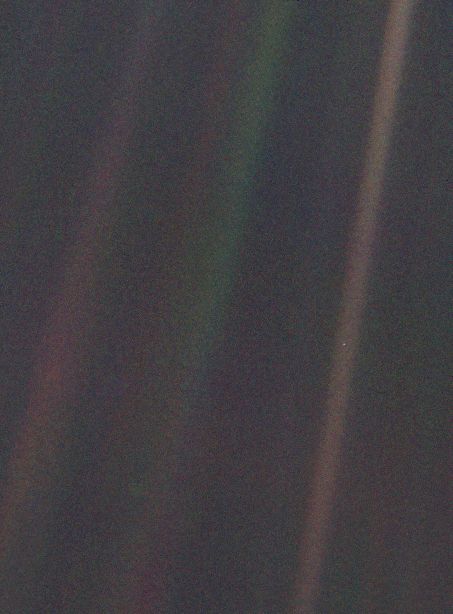
Voyager 1 left Earth on September 5, 1977, riding a once-in-176-years alignment of the outer planets that let a single spacecraft visit Jupiter and Saturn in succession. It photographed Jupiter’s Great Red Spot and volcanoes erupting on Io, threaded Saturn’s rings, and then, its planetary work done, turned north out of the ecliptic and kept going — the fastest, farthest departure in history, a title it has now held for decades. On February 14, 1990, at the urging of Carl Sagan, it turned its cameras around from about 6 billion kilometres (3.7 billion miles) away and took the Family Portrait of the solar system, in which Earth appears as the famous Pale Blue Dot: a speck of light in a scattered sunbeam, every human who ever lived contained in a fraction of a pixel. The cameras were switched off afterwards to save power. The speck kept receding.
On August 25, 2012, Voyager 1 crossed the heliopause — the boundary where the solar wind gives way to the plasma between the stars — and entered interstellar space, the first human-made object to do so. Precision matters in describing that, too: the spacecraft left the Sun’s heliosphere, the bubble of the solar wind, but astronomers still debate the outer architecture of the Sun’s gravitational domain, including the distant Oort cloud, and NASA’s own careful formulation is the one used here. What is not debated is the environment Voyager 1 now samples directly: interstellar plasma, galactic cosmic rays unscreened by the Sun, and magnetic fields that belong to the galaxy rather than to our star — measurements no other operating spacecraft can make, from a vantage point nothing else will reach for generations.
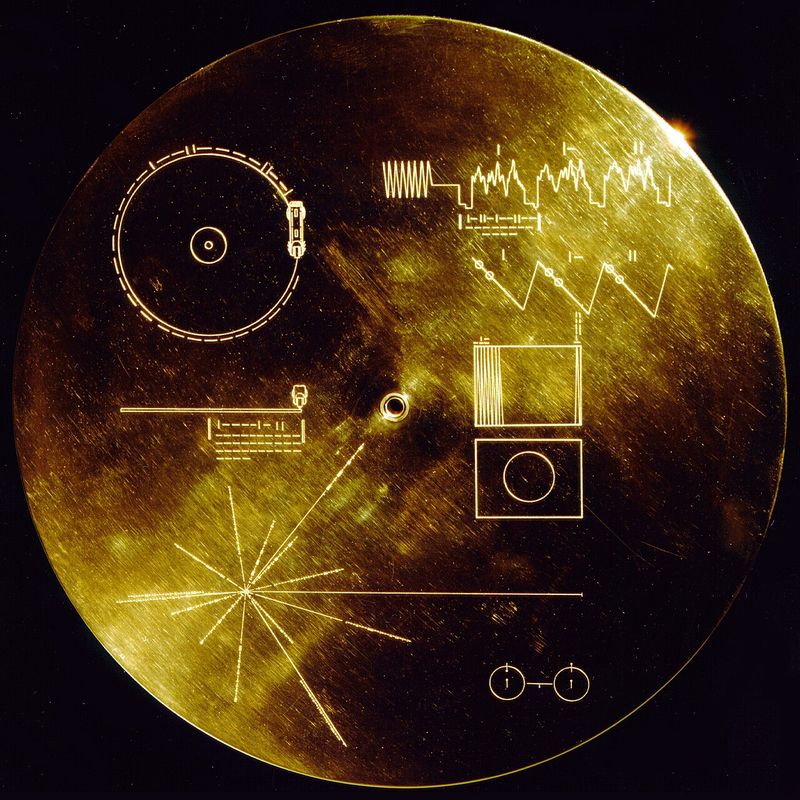
Bolted to the spacecraft’s side, throughout all of this, is the Golden Record: a gold-plated copper disc carrying greetings in 55 languages, the sounds of whales and thunder and a baby’s cry, music from Bach to Chuck Berry, and 115 images of Earth, assembled by a committee chaired by Sagan. It was always the mission’s message in a bottle, addressed to no one in particular and expected to outlast everything on Earth that made it. At one light-day out, the bottle is a day’s light-travel from the shore it left — a distance that is, by the standards the record was built for, nothing at all. It was built for billions of years. It has used up 49.
Borrowed power: the arithmetic of the end
Voyager 1 runs on three radioisotope thermoelectric generators — nuclear batteries whose plutonium fuel decays a little more each year, surrendering roughly 4 watts of electrical power annually to entropy. There is no refuelling, no servicing, no rescue: the power curve points only down, and the mission’s last decade has been an exercise in deciding, year by year, what the spacecraft can still afford to run. In September 2026, engineers completed the most ambitious conservation step yet, a coordinated swap the mission calls the “Big Bang”: three devices were switched off and lower-power alternatives put in their place, stretching the remaining supply further into the 2030s than the previous configuration allowed. Mission reporting indicates that two science instruments — measuring magnetic fields and plasma waves — remain in operation, returning the only direct measurements of interstellar space humanity possesses.
The arithmetic is unforgiving but not immediate. Each watt saved is time bought; each instrument retired is a sense surrendered to keep the others alive. The mission’s planners have become, of necessity, triage artists, trading capability for longevity in the knowledge that whenever the last instrument finally falls silent, there will be no second chance and no successor on the pad: nothing currently built or funded will reach Voyager 1’s distance within the professional lifetimes of the people who would build it. The light-day milestone lands in the middle of that arithmetic — a celebration, yes, but also a reminder that the conversation now conducted over two-day delays is being held on borrowed power, and that every future milestone, including the 50th anniversary of launch in 2027, will be reached by a fainter spacecraft than the one that reached the last.
Which light-day? A note on the definition
Careful readers — and ephemeris enthusiasts — may notice that “one light-day from Earth” can be measured more than one way, and NASA’s date rests on a specific choice that deserves to be stated plainly. The November 18, 5:16:07 a.m. EST figure is the moment the straight-line distance between Earth and Voyager 1 equals one light-day: the spacecraft’s position, as computed from the JPL ephemeris, will be 16,094,799,096 miles from Earth at that second. Independent checks against JPL’s Horizons system note two neighbouring moments. The arriving signal’s one-way light time — the age of the radio waves actually reaching Earth, which accounts for the geometry of the moving spacecraft and the moving planet — reaches a full 24 hours roughly 16 hours later, at about 02:18 UTC on November 19. And measured from the Sun rather than from Earth, Voyager 1’s distance reaches one light-day later still, around February 4, 2027. None of this contradicts NASA’s date; it refines it. A light-day is a distance wearing a clock’s clothing, and which clock you read — the ruler, the arriving signal, or the Sun-centred measure — moves the celebration by hours or months. NASA’s choice, the Earth-distance figure, is the one the agency is marking on Wednesday, and it is the figure used throughout this article.
How to join in: Shine Bright, and the JPL discussion
NASA is marking the milestone the night before it happens, and the invitation comes with an honesty clause. After sunset on Tuesday, November 17 — in each time zone, as darkness arrives — the agency’s “Shine Bright” event invites people everywhere to step outside and flash Voyager’s call sign, VGR, in Morse code toward the sky, using phones, flashlights or building lights: V is three short flashes and one long; G is two long and one short; R is short, long, short. NASA’s page for the event, at go.nasa.gov/shinebright, flashes the pattern automatically for anyone who would rather hold up a screen than work a torch. And NASA states the essential fact without varnish: Voyager 1 cannot detect any of it. The light is far too faint and the spacecraft has no instrument watching for it. Shine Bright is a symbolic wave — a planet turning, for one evening, to wave at the most distant thing it ever made — and its meaning lies in the waving, not in any signal received.
The following day, the conversation turns technical. On Thursday, November 19, JPL hosts a moderated discussion of the milestone at noon EST (9 a.m. PST) in the von Kármán Auditorium in Pasadena. The announced panel brings together Nicky Fox of NASA’s Science Mission Directorate, Cornell astronomer Jonathan Lunine, project manager Suzanne Dodd, mission manager Kareem Badaruddin and project scientist Jamie Rankin — the leadership of a mission whose spacecraft is older than most of the audience that will fill the hall, discussing a machine none of them will ever see again and all of them still talk to, two days at a time.
What happens next
Voyager 1’s road from here is measured in eras rather than events. Its trajectory carries it toward Gliese 445 — catalogued as AC +79 3888 — a dim star more than 17 light-years away in the constellation Ursa Minor; in roughly 40,000 years, long after its transmitters have fallen silent, the spacecraft is expected to pass within about 1.7 light-years of that star, closer to it than to the Sun it left. Its twin has its own appointment with this week’s milestone: Voyager 2, launched on August 20, 1977 on the longer road past Uranus and Neptune, is on pace to reach one light-day from Earth in November 2035 — nine years from now, when it will be 58 years into its flight. And in September 2027, barely ten months after Wednesday’s crossing, Voyager 1 will pass the 50th anniversary of its launch, a golden jubilee for a spacecraft that was designed to last five years.
Signal Post News readers following the week’s other space stories will recognise the contrast. This newsroom has covered a telescope falling out of the sky — NASA’s Swift Telescope Is Falling to Earth After a Failed Rescue — a heavy-lift rocket still learning its trade in Starship Flight 15 Reaches Orbit as Booster Catch Is Aborted, a new world found at the edge of the map in A New Dwarf Planet Discovered Beyond Pluto, and a first foreign visitor preparing to fly to China’s station in Pakistani Astronaut China Space Station Mission. Voyager 1 is the ancestor of all of it: the proof, launched on slide-rule-era mathematics and 1970s electronics, that a machine built by this species can leave the Sun’s wind behind, cross a full day of light, and still answer — eventually — when home calls. On Wednesday at 5:16:07 a.m. Eastern, the distance becomes official. The answer to the next hello will arrive, as all answers from Voyager 1 now do, two days later. The mission has made its peace with the wait. It has had 49 years of practice.
Sources
- NASA Science, “Voyager 1: What Is a Light-Day?” (published August 19, 2026; updated November 12, 2026) — science.nasa.gov: the crossing on Wednesday, November 18, 2026 at 5:16:07 a.m. EST; one light-day defined as 16,094,799,096 miles (25,902,068,356 km); 49 years, 2 months and 11 days of flight at the crossing; the scale comparisons (Moon, Sun, Mars, Neptune, Proxima Centauri); the Shine Bright event after sunset on Tuesday, November 17; Voyager 2’s one-light-day crossing in November 2035; and the Gliese 445 trajectory.
- NASA / Jet Propulsion Laboratory news release 2026-078, October 29, 2026 — NASA’s Voyager 1 Conserves Power, Resolves Brief Communications Pause: the missed Deep Space Network contacts of October 18 and 19; the signal’s return on October 20 before any command was sent; the offline thruster group and the automatic switch to backups by fault protection; the cause still under investigation; the September “Big Bang” power swap; and project manager Suzanne Dodd’s “wait two days” description of the round-trip delay.
- NASA, Shine Bright for Voyager — go.nasa.gov/shinebright: the public event after sunset on Tuesday, November 17, 2026; the VGR Morse pattern (V: three short, one long; G: two long, one short; R: short, long, short); and NASA’s statement that the gesture is symbolic and cannot be detected by the spacecraft. JPL’s moderated discussion follows at noon EST on Thursday, November 19, in the von Kármán Auditorium, with Nicky Fox, Jonathan Lunine, Suzanne Dodd, Kareem Badaruddin and Jamie Rankin announced as panellists.
- Signal Post News, related coverage: NASA’s Swift Telescope Is Falling to Earth After a Failed Rescue; Starship Flight 15 Reaches Orbit as Booster Catch Is Aborted; A New Dwarf Planet Discovered Beyond Pluto; Pakistani Astronaut China Space Station Mission: Shenzhou-24 to Carry First Foreign Visitor to Tiangong.
- Photos: artist’s rendering of the Voyager spacecraft, NASA/JPL-Caltech via Wikimedia Commons (public domain); the Pale Blue Dot, photographed by Voyager 1 on February 14, 1990, NASA/JPL-Caltech via Wikimedia Commons (public domain); the Voyager Golden Record cover, “The Sounds of Earth,” NASA via Wikimedia Commons (public domain) — each credited in its caption.