Technology · Space · SpaceX
The Starship Flight 15 launch delivered exactly half of the double catch SpaceX wanted on Friday: Super Heavy refused its own homecoming and diverted to the Gulf, while Ship 42 settled into orbit and put 26 Starlink satellites to work. Saturday’s scheduled attempt to catch the Ship itself — the first ever tried — now decides what this flight means.
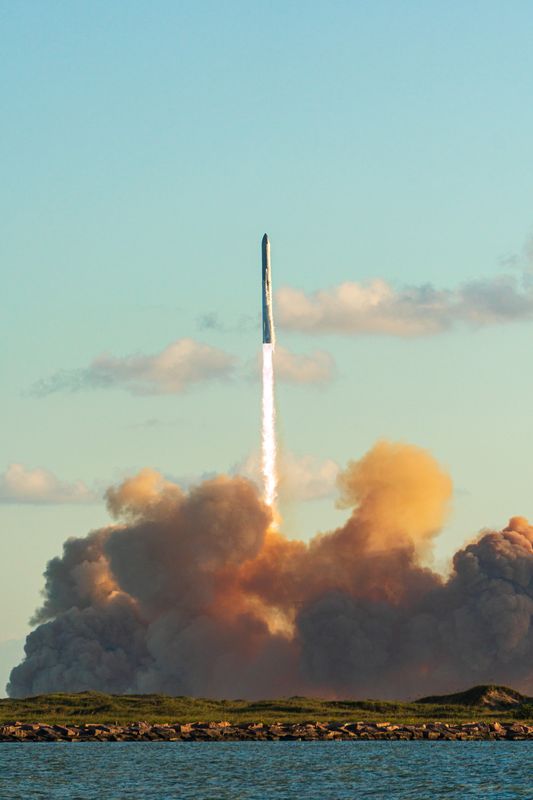
STARBASE, Texas, November 13, 2026 — The Starship Flight 15 launch was supposed to be the day SpaceX caught both halves of the largest rocket ever flown. Instead, Friday delivered a split verdict that captures the programme exactly where it stands. The upper stage, Ship 42, flew a nearly flawless mission: it reached orbit roughly 26 to 27 minutes after liftoff, at about 275 kilometres up, and over the following 42 minutes deployed all 26 of its Starlink V3 satellites, with contact confirmed with every one of them. The booster beneath it never came home. Super Heavy Booster 22, due back at the Starbase tower about six and a half minutes after liftoff to be caught by the tower’s arms, detected a problem in its own guidance systems, aborted the catch by itself and diverted offshore, ending its flight in the Gulf of Mexico. SpaceX has not explained the fault beyond that description, and no one should pretend otherwise. What Friday proved, and what it did not, now hangs on a second appointment: a first-ever attempt to catch the returning Ship at the same tower, scheduled for Saturday afternoon — if, and only if, the vehicle comes home healthy.
What happened on the Starship Flight 15 launch, minute by minute
Liftoff at 5:47 p.m. ET, and a clean climb on 33 Raptors
Flight 15 lifted off at 5:47 p.m. ET on Friday, November 13, from Starbase, on the southern tip of Texas. The vehicle was Ship 42 stacked on Super Heavy Booster 22 — a combination roughly 124 metres, or about 400 feet, tall — with the booster’s 33 Raptor engines providing the thrust off the pad. The Federal Aviation Administration had issued the Flight 15 launch licence on Friday afternoon, clearing the way for the early-evening window. That licence is a separate matter from the nationwide air-traffic ground stop the FAA imposed the same day for unrelated reasons, a story this newsroom has covered on its own terms; the two decisions shared a date and an agency, and nothing else. This was the 15th Starship test flight since the programme began flying in 2023, and only the second ever to reach orbit — the first was Flight 14 in September, which also carried the first operational Starlink satellites on a Starship. Friday’s ascent, by every account of the broadcast and the wire reporting that followed it, was uneventful in the best sense: the stack cleared the tower, rode its boost phase and reached stage separation at roughly two and a half minutes, the point at which the mission split in two.
The Super Heavy Gulf splashdown: a GNC abort, not a crash
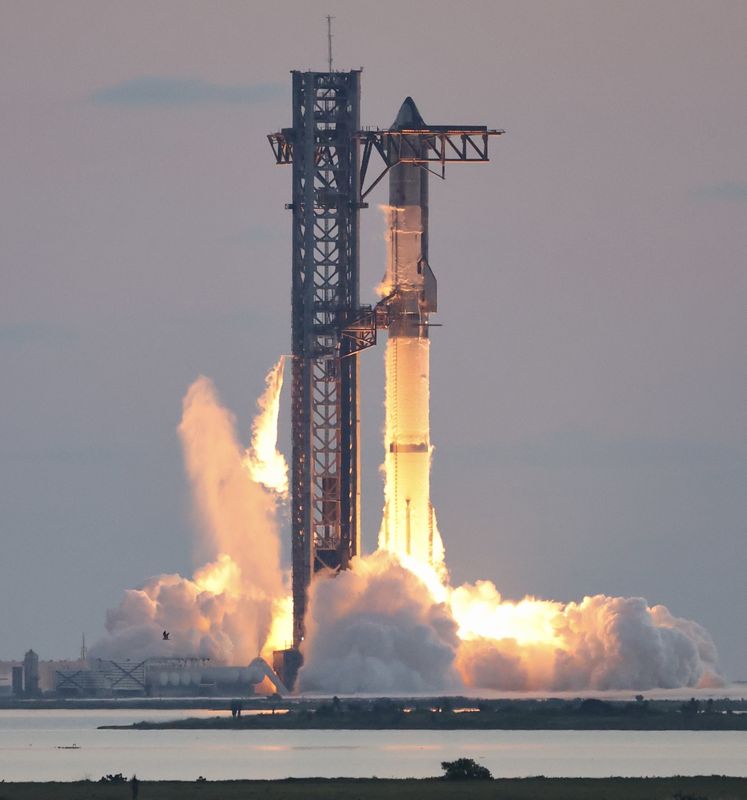
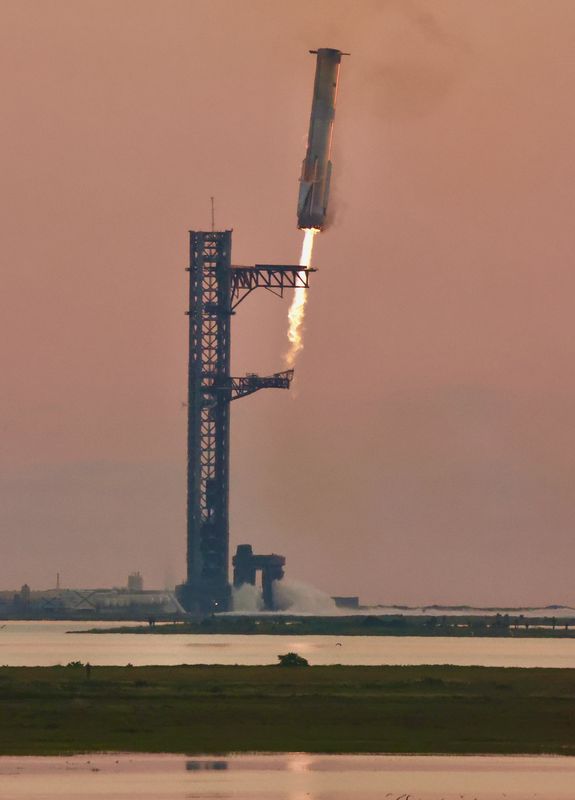
Super Heavy’s job after separation was to fly itself back to Starbase and be plucked out of the air by the launch tower — the signature manoeuvre SpaceX calls the catch. It never got the chance to try. As SpaceX commentator Dan Huot described it on the company’s broadcast, the booster aborted the attempt itself after detecting an issue in its Guidance, Navigation and Control systems — the GNC suite that tells the vehicle where it is, where the tower is, and whether the two can safely meet. Rather than press toward the pad with suspect guidance, the booster diverted to its contingency plan: an offshore splashdown in the Gulf of Mexico. According to Spaceflight Now’s reporting of the livestream, the booster burst into flames as it hit the water — a fireball at the end of a controlled diversion, not a vehicle falling out of the sky. The distinctions matter, and Friday’s coverage has not always kept them. The booster did not crash on land. It did not threaten the tower or the pad. And by SpaceX’s own mission design, it did not fail the flight’s primary objectives, which were orbital: the abort was the system doing precisely what it is built to do when its numbers stop adding up — refuse the catch and take the safe water landing it was always carrying as a backup. What SpaceX has not done is explain the GNC issue itself: no sensor, software or hardware cause has been named, and until the company or the FAA’s mishap process says more, any account that supplies one is inventing it.
Ship 42 orbit insertion and 26 Starlink V3 satellites deployed
While the booster was ending its flight in the Gulf, Ship 42 was beginning its own. A second burn of roughly 20 seconds settled the Ship into orbit some 26 to 27 minutes after launch, at an altitude of about 275 kilometres — only the second time in 15 flights that a Starship has completed that step, and confirmation that September’s Flight 14 was not a one-off. Then came the payload work. Over about 42 minutes, Ship 42 deployed all 26 of the Starlink V3 satellites it carried, and SpaceX confirmed contact with the full set. That makes Flight 15 the second consecutive Starship mission to function as a working orbital launch service for the company’s own constellation — carrying the larger V3 satellites that the Falcon 9 cannot lift in the same numbers and that the next phase of Starlink’s capacity depends on. As of Friday evening, Ship 42 remained in orbit, coasting at the start of a planned passage of about 14 orbits over roughly 22 and a half hours, while controllers assessed the one experiment still left on the manifest.
Why this matters: the catch is the whole Starship bet
Full rapid reusability is the point — orbit is only the entrance fee
It is tempting to score Flight 15 as a success with an asterisk: orbit achieved, satellites deployed, booster lost. That understates what SpaceX is actually testing. Starship’s economics do not rest on reaching orbit — expendable rockets have done that for decades. They rest on flying the same vehicle again, quickly and cheaply, the way an airliner turns around at a gate. Every element of the design serves that single idea, and the tower catch is its purest expression: a vehicle that is caught by the tower needs no landing legs, carries no mass penalty for them, requires no ocean recovery fleet, no port, no days-long tow home. It comes back to the very structure that launched it, where it can in principle be inspected, restacked and flown again. Catching a booster, as SpaceX has done before, proves that logic for the big first stage. Catching a Ship would prove it for the part of the vehicle that actually goes to orbit — the part with the heat shield, the payload bay, the crew cabin in its future human-rated form, and the propellant tanks that NASA’s Artemis programme is counting on as a lunar lander. A caught booster saves a booster. A caught Ship closes the loop on the entire system.
What catching a Ship would prove that catching a booster cannot
The Ship is the harder catch in every dimension. It returns not from a suborbital hop a few minutes after launch, but from orbital velocity, through the full violence of re-entry heating that its tile shield has to survive intact. Its approach to the tower comes at the end of that ordeal, with a vehicle whose aerodynamic surfaces have just been baked and stressed, and it must thread itself into the tower arms with the same precision demanded of a fresh booster. A successful Ship catch on Saturday would therefore certify far more than a guidance trick: it would demonstrate a heat shield that survives orbit and still flies precisely, a propulsion system that relights and manoeuvres after a day in space, and a recovery model in which the orbital spacecraft — historically the part you throw away or refurbish for months — comes home to its launch mount the next day. That is the capability on which the programme’s promises about flight rate, cost per kilogram, Mars cargo and the Artemis lander schedule all ultimately stand. It is also, as of Friday night, still unproven.
The split scorecard: a working launch service, an unproven reusable system
Starship-the-launch-service works — two orbital Starlink flights in a row
Judged purely as a launch service, Flight 15 was a clear success, and it is worth saying plainly. Two consecutive Starship flights have now reached orbit carrying operational payloads; 26 more Starlink V3 satellites are in service; the vehicle’s orbital insertion, deployment sequence and satellite checkout all performed. For Starlink, whose business case increasingly turns on how fast the bigger V3 satellites can be orbited in bulk, a Starship that reliably delivers two dozen at a time is already commercially meaningful even before anyone catches anything. The ascent side of this programme — engines, staging, orbital burns, payload deployment — is maturing in the way flight programmes are supposed to mature: each flight repeats the last success and adds one new thing.
Starship-the-reusable-system is still unproven
Judged as a reusable system, Friday moved the needle the other way. The booster catch was aborted — for sound reasons, by the vehicle’s own judgement, but aborted all the same, and the booster was expended into the Gulf. The current Version 3 Super Heavy generation has yet to be caught at all, which means the newest booster design has a splashdown record and no recovery record. And the Ship catch, the milestone the whole architecture is aimed at, remains an appointment rather than an achievement. None of this is failure in the sense of a programme in trouble; test programmes learn by breaking sequences apart and fixing the weak link. But it does mean the central promise of Starship — full, rapid reuse of both stages — is, after 15 flights, still a promise. The gap between “Starship reaches orbit” and “Starship flies again next week” is the gap this programme still has to close, and Friday widened the evidence for the first claim without narrowing the second.
Who benefits, who is exposed: Artemis, Starlink capacity and the critics
SpaceX and Starlink take the orbital win; NASA watches the recovery column
The immediate beneficiaries are straightforward. SpaceX gets a second orbital data point, a validated V3 deployment campaign and a booster abort that, however unwelcome, demonstrated its contingency logic under real conditions. Starlink gets capacity: every V3 in orbit is bandwidth the constellation can sell, and a second straight orbital flight strengthens the case that Starship, even in test-flight form, is becoming a dependable way to add it. NASA’s stake is longer and more anxious. Starship is the designated lander for the Artemis programme’s return of astronauts to the lunar surface, a role that depends not merely on orbit but on a demanding chain of refuelling flights and, ultimately, on flight rates that only reuse can sustain. Each orbital success reassures that schedule; each recovery shortfall is a reminder of how much of the chain still rests on capabilities — routine catches, rapid turnaround, high-cadence tanker flights — that have yet to be demonstrated together.
The critics’ case: recovery, not orbit, is the hard part
Sceptics of the programme have a ready reading of Friday, and it is not frivolous. Reaching orbit, they argue, was solved engineering two generations ago; the genuinely hard problems of Starship are all in the return — heat shields, guidance margins, tower operations, refurbishment — and Flight 15’s headline event was a return that declined to happen. On that reading, the credibility question attaches to the programme’s most ambitious scheduling claim, full operational capability around the end of 2027: a target that requires not one successful Ship catch but a rhythm of them, plus a caught Version 3 booster line, plus the Florida infrastructure to run the system at scale. That Florida piece is real and advancing — the Starship tower at Launch Complex 39A is in final testing — but a second launch-and-catch site multiplies the programme’s options only once the manoeuvre it exists to perform has been shown to work at the first one. The fair summary is that both readings of Friday are true at once: the launch service is proving itself faster than the recovery system, and the programme’s future depends on which side of that ledger closes the gap.
The Starship catch attempt Saturday: three scenarios for Ship 42
A health-conditional window at about 4:17 p.m. ET
Ship 42’s long coast — about 14 orbits over roughly 22 and a half hours — ends, if all goes to plan, with the attempt no Starship has ever made. SpaceX has scheduled a first-ever try at catching the returning Ship at the Starbase tower for Saturday, November 14, at about 4:17 p.m. ET (21:17 UTC). The conditional is not boilerplate: the attempt goes ahead only if every re-entry and approach system on the vehicle checks out healthy, and SpaceX retains contingency splashdown options off Hawaii, off Chile and in the Gulf if they do not. As of publication, the attempt has not happened, and this article makes no claim about its outcome — only about what each outcome would mean.
Clean catch, waived-off splashdown, or re-entry loss
Scenario one is the clean catch: Ship 42 survives re-entry, flies its approach and is taken by the tower. That single image would convert Starship’s central claim from projection to demonstration, and Flight 15 would be remembered as the first full ascent-and-recovery mission in the programme’s history despite the booster. Scenario two is the waived-off splashdown: some system — thermal, propulsive, guidance — fails its health check, and SpaceX sends the Ship to a controlled ocean landing instead. That would be Friday’s booster story repeated one stage up: disappointing, defensible, and still productive of re-entry data, but it would leave the catch unproven and push the defining test to Flight 16. Scenario three is the loss of the vehicle during re-entry itself — the outcome every heat-shield engineer works against. It would not erase Flight 15’s orbital success, but it would reframe the flight as evidence that the return from orbit, not the climb to it, remains the programme’s frontier, and it would likely lengthen every downstream schedule, Artemis included. Flight 16, whenever it flies, inherits whichever of those three realities Saturday produces — and with it, the question Friday left open: not whether Starship can go to orbit, which it has now done twice in a row, but whether it can come all the way home.
Related coverage: SpaceX Starship First Orbital Flight Deploys 26 Satellites · Ukraine’s Starshield Contract Expires in Mid-2027 — and Kyiv Still Has No Answer on October · SpaceX Buys Wireless Spectrum to Take Starlink Mobile
Sources
- Reuters, November 13, 2026 — reporting of the Flight 15 launch from Starbase, Ship 42’s orbital insertion and Starlink deployment, and the aborted booster catch and Gulf splashdown.
- Scientific American, November 13, 2026 — coverage of Flight 15 as the 15th Starship test flight and only the second to reach orbit, and of the scheduled first Ship catch attempt.
- Florida Today, November 13, 2026 — live updates of the launch, including liftoff at 5:47 p.m. ET, the booster diversion and the satellite deployment sequence.
- Spaceflight Now, November 13, 2026 — live coverage including SpaceX commentator Dan Huot’s description of the Guidance, Navigation and Control abort and the booster’s fiery Gulf splashdown.
- The Motley Fool, November 13–14, 2026 — analysis of Flight 15, the split between Starship’s orbital success and its unproven recovery system, and the Saturday catch window.