Science · Space · Astronomy
The Rubin Observatory was still being commissioned when its software pulled a bright, slow-moving point of light out of one of the most crowded patches of sky astronomers know. That point is 2026 ED138 — quite possibly a world about a thousand kilometres wide that hid in plain sight for a decade of photographs.
A new dwarf planet discovered beyond Pluto is not a headline astronomy gets to write very often — roughly once a generation, by the discoverers’ own reckoning. Astronomers working with the NSF–DOE Vera C. Rubin Observatory in Chile have identified a large, bright icy body, provisionally designated 2026 ED138, that is a strong candidate to become the sixth dwarf planet recognised by the International Astronomical Union. The object currently sits about 46 astronomical units from the Sun — 46 times the Earth–Sun distance, and well beyond Pluto’s average of 40 — and early estimates put it at somewhere between 600 and 1,500 kilometres across, most likely close to 1,000. It was found not by a human scanning photographs but by search software sifting pre-survey data from the most powerful sky-survey telescope ever built, and it was announced on October 27, 2026, at the American Astronomical Society’s Division for Planetary Sciences meeting in Spokane, Washington, with the IAU Minor Planet Center publishing the discovery the same day as Minor Planet Electronic Circular MPEC 2026-U85. For now ED138 remains a candidate, not a confirmed dwarf planet: its size, and with it the roundness that the dwarf planet definition demands, still has to be pinned down. But if the measurements hold, the solar system’s shortest official list is about to grow for the first time in twenty years.
How the discovery happened
The discovery began, as so many modern ones do, with code. On October 13, 2026, Matthew Holman — a Rubin Operations team member and senior astrophysicist at the Center for Astrophysics | Harvard & Smithsonian — was running data Rubin had collected earlier in the year through a distant-object search program he co-developed with his colleague Kevin Napier. The code’s job is unglamorous and immense: take billions of detections of moving points of light, compare them across nights, and work out which scattered sightings belong to the same slow-drifting body. Distant objects beyond Neptune move so slowly against the stars that linking their appearances into a single orbit is a computational problem first and an observational one second. What the code handed Holman that evening was a match bright enough, at its calculated distance, to imply something unusually large.
The “must be a bug” moment
Holman’s first reaction was not celebration. It was suspicion — of his own software. Objects this big, this bright and this far out are supposed to have been found already; the reflex of an experienced survey astronomer handed an apparently impossible result is to assume a false positive, a linking error, a bug. He described his response as one of excited disbelief, and he immediately set about trying to break the result: checking whether he or the code had done something wrong. That instinct matters to the credibility of what followed, because ED138 survived the attempt to kill it. The detections were real, they were consistent, and they pointed to a single body moving on a coherent, distant orbit.
Twenty more sightings, and a decade hiding in the archive
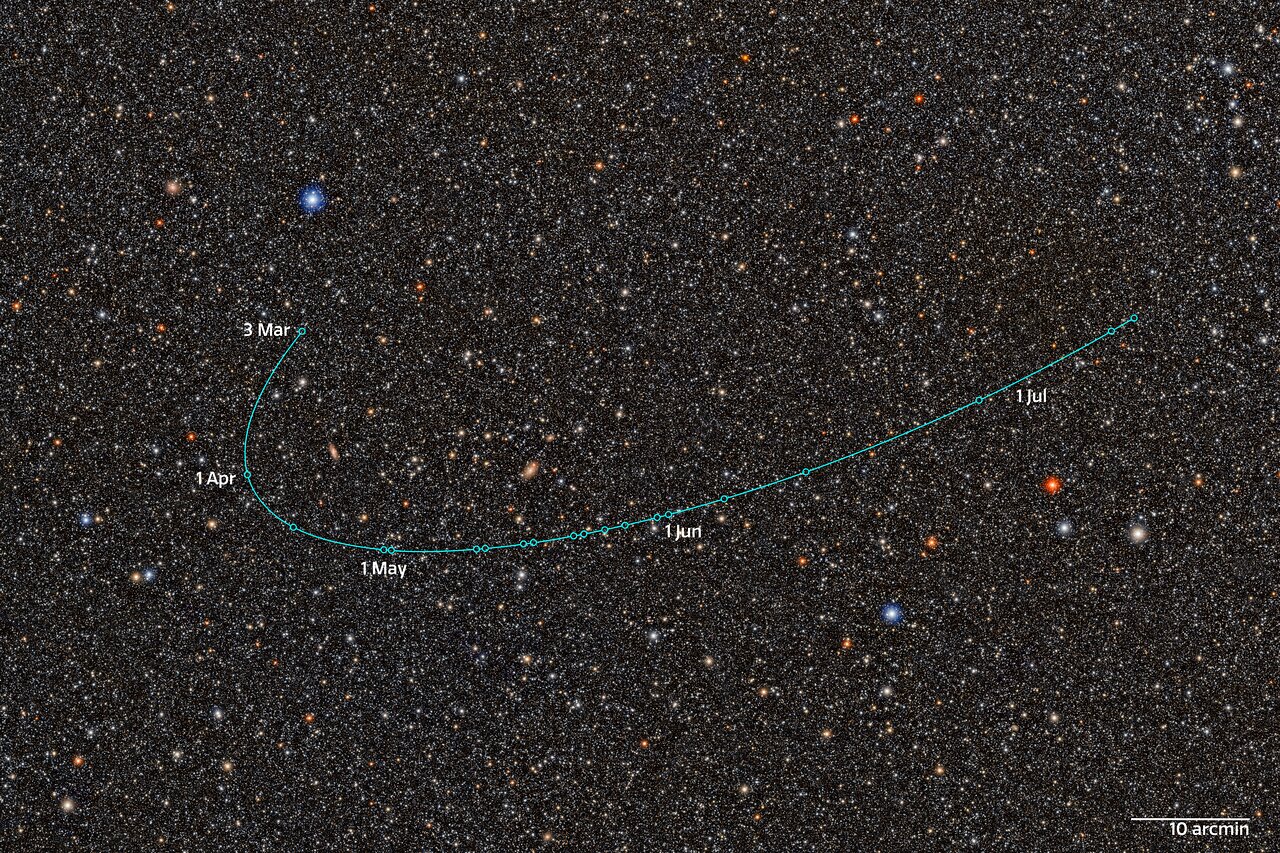
The confirmation came from Mario Jurić, a University of Washington astronomer and Rubin’s Solar System lead scientist, who searched Rubin’s catalogues and images and found 20 more observations of the same object. In total, the Simonyi Survey Telescope — Rubin’s 8.4-metre instrument on Cerro Pachón in Chile, fitted with the 3,200-megapixel LSST camera, the largest digital camera in the world — recorded ED138 30 times across 20 nights between March 4 and July 11, 2026. Then the trail jumped telescopes and years. Archival images from the Dark Energy Camera, DECam, on the Blanco telescope in Chile, recovered through a precovery search, contained ED138 on 14 nights between 2016 and 2023. A precovery — finding an object in photographs taken before anyone knew it existed — stretches the observed arc of an orbit, and in this case it stretched past ten years. That decade-long arc is what turned a promising detection into a solid orbit: with positions spanning 2016 to 2026, the Minor Planet Center could publish orbital elements precise enough for other astronomers to find the object again on demand.
There is something quietly astonishing in that timeline. ED138 was photographed, repeatedly, for a decade before it was discovered. It sat in archives, pixel by pixel, while the telescopes that recorded it were pointed at other science. The discovery was not that the photons finally arrived; it was that software, a survey cadence and a team finally existed that could connect them.
The numbers in context
How big is 2026 ED138?
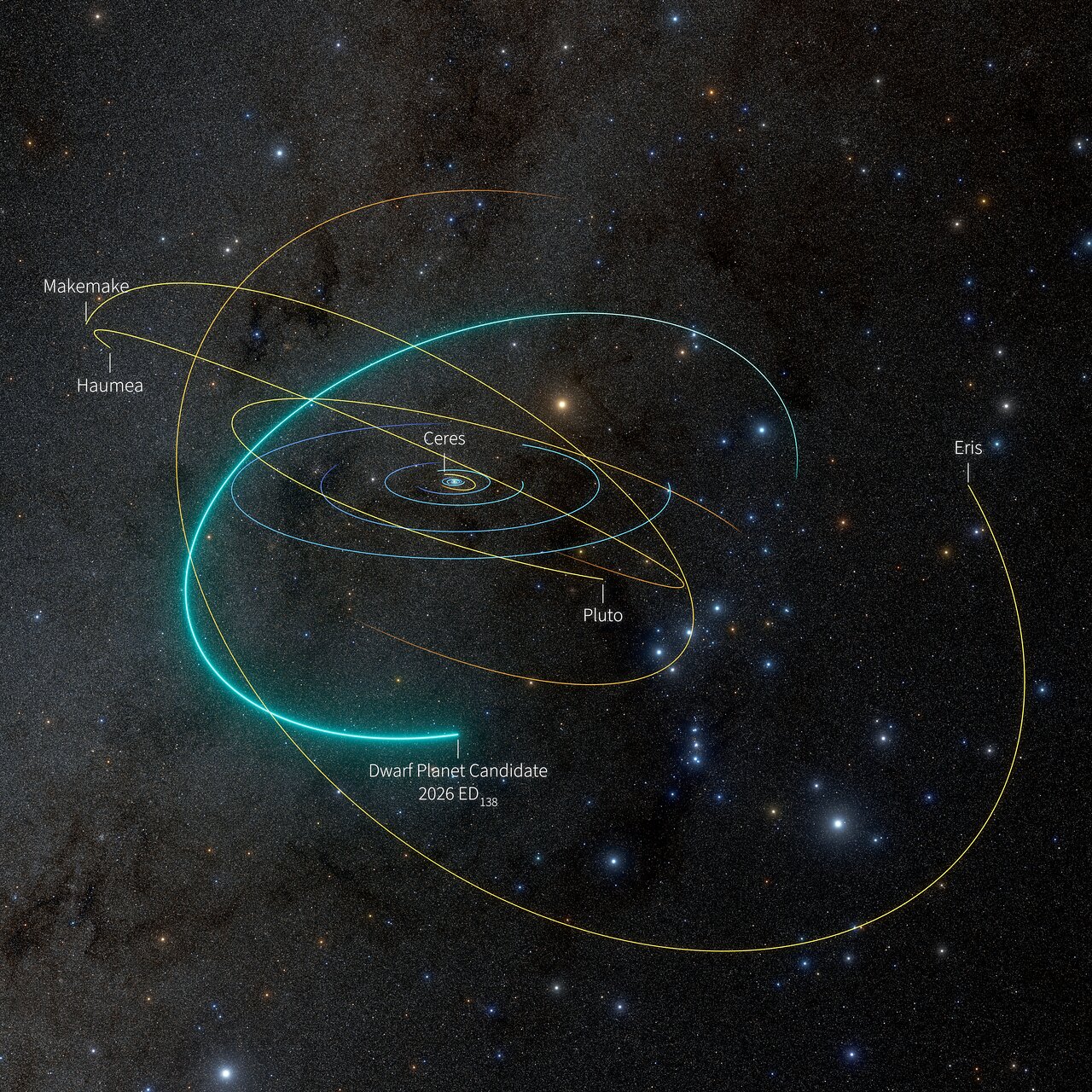
The honest answer is a range, and the range is wide: 600 to 1,500 kilometres in diameter. The width of that range is not sloppiness — it is physics. Astronomers know how bright ED138 appears (its absolute magnitude is HV = 3.19 ± 0.04) and how far away it is, but converting brightness into size requires knowing how reflective its surface is, its albedo. A small, bright, frosty world and a large, dark one can shine identically. Assume an albedo of 0.10 and the diameter lands near 970 kilometres. Set that against the known family: Pluto measures 2,377 kilometres across, Eris is only slightly smaller, and Ceres — the asteroid-belt dwarf planet — is about 940 kilometres. So at the middle estimate, ED138 would be a near-twin of Ceres and roughly two-fifths Pluto’s width; at the top of the range it would comfortably exceed Makemake’s lower estimates, and even at the bottom of the range it would sit in the size regime where an icy body’s own gravity is expected to pull it into a round shape. Brightness tells a similar story of rarity: only nine known trans-Neptunian objects are intrinsically brighter than ED138, it is the brightest TNO found since (532037) Chiminigagua in 2013, and by size it is the largest trans-Neptunian object found in about 20 years.
An orbit tilted steeper than Pluto’s
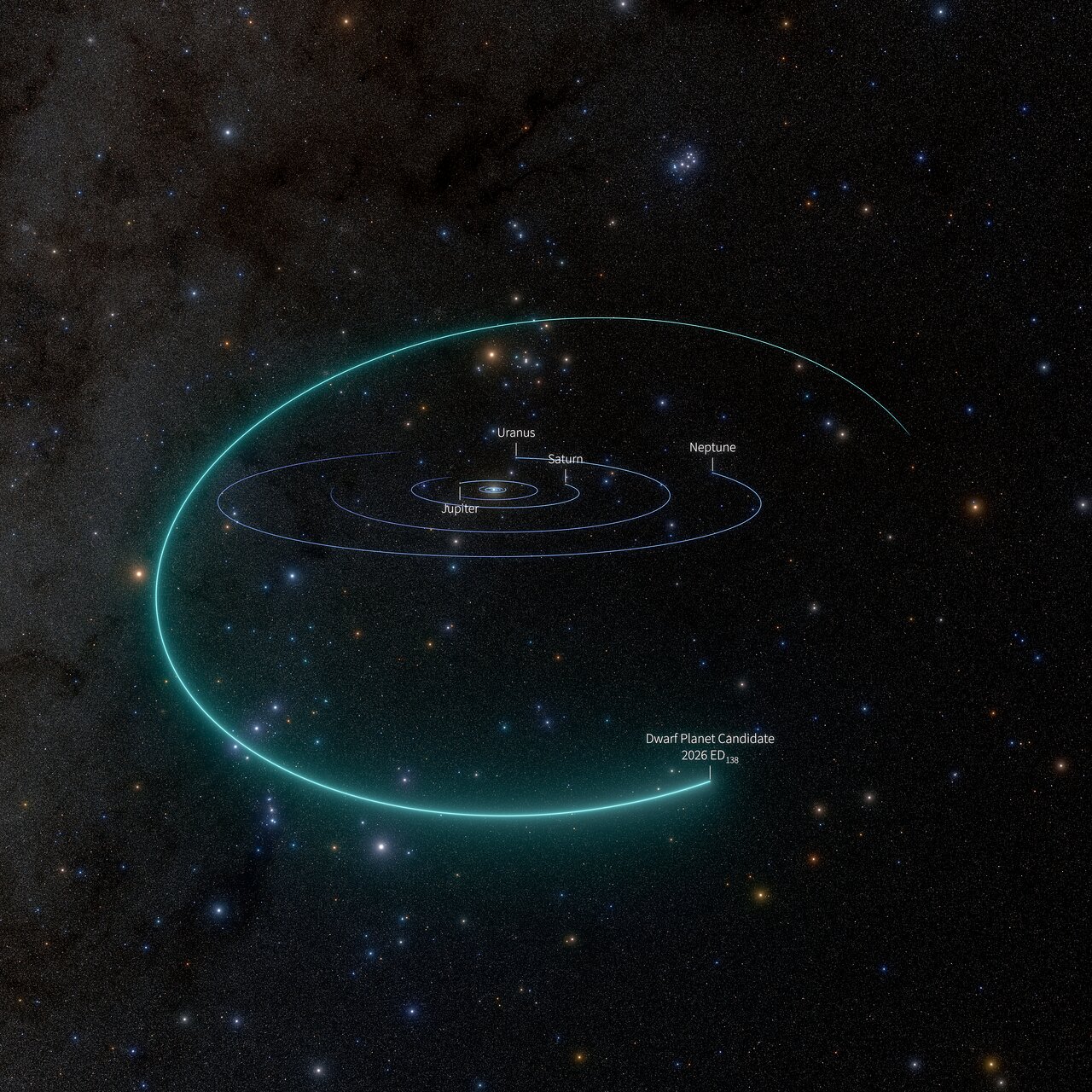
ED138’s orbit is a classical Kuiper Belt orbit with a twist — literally. Its semi-major axis is 43.09 AU, its eccentricity a modest 0.139, and its closest approach to the Sun, its perihelion, is 37.1 AU, which keeps it permanently beyond Neptune’s reach for direct encounters. What stands out is the tilt: an inclination of 24.4 degrees to the plane of the planets, noticeably steeper than Pluto’s already dramatic 17 degrees. A tilt like that is a fossil. Objects born in the flat disc of the early solar system do not acquire 24-degree inclinations on their own; something — most plausibly gravitational scattering during Neptune’s outward migration through the young Kuiper Belt — lifted it. ED138 also sits near the 12:7 mean-motion resonance with Neptune, the same resonance Haumea occupies, in which the object completes seven orbits for Neptune’s twelve; whether it is truly locked in that resonance is not yet settled. Its measured colour, g−r = 0.63, is redder than the distinctive Haumea family of collision fragments, so whatever ED138 is, it is not a shard of that famous impact.
Why this matters
A sixth dwarf planet changes the census, not just the list
Astronomers have catalogued more than 6,000 trans-Neptunian objects, yet the IAU recognises exactly five dwarf planets. That gap is not because the outer solar system lacks big worlds — it is because recognition demands proof of size and roundness that faint, distant objects rarely allow. A confirmed ED138 would therefore matter twice over: as a world in its own right, and as evidence that the recognised census has been limited by our instruments rather than by nature. Every large TNO whose size is firmly measured recalibrates estimates of how many Pluto-scale and Ceres-scale bodies the Kuiper Belt holds, and those numbers feed directly into models of how much material the solar system formed from and where the rest of it went.
A tracer for Neptune’s migration
ED138’s tilted, near-resonant orbit makes it a tracer particle for the solar system’s most consequential reshuffle. The leading account of the outer solar system’s history holds that Neptune migrated outward through a dense primordial disc, scattering most of its contents and capturing some objects into resonances as it went. The proportions of objects in resonances like the 12:7, and the distribution of inclinations among hot classical objects like ED138, are among the few surviving records of how fast, how far and how violently that migration proceeded. One object does not rewrite the story — but a bright, well-measured one, whose orbit can be followed precisely and whose surface can be studied spectroscopically, is exactly the kind of data point the models are hungry for.
What it proves about Rubin before the survey has begun
Perhaps the sharpest significance of the find is institutional. ED138 was not discovered during the Legacy Survey of Space and Time, Rubin’s ten-year flagship program. It was discovered in commissioning and pre-survey data — the warm-up. Jurić put it plainly: “Finding an object this big, roughly 1,000 kilometers across, is something that happens maybe once in a generation. It’s the largest trans-Neptunian object found in about 20 years, and Rubin turned it up while we were still commissioning the telescope.” A facility that finds a generational object before its survey proper starts has made its case more persuasively than any commissioning report could. Rubin’s combination — a huge field of view, the world’s largest camera, a cadence that re-images the entire southern sky every few nights, and linking software built for billions of detections — is precisely the combination the outer solar system required, because its remaining large worlds were never going to be found by staring deeper at the same well-surveyed patches.
What is a dwarf planet? The 2006 definition behind the headline
To understand what ED138 is waiting for, it helps to remember how the category was born. In 2006, after the discovery of Eris — a body initially reported as larger than Pluto — forced the question of how many “planets” the solar system might end up with, the International Astronomical Union voted in Prague to define a planet as a body that orbits the Sun, is round under its own gravity, and has cleared its neighbourhood of other material. Pluto met the first two tests and failed the third, and was reclassified as a dwarf planet: round, orbiting the Sun, but sharing its zone with a belt of peers. The decision remains the most argued-over vote in modern astronomy, but the category it created is the one ED138 now knocks on. The five current members span the solar system’s geography: Ceres in the asteroid belt between Mars and Jupiter, and Pluto, Eris, Haumea and Makemake in the Kuiper Belt and beyond. Each of the five was, in its time, a find that rearranged textbooks — which is why big TNO discoveries qualify as generational events. Eris, the last to upend the census, was identified in 2005. The two-decade wait since then is the measure of ED138’s reception this week.
Reasons for caution
The candidacy could still fail on size
Nothing about ED138’s existence is in doubt; its orbit is anchored by a decade of observations. What is unproven is the single fact its promotion depends on: its true diameter. The entire case currently rests on brightness plus an assumed reflectivity. If ED138 turns out to have an unusually bright surface — fresh frost is a superb reflector — it could be substantially smaller than 970 kilometres, conceivably below the size at which an icy body reliably relaxes into roundness, and the candidacy would stall. That is not a remote technicality; albedo uncertainty is the reason several other large TNOs sit in the same limbo. The discovery team has been careful to say “candidate” every time, and readers should hold the same discipline: this is a probable dwarf planet, announced honestly as a probable one.
No, it is not Planet Nine
Every large outer-solar-system discovery now attracts the same question, so let it be answered directly: 2026 ED138 is not Planet Nine, and it is not evidence for it. The Planet Nine hypothesis posits an unseen planet of several Earth masses, orbiting hundreds of astronomical units away, whose gravity shepherds the most distant known objects into clustered orbits. ED138 is a body of perhaps a thousand kilometres — thousands of times less massive than the hypothetical planet — on a well-behaved 43 AU orbit firmly inside the classical Kuiper Belt. It neither matches the predicted perturber nor needs one to explain its path. Its importance is real but different: it is a census discovery, not a missing-planet discovery.
The amateurs can see it — if they know where to look
One of the discovery’s most charming footnotes is Holman’s observation that ED138 is bright enough for capable amateur astronomers to observe, provided they know exactly where to point. That is a genuine shift in kind for an object at 46 AU, a realm usually reserved for professional apertures. Expect the coming months to bring the familiar, productive churn of follow-up astrometry from skilled observers, refining the orbit further — and expect more than a few backyard images of a world that, until this month, had no name at all, not even a provisional one.
Why it hid for so long
If ED138 is so bright, why did it take until 2026 — and a brand-new observatory — to find it? Geography, twice over. In the sky, the object sits at a galactic latitude of about minus 12 degrees, close to the plane of the Milky Way, where the foreground is a blizzard of stars. Earlier surveys tended to avoid those crowded fields or cover them shallowly, because a faint moving point is easily lost among millions of stationary ones; ED138 was, in effect, hiding in the glare of our own galaxy. On the ground, it is a southern-sky object, difficult to observe well from the northern hemisphere where most historical survey telescopes sit. Rubin, perched in Chile and designed to sweep the whole southern sky repeatedly regardless of how crowded any given field is, was built in a way that removed both excuses at once.
What happens next
The confirmation path is well defined, and it will take months rather than weeks. The cleanest size measurement would come from a stellar occultation — ED138 passing in front of a distant star, its shadow timed from multiple sites to trace its silhouette — but occultations by a specific object are opportunities that must be predicted and chased. More schedulable are infrared and thermal measurements, which sense the object’s own heat and break the brightness–albedo deadlock by constraining size and reflectivity together. Spectroscopy can then ask what its surface is made of — water ice, methane, the reddish organic residues called tholins — and lightcurve observations can reveal its rotation and whether its brightness varies with a elongated shape or a companion. If those measurements confirm a diameter in the expected range for hydrostatic equilibrium, the IAU process follows: ED138 would receive a permanent minor-planet number, and in time a proper name, proposed by its discoverers under the naming conventions for distant objects. “2026 ED138” is a provisional designation, a filing label; the sixth dwarf planet, if that is what it becomes, will be known by something else.
The larger forward story belongs to the survey itself. LSST’s decade of southern-sky scanning is expected to multiply the known TNO population many times over, and it will do so while covering, deeply and repeatedly, exactly the regions earlier surveys skipped — the galactic plane’s crowded fields and the far southern sky. ED138’s lesson is that those skipped regions are skipped treasure: the biggest world found in twenty years was not lurking at the edge of detectability but in plain archival sight, behind a curtain of stars. There is no reason to assume it was the only one behind the curtain. Rubin has a decade to check.
Related coverage
- SpaceX Crew-12 Splashdown: Crew Dragon Freedom Lands in the Pacific After Eight Months on the ISS
- SpaceX Crew-13 launch to the International Space Station
- Google’s Project Suncatcher and AI chips in space
Sources
- Rubin Observatory / NSF NOIRLab — “NSF–DOE Vera C. Rubin Observatory Reveals Its First Dwarf Planet Candidate in Our Solar System” (Science Release noirlab2626, October 27, 2026): the discovery account, Holman and Jurić statements, the 30 Rubin observations and the DECam precoveries.
- IAU Minor Planet Center — MPEC 2026-U85: 2026 ED138 (October 27, 2026): the official discovery circular and published orbital elements.
- CNN — “‘It’s big’: Astronomers make startling discovery of a possible dwarf planet beyond Pluto” (October 28, 2026): Holman’s false-positive check and the confirmation timeline.
- USA Today — “World spotted beyond Pluto could be solar system’s next dwarf planet” (October 29, 2026): the size range, the crowded Milky Way field and what confirmation requires.
- Astronomy Magazine — “Rubin spots possible dwarf planet” (October 2026): how astronomers confirmed ED138 and the composite orbital-path image.
- The Register — “Boffin’s software found a possible dwarf planet — a result so rare he thought it must be a bug” (October 29, 2026): the Holman–Napier linking code and the Milky Way plane explanation.
- Phys.org — “Rubin Observatory reveals its first dwarf planet candidate in our solar system” (October 2026): the announcement as carried by the science wire, including the Jurić “once in a generation” assessment.