Science · Space
A 1.5-ton observatory that chased the universe's biggest explosions for 22 years has been switched off and is coming home in flames. The U.S. Space Force expects reentry on or around Friday; NASA says most of it will burn up, but dense tungsten pieces could survive.
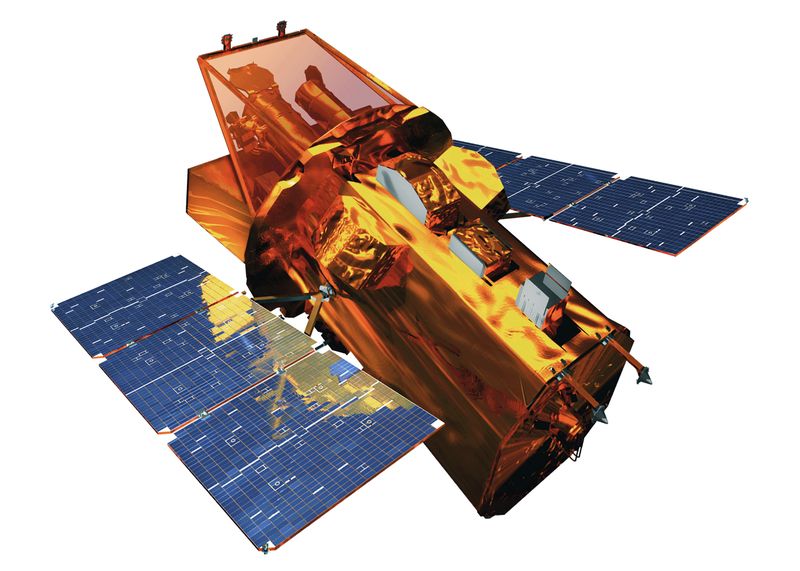
There is a 1.5-ton telescope falling out of the sky, and for the first time in its almost 22 years in orbit, nobody can tell it what to do. NASA’s Neil Gehrels Swift Observatory — the spacecraft that taught astronomy how to catch a gamma-ray burst in the act — has been switched off, and the U.S. Space Force is now tracking its dwindling orbit as it spirals toward an uncontrolled reentry the service predicts will come on or around Friday, according to the Associated Press. Most of the observatory is expected to burn up on the way down. Some of it, NASA says, may not.
The ending is abrupt for a mission that was never supposed to last this long. Swift was designed for a two-year primary mission after its launch on November 20, 2004. It worked for nearly twenty-two. In that time it detected more than 2,000 gamma-ray bursts and more than 1,400 supernovae, took more than 1.5 million ultraviolet and optical images, and built an open archive of roughly 12 terabytes of data behind some 7,000 scientific papers. It survived long enough to watch a commercial rescue spacecraft fly out to save it this summer — and to watch that rescue fail, nine miles short.
A forecast, not a fixed date
Everything about the timing needs to be read as a forecast, because that is all anyone has. The Associated Press, reporting on November 1, said the U.S. Space Force predicts Swift will reenter on or around Friday, with the service continuing to track the spacecraft’s decaying orbit. NASA’s own public statement, issued on October 23 under the headline “NASA’s Swift Mission Ends Ahead of Re-Entry,” was deliberately vaguer, saying only that reentry would come “in the next few weeks.” Nature, on October 27, reported that some researchers were predicting reentry as early as November 2. Those estimates are not necessarily in conflict: reentry predictions are notoriously slippery until a spacecraft’s final days, because the density of the upper atmosphere — the very thing dragging Swift down — swells and thins with solar activity. Forecasts narrow as the altitude falls, and the Space Force’s window should be expected to tighten, and possibly shift, as the week goes on.
What is not in serious dispute is the geography. Swift’s orbit carries it over a band spanning parts of Africa, Australia, India, Southeast Asia and Central and South America, and any surviving debris would come down somewhere along that track. Brad Cenko, NASA’s chief scientist for the mission and its principal investigator, told the AP that most of the 1.5-ton telescope is expected to burn up during reentry, but that components made of tungsten — a metal denser than lead — and some mirror parts could survive the plunge. Surviving wreckage is most likely to fall in the ocean, he said, simply because oceans cover most of the ground track. NASA’s consistent position is that harm to any person is unlikely.
The day the mission ended
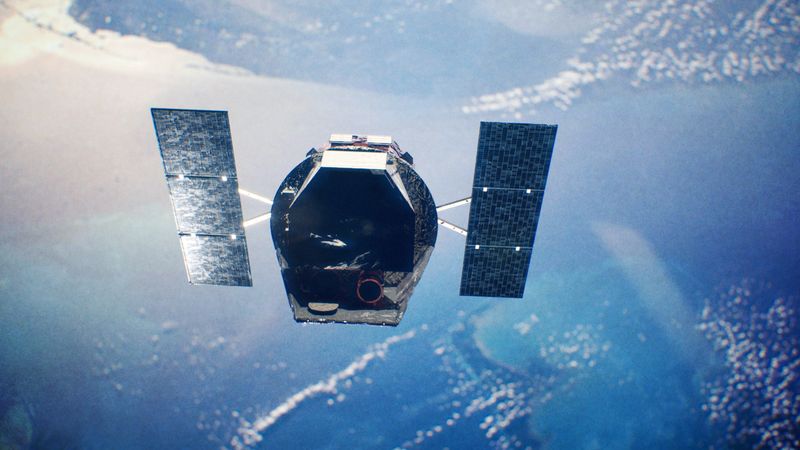
The end, when it came, was a matter of physics rather than failure. On October 20, NASA said, Swift’s orbit had decayed to 171 miles — 275 kilometres — and the spacecraft could no longer compensate for the increased atmospheric drag at that altitude. It entered safe mode, the protective state spacecraft fall back into when something is wrong. The mission operations team at Penn State University, in University Park, Pennsylvania, which has run Swift for its entire life, then sent the command that effectively ended operations, preparing the observatory for re-entry. Swift’s final observation was taken on October 20. NASA announced the conclusion of operations on October 23. A spacecraft built to react to the most sudden events in the universe — it could slew to a new target in about a minute — spent its last days doing the opposite: waiting, silent, for gravity to finish the job.
Why Swift fell out of the sky
Swift has no propulsion. That single design fact, unremarkable for a budget-conscious science mission launched in 2004, is the whole story of its death. It began its life in a near-circular orbit roughly 585 to 600 kilometres up, high enough that the whisper-thin upper atmosphere barely touched it. But the Sun has been anything but quiet. At the peak of Solar Cycle 25, heightened solar activity heated Earth’s upper atmosphere and caused it to expand, thickening the air at altitudes that are normally close to vacuum. Drag on Swift increased, each orbit shaved a little more height off the next, and the decay fed on itself: the lower Swift sank, the denser the air, the faster it sank. By October, the arithmetic had run out. Nothing was broken. The sky, in effect, rose up to meet the satellite.
The rescue that came within nine miles
NASA tried to buy Swift more time, in what became the first serious commercial attempt to service an uncrewed science satellite that was never designed to be serviced. In September 2025 the agency awarded about $30 million to Katalyst Space Technologies, based in Arizona, to build LINK, a robotic spacecraft with three arms intended to rendezvous with Swift, capture it and boost it back to a safer orbit. LINK launched on July 3, 2026, aboard a Northrop Grumman Pegasus XL rocket dropped from an aircraft over Kwajalein Atoll in the Pacific. It reached Swift’s neighbourhood. It never reached Swift. An attitude-control problem — reports described reaction-wheel failures, and a faulty valve that sent the spacecraft spinning — held LINK some 12 to 15 kilometres, roughly seven to nine miles, from its target: close enough to see the telescope it had come to save, too unstable to touch it. On August 19, NASA abandoned the boost. LINK itself reentered Earth’s atmosphere on September 25, 2026.
There is a coda that says much about the spacecraft at the centre of this story. After the rescue was called off, Swift briefly went back to work. Lower and slower, but still functional, it resumed science operations and detected more gamma-ray bursts in its final weeks, as if nothing had happened, until the sinking orbit finally forced the October shutdown. The observatory outlived its rescuer by more than a month.
Twenty-two years as astronomy’s first responder
To understand what is being lost, it helps to understand what Swift actually was. Launched on a Delta II rocket from Cape Canaveral on November 20, 2004, it carried three instruments that worked as a relay team: the Burst Alert Telescope, which watched a huge swath of sky for the gamma-ray flash of a burst; the X-ray Telescope, which pinpointed the fading afterglow; and the Ultraviolet/Optical Telescope, which captured the event in ordinary and ultraviolet light. Gamma-ray bursts — the most luminous explosions known, marking the collapse of massive stars and the merger of neutron stars — fade within hours. Swift’s gift was speed: it could detect a burst, turn, and beam the position to telescopes worldwide within moments, so that Hubble, later the James Webb Space Telescope, and the great ground-based observatories could all pile onto an event that would otherwise have vanished unobserved. In January 2018 the mission was renamed the Neil Gehrels Swift Observatory, for its first principal investigator, Neil Gehrels, who had died in 2017.
Why this matters
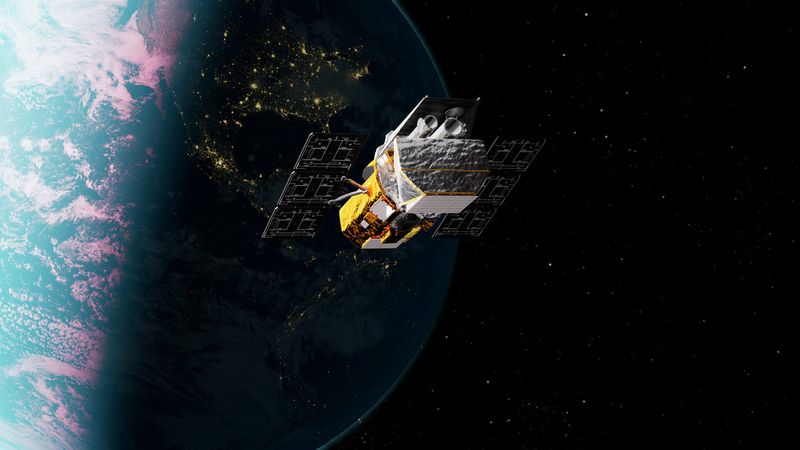
Swift’s fall matters on three levels, and only one of them is the fireball. The first is the science gap. No other operating observatory combines Swift’s particular trio of speed, three-wavelength coverage and instant global alerts. Without it, the first hours of the universe’s most violent events — the hours when the physics is strangest and the data richest — become measurably harder to catch. NASA has been candid that there is no direct replacement: Shawn Domagal-Goldman, a senior agency official, has said NASA is exploring how to use and augment its existing fleet and fast commercial capabilities to cover some of the gap. That is an improvisation, not a successor, and astronomers who built their careers on Swift alerts know the difference.
The second level is industrial. The LINK mission failed, but it failed at the frontier: a small company, on a fixed-price-style award of about $30 million, built and flew a three-armed capture spacecraft to the vicinity of a satellite launched before the iPhone existed, with no docking port and no servicing provisions of any kind. NASA documented what it learned in a lessons-learned report on September 28, covering the rendezvous and proximity operations that did work. Every future servicing, life-extension and debris-removal mission — a market governments are actively trying to create — now starts from data bought with LINK’s near-miss.
The third level is the argument Swift’s return will inevitably feed: what should be allowed to simply fall? Low Earth orbit is crowding fast with mega-constellations, spent stages and dead satellites, and uncontrolled reentries like this one are becoming routine. The honest numbers cut both ways. The risk to any individual person from Swift is vanishingly small, NASA stresses that harm is unlikely, and the expected debris field is an ocean. But the traffic is rising, the objects are getting bigger and more numerous, and “unlikely” multiplied by thousands of future reentries is a policy question, not a rounding error. Swift, designed in an era when one satellite falling was an event, is returning in an era when it is a statistic — and its tungsten heart will be cited by both sides of that debate.
Who gains, who loses
The losers are clearest. Time-domain astronomers lose their alarm clock; Penn State loses a mission its people have operated for more than two decades; NASA loses a productive observatory with no replacement on the launch manifest. The gains are quieter but real. Katalyst and the wider servicing industry gain flight heritage and a documented failure they can engineer against — the most valuable kind of failure, the survivable one. Archivists and theorists gain certainty that Swift’s data, all of it public from the start with no proprietary period and mirrored in Italy and the United Kingdom, is now a fixed, complete legacy to mine for decades. And regulators gain a test case: a well-tracked, well-communicated uncontrolled reentry of a substantial spacecraft, against which future disposal rules will be argued.
What happens next
Expect the forecast to sharpen. As Swift’s altitude collapses this week, Space Force tracking updates should narrow the reentry window from a day to hours, and the predicted ground track will firm up along its Africa–Australia–India–Southeast Asia–Americas band. A 1.5-ton spacecraft breaking up at hypersonic speed may be visible as a bright, fragmenting streak to observers under the final passes, though whether anyone is underneath, awake and looking up is a matter of chance. Most of the structure should burn; any tungsten or mirror debris that survives is expected to reach the ocean. After that, the mission continues in the only form left to it: the archive. Swift’s 12 terabytes will keep producing papers for years, its burst catalogue will remain the field’s reference set, and the question NASA is left holding — whether the next Swift is a flagship, a commercial service, or a gap the field simply learns to live with — will shape time-domain astronomy for the next decade. The telescope is coming home in flames. The science it made possible is not.
Related coverage
SpaceX Crew-13 Blasts Off: Four Astronauts Begin Fastest-Ever Dash to the ISS
SpaceX Falcon 9 Turns Into a Glowing ‘Space Jellyfish’ Over the East Coast
Sources
NASA, “NASA’s Swift Mission Ends Ahead of Re-Entry,” October 23, 2026 — science.nasa.gov · Associated Press (Marcia Dunn), reporting on the U.S. Space Force reentry forecast and principal investigator Brad Cenko, November 1, 2026 — via BytesEU · Nature, news report on Swift’s final days and reentry predictions, October 27, 2026 — nature.com · The Register, “Swift operations end,” October 26, 2026 — theregister.com