War · Iran · Middle East
On Sunday it was a report sourced to a single US military official, due “within a day” and pointedly unconfirmed by the Pentagon. On Monday, US Central Command confirmed it: the Theodore Roosevelt carrier strike group arrived in the Middle East over the weekend — and for now, three American carrier strike groups are operating in the region at once.
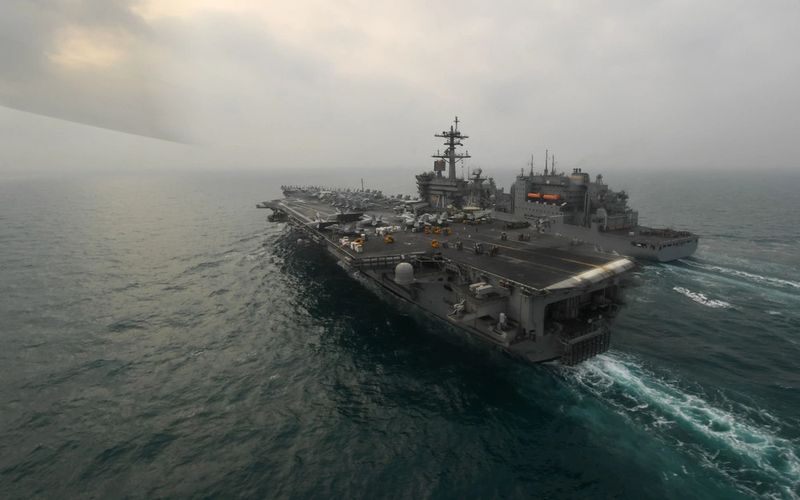
IN THE ARABIAN SEA, November 16, 2026 — The USS Theodore Roosevelt Middle East arrival is no longer a report. US Central Command confirmed on Monday that the Theodore Roosevelt carrier strike group arrived in the Middle East over the weekend, a confirmation carried by the Associated Press and USNI News that converts Sunday’s single-source expectation into an established fact: three US carrier strike groups — Theodore Roosevelt, George Washington and George H.W. Bush — are now in the region, and the USS Makin Island Amphibious Ready Group is also moving in. The confirmation matters because of how carefully the story had to be handled a day earlier, and because of what it does not yet answer: how long all three carriers stay.
Track it live: Iran war tracker — follow carrier movements, Strait of Hormuz shipping and the wider US–Iran confrontation as they develop.
Signal Post News has followed this deployment since the decision itself was reported in early October, when the Pentagon dispatched the Roosevelt group from San Diego as President Trump weighed his post-midterm Iran options — the story told in our October report, USS Theodore Roosevelt: The Third Carrier Sailing to the Middle East. That decision is not the news today, and this article does not re-report it as one. The news is the arrival: a transit of some six weeks, tracked port by port and strait by strait, has ended where the October orders pointed it — in Central Command’s area of responsibility, alongside two carriers that have been holding the region for months.
What we know
- The confirmation: US Central Command confirmed on Monday, November 16, that the USS Theodore Roosevelt carrier strike group arrived in the Middle East over the weekend. The Associated Press and USNI News both carried the confirmation. Until Monday, neither the Pentagon nor CENTCOM had publicly confirmed the arrival schedule.
- The three carriers: three US carrier strike groups are now in the region — USS Theodore Roosevelt (CVN-71), USS George Washington (CVN-73) and USS George H.W. Bush (CVN-77). USNI News’ Fleet and Marine Tracker of November 9 already placed George Washington and George H.W. Bush in the Arabian Sea in support of US operations in the Middle East.
- The amphibious group: the USS Makin Island Amphibious Ready Group — two landing ships with roughly 2,000 Marines embarked, per AP and USNI reporting — is also moving into the region.
- The group: Roosevelt deploys as the flagship of Carrier Strike Group 9, with Carrier Air Wing 11 embarked, the cruiser USS Chosin (CG-65) and destroyers including USS Decatur (DDG-73) with Destroyer Squadron 23 embarked. USS Paul Hamilton (DDG-60) is not listed here as accompanying the carrier into Central Command: per USNI, after Singapore it sailed east into the South China Sea.
- The open question: whether Roosevelt ultimately relieves George Washington — the expectation USNI reporting carried into the weekend — or remains alongside her for an extended overlap is not resolved by Monday’s confirmation. CENTCOM confirmed an arrival, not a rotation schedule. The duration of the three-carrier overlap is unknown.
- The timing: the confirmation landed on the same Monday that saw a fresh wave of tanker strikes around the Strait of Hormuz — reported in our companion coverage, Tankers Hit in the Strait of Hormuz as a Third U.S. Carrier Arrives. No US official has announced a decision linking the arrival to a resumption of strikes, and none is claimed here.
From “reportedly” to confirmed: how the story changed in 24 hours
On Sunday, the honest sentence was a hedged one. The New York Times, citing a US military official, reported that Theodore Roosevelt would join the two carriers already in the Middle East “within a day” — pointing to Monday. The account travelled quickly, relayed by Anadolu Agency, Clash Report and JFeed, but it rested on a single official speaking to one newspaper, and the institutions that own the fact had not spoken: as of Sunday, the Pentagon and CENTCOM had not publicly confirmed the arrival schedule, and the Navy had not announced that the ship had entered the region. Any newsroom writing on Sunday, this one included, had to carry the arrival as reported and expected, not as done.
Monday’s confirmation changes the grammar of the story, and it is worth being precise about what it changes and what it does not. It establishes that the Roosevelt group is in the Middle East, that it arrived over the weekend, and that three carrier strike groups are in the region now, with the Makin Island group moving in as well. It does not establish how the three-carrier posture is meant to evolve — whether Washington is about to be relieved, whether the overlap is a deliberate surge or a scheduling seam, or how long it lasts. Those questions were open on Sunday and, on the public record, they remain open on Monday. What is no longer open is the arrival itself.
The three carriers
The two decks Roosevelt joins have been the region’s standing carrier presence for most of the year. USS George H.W. Bush (CVN-77), homeported in Norfolk, has been in the region since the spring. USS George Washington (CVN-73), the forward-deployed carrier based at Yokosuka, Japan, has been in the Middle East since August, when she was sent over the summer to relieve USS Abraham Lincoln. USNI’s November 9 tracker put both strike groups in the Arabian Sea — George Washington’s Carrier Strike Group 5 with Carrier Air Wing 5 and the destroyer USS Shoup among its escorts, and the George H.W. Bush group alongside — operating in support of US operations in the Middle East. Between them, the two groups have carried the region’s carrier air power through the autumn’s Hormuz crisis, including the record month of ship attacks in October that this newsroom documented in Ship Attacks in the Strait of Hormuz Hit a Record High in October.
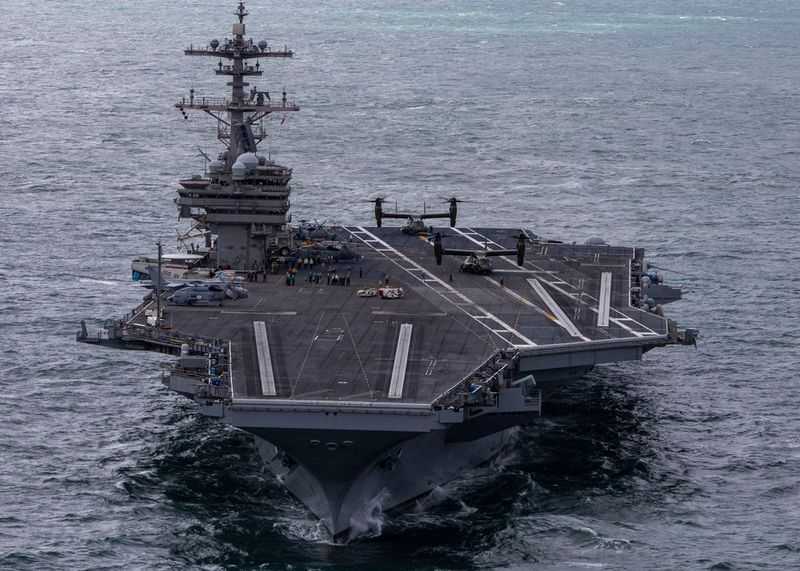
Roosevelt is the Pacific Fleet’s contribution to that posture, and her arrival completes a rebalancing with a cost that is easy to overlook from the Arabian Sea. She is a San Diego carrier, homeported at Naval Air Station North Island, and every week she spends in Central Command’s waters is a week the US Navy’s Pacific carrier presence is drawn down to sustain the Middle East. That trade-off — concentration in one theatre purchased with thinness in another — is the standing arithmetic of a carrier fleet with global commitments and a finite number of flight decks, and it is one reason the relief-versus-overlap question in the next section matters well beyond the Gulf.
The road to the Arabian Sea
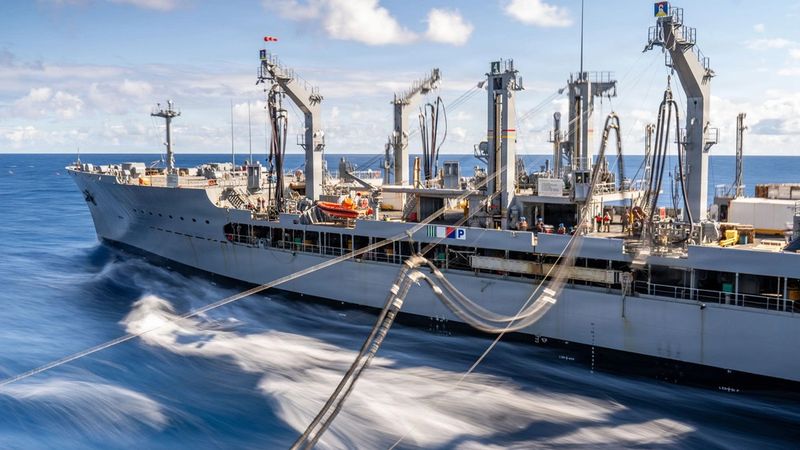
Roosevelt’s route to Monday’s confirmation can be reconstructed almost week by week from the Navy’s own tracking, and it reads as a deliberate, unhurried deployment rather than an emergency surge. The group left San Diego in late September. It visited Yokosuka, Japan, from October 16 to 19, then exercised with Japanese forces in Exercise Keen Sword 27. On November 4, in the South China Sea, Roosevelt conducted a replenishment-at-sea with the Australian replenishment oiler HMAS Stalwart — an evolution the US Navy itself filmed and released through DVIDS. The group then made a port visit to Singapore, arriving Friday, November 6 and departing Monday, November 9, and from Singapore it turned west: USNI’s Western Pacific Pulse, drawing on ship trackers, followed the group through the Malacca Strait and across the Indian Ocean, en route to US Central Command. Ship spotters placed Roosevelt in the Andaman Sea after the Singapore departure. The final leg, from the Indian Ocean into CENTCOM’s area, is the one that ended, over the weekend, with the arrival CENTCOM confirmed on Monday.
The strike group that made that transit is Carrier Strike Group 9: Theodore Roosevelt herself, with Carrier Air Wing 11 embarked; the guided-missile cruiser USS Chosin (CG-65); and guided-missile destroyers including USS Decatur (DDG-73), with Destroyer Squadron 23 embarked. One composition point deserves an explicit note, because strike-group rosters are often copied forward uncritically from departure releases. USS Paul Hamilton (DDG-60), which had sailed with the group earlier in the deployment, is not counted in this article as accompanying the carrier into Central Command: USNI reported that after Singapore, Paul Hamilton sailed east into the South China Sea. Until a fresher source places her with the group in CENTCOM’s area, she belongs to the deployment’s Pacific chapter, not its Middle East one.
Relief or reinforcement? The question CENTCOM did not answer
Three carriers in one region can mean two very different things, and the difference is the largest unresolved fact in this story. In the first reading, Roosevelt is a relief: USNI’s expectation, relayed by Clash Report ahead of the arrival, was that she would relieve George Washington, whose Middle East deployment began in August after a summer transit from Japan. On that reading, the three-carrier moment is a seam — the brief overlap while one group hands the watch to another — and the region returns to two carriers once Washington departs. In the second reading, Roosevelt is a reinforcement: a deliberate decision to hold three strike groups in theatre at once, concentrating naval air power at a moment of acute tension with Iran, for as long as Washington chooses to pay the Pacific price of doing so.
Monday’s confirmation does not choose between those readings, and this article will not choose for it. CENTCOM confirmed an arrival and, with it, a present fact — three carrier strike groups in the region now. It did not publish a rotation schedule, a departure date for George Washington, or a planned duration for the overlap. The next hard evidence will come from the trackers and from movement: USNI News’ Fleet and Marine Tracker, updated on Mondays, will show whether Washington is still in the Arabian Sea next week or heading home, and any Navy announcement of her departure will convert the relief reading from expectation into fact. Until then, the disciplined description is the one the sources support: a three-carrier overlap exists; its duration is unknown.
Why this matters
Begin with the signal, because carrier movements are read in Tehran as fluently as they are read in Washington. A third strike group’s arrival concentrates, in one sea, three nuclear-powered flight decks and their embarked air wings, three cruiser-and-destroyer screens, and the strike, surveillance and air-defence capacity that sails with them. Whatever the rotation plan turns out to be, the posture on Monday is the posture an Iranian planner has to reckon with on Monday. The arrival also lands in a crowded week. On Sunday, the original report of Roosevelt’s imminent arrival coincided with Bahrain’s drone interceptions and the Islamic Revolutionary Guard Corps’ claim to have struck a US radar in Bahrain — events this newsroom covered in Iran’s Guards Say They Struck a US Radar in Bahrain as Hormuz Tanker Claims Mount. On Monday, the confirmation arrived on the same day as the Hormuz tanker wave. That is context, and it is legitimately part of how the buildup will be read in the region. It is not evidence of a coordinated decision, and no source cited here confirms a link between the arrival and any decision to resume strikes. Signal Post News reports the coincidence of timing as exactly that.
The second significance is maritime, and it connects the carriers to the water they have come to dominate. The Strait of Hormuz has endured its most dangerous year in decades: ship attacks hit a record high in October, traffic has run far below pre-war levels, and diplomacy over reopening the strait — including the two-day reopening plan discussed around the Doha talks, covered in Iran Says Hormuz Could Reopen in Two Days as Doha Talks Produce a Draft — has yet to restore normal passage. Carriers do not sweep mines and do not escort every tanker, but their air wings are the region’s standing instrument for surveillance, deterrence and, if ordered, strikes against the coastal systems that threaten shipping. A third group thickens all of that at the moment the tanker war has flared again.
The third significance is the Pacific ledger. Roosevelt is the second carrier the Middle East has drawn from the Pacific’s orbit this year, after George Washington’s summer move from Yokosuka. Each such move is defensible in isolation; together they describe a fleet whose centre of gravity has shifted west of Suez for the duration of the Iran confrontation, with the Indo-Pacific held by a thinner line. Allies and rivals in Asia track American carrier whereabouts as closely as anyone in the Gulf does. The Makin Island Amphibious Ready Group’s move into the region adds the other half of the classic pairing: amphibious ships and embarked Marines, the force for evacuations, raids and presence ashore, arriving in the same confirmation cycle as the third carrier.
What happens next
Four things will clarify the picture in the coming days. First, the trackers: the next USNI Fleet and Marine Tracker will fix the three groups’ positions and show whether the Arabian Sea concentration is holding or already unwinding. Second, George Washington: any announcement of her departure — or, equally telling, her continued presence on station into December — will settle the relief-versus-reinforcement question that Monday’s confirmation left open. Third, the Makin Island group’s arrival and tasking, which will indicate whether Washington is preparing options ashore as well as at sea. Fourth, Hormuz itself: whether the tanker strikes of Monday mark a new tempo, and whether the carrier concentration is followed by fresh US statements, escort arrangements or warnings to Tehran.
What is settled, as of Monday, can be stated in one sentence. The deployment decided in October, reported as imminent on Sunday, is confirmed on Monday: USS Theodore Roosevelt is in the Middle East, three American carrier strike groups are in the region, and the largest concentration of US naval air power in this theatre during the present confrontation is no longer a projection. It is a position on the chart.
Sources
- US Central Command (CENTCOM), confirmation issued Monday, November 16, 2026, as reported by the Associated Press and USNI News — the Theodore Roosevelt carrier strike group arrived in the Middle East over the weekend; three US carrier strike groups are now in the region (Theodore Roosevelt, George Washington and George H.W. Bush); the USS Makin Island Amphibious Ready Group is also moving in.
- Associated Press, November 16, 2026 — reporting of the CENTCOM confirmation of the Roosevelt group’s arrival, the three-carrier posture and the Makin Island Amphibious Ready Group’s movement into the region.
- USNI News, November 16, 2026 — reporting of the Roosevelt arrival confirmation; and USNI News Fleet and Marine Tracker, November 9, 2026 — George Washington (Carrier Strike Group 5, Carrier Air Wing 5, USS Shoup) and the George H.W. Bush carrier strike group operating in the Arabian Sea in support of US operations in the Middle East; Theodore Roosevelt in Singapore November 6–9 and in the Andaman Sea per ship spotters.
- USNI News Western Pacific Pulse, November 6 and November 13, 2026 — Roosevelt’s replenishment-at-sea with HMAS Stalwart on November 4; the group’s departure from Singapore, westward transit through the Malacca Strait and Indian Ocean routing toward US Central Command; USS Paul Hamilton sailing east into the South China Sea after Singapore.
- The New York Times, Sunday, November 15, 2026, citing a US military official — Theodore Roosevelt to join two other US carriers in the Middle East “within a day”; as relayed by Anadolu Agency, Clash Report and JFeed, with a full secondary account at crisis.zone, “USS Theodore Roosevelt reportedly due in Middle East” (November 15, 20:42 UTC). As of Sunday, the Pentagon and CENTCOM had not publicly confirmed the arrival schedule.
- Clash Report, “US Aircraft Carrier Arrives in Singapore Ahead of Middle East Transit” (November 8, updated November 15, 2026) — USNI-based account of the strike group’s composition (Carrier Strike Group 9, Carrier Air Wing 11, USS Chosin, USS Decatur with Destroyer Squadron 23) and the expectation that Roosevelt would relieve USS George Washington.
- DVIDS (US Navy, public domain) — video 1028571, Roosevelt replenishment-at-sea with HMAS Stalwart, November 4, 2026; video 1027744, helicopter flight operations, October 24, 2026.
- Signal Post News, related coverage: USS Theodore Roosevelt: The Third Carrier Sailing to the Middle East (October 2026, the deployment decision); Tankers Hit in the Strait of Hormuz as a Third U.S. Carrier Arrives; Iran’s Guards Say They Struck a US Radar in Bahrain as Hormuz Tanker Claims Mount; Ship Attacks in the Strait of Hormuz Hit a Record High in October; Iran Says Hormuz Could Reopen in Two Days as Doha Talks Produce a Draft.
- Photos: USS Theodore Roosevelt alongside a replenishment ship, US Navy via DVIDS (public domain), image 4146488; a fleet replenishment oiler’s fueling rigs during a fueling-at-sea with Theodore Roosevelt, US Navy via DVIDS (public domain), image 9666368; USS George H.W. Bush flight-deck operations, US Navy via DVIDS (public domain), image 9356572 — each credited in its caption.