War · Iran · Energy
The latest Strait of Hormuz tanker attacks struck three named vessels in two days — and the verified weapon, in each case, was a projectile, not a mine. Iran says six tankers hit mines and a supertanker sank. Those claims name no ships, and neither Reuters nor the Associated Press could verify them.
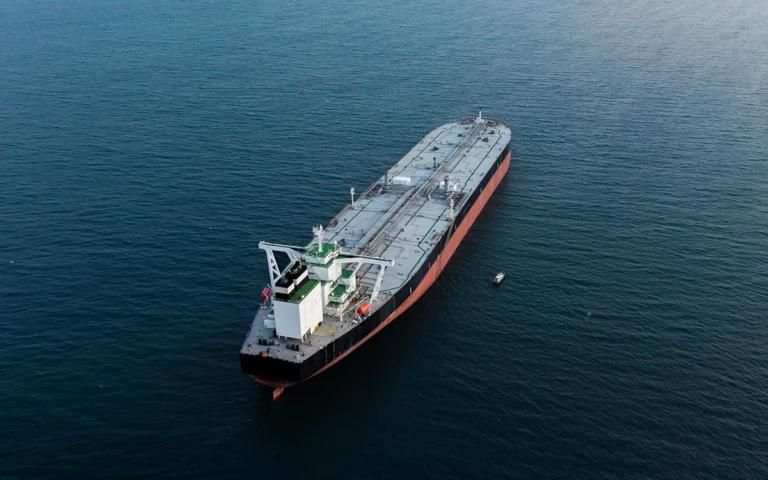
IN THE STRAIT OF HORMUZ, November 16, 2026 — The Strait of Hormuz tanker attacks that shipping monitors verified across Sunday and Monday hit three named vessels — the supertanker Al Dhannah, the tanker On Phoenix and the LPG carrier Tara Gas — each struck by a projectile in attacks reported by the UK Maritime Trade Operations centre and compiled by TradeWinds. A second, larger story ran alongside the verified one: Iran’s Islamic Revolutionary Guard Corps said mines had damaged six tankers across the two days and that a supertanker had sunk, claims for which Tehran named no vessels and which Reuters and the Associated Press both said they could not verify. And on the same Monday, U.S. Central Command confirmed that the Theodore Roosevelt carrier strike group had arrived in the Middle East — a third U.S. carrier group now in the region, on the very day the tanker war flared again.
Track it live: Iran war tracker — carrier movements, Strait of Hormuz shipping and the wider U.S.–Iran confrontation as they develop; and the oil price forecast tracker — Brent, WTI and the market’s reading of the Hormuz risk.
What we know
- Three named ships, hit by projectiles: the ADNOC-managed supertanker Al Dhannah was hit in her steering gear room on Sunday; the Panama-flagged On Phoenix was struck at 05:58 UTC on Monday, with an engine-room fire and her crew all accounted for; and the LPG carrier Tara Gas was disabled off Khasab, Oman, at 19:00 GMT on Monday, her 25 crew safe. UKMTO reported the Monday attacks; maritime security firm Vanguard Tech identified the vessels.
- Verified without reference to mines: TradeWinds’ assessment is that three of the reported attacks have been verified — and the weapon reported in the verified incidents is projectiles, not confirmed mines.
- Iran’s claims are claims: the IRGC says mines damaged six tankers across Sunday–Monday and that a supertanker carrying more than two million barrels sank. Iran named no vessels or flags and released no casualty figures; Reuters and AP could not verify the mine claims.
- A third carrier, confirmed: CENTCOM confirmed on Monday that the Theodore Roosevelt strike group arrived in the Middle East over the weekend. Three U.S. carrier strike groups are now in the region — Theodore Roosevelt, George Washington and George H.W. Bush — and the USS Makin Island Amphibious Ready Group is also moving in.
- Oil fell anyway: Brent crude settled $3.40 lower at $92.44 a barrel on Monday, and WTI fell $2.84 to $85.72 — the market, for now, pricing diplomacy and surplus over the weekend’s violence.
Verified, and claimed: two different stories
Almost every confused headline this story will generate over the next 48 hours will come from collapsing two separate accounts into one, so this article keeps them apart from the start. The verified account is narrow, specific and sourced to the institutions that log attacks on shipping. UKMTO, the Royal Navy-run reporting centre that issues the strait’s attack alerts, reported a tanker struck by an unknown projectile while leaving the Strait of Hormuz at 05:58 UTC on Monday, an engine-room fire, and a crew all accounted for. It reported a second attack at 19:00 GMT on Monday, about seven nautical miles off Khasab, Oman, that disabled a liquefied petroleum gas carrier with an engine-room fire. Vanguard Tech, the maritime security firm, put names to both hulls: On Phoenix in the morning, Tara Gas in the evening. A third verified hit reached back to Sunday: the supertanker Al Dhannah, struck in her steering gear room as she approached the strait. TradeWinds, the shipping industry’s newspaper of record, assessed the position plainly: three of the reported attacks have been verified — without reference to mines.
The claimed account is broader, louder and, so far, empty of the details that would let anyone check it. Iranian state television, carrying the IRGC Navy’s version, said three oil tankers caught fire overnight into Monday after hitting naval mines. The Guards’ wider claim covers six tankers damaged by mines across Sunday and Monday, a fourth vessel set afire by a mine on Monday, and a supertanker carrying more than two million barrels of crude sunk after what were described as massive explosions. Iran named no vessels. It named no flags. It released no casualty figures and no imagery that independent reporting has been able to tie to a hull. Reuters stated it could not verify the mine claims; the Associated Press stated the same. That is the whole of the fencing, and it matters: as of Monday night, no ship has been verified to have hit a mine in this wave, and no supertanker has been verified to have sunk. What has been verified is three ships hit by projectiles.
The pattern will be familiar to readers who have followed this newsroom’s coverage through the past week. Between November 10 and 14, Iran claimed tanker mine strikes on an almost daily rhythm; none of the vessels was publicly identified, a sequence we tracked in Iran’s Guards Say They Struck a US Radar in Bahrain as Hormuz Tanker Claims Mount. CENTCOM, for its part, said on October 28 that the internationally recognised primary transit routes through the strait are cleared, and has called Iran’s mine claims false. Neither side’s assertion settles the question on its own. What settles it, incident by incident, is the unglamorous machinery of UKMTO alerts, security-firm identifications and named ships with named damage — and on Monday, that machinery verified projectiles.
The three named ships
Al Dhannah, Sunday. The first of the wave came on Sunday, against the largest hull of the three. Al Dhannah is a 299,300-deadweight-tonne supertanker managed by ADNOC, the Abu Dhabi National Oil Company’s shipping arm — a very large crude carrier of the class that carries roughly two million barrels. Vanguard Tech, via TradeWinds, reported that she was hit by a projectile in her steering gear room while approaching the strait, and that she turned back toward Dubai. The steering gear room is a telling place to be hit: it houses the machinery that works the rudder, and damage there threatens a ship’s ability to steer without necessarily threatening the hull or the cargo. No casualties were reported in the verified accounts of the Al Dhannah strike, and the ship’s turn back toward Dubai indicates she remained able to make her way under her own power or assistance to a safe port.
On Phoenix, Monday 05:58 UTC. The Monday wave opened before dawn. UKMTO reported a tanker struck by an unknown projectile while leaving the strait at 05:58 UTC, with a fire in the engine room and the crew all accounted for — the formulation UKMTO uses when a master has confirmed no one is missing. Vanguard Tech identified the ship as the Panama-flagged On Phoenix, hit roughly three nautical miles off Oman, on the strait’s southern shore. The Associated Press carried the report, sourced in part through Iranian state television’s own acknowledgement of the UKMTO alert — a reminder that even Tehran’s media ecosystem reported this incident in UKMTO’s terms, as a projectile strike, whatever the IRGC’s parallel mine narrative said. An engine-room fire is among the most serious survivable events on a tanker: it threatens propulsion and power, and on a laden ship it is fought a bulkhead away from cargo spaces. The crew being accounted for, and no sinking or abandonment reported, marks the outcome as a ship hurt, not lost.
Tara Gas, Monday 19:00 GMT. The day’s second verified hit came in the evening, and against a different kind of target. At 19:00 GMT, about seven nautical miles off Khasab — the Omani port town on the Musandam Peninsula that guards the strait’s southern shore — an attack disabled the Tara Gas, a 78,700-cubic-metre LPG carrier built in 2005, with an engine-room fire. Vanguard Tech identified her, as it had On Phoenix. All 25 of her crew were safe, with no injuries, according to India’s shipping minister, Sarbananda Sonowal — the official confirmation that the crew, Indian-officered as so much of the world’s tanker fleet is, had come through. An LPG carrier carries liquefied petroleum gas in pressurised or refrigerated tanks; a disabled gas carrier off Khasab is a hazard to navigation and a salvage problem even where, as here, the cargo held and the crew is safe. Three ships, three projectile strikes, two days: that is the verified wave, and it is quite enough to matter without a single mine in it.
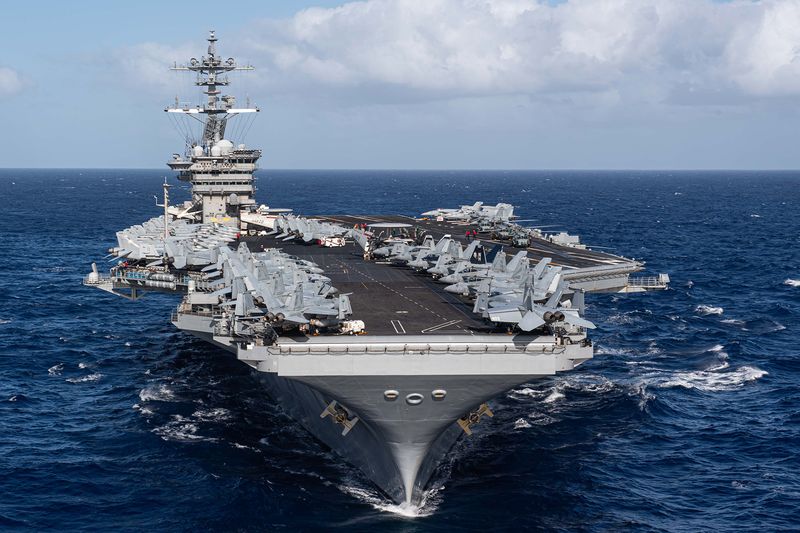
The third carrier arrives on the same Monday
The military fact of the day was confirmed in a single, flat sentence’s worth of officialdom: the Theodore Roosevelt carrier strike group arrived in the Middle East over the weekend, and U.S. Central Command confirmed it on Monday. With that confirmation, carried by the Associated Press and USNI News, three U.S. carrier strike groups are in the region at once — Theodore Roosevelt, George Washington and George H.W. Bush — the largest concentration of American naval air power in this theatre during the present confrontation. Behind them, the USS Makin Island Amphibious Ready Group — two landing ships with roughly 2,000 Marines embarked, per AP and USNI reporting — is also moving into the region, adding the amphibious half of the classic pairing: ships and Marines for evacuations, raids and presence ashore. The full account of the arrival — the six-week transit from San Diego, the Singapore stop, the Malacca Strait crossing, and the still-open question of whether Roosevelt relieves George Washington or reinforces her — is told in our companion report, USS Theodore Roosevelt Middle East Arrival Puts Three US Carriers in the Region.
The coincidence of timing deserves to be stated precisely, because it will be read in Tehran and Washington alike as a message whether or not it was sent as one. The confirmation landed on the same Monday that UKMTO logged two tanker attacks in the strait and the day after a third. No U.S. official has announced a decision linking the carrier’s arrival to the tanker strikes, and none is claimed here: Roosevelt’s deployment was ordered in October and her arrival date was set by a six-week transit, not by Monday’s events. But posture is posture. Whatever the rotation plan turns out to be, the force an Iranian planner must reckon with on Monday night is three carrier flight decks, their cruiser-and-destroyer screens, and an amphibious group inbound — arrayed around a strait where three merchant ships have just been hit.
Why this matters: mines, projectiles, and a permit regime
Start with the distinction this article has insisted on, because it is not pedantry — mines and projectiles are different wars. A projectile strike is an event: a weapon is fired, a ship is hit, and when the firing stops the danger from that weapon stops with it. A mine is a condition. Naval mines persist after the fighting pauses, after ceasefires are signed and after the minelayer has gone home; they are indiscriminate, they drift and they break loose, and clearing them is slow, specialised work measured in weeks and months, conducted by a small number of minehunters at walking pace through water someone else may still be watching. That is why the word matters commercially as much as militarily: a strait with confirmed mines in it is a strait insurers price differently, charterers avoid differently and navies clear on a timeline that outlasts the headlines. It is also why the verification discipline matters. If mines are confirmed, the story changes in kind, not just degree. As of Monday, they have not been — and the two wire services that checked Tehran’s account said so in as many words.
The second contest underneath the shooting is about permission. Tehran’s framing, repeated through the crisis, is that only the northern corridor through the strait — the lane in Iranian waters, transited under permits from the Persian Gulf Strait Authority, the PGSA — is “authorised”, and that ships outside that regime are fair warning. Both of the Monday ships identified in verified reporting were reportedly on the PGSA’s non-compliant list. The United States, meanwhile, guides shipping through the southern corridor that Tehran calls unauthorised — the internationally recognised routing along the Omani shore, off the Khasab coast where Tara Gas was hit and the Omani waters off which On Phoenix was struck. Read the geography of Monday’s verified hits against that map and the sovereignty fight becomes concrete: the ships hit were in or near the southern routing, in the Omani-side waters of the strait, on the passage the U.S. upholds and Iran refuses to recognise. Whether that pattern is targeting doctrine or opportunity is not established by Monday’s reporting, and this article does not claim it. But the permit regime is now impossible to separate from the attack pattern, and every master transiting this week will have to choose a corridor knowing exactly that.
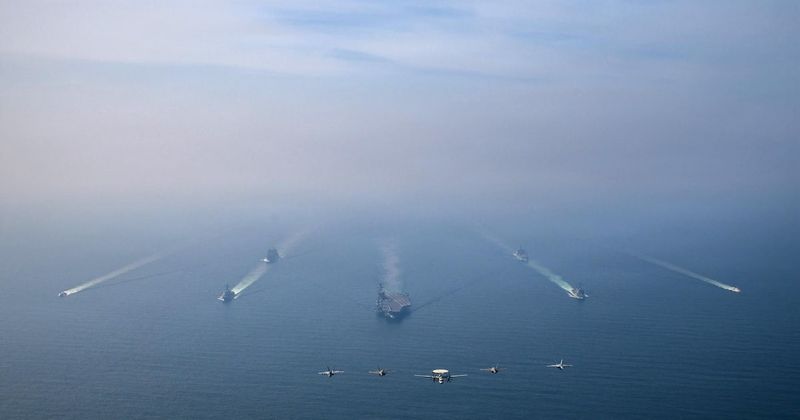
The third point is the limit of the naval answer, and it is worth stating against the day’s carrier headlines: three carriers do not sweep mines. Carrier air wings are the region’s standing instrument for surveillance, deterrence and, if ordered, strikes against the coastal systems that threaten shipping — the launchers, radars and bases ashore. They are not, and cannot be, a minesweeping force, an escort for every tanker, or a guarantee that a projectile will not be fired at the next ship to leave the strait on the southern routing. If the verified threat remains projectiles, the counter is air power, air defence and deterrence, and Monday’s concentration speaks directly to it. If mines are ever confirmed, the counter is a different fleet entirely — and a much slower clock. Knowing which war is actually being fought is the precondition for everything else, which is why the fencing in this story is the story.
The context: a record October, a slower November, then this
The war for the strait began with the wider war in February 2026, and the shipping crisis has outlasted every prediction made about it since. October was its worst month: ship attacks in and around the strait hit a record high, a grim ledger this newsroom compiled in Ship Attacks in the Strait of Hormuz Hit a Record High in October. The International Maritime Organization’s count gives the scale its official shape: 136 maritime security incidents in and around the strait between March 1 and November 11, including 35 in October alone. UKMTO’s weekly overview counted at least seven tanker attacks in the week to November 11, even as the month’s tempo eased from October’s peak — and traffic through the strait is running roughly 65 percent below pre-war levels, a measure of how many owners have simply stopped sending ships. November, until this weekend, had been the slower month the diplomats pointed to. Sunday and Monday ended that talking point.
Diplomacy, meanwhile, has produced paper but not passage. Iran’s position that Hormuz could reopen in two days under a draft produced around the Doha talks — covered in Iran Says Hormuz Could Reopen in Two Days as Doha Talks Produce a Draft — has yet to restore normal transit, and the strikes of the past two days landed while that draft sat unimplemented. The market’s verdict on Monday was the day’s most counterintuitive fact: Brent settled $3.40 lower at $92.44 a barrel and WTI fell $2.84 to $85.72, on a day when three tankers were burning or disabled and a third carrier arrived. Traders were pricing the diplomacy track, comfortable global supply and the IEA’s October figure of 18.4 million barrels a day still moving out of the region over the fear premium the headlines argued for. Markets have been wrong about this strait before, in both directions; but a $3.40 fall on a three-tanker Monday is a statement about where the marginal barrel thinks this goes next, and it is part of the record of the day.
The numbers
- 3 — vessels verified hit across Sunday–Monday: Al Dhannah (Sunday), On Phoenix (Monday, 05:58 UTC) and Tara Gas (Monday, 19:00 GMT) — each by a projectile, per UKMTO reporting compiled by TradeWinds, with Vanguard Tech identifications.
- 6 — tankers Iran’s IRGC claims were damaged by mines across Sunday–Monday, plus a claimed sunken supertanker: a claim only, with no vessels named and no verification by Reuters or AP.
- 25 — crew aboard Tara Gas, all safe with no injuries, per India’s shipping minister Sarbananda Sonowal. On Phoenix’s crew were likewise all accounted for.
- 136 — maritime security incidents recorded by the IMO in and around the strait from March 1 to November 11, including 35 in October.
- 65% — the approximate fall in strait traffic against pre-war levels, per UKMTO’s weekly overview, which also counted at least seven tanker attacks in the week to November 11.
- 3 — U.S. carrier strike groups now in the region (Theodore Roosevelt, George Washington, George H.W. Bush), confirmed by CENTCOM on Monday, with the Makin Island Amphibious Ready Group moving in.
- $92.44 — Brent crude’s Monday settlement, down $3.40 on the day; WTI settled at $85.72, down $2.84.
What happens next
Four threads will decide whether Monday was a spike or a new tempo. First, the advisories: UKMTO and the Joint Maritime Information Center will set the guidance every master in the Gulf now reads before sailing — routing advice, reporting requirements and any change to the threat assessment for the southern corridor. Watch whether the verified projectile pattern draws a formal warning, and whether any authority, anywhere, upgrades the mine claim from assertion to evidence. Second, identifications: if Iran’s six-tanker claim is ever matched to named hulls, flags and damage, the fencing in this article changes and we will say so; until then it remains what Reuters and AP found it to be. Salvage and inspection of Tara Gas off Khasab, and Al Dhannah’s condition in Dubai, will add physical evidence about the weapons used. Third, the U.S. response: three carriers are in place, the Makin Island group is coming, and Washington’s choice — statements, escorts, strikes or silence — will be read against Monday’s attacks within days. Fourth, the calendar: the OPEC+ meeting on November 29 now sits less than two weeks out, with the strait’s traffic at a fraction of normal, exports still flowing at 18.4 million barrels a day on October’s count, and a market that on Monday chose to sell the crisis. What is settled tonight is narrower and harder than the claims around it: three named ships were hit by projectiles in two days, a third American carrier is in the region, and the most contested twenty-one miles of water on earth just had its worst weekend since October.
Sources
- UK Maritime Trade Operations (UKMTO) — attack reports of Monday, November 16, 2026: a tanker struck by an unknown projectile while leaving the Strait of Hormuz at 05:58 UTC, engine-room fire, crew all accounted for; and a second attack at 19:00 GMT, about seven nautical miles off Khasab, Oman, disabling a vessel with an engine-room fire. UKMTO weekly overview: at least seven tanker attacks in the week to November 11; strait traffic roughly 65 percent below pre-war levels.
- TradeWinds, November 16, 2026 — compilation and assessment of the weekend wave: three of the reported attacks verified, without reference to mines; Vanguard Tech identifications of On Phoenix (Panama-flagged, about three nautical miles off Oman) and Tara Gas (78,700-cbm LPG carrier, built 2005); and the Sunday projectile strike on the ADNOC-managed 299,300-dwt supertanker Al Dhannah in her steering gear room, after which she turned back toward Dubai.
- Associated Press, November 16, 2026 — reporting of the UKMTO projectile strike on the tanker leaving the strait (via Iranian state television’s reporting of the alert); the statement that AP could not verify Iran’s mine claims; and, with USNI News, the CENTCOM confirmation of the Theodore Roosevelt strike group’s arrival, the three-carrier posture and the Makin Island Amphibious Ready Group’s movement into the region.
- Reuters, November 16, 2026 — the statement that Reuters could not verify the IRGC’s mine claims; Iran named no vessels or flags and released no casualty figures for the claimed six mined tankers or the claimed sunken supertanker.
- U.S. Central Command (CENTCOM) — confirmation issued Monday, November 16, 2026, that the Theodore Roosevelt carrier strike group arrived in the Middle East over the weekend; and CENTCOM’s October 28 statement that internationally recognised primary transit routes through the strait are cleared, characterising Iran’s mine claims as false.
- USNI News, November 16, 2026 — reporting of the Roosevelt arrival confirmation, the three carrier strike groups in the region and the Makin Island Amphibious Ready Group (two landing ships, roughly 2,000 Marines) moving in.
- India’s shipping minister Sarbananda Sonowal, November 16, 2026 — all 25 crew of Tara Gas safe, with no injuries.
- International Maritime Organization (IMO) — 136 maritime security incidents recorded in and around the strait from March 1 to November 11, 2026, including 35 in October. Market data as compiled in AP reporting of the Monday session: Brent settled $3.40 lower at $92.44 a barrel; WTI fell $2.84 to $85.72. IEA October figure: regional exports of 18.4 million barrels a day.
- Signal Post News, related coverage: USS Theodore Roosevelt Middle East Arrival Puts Three US Carriers in the Region; Iran’s Guards Say They Struck a US Radar in Bahrain as Hormuz Tanker Claims Mount; Ship Attacks in the Strait of Hormuz Hit a Record High in October; Iran Says Hormuz Could Reopen in Two Days as Doha Talks Produce a Draft.
- Photos: a crude oil tanker underway at sea, file photograph via Eagle Intel Reports; USS Theodore Roosevelt from ahead with her air wing on deck, U.S. Navy photograph via BWXT; a U.S. carrier strike group in formation with an air-wing flyover, U.S. Navy photograph via the Council on Foreign Relations — each credited in its caption. All are file photographs; none depicts the vessels hit on November 15–16, 2026, and no verified imagery of those attacks has been released.