War · Iran · Bahrain · Strait of Hormuz
The Iran Bahrain radar strike claim arrived on Friday carrying everything this war now runs on: a Revolutionary Guard statement, carried by the semi-official Tasnim news agency and Iranian state media, saying a US early-warning radar in Bahrain had been “targeted and destroyed” — and, within hours, a flat American denial. US Central Command said Iran had launched two one-way attack drones toward Bahrain and that US forces shot down both, with no injuries and no damage, and it said the claim that Iran attacked or destroyed a radar system was false. It is the first time since early September that Tehran has claimed an attack on American military assets in a Gulf country — and it landed in the middle of a week of mounting Iranian claims about tankers, mines and explosions in the Strait of Hormuz, almost none of which anyone else can verify.
Track it live: Live Global Trackers — Iran War · Live Global Trackers — Wars & Conflicts
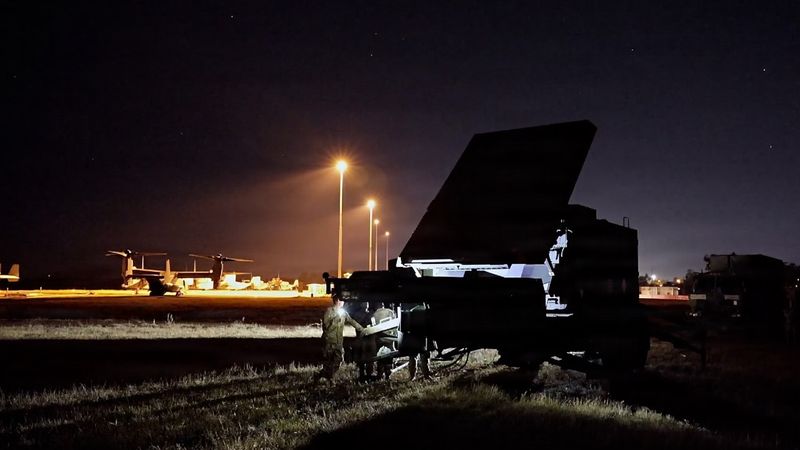
MANAMA, November 13, 2026 — The claim, as Reuters reported it on Friday, was precise in everything except evidence. Iran’s Islamic Revolutionary Guard Corps said its Aerospace Force had targeted a US early-warning radar in Bahrain, the island kingdom that hosts the headquarters of the US Navy’s Fifth Fleet at Naval Support Activity Bahrain in Manama. The Guards said the radar was “targeted and destroyed,” and they framed the strike as retaliation: late on Thursday, they said, an air attack had hit a telecommunications tower in Sirik, in Iran’s Hormozgan province, on the shore of the Strait of Hormuz. The Bahrain strike, the Guards said, was “a serious warning” to Washington. Signal Post News stresses what the sourcing requires: the destruction of the radar is an Iranian claim only. No imagery, wreckage or independent confirmation has been produced for it, and the United States says it did not happen.
Even as a claim, though, the target choice is the story. Tehran did not say it had hit a ship, a runway or a fuel depot. It said it had hit the eyes of the American air-defence network in the Gulf — the sensors on which the Fifth Fleet and the bases around it depend to see incoming drones and missiles in time to shoot them down. And it made the claim at a moment chosen with equal care: the day after President Donald Trump publicly walked away from the negotiating track with Iran, and in the same week that Iran’s military has been announcing, almost daily, that tankers are exploding on mines in the Strait of Hormuz. Separating what happened over Bahrain on Friday from what each side needs the world to believe happened is now the central task — and on the evidence available, the two are very different things.
What CENTCOM says happened: two drones, both downed, no damage
The American account arrived on Friday via US Central Command’s post on X, and it describes a much smaller event. Iran, CENTCOM said, launched two one-way attack drones toward Bahrain. US forces shot down both. There were no injuries and no damage. And the command addressed the Guards’ announcement directly: the claim that Iran had attacked or destroyed a radar system was false. The Associated Press, the Times of Israel and CNN all reported the CENTCOM statement on Friday. Two details of wording matter. CENTCOM said the drones were launched “toward Bahrain” — it did not say they were aimed at a radar, or at any specific installation. And its denial was categorical, not hedged: not “no significant damage,” but no damage at all, and a radar claim it labelled false outright.
Bahrain itself, notably, had said nothing by the time the wire reports moved: the kingdom’s Information Ministry did not immediately comment, according to both AP and Reuters. That silence is itself a data point. Manama is the host caught in the middle of this exchange — the drones, on the American account, were flying at its territory; the base the Guards named sits in its capital — and its government has spent this war trying to hold a line between its American security guarantor and its own population, in the only Gulf state ruled by a Sunni royal family with a Shia majority. A public Bahraini statement confirming either side’s version would commit it; saying nothing keeps both doors open a little longer.
The Hormuz claims: four tankers, two mines, one confirmed fire
The radar claim did not arrive alone. It capped a week in which Iran’s military said four oil tankers had been hit by explosions on Wednesday and Thursday after allegedly using a shipping route Tehran calls unauthorised. Two of the vessels, Iran said, were supertankers that struck naval mines, carrying more than four million barrels of crude between them. Reuters reported the claims with an explicit caveat: it could not independently verify them. No shipping company has confirmed losing a laden supertanker to a mine this week, and no wreck, distress call or casualty report matching the Iranian account has surfaced from the industry that would normally produce all three within hours.
One element of the week’s shipping violence is confirmed, and it is worth separating cleanly from the claims around it. The United Kingdom Maritime Trade Operations centre, UKMTO, reported that a vessel was hit by an unidentified projectile on Wednesday about 14 nautical miles northwest of Ras Al Khaimah in the United Arab Emirates, as it was leaving the strait; the impact started a fire in the engine room and the crew was evacuated. That incident is real, reported through the channel mariners actually use. It also resembles the pattern Signal Post News documented in the IRGC’s earlier claims of tankers and a tugboat set ablaze in the strait: a genuine, limited attack on shipping, wrapped inside a much larger Iranian narrative of mines and sunken tonnage that outside observers cannot confirm. On Friday the claims grew again: the IRGC’s navy said a liquefied-gas tanker had struck a mine in the eastern strait. No ship was named, and UKMTO issued no matching report. Even the cargo is disputed between the wires — Reuters described the vessel as carrying liquefied natural gas, while AP, relaying Iranian state outlets IRNA and Press TV, described liquefied petroleum gas. Signal Post News does not pick between them; the disagreement is a measure of how thin the verified record is.
Washington’s counter-claim: the lanes are clear, and 900 million barrels have moved
Against the mine narrative, the United States has been running a counter-narrative of its own, and it is built on a number. Adm. Brad Cooper, the CENTCOM commander, has said the main Hormuz shipping lanes were cleared of mines weeks ago and remain mine-free, and that Iranian mine reports are false. A CENTCOM spokesman has put traffic through the strait since early May at more than 900 million barrels of crude — a figure designed to say, in one statistic, that the waterway Iran claims to be mining is in fact functioning. Both sides are, in effect, arguing about the same question with opposite answers: is the Strait of Hormuz open, or is it a war zone that only Iran’s permission makes passable? About a fifth of the world’s seaborne oil normally transits the strait, which is why the answer moves prices even when the facts are contested.
The incident data sits awkwardly between the two narratives. Lloyd’s List, the shipping industry’s publication of record, counted 37 vessel attacks in October — the highest monthly total of the conflict — and at least 14 more confirmed attacks so far in November, figures reported by CNN. The Washington Institute’s data, cited by Reuters, recorded at least 10 ships struck in the first 10 days of November alone. Those numbers do not support Tehran’s specific claims of mined supertankers, and none has been produced. But they do establish that the strait is being fought over at a tempo neither capital’s statements fully capture: attacks are real and rising, mines are claimed and denied, and a fifth of the world’s oil is sailing through the argument.
Oil markets are shrugging — for now
The market’s verdict on Friday’s exchange, so far, is a shrug. Brent crude settled at around $96 a barrel on Thursday and edged lower on Friday, even as the radar claim and the drone interceptions moved. The International Energy Agency added to the calming side of the ledger on Friday, saying the oil market is showing tentative signs of rebalancing, with global supply surpassing demand for the first time since the war began, as CNN reported. Traders have learned to discount unverified claims in both directions: a Guards statement is not a lost cargo, and a CENTCOM denial is not an insurance policy. What the market is really pricing is the flow figure — and on the American account, 900 million barrels since May says the flow continues. Readers following the crude price can track it on Signal Post News’ oil price tracker. The shrug has a limit, though, and it is not set by statements. It is set by underwriters: if confirmed attacks keep climbing at October and November’s pace, war-risk premiums for Hormuz transits rise until some owners simply stop sailing, and the strait closes by spreadsheet rather than by mine.
Why this matters
A radar is a message, not just a target
Start with the target, because Tehran chose it to be read. An early-warning radar is the sensor that lets everything else in an air-defence network work: it finds the incoming drone or missile, and cueing from it is what lets interceptors launch in time. Claiming to have destroyed one inside Bahrain — the home of the Fifth Fleet, the command that runs American naval power from the Red Sea to the Arabian Sea — is a way of saying, without attacking a carrier or a barracks full of sailors, we can reach the thing that protects the things you value most. It is deterrence signalling in its purest form: maximum implication, minimum escalation, and — if CENTCOM is right that nothing was hit — zero actual cost imposed on the United States. The claim also flatters a domestic and regional audience: the Guards can present themselves as having answered an alleged Israeli-American strike on Iranian soil at Sirik within a day, proportionally and precisely, whether or not any radar burned.
The timing is the second message
Tehran had not claimed an attack on American assets in a Gulf state since early September — more than two months of relative restraint on that particular rung of the ladder, even as the Hormuz shipping fight intensified. The return to Gulf-state targeting claims came one day after President Trump posted on Truth Social, “We don’t need a deal with Iran. Those days have long since passed!”, and directed Vice President JD Vance to shift his focus away from the Iran negotiations file. Read together, the sequence looks like an answer: if Washington is publicly closing the diplomatic track, Tehran will publicly reopen the military one — at the level of claims and drones first. Iran’s own politics supplied a matching signal days earlier. President Masoud Pezeshkian said on Monday that Supreme Leader Mojtaba Khamenei had instructed the government “to end the state of neither war nor peace” — a phrase that can mean settling the conflict or escalating out of limbo, and which Friday’s claim suggests Tehran is prepared to interpret the second way if the first is refused. Meanwhile, Mossad director Roman Gofman was in Washington on Friday, amid reports, attributed by CNN to Israeli sources, that Prime Minister Benjamin Netanyahu has pushed for a return to open war. Every capital in this story is, this week, telling its own public that the pause is ending.
The claim is the battlefield
The deepest contest on Friday was not over a radar. It was over who gets believed. Iran’s information strategy in this war has become a volume business: claims of mined supertankers, destroyed radars and burning tugboats, issued faster than any navy or newsroom can check them, each one forcing Washington to respond and thereby amplifying the original claim. CENTCOM’s counter-strategy is categorical denial plus traffic statistics — the 900-million-barrel figure is a press release compressed into a number. The weakness of the Iranian approach is credibility decay: claims that never produce wreckage teach audiences to discount the next one, including a future claim that might be true. The weakness of the American approach is the mirror image: a command that says “false” about everything has nowhere to go on the day something is actually hit, and Gulf governments asked to host American forces are left to wonder which version their own security depends on. Bahrain’s silence on Friday is what that uncertainty looks like from inside the host country — the same kingdom whose courts, this month, have been trying dozens of Shia clerics accused of serving Tehran, in a case Signal Post News covered as the Iran war coming home to Bahrain.
Who gains, who pays
Tehran gains if the claim is believed anywhere that matters: among Gulf publics deciding whether American protection is worth its risks, among shipowners deciding whether the strait is worth its premiums, and at home, where the Guards can show reach without losses. CENTCOM gains if the denial holds, because the entire architecture of American deterrence in the Gulf rests on host states believing US defences work — two drones launched, two drones downed, nothing damaged is precisely the story that architecture needs. The clearest losers are the hosts. Bahrain did not choose Friday’s exchange, cannot verify it, and will host the consequences of either version: if Iran can hit Gulf bases, Bahrain is exposed; if Iran only claims to, Bahrain is still the named target in the next statement. Shipowners and insurers pay in the currency they understand: October’s record 37 attacks and November’s continuing toll push premiums up regardless of which capital is lying about mines. And oil consumers, for now, are the surprise non-losers — with Brent near $96 and the IEA seeing supply outrun demand for the first time since the war began, the market is treating Friday as noise. Markets have been wrong about this strait before, and the premium for finding out is paid at the pump.
The warnings around the exchange
Friday’s claim came with an economic threat attached. The Guards warned that companies working with the United States to move oil through the strait face tougher penalties — a message aimed at the shipping firms, charterers and insurers whose decisions actually determine whether Hormuz stays open in practice. A day earlier, Foreign Ministry spokesman Esmaeil Baqaei had widened the circle of responsibility, saying on Thursday that any country helping American forces bears full responsibility for doing so. Together, the two statements draw the map Tehran wants its audience to see: the United States at the centre, and around it a ring of hosts, helpers and commercial partners, all put on notice that association itself is now a stated ground for retaliation. Gulf capitals heard a version of that message in September; they are hearing it again, louder, with a radar in Bahrain named as the proof of concept.
Background: how the war reached this Friday
The wider war began on February 28, 2026, when the United States and Israel struck Iran. Tehran answered by attacking US bases across the Gulf states and moving to restrict shipping through the Strait of Hormuz; Washington imposed a naval blockade on Iranian ports. In the months since, the conflict has settled into its present shape: a shooting war at sea and in the air, a claims war in statements, and a diplomatic track that has repeatedly opened and closed. Bahrain’s place in that architecture predates the war by decades — the Fifth Fleet has been headquartered at Naval Support Activity Bahrain, in the Juffair district of Manama, for a generation, making the small kingdom the fixed address of American naval power in the region and, unavoidably, one of the first addresses on any Iranian target list. Early September was the last time Tehran claimed to have struck American assets in a Gulf country. Friday ended that pause — at minimum as a matter of rhetoric, and, on Tehran’s account, as a matter of fact.
What happens next
Three paths run from Friday, and the next few days will show which one the principals are on. The first is quiet de-escalation: the drones are filed as a one-off answer to Sirik, Bahrain’s silence holds, no second salvo follows, and the claim-versus-denial exchange joins the long list of this war’s unverifiable afternoons. This path requires Tehran to decide that the message has been sent and Washington to decide that two intercepted drones do not require a reply in kind — a combination that has held before, including after September. The second path is the slow spiral, fought through the shipping market: more claimed mines, more confirmed projectiles of the kind UKMTO logged off Ras Al Khaimah, rising war-risk premiums, and eventually owners refusing transits until the strait throttles itself without either navy firing the decisive shot. October’s record attack count says this path is already partly travelled. The third path is the dangerous one: a strike that is verified — wreckage, casualties, imagery no denial can dissolve — on a US installation in a Gulf state. That is the event that converts the claims war back into a shooting war at full scale, forces the American response both capitals have so far choreographed around, and drags the host country from silence into the centre of the conflict. Until then, the signposts are mundane and worth watching: UKMTO incident reports, which separate fact from claim at sea; any Bahraini government statement, which would end Manama’s studied neutrality between the two versions; and the insurance market, which will price Friday’s radar — destroyed or imaginary — into every barrel that sails the strait next week.
Related coverage: Iran’s earlier tanker and tugboat fire claims in the Strait of Hormuz and Bahrain’s mass trial of Shia clerics as the Iran war comes home.
Sources
Reuters, “Iran’s Guards say they targeted US early-warning radar in Bahrain” (Nov. 13, 2026), reuters.com; CNN, “Iran targets US military site in Gulf for first time in two months” (Nov. 13, 2026), cnn.com; Associated Press via Military.com, “US Military Downs 2 Iranian Attack Drones as Iran Claims a Strike on a US Radar in Bahrain,” military.com; Arab News coverage of the IRGC claim and the Hormuz tanker reports (Nov. 13, 2026); US Central Command statement on X (Nov. 13, 2026). Iranian claims are attributed to the IRGC, Tasnim and Iranian state media as reported by Reuters and AP; the radar-destruction claim is unverified and is denied by CENTCOM. Shipping-incident data: UKMTO incident reporting; Lloyd’s List attack counts as reported by CNN; Washington Institute data as cited by Reuters. Photos: U.S. Army and U.S. Navy, public domain, via Wikimedia Commons; both are file photos and do not show Friday’s events.