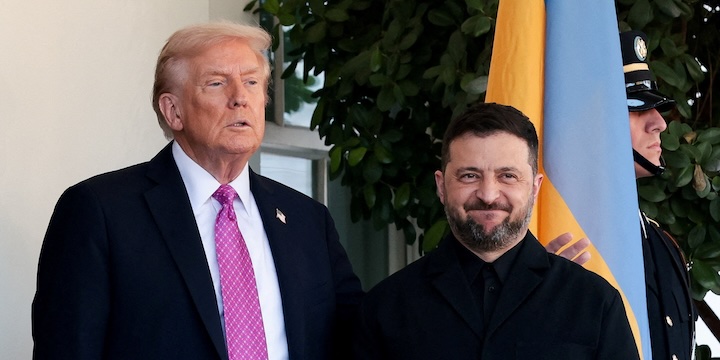
President Donald Trump and Ukrainian President Volodymyr Zelensky used a 40-minute meeting on the sidelines of the United Nations General Assembly in New York to discuss a possible ceasefire covering energy targets, a broader end to Russia’s war in Ukraine and Kyiv’s request for more air defense before winter. The talks ended without an announced agreement.
Afterward, Zelensky told reporters that Ukraine was ready for “any format” of a reciprocal energy ceasefire. He said Trump had not asked Ukraine to halt refinery strikes unilaterally and that Washington would convey the proposal to Russia. Trump, speaking before the meeting, said the two leaders were trying to find a solution and expressed confidence one could be reached. Neither leader published draft terms.
What was agreed—and what was not
The clearest outcome was continued U.S. mediation, not a truce. Zelensky said Kyiv would stop attacks across Russia’s energy sector if Russia stopped attacks on Ukraine’s electricity, heating, water and other energy systems. That formula preserves reciprocity: restraint by one side would depend on restraint by the other.
No public statement established when a pause would begin, which facilities would be protected, whether oil refineries and export terminals would be treated the same as power stations, or who would investigate alleged violations. There was also no public Russian acceptance. Kremlin spokesman Dmitry Peskov had earlier said Moscow favored work toward a comprehensive, durable settlement rather than a temporary ceasefire and argued that Kyiv’s public signals were inconsistent. That is Russia’s stated position; it does not resolve whether Moscow would accept a narrower arrangement presented by Washington.
Zelensky’s flexibility has limits
Zelensky’s phrase “any format” signals procedural flexibility. He also repeated that he was prepared for a trilateral meeting with Russian President Vladimir Putin and Trump. But his substantive condition remains reciprocal protection: Ukraine would not be expected to stop striking Russian fuel infrastructure while Russian forces continued attacks on Ukraine’s grid and heating system.
This distinction matters because a unilateral refinery halt and a mutual energy ceasefire are not equivalent. The first would remove one source of pressure on Russia without guaranteeing relief for Ukrainian civilians. The second could protect civilians and reduce fuel-market volatility, but only if both sides accept common definitions and credible monitoring.
Refinery pressure and fuel-price politics
The meeting took place as Ukraine’s long-range strikes on Russian refineries were affecting a global market already strained by conflict in the Middle East. The Wall Street Journal reported that U.S. diesel averaged $6.53 a gallon on Sept. 22, citing the Oil Price Information Service, and that U.S. commercial diesel inventories had fallen 11% since the start of the Iran war. Trump had publicly linked his concern to refinery damage and high diesel prices, although Zelensky said energy prices were not discussed in the meeting itself.
Zelensky told the Journal that Ukrainian forces had destroyed 45% of Russia’s refining capacity. Signal Post News has not independently established that figure. “Destroyed capacity” can also mean different things: a processing unit out of service for days is not the same as a refinery permanently eliminated, and capacity affected is not necessarily equal to sustained lost output. The claim is presented here only as Zelensky’s assessment.
The politics are immediate. High diesel prices raise transport and consumer costs in the United States before the November midterm elections. For Ukraine, refinery strikes are intended to restrict fuel supply, reduce export revenue and impose costs far from the front. A reciprocal pause could ease market pressure, but it would also remove one of Kyiv’s most visible forms of leverage. Trump’s incentive is rapid de-escalation with an economic dividend; Zelensky’s incentive is to exchange restraint for measurable protection, not simply surrender a pressure tool.
The winter package and Patriot shortage
Zelensky told the Wall Street Journal that he requested a “winter package” including Patriot antimissile systems and other technology. Asked about the response, he said nobody had said no, but he did not announce a commitment. That is a diplomatic opening rather than a weapons pledge.
Patriot interceptors are central because ballistic missiles give defenders little reaction time and because Ukraine says interceptor shortages have reduced its ability to stop them. A winter package would have to address both batteries and the steady supply of missiles. It would also compete with U.S. and allied demand elsewhere. The practical test is not whether the request was heard but whether specific systems, interceptors, delivery dates and financing are agreed.
The linkage between air defense and a ceasefire is important. If a pause lacks verification or collapses quickly, Ukraine would still need to protect power plants, substations, heating networks and cities. Air-defense support is therefore insurance against failed diplomacy, not a substitute for it.
Why verification is the central problem
Energy systems are interconnected and often dual-use. A refinery can supply both civilian vehicles and the military; a power station can serve homes and defense plants; a port can handle food exports, fuel and military cargo. Negotiators would need an agreed protected-target list and a process for handling mixed-use sites.
Attribution is equally difficult. Both countries use drones at long range, while debris from interceptions can cause damage away from the intended target. A workable arrangement would require time-stamped incident reporting, evidence-sharing and a channel for rapid investigation before either side declares the deal broken. Satellite imagery can document fires and outages but may not establish which weapon caused them or whether a military target was located nearby.
A moratorium could also be exploited. Each side may fear that the other would use a pause to repair infrastructure, rebuild inventories or shift air-defense systems. Those concerns do not make a deal impossible, but they explain why reciprocal language alone is insufficient.
Who gains from a narrow ceasefire
Ukrainian civilians would gain if Russian attacks on electricity, heating and water systems actually stopped before winter. Russian consumers and fuel producers would gain if refinery attacks paused. Global fuel buyers could benefit from lower disruption risk. Washington would gain a visible diplomatic result and potentially less pressure on diesel prices.
The costs are also uneven. Ukraine would pause a campaign that has demonstrated reach and imposed economic costs, while Russia would suspend attacks on infrastructure it has repeatedly used to pressure Ukraine. Whether that exchange is balanced depends on the real damage each side can inflict, the scope of protected facilities and what happens after a violation.
Three winter scenarios
A monitored reciprocal pause: Washington secures written commitments, a defined list of energy targets and an incident channel. Attacks fall, repair crews gain time and the parties test whether a limited agreement can support wider talks. This is the most stabilizing path, but no such mechanism was announced after the meeting.
An informal restraint that erodes: Both sides reduce some strikes without publishing terms. One contested incident then prompts reciprocal accusations and a return to attacks. This may still provide a short repair window, but it offers little predictability.
No agreement and heavier winter attacks: Russia intensifies strikes on Ukraine’s grid and industrial base while Ukraine continues hitting refineries, ports and military infrastructure. That path would test Patriot stocks, increase civilian hardship and keep fuel markets exposed to disruption.
What to watch next
The next meaningful signals are concrete: whether the United States transmits written terms to Moscow; whether Peskov or Putin accepts reciprocal limits; whether Kyiv receives a detailed air-defense offer; and whether strike patterns change. Statements of willingness are necessary, but a ceasefire exists only when scope, timing, verification and consequences are agreed.
The New York meeting narrowed one uncertainty—Ukraine says it will consider a reciprocal arrangement in multiple formats. It did not settle the larger question of whether Russia will participate or whether Trump is prepared to pair mediation with sanctions, military support or other pressure. The outcome is therefore a diplomatic opening, not a breakthrough.
Sources and reporting notes
- Reuters, Sept. 22, 2026: Zelensky says the meeting covered peace efforts and an energy ceasefire.
- Reuters, Sept. 22, 2026: pre-meeting report on the proposed energy truce, fuel prices and winter risk.
- The Wall Street Journal, Sept. 22, 2026: Zelensky’s winter-package request, refining-capacity claim and energy-market context.
- EuropeSays report on Zelensky’s post-meeting remarks and Peskov’s previously stated preference for a comprehensive settlement.
Reporting cutoff: September 22, 2026, 11:55 p.m. Pacific time. Zelensky’s description of the meeting and his 45% refining-capacity estimate are attributed to him; neither is treated as independently established beyond what Reuters and The Wall Street Journal reported. Peskov’s position is presented as the Kremlin’s stated view. The analysis of reciprocity, fuel-price incentives, verification, air-defense constraints and winter scenarios is Signal Post News synthesis.