
President Donald Trump is pressing Ukrainian President Volodymyr Zelenskyy to stop attacks on Russian oil refineries as the two leaders prepare to meet in New York later Tuesday, September 22, on the sidelines of the United Nations General Assembly. The meeting had not concluded at the time of publication. The immediate issue is whether Kyiv and Moscow can accept a reciprocal pause covering energy infrastructure while their broader war continues.
The pressure campaign became explicit over the previous nine days. On September 13, during a visit to Ireland, Trump publicly told Zelenskyy to “stop knocking out diesel fuel in Russia,” adding: “There are plenty of other targets. Don’t hit diesel fuel. That’s hurting the world,” according to the New York Post. That is Trump’s stated explanation for his position as U.S. diesel prices have reached record levels; it does not by itself establish that Ukrainian attacks caused those prices.
On Sunday, September 20, Trump telephoned Zelenskyy. The Financial Times, citing a senior Ukrainian official, reported that Trump’s central message was “diesel, diesel … diesel” and that he urged Kyiv to stop targeting Russian refineries, according to The Times. Zelenskyy publicly confirmed what he called “an important conversation,” but his public account did not mention refineries.
Trump then wrote on Truth Social on Monday, September 21, that Russia had “unfortunately lost control of its Diesel Oil industry due to its War with Ukraine,” that many refineries had been blown up and were at least temporarily out of commission, and that the war was “ridiculous and never ending.” He also claimed that 25,000 people, “mostly soldiers,” were being killed each month. That monthly figure is Trump’s claim; it has not been independently verified and should not be treated as an established toll.
Secretary of State Marco Rubio has publicly endorsed the narrower diplomatic idea. Rubio told Fox News that an “energy infrastructure ceasefire” would be “a great idea,” describing an arrangement in which Ukraine’s infrastructure would not be targeted and Russian energy supplies would also be spared. He called that reciprocal outcome “ideal,” according to The Times.
Tuesday’s diplomatic sequence
Trump is scheduled to address the UN General Assembly on Tuesday morning before meeting Zelenskyy later in the day, Reuters reported. Russian Foreign Minister Sergei Lavrov is expected in New York and is due to meet Rubio on Wednesday. That sequence matters because any proposal discussed by Trump and Zelenskyy would still require Moscow’s agreement; the United States and Ukraine cannot create a bilateral ceasefire on Russian targets by themselves.
The relationship surrounding the talks has been volatile. Trump and Zelenskyy argued publicly in the Oval Office in February 2025. At the September 2025 UN General Assembly, Trump said Ukraine could expel Russia from all the territory it occupied. The United States has since ended the large military-aid program maintained by the previous administration, increasing the political cost to Kyiv of openly defying the White House.
The fighting did not pause
Diplomatic discussion has not produced a halt on the ground. Overnight into Tuesday, Russia struck industrial sites in Dnipro, Kryvyi Rih and Pavlohrad. Dnipropetrovsk regional governor Oleksandr Hanzha said three people were killed and six injured in Dnipro. Ukraine’s air force said the barrage included Oniks and ballistic missiles, four cruise missiles and 212 drones, according to a separate Reuters report.
In Chernihiv, regional official Vitalii Diakivnych said an attack on an energy facility cut power to nearly 100,000 consumers. Officials also reported hits on industrial and critical infrastructure in Poltava. Those accounts come from Ukrainian officials; Russia did not immediately provide an independently verifiable target-by-target account in the cited reporting.
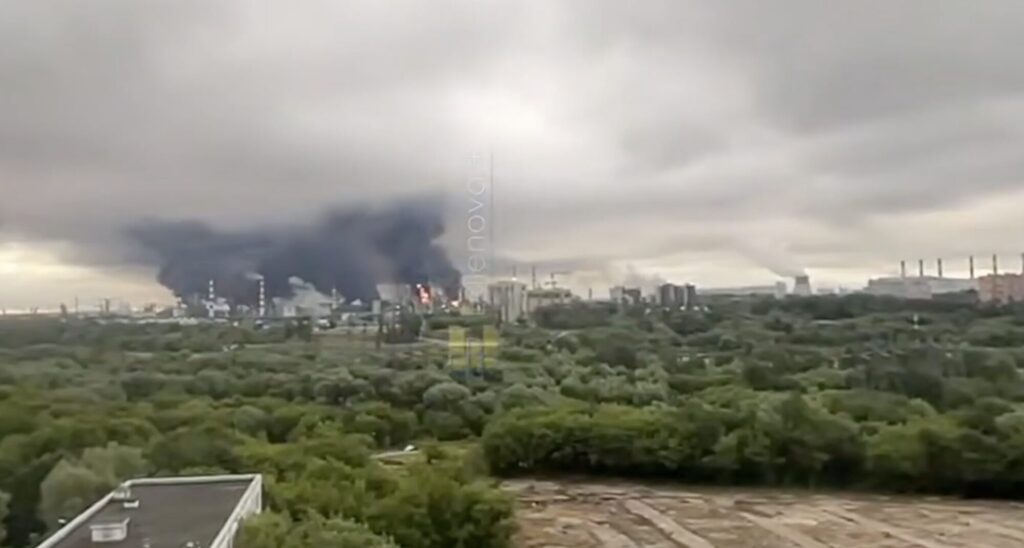
Ukrainian drones also struck Russia’s Samara region. Governor Vyacheslav Fedorishchev said one person was killed and four were wounded, and that civilian targets including houses and cars were hit. On Sunday, a Ukrainian drone attack killed three people and struck a Moscow oil refinery during Russia’s tightly controlled parliamentary election, according to the cited reporting. These reciprocal attacks underline the central obstacle to Trump’s proposal: neither side wants to give up a tool it regards as leverage while the other side remains free to strike.
Why this matters
The energy war now sits at the intersection of battlefield leverage, global fuel markets and UN diplomacy. Ukraine’s refinery campaign is designed to impose costs inside Russia and reduce Moscow’s ability to convert crude oil into fuels. Russia’s attacks on Ukraine’s electricity system and other infrastructure impose a different but related pressure on civilians and industry. A mutually accepted pause would be the first agreed de-escalation in this phase of the war, even if it left the front lines and other military targets outside its scope.
That promise is also fragile. Trump said last week that an energy ceasefire had been agreed, but no agreement had been reached and strikes continued on both sides. The gap between the announcement and events on the ground is a warning against treating political language as an operational deal. A workable arrangement would need defined targets, a start time, evidence rules and a process for alleged violations.
Background: how the refinery campaign changed the equation
The International Energy Agency reported that Ukraine hit a Russian refinery on average once every three days during the first eight months of 2026, according to The Times. The IEA said Russian refining production fell to its lowest level in more than 20 years. That pairing — a sustained strike tempo followed by a multidecade production low — explains why diesel has moved to the center of Trump’s talks with Zelenskyy. It does not, on its own, quantify how much of the output decline came from physical damage rather than maintenance, sanctions, logistics or market decisions.
Russia’s reciprocal campaign has kept Ukraine’s grid and industrial base under pressure. The September 22 attacks in Chernihiv, Poltava and the Dnipro region came immediately before the New York meeting. Kyiv is reluctant to stop unilaterally because it views the refinery campaign as one of its strongest remaining tools for pushing Moscow toward negotiations, Reuters reported. The UN General Assembly gives Washington a stage and rapid access to delegations, but it does not remove that strategic asymmetry.
Who benefits, who loses — and what critics say
Ukraine would preserve U.S. political support if it accepted Trump’s request, and its grid could gain protection if Russia made and observed an equivalent commitment. But Kyiv would also suspend a campaign it believes has created negotiating leverage. Refusing could preserve that pressure while widening disagreement with the White House.
Russia would gain breathing room for a refining sector operating at a reported 20-year output low. In exchange, it would have to spare Ukraine’s electricity system and any other energy targets explicitly covered by a deal. That reciprocity is the proposal’s political foundation and its enforcement challenge.
Global diesel consumers, transport networks and developing economies exposed to imported-fuel costs could benefit if the arrangement reduced supply risk. But lower risk is not the same as a guaranteed price decline: refining capacity, crude flows, inventories, seasonal demand and sanctions also shape diesel markets.
Skepticism in Kyiv centers on whether Moscow would comply. Mykola Sydorenko, a 57-year-old Kyiv businessman, told Reuters: “Will Putin agree to stop attacking residential areas and killing civilians? He won’t. So why are we supposed to agree to anything?” His view is one resident’s assessment, not evidence of Russia’s future conduct, but it captures the trust deficit negotiators must confront.
What the numbers imply
The IEA’s once-every-three-days average works out to roughly ten refinery strikes in a 30-day month, though actual attacks may cluster. The more important before-and-after signal is the change in output: after the campaign accelerated through the first eight months of 2026, Russian refining was reported at its lowest level in more than two decades. The cited data support a strong association, not a precise claim that every unit of lost output was caused by a Ukrainian strike.
The overnight Ukrainian tally of 212 Russian drones shows the scale at which any limited truce would sit. Even if energy sites were removed from target lists, large attacks on military and industrial targets could continue. The number also illustrates the monitoring burden: investigators would need to distinguish a drone’s intended target from where it was intercepted or where debris fell.
Trump’s claimed 25,000 deaths per month is a different kind of number. It is a broad political assertion without independent verification in the cited reports. Independently reported casualty counts are built from narrower time periods, identified incidents and different definitions; they cannot be used to validate Trump’s monthly figure without a common method and scope.
What happens next
Three scenarios are plausible. First, Trump and Zelenskyy could agree on the outline of a limited energy-infrastructure ceasefire, with Wednesday’s Lavrov–Rubio meeting becoming the first test of whether Moscow will match it. Second, mutual strikes could continue if Kyiv refuses to stop without a simultaneous, verifiable Russian commitment. Third, the parties could announce a partial pause whose boundaries remain disputed and whose violations are difficult to attribute.
Verification is the practical question beneath all three scenarios. A credible deal would need an agreed definition of “energy infrastructure,” shared timing, independent evidence and a channel for investigating alleged breaches. Satellite imagery, fire reports, power-outage data and military statements can document effects, but none automatically proves intent. Without a monitoring mechanism accepted by both sides, each strike near a refinery, substation or pipeline could reopen the dispute.
Tuesday’s meeting may show whether Washington and Kyiv can agree on those terms. It cannot by itself deliver a ceasefire, and as of publication it had produced no announced outcome. The next meaningful signal will be whether Zelenskyy describes a reciprocal framework after the bilateral — and whether Lavrov and Rubio discuss the same framework on Wednesday.
Related coverage: Zelenskyy offers a reciprocal halt to energy strikes if Moscow spares Ukraine’s grid and food exports.
Sources and reporting notes
- Reuters, September 22, 2026: Trump–Zelenskyy meeting schedule, Sunday call, energy-truce diplomacy and Kyiv reaction
- The Times: Financial Times account of the Sunday call, Rubio interview, IEA data and reciprocal strikes
- New York Post, September 21, 2026: Trump’s Truth Social statement and September 13 remarks in Ireland
- Reuters, September 22, 2026: strikes on Dnipro, Kryvyi Rih, Pavlohrad, Chernihiv and Poltava
Reporting cutoff: September 22, 2026, before the scheduled Trump–Zelenskyy bilateral concluded. Battlefield accounts and casualty figures are attributed to the officials who supplied them. Trump’s monthly death estimate is his claim and is not presented as an independently verified toll.