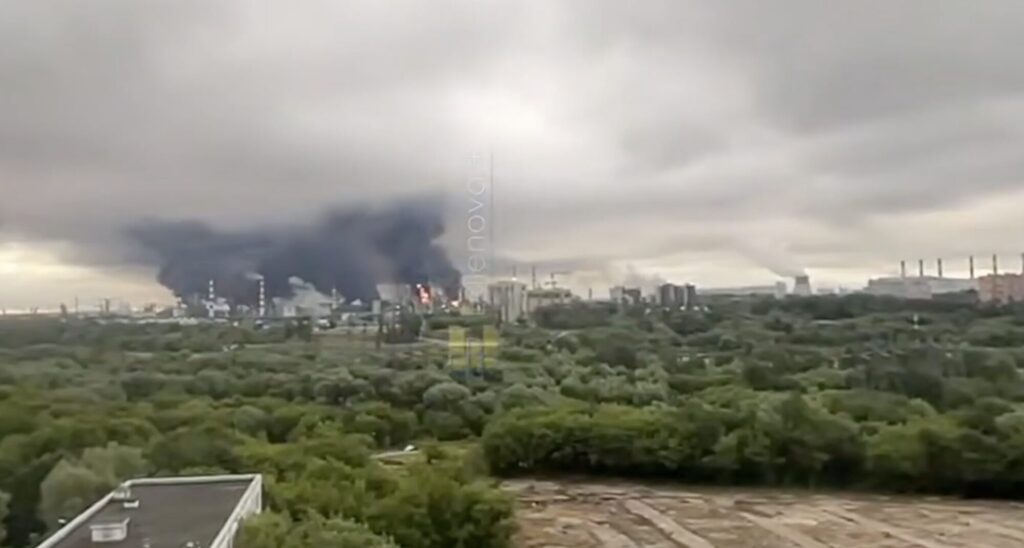
Ukrainian drones struck Russia’s Samara region overnight into Tuesday, September 22, according to the regional governor, extending Kyiv’s campaign against infrastructure deep inside Russia just as U.S. President Donald Trump was pressing Ukrainian President Volodymyr Zelenskyy to reduce attacks on Russian oil refineries.
Samara Governor Vyacheslav Fedorishchev said air defenses had intercepted dozens of drones and that civilian targets, including houses and cars, were damaged. Samara Mayor Ivan Noskov described the assault as a “massive attack” on the city, more than 1,000 kilometres southeast of Moscow. Those are Russian official accounts. Independent access to the affected sites was not available at the reporting cutoff, and neither the total number of drones launched nor the interception figure could be verified independently.
Video circulated by Ukrainian and Russian-language monitoring channels appeared to show a large fire at refinery infrastructure. Gerashchenko, a former Ukrainian government adviser, identified the site as the Rosneft-owned Kuibyshev refinery in Samara. Defense Express, however, attributed widely shared fire imagery from the same night to the Syzran refinery elsewhere in Samara region. Russian authorities had not released a refinery-damage assessment, and Ukraine’s General Staff had not publicly claimed this specific Samara operation by the cutoff. The responsible conclusion is therefore narrow: an overnight drone attack in Samara region is confirmed; the precise refinery target and the provenance of the fire videos remain unsettled.
What is confirmed—and what is not
- Confirmed by Russian regional officials: Samara region came under a large overnight drone attack. Air defenses operated, emergency services responded, and civilian property was damaged.
- Reported but not independently verified: dozens of drones were destroyed. No independently audited launch or interception count was available.
- Visible but not geolocated: footage shared online appeared to show an intense refinery fire. Gerashchenko named Kuibyshev; another same-day report pointed to Syzran.
- No public damage assessment: Russian authorities had not said whether refining units, storage tanks or pipelines were damaged or whether operations stopped.
- No specific Ukrainian claim at cutoff: Ukraine’s General Staff had not publicly taken responsibility for the Samara strike described here.
The distinctions matter because refinery-fire video is easy to miscaption. Reuters documented an earlier case in which months-old footage of a Russian refinery fire was recirculated as a newer attack. Kuibyshev itself suffered documented strikes and fires earlier in 2026, increasing the risk that old images could be reused without context.
The strike unfolded alongside another night of attacks on Ukraine
The Samara operation did not occur in isolation. Russian forces launched strikes across Ukraine during the same overnight period. Local authorities in Dnipro reported at least two people killed. Russia’s Defense Ministry said its forces hit industrial and military facilities, fuel-and-energy infrastructure, ports and maritime targets. Those descriptions are Russian military claims and do not independently establish every target or result.
The reciprocal attacks show why the phrase “energy truce” is politically difficult. Moscow describes strikes on Russian territory as attacks on civilian and industrial infrastructure. Kyiv argues that Russian energy assets help sustain military logistics and state revenue, while pointing to Russia’s repeated attacks on Ukraine’s power system. International humanitarian law does not turn on the label used by either side; it requires distinction, proportionality and precautions, with the status and function of each target assessed on the available evidence.
Why the Kuibyshev refinery matters
The Kuibyshev refinery is part of Rosneft’s Samara refining hub, alongside the Novokuibyshevsk and Syzran plants. Its stated design capacity is about 7 million tonnes of crude a year, or roughly 140,000 barrels a day. Industry data cited by Reuters indicate it processed 4.7 million tonnes in 2024 and produced about 800,000 tonnes of gasoline, 1.4 million tonnes of diesel and 1.3 million tonnes of fuel oil.
On June 10, 2026, a drone attack halted processing at both of Kuibyshev’s primary crude-distillation units, Reuters reported, citing two industry sources. Each unit was rated at about 10,000 tonnes per day. Rosneft did not immediately comment at the time. That previous shutdown is relevant background, not proof that the same units were hit again on September 22.
Refineries are unusually consequential targets because they turn crude oil into usable fuels. Russia can continue producing crude while losing the ability to convert enough of it into diesel, gasoline, aviation fuel and other products. Repairing damaged distillation, cracking or hydrotreating units can take longer than extinguishing a storage-tank fire, and repeated attacks can force operators to run plants below capacity even when no single strike destroys a facility.
What the numbers mean
- Strike tempo
- About one refinery hit every three days, January–August 2026
- Refining output
- Lowest level in more than 20 years
- Diesel production
- Down nearly 30%
- Petrol production
- Down about 20%
Those figures were reported by The Times from International Energy Agency data. They describe a national system under pressure, not the effect of this single Samara attack. A strike every three days can force maintenance crews, spare parts, air-defense units and emergency services to spread across a wide network. The 30% diesel decline is especially important because middle-distillate markets are relatively tight and diesel is central to trucking, agriculture, industry and military logistics.
Lower refinery runs do not automatically mean Russia runs out of fuel. The state can redirect supplies, limit exports, draw stocks, prioritize military and essential users, and increase throughput at undamaged plants. But each adjustment shifts costs elsewhere. Curtailing exports can tighten international diesel markets; moving crude abroad rather than refining it domestically reduces the value captured inside Russia; and concentrating output at fewer plants creates new bottlenecks.
Trump’s diesel warning moves the refinery war into diplomacy
Trump and Zelenskyy spoke on Sunday, September 20. Axios reported, citing a source familiar with the call, that Trump repeatedly raised Ukrainian attacks on Russian refineries because of their effect on global diesel prices. The Financial Times separately reported that a Ukrainian official described the message as “diesel, diesel … diesel.” Both accounts rely on reporting about a private conversation; the White House did not publish a transcript confirming that wording.
Trump then wrote on September 21 that Russia had “lost control of its Diesel Oil Industry” and that many refineries were temporarily out of commission. He again called for the war to end and claimed that 25,000 people, mostly soldiers, were being killed each month. That casualty figure is the president’s assertion and was not independently verified in the public evidence reviewed for this report.
The timing makes the Samara strike politically significant. Trump and Zelenskyy were due to meet on September 22 on the sidelines of the United Nations General Assembly in New York. What might otherwise have been treated as another entry in a long campaign now sits directly inside a negotiation over de-escalation, energy prices and leverage.
Zelenskyy’s reciprocal energy-truce proposal
Zelenskyy has offered a conditional arrangement: Ukraine would halt strikes on Russian energy facilities if Russia stopped attacking Ukraine’s energy sector, critical infrastructure and food exports. The proposal is reciprocal, not a unilateral promise to end the refinery campaign. It also leaves difficult questions about definitions, verification, alleged violations and whether ports, fuel depots or dual-use industrial sites would be covered.
Ukraine’s chief negotiator, Rustem Umerov, said the remaining differences in the broader talks had narrowed from dozens of obstacles to “one or two” key issues. That suggests movement, but it does not identify the unresolved points or prove an agreement is imminent. French President Emmanuel Macron warned against strikes on energy infrastructure, adding European pressure for restraint while Ukraine argues that reciprocity is essential.
Why it matters
The refinery campaign links three systems that are usually discussed separately: the battlefield, Russia’s domestic economy and the global fuel market. Kyiv can impose costs far beyond the front without relying on the largest Western-supplied missiles. Moscow must decide how much air defense to hold around distant energy assets rather than military targets. Washington, meanwhile, faces a tension between supporting Ukraine’s ability to raise the cost of Russia’s war and containing fuel-price pressure at home and abroad.
Samara is also a test of evidence discipline. The attack itself is not in serious doubt because Russian officials acknowledged it. The identity and condition of a refinery cannot be established from a viral fireball alone. Treating every clip as verified would overstate Ukraine’s operational success and could distort estimates of Russian supply losses before market data or satellite imagery show whether a plant actually stopped processing.
Winners, losers and critics
Ukraine gains leverage if repeated strikes force Russia to spend more on defense, repairs and fuel management. Kyiv can point to the refinery campaign as evidence that the costs of continuing the war are not confined to Ukrainian territory. That leverage weakens if unverified strike claims are exaggerated or if allies judge the market impact unacceptable.
Russia and Rosneft bear the direct risk. Even short outages reduce flexibility across the Samara hub. Residents near industrial sites also face danger from falling debris, fires and air-defense activity; Russian officials’ reports of damaged homes and cars require investigation independent of the military value of any intended target.
Diesel consumers lose when supply tightens. European industry, shipping, trucking and agriculture are exposed to refining margins even when crude prices are stable. Traders benefit from volatility, but economies that import middle distillates absorb higher costs.
Critics of the refinery campaign argue that attacks risk civilian harm, environmental damage and global price spikes while complicating negotiations. Supporters answer that refineries generate tax revenue and military fuel and that a reciprocal halt must include Russian attacks on Ukraine’s grid. Both arguments depend on target-specific facts and on whether any truce can be monitored rather than assumed.
Three scenarios from here
- A verified reciprocal pause. Washington brokers a written or publicly acknowledged arrangement covering defined energy targets. Russia and Ukraine exchange lists, a monitoring mechanism records alleged breaches, and refinery attacks decline. This would reduce one source of diesel-market risk without ending the wider war.
- A narrow or ambiguous understanding. The parties avoid a formal deal but quietly reduce some attacks. Disputes over what counts as energy infrastructure continue, and each side preserves the option to strike fuel logistics described as military. Markets get partial relief, but a single major outage could collapse the restraint.
- The campaign intensifies. Talks fail or a claimed violation ends them. Ukraine continues long-range refinery strikes; Russia expands attacks on Ukraine’s power and industrial systems; air defenses disperse further; and diesel supply remains under pressure. In that case, verified throughput data—not viral footage—will be the clearest measure of strategic effect.
What to watch next
The most important evidence will be operational: a Russian or Rosneft statement naming the affected site; commercial tracking or industry-source confirmation that throughput changed; satellite imagery showing damage; a Ukrainian General Staff claim with target details; and any public language after the Trump–Zelenskyy meeting defining reciprocal restraint. Until then, the fire footage should remain labeled as reported imagery rather than proof of damage at Kuibyshev.
Sources
- The Times: Samara attack, Dnipro deaths, Trump–Zelenskyy call and IEA refinery figures, September 22, 2026
- Newsline24 live report: Russian official statements, Trump remarks, Zelenskyy proposal and Macron warning, September 22, 2026
- InvestingLive summary of Axios reporting: diesel pressure, Umerov statement and Tuesday meeting
- Anton Gerashchenko on X: four refinery-fire clips and Kuibyshev attribution, September 22, 2026
- Defense Express: same-morning attribution of fire footage to the Syzran refinery
- Reuters: June 10 Kuibyshev shutdown, unit capacities and 2024 product output
- Reuters Fact Check: earlier Russian refinery footage recirculated with a false new caption
Sourcing note: Russian regional officials confirm the attack and civilian-property damage; Russian and Ukrainian military descriptions remain attributed claims. Gerashchenko’s four videos are source-published footage, not independently authenticated evidence of the September 22 Kuibyshev incident. No official refinery-damage assessment or independently verified Ukrainian claim for this specific strike was available by the cutoff. The image above is contextual and is not presented as a scene from Samara.