War · Iran · United Kingdom
Iran threatens U.S. bombers stationed in Britain with a missile strike that Tehran says is now within its reach — if, and only if, those aircraft are used against Iran. On Sunday, Iranian state broadcasters warned that a modified Khorramshahr ballistic missile could reach the American aircraft at RAF Fairford in England. The warning is conditional, the weapon claim is unconfirmed, and the arithmetic behind it does not add up on any figure Iran has ever published: the missile’s declared range is roughly 2,000 kilometres, and Fairford sits roughly 4,500 kilometres away.
Track it live: Iran war tracker · Live war trackers
FAIRFORD, England, November 16, 2026 — Iran threatens U.S. bombers on British soil in the most specific terms Tehran has yet used in this war. Iranian state broadcasters said on Sunday that a modified Khorramshahr ballistic missile could reach U.S. aircraft stationed at RAF Fairford, the Gloucestershire air base that hosts America’s rotating bomber deployments in Europe, and added a sentence designed to be quoted: “the range of Iran’s missiles is not limited to what they have seen.” The New York Post, reporting the broadcast on November 15 and citing the Wall Street Journal, attached the caution that this article keeps attached to every version of the claim: it remains unclear whether Iran’s ballistic missile is actually capable of reaching the UK air base. Nothing in Sunday’s warning announced an attack, a launch or a decision. It announced a condition — and understanding that condition, and the distance problem buried inside the claim, is the whole story.
The timing is not incidental. The broadcast landed the same weekend the Wall Street Journal reported that the U.S. intelligence community assesses Iran still holds between 1,500 and 2,500 ballistic missiles — a low-confidence assessment, attributed in full below — meaning Tehran has rebuilt roughly half the arsenal it held before the war. A threat is only as loud as the stockpile behind it, and Tehran chose to name a British runway in the same news cycle in which Washington’s own analysts were reported to be counting Iranian missiles in the thousands again. This article sets out what was actually said, what the named missile can actually do on the public record, what U.S. intelligence is reported to believe about the arsenal behind the warning, and why Fairford — a base the United States emptied of its B-1 bombers only last month, after an alleged plot that Iran denies and that remains an allegation — keeps returning to the centre of this war’s map.
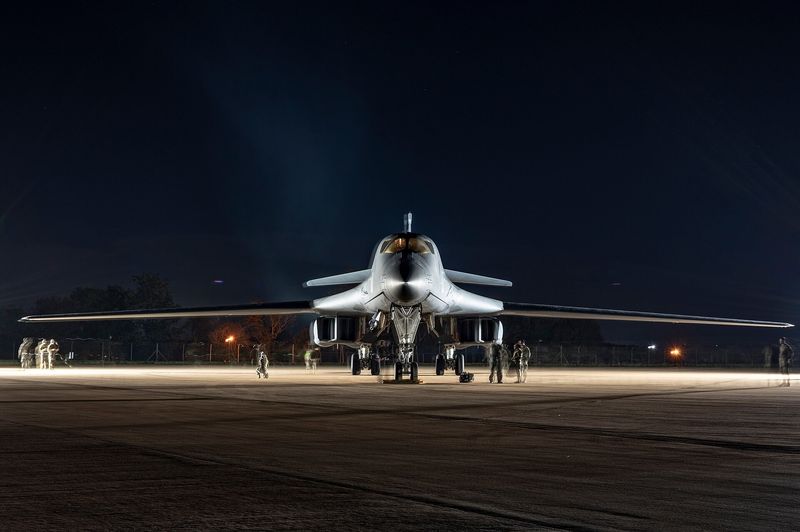
A conditional threat, stated in full
The first precision lock on this story is grammatical, and it matters more than any other: Tehran’s warning is conditional. Iran has threatened to strike the bases from which American aircraft operate against it — if those aircraft are used to bomb Iran. It has not announced that it will strike Fairford, has not set a date, and has not claimed that a strike is imminent. The clearest statement of the condition came four days before the broadcast, on Wednesday, November 11, when Iran’s security chief Mohsen Rezaei — secretary of the Supreme National Security Council and an Islamic Revolutionary Guard Corps general — said that if American aircraft take off from a base in a European country to bomb Iran, Iran will strike those bases too, including islands Washington believes sit beyond the range of Iranian missiles. AFP carried the remarks via Al Mayadeen, in a translation by MEMRI. Rezaei paired the warning with a refusal that defines Tehran’s negotiating floor: Iran will not remove “a single grain” of its enriched uranium.
Sunday’s broadcast then did something Rezaei had not: it named a base and a weapon. RAF Fairford. A modified Khorramshahr. That specificity is what makes this a new development rather than another turn of a familiar screw, and it is why this newsroom is publishing it as a standalone story rather than folding it into earlier coverage. The doctrinal scaffolding beneath the warning has been assembled in public over the past month. On October 31, Supreme Leader Mojtaba Khamenei issued a directive for unrestricted retaliation regardless of geography. The IRGC has announced the removal of its self-imposed 2,000-kilometre missile-range cap, through its spokesman, Brigadier General Hossein Mohebbi — a step this newsroom covered when Iran lifted its missile range limit and said it would prove the new reach in practice. Sunday’s broadcast is best read as the third panel of that triptych: the doctrine announced, the cap removed, and then a named target on another continent offered as the proof of concept. A doctrine, however, is not a capability — and it is on capability that the warning runs into its problem.
The arithmetic problem: 2,000 kilometres against 4,500
Here is the gap, stated as plainly as the numbers allow. The Khorramshahr-4, the missile Tehran named, has a declared range of roughly 2,000 kilometres, carrying a warhead of about 1,500 kilograms. RAF Fairford is roughly 4,500 kilometres — about 2,800 miles — from Iran. The distance Tehran claims its modified missile can now cover is therefore more than double the range Iran itself declares for the weapon, a gap of some 2,500 kilometres that no test, no parade and no independent assessment has closed. There is no independent confirmation that a modified Khorramshahr variant can reach the United Kingdom. None. The claim rests, today, entirely on an Iranian state broadcast and on the assertion that the range of Iran’s missiles “is not limited to what they have seen” — a sentence that asks the listener to treat the absence of evidence as the evidence.
The closest thing to a bridge across that gap in the open literature still falls well short of Gloucestershire. Modelling published in 2019 by the United Kingdom, France and Germany assessed that a Khorramshahr variant fitted with a lighter warhead might reach roughly 3,000 kilometres — a serious extension, and still some 1,500 kilometres short of Fairford. Range in missile design is bought with weight: a lighter warhead flies farther and delivers less. A variant stretched toward 4,500 kilometres would be a substantially different weapon from the one Iran declares, and weapons of that class are not usually kept invisible; they are tested, and tests are seen. Until a modified Khorramshahr is demonstrated at anything like the claimed distance, the honest status of Sunday’s central technical claim is the one the New York Post attached to its own report: unclear — Tehran’s assertion, not an established capability. Readers should hold the threat and the capability as two separate facts. The threat is real, on the record and attributable. The capability is claimed, unverified and, on the declared numbers, arithmetically short.
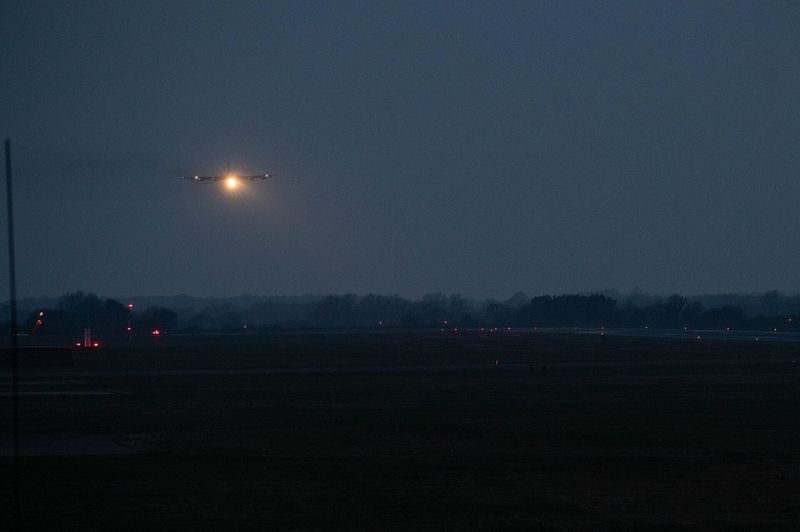
The arsenal behind the warning: 1,500 to 2,500 missiles, at low confidence
If the range claim is the weak leg of Tehran’s warning, the stockpile reporting is the strong one — and it must be quoted with its attribution and its confidence level intact, because both are part of the fact. The Wall Street Journal reported on November 15 that the U.S. intelligence community assesses Iran has between 1,500 and 2,500 missiles in its arsenal. The Journal is explicit, and this article repeats it without dilution: that is a low-confidence assessment. Israeli officials similarly assess that Iran holds more than 1,500 missiles. Simone Ledeen, a former deputy assistant secretary of defense, drew the conclusion the range implies: even at the bottom of it, 1,500 missiles would mean Tehran has replenished more than half of its estimated pre-war stockpile — the arsenal the United States and Israel spent the war’s opening phase trying to destroy.
What that number does and does not establish deserves the same care as the range gap. A stockpile of 1,500 to 2,500 ballistic missiles, if the low-confidence assessment is right, is a statement about volume, not about reach: the overwhelming majority of Iran’s missiles are short- and medium-range weapons built for targets in the Gulf and the Levant, and volume alone does not put a British runway inside the envelope. What volume does buy is endurance and options — the ability to sustain salvos, to absorb attrition, and to keep a threat credible across a long war rather than a single exchange. It also buys negotiating weight, which is the currency Tehran has been spending all month: Rezaei’s refusal to surrender “a single grain” of enriched uranium was not the language of a leadership that believes its deterrent is spent. The broadcast naming Fairford and the Journal’s stockpile assessment arrived together, and each amplified the other. Neither should be read as more than it is: a conditional threat, an unconfirmed range claim, and a low-confidence count of an arsenal that has plainly, on Washington’s own reported assessment, been substantially rebuilt.
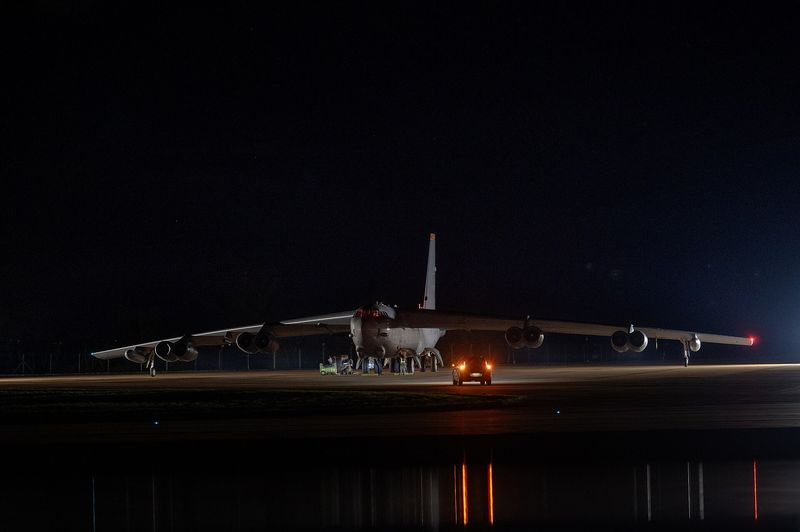
Why Fairford: the base, the withdrawal and the alleged plot
RAF Fairford is not a random pin on a map. The Gloucestershire base is the U.S. Air Force’s forward operating location for bombers in Europe — the runway from which B-52s, B-1s and B-2s rotate through Bomber Task Force deployments, close enough to matter in a European or Middle Eastern contingency and public enough, through airshows and spotters’ fences, to be the most visible symbol of American air power on British soil. It is also, as of last month, a base with a wound. In October, the United States withdrew its B-1 bombers from Fairford after a suspected Iran-linked plot against the base was disrupted — the episode this newsroom covered when the U.S. pulled its B-1 bombers from RAF Fairford after the Iran plot. Prime Minister Andy Burnham said the IRGC was “almost certainly” behind the suspected plot — his words, attributed here as they were in this newsroom’s coverage of his statement and the sanctions debate that followed.
The criminal case that grew out of that autumn is now the legal spine of the Fairford story, and its status must be stated exactly. On November 10, the U.S. Department of Justice unsealed charges against three men — Mohammad Baqer Saad Dawood al-Saadi, who is in U.S. custody, Mohsen Mohajeri and Mohammad Ali al-Hassani — in an eight-count superseding indictment covering some 18 to 20 attacks and attempted attacks, including an alleged plot at RAF Fairford on September 27, 2026, involving suspicious vans, a declared major incident and seven arrests in the United Kingdom. Prosecutors tie the defendants to the IRGC, to Kata’ib Hizballah and to HAYI. Iran denies involvement. An indictment is an allegation, not a finding: the defendants are presumed innocent, nothing in the charges has been proven in court, and this article reports the plot throughout as alleged — the same standard applied in the charges brought under the National Security Act in the British proceedings. What can be said without qualification is narrower and still remarkable: within seven weeks, Fairford has been the subject of an alleged sabotage plot, a superpower’s bomber withdrawal, a prime ministerial accusation — and now a named missile threat from Tehran itself.
One further movement belongs in the record, stated with the restraint its sourcing requires. The Wall Street Journal has also reported, in coverage carried by the Associated Press on November 10, that the U.S. military evacuated aircraft from RAF Mildenhall, the Suffolk tanker base, “in the wake of a threat from Iran.” More specific versions of that story circulating elsewhere — particular aircraft types and counts — have not been verified against a solid source, and this newsroom does not publish them. The verified residue is enough on its own: in the same fortnight, aircraft were reported moved at a second British base because of an Iranian threat, which is the practical context in which Sunday’s broadcast will be read in London and Washington — not as rhetoric in a vacuum, but as the latest line in a sequence that has already moved real aeroplanes.
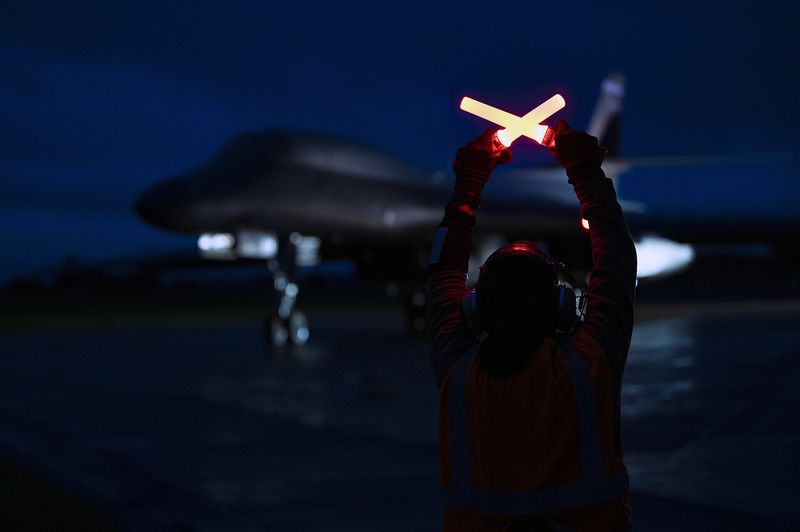
Why this matters
A threat that redraws the map, whether or not the missile can fly it
Deterrence runs on declared intentions as much as on demonstrated hardware, and Sunday’s broadcast was a declaration of intention with a map attached. Until this weekend, Tehran’s retaliation doctrine — Khamenei’s October 31 directive, the IRGC’s removal of the range cap, Rezaei’s warning about European bases and out-of-range islands — had been stated in the abstract. Naming Fairford converts the abstraction into a planning problem for named people: the British government, which hosts the bombers; the U.S. Air Force, which flies them; and the alliance lawyers and targeteers who must now price a scenario in which a European host base is struck in retaliation for an American operation. Even an incapable missile changes that calculus at the margins, because no planner can bank a defence on an adversary’s declared range being honest — which is, of course, precisely the effect the sentence about ranges “not limited to what they have seen” was written to produce. The claim’s unverifiability is not a flaw in the threat. From Tehran’s side of the table, it is the threat.
Britain’s exposure is now explicit, and it cuts both ways
For London, the broadcast formalises a vulnerability that the autumn had already exposed in miniature. The alleged September plot was a ground-level threat — vans, arrests, a major incident — of the kind British security services are organised to hunt. A ballistic-missile threat, even a conditional and technically doubtful one, sits in a different ministry, a different budget line and a different public conversation: missile defence, dispersal, and the terms on which American bombers use British runways at all. Burnham’s “almost certainly” attribution over the alleged plot showed a government willing to name Tehran in public; Sunday’s warning tests whether that willingness extends to hosting, visibly and indefinitely, the aircraft Tehran has now named as targets. The pressure runs in both directions — Washington will read any thinning of the Fairford presence as the threat working, and this newsroom’s wider Iran war coverage shows a pattern in which each side’s signalling is calibrated to the other’s domestic audience as much as to its generals.
The numbers that are solid, and the ones that are not
Strip this story to its load-bearing facts and three things stand. First, the condition: Iran has said, at security-chief level and on state broadcasts, that bases used to attack it — including in Europe — become targets in its retaliation doctrine. Second, the distance: Fairford is roughly 4,500 kilometres from Iran, and no Iranian missile has a confirmed range anywhere near it; the declared figure for the named weapon is roughly 2,000 kilometres, and the most generous allied modelling reaches roughly 3,000. Third, the volume: the U.S. intelligence community, per the Wall Street Journal and at low confidence, counts 1,500 to 2,500 Iranian ballistic missiles — a rebuilt arsenal, whatever its reach. Everything else in the weekend’s noise — the modified missile, the unseen range, the implied imminence — is claim layered on those three facts. Readers who keep the three separate will read the next Iranian broadcast, and the next stockpile leak, more clearly than the broadcasts intend.
What happens next
The near-term test of Tehran’s claim is empirical and, conveniently, observable: a missile that can fly 4,500 kilometres must eventually be flown, and long-range tests are visible to every satellite and radar in the region. Watch, first, for any Iranian test launch on an extended trajectory — the single event that would convert Sunday’s assertion into a demonstrated capability — and, second, for its continued absence, which month by month reprices the broadcast as signalling rather than disclosure. Watch, too, the two legal and military clocks already running: the American prosecution of al-Saadi, Mohajeri and al-Hassani, in which the alleged Fairford plot will be tested as evidence rather than asserted as intelligence, with the defendants presumed innocent until a court says otherwise; and the posture of the bases themselves — whether bomber rotations return to Fairford at their previous visibility, whether the reported Mildenhall precautions harden into permanent dispersal, and whether London says anything in public about defending the runways it lends.
And watch the diplomacy that the threat was built to bend. Rezaei welded the missile warning to the uranium refusal in a single appearance, and Khamenei’s retaliation directive removed geography as a limit on Iran’s answer to any future strike. That is the architecture of a negotiating position as much as of a targeting plan: Tehran is telling Washington and its European hosts that the price of the next attack on Iran now includes, at least in declared doctrine, the bases the attack would fly from — and telling its own audience that the arsenal the war was meant to destroy has been rebuilt to between 1,500 and 2,500 missiles on the assessment of the adversary’s own intelligence community, low confidence and all. Whether the Khorramshahr can reach Gloucestershire is a question for engineers and, one day, perhaps for a test range. Whether the threat of it changes what flies from Fairford is a question being answered now, in deployment orders and court filings, long before any missile could.
Sources
- Wall Street Journal, November 15, 2026: the U.S. intelligence community’s assessment that Iran has between 1,500 and 2,500 missiles in its arsenal — a low-confidence assessment, attributed that way throughout this article; Israeli officials’ similar assessment of more than 1,500 missiles; and Simone Ledeen, former deputy assistant secretary of defense, on Tehran having replenished more than half its estimated pre-war stockpile even at the 1,500 figure. The Journal also reported, in coverage carried by the Associated Press on November 10, that the U.S. military evacuated aircraft from RAF Mildenhall “in the wake of a threat from Iran”; more specific aircraft numbers circulating in weaker sourcing were not verified and are not published here.
- New York Post, November 15, 2026, citing the Wall Street Journal: Iranian state broadcasters’ warning on Sunday, November 15, that a modified Khorramshahr ballistic missile could reach U.S. aircraft at RAF Fairford in England, about 2,800 miles from Iran, including the statement that “the range of Iran’s missiles is not limited to what they have seen”; the Post’s own caution that it remains unclear whether Iran’s ballistic missile is actually capable of reaching the UK air base is carried in this article’s text. The Khorramshahr-4’s declared range of roughly 2,000 km with a 1,500 kg warhead, Fairford’s distance of roughly 4,500 km, and 2019 UK–France–Germany modelling of a lighter-warhead variant at roughly 3,000 km are stated as the public record against which Tehran’s unconfirmed claim is measured.
- AFP via Al Mayadeen, November 11, 2026, with MEMRI translation: Iran’s security chief Mohsen Rezaei (Supreme National Security Council secretary and IRGC general) stating that if American aircraft take off from a base in a European country to bomb Iran, Iran will strike those bases too, including islands Washington believes are out of missile range; and his rejection of removing “a single grain” of enriched uranium. Context chain as reported: Supreme Leader Mojtaba Khamenei’s October 31 directive for unrestricted retaliation regardless of geography, and the IRGC’s announced removal of its self-imposed 2,000 km missile-range cap, per IRGC spokesman Brig. Gen. Hossein Mohebbi. The threat is reported throughout as conditional on U.S. aircraft being used against Iran.
- U.S. Department of Justice (charges unsealed November 10, 2026), with BBC reporting, November 11, 2026: the eight-count superseding indictment of Mohammad Baqer Saad Dawood al-Saadi (in U.S. custody), Mohsen Mohajeri and Mohammad Ali al-Hassani, covering some 18–20 attacks and attempted attacks including the alleged September 27, 2026 plot at RAF Fairford (suspicious vans; major incident declared; seven men arrested in the UK), with prosecutors tying the defendants to the IRGC, Kata’ib Hizballah and HAYI. Iran denies involvement. The indictment is an allegation; the defendants are presumed innocent, and the plot is described as alleged throughout this article. UK Prime Minister Andy Burnham’s statement that the IRGC was “almost certainly” behind the suspected Fairford plot is attributed to him.
- Signal Post News, related coverage: US Pulls B-1 Bombers From RAF Fairford After Iran Plot; Iran Lifts Its Missile Range Limit; UK PM Burnham on the IRGC and the Fairford Plot; Two Men Charged Over RAF Fairford Incident. Follow the war on the Iran war tracker.
- Photos: U.S. Air Force file photos, public domain, via Wikimedia Commons — a B-1B Lancer on the Fairford flightline at night, October 26, 2023, by Senior Airman Ryan Hayman; a B-52H Stratofortress arriving at Fairford for Bomber Task Force 25-2, February 11, 2025, and airmen preparing a B-52H at Fairford, February 27, 2025, both by Senior Airman Brooklyn Golightly; a crew chief preparing to marshal a B-1B Lancer at Fairford, October 19, 2021, by Senior Airman Colin Hollowell. All are file photos from earlier deployments; none depicts November 2026 events, and no Iranian state or IRGC imagery is used in this article.