US withdraws B-1 bombers Fairford
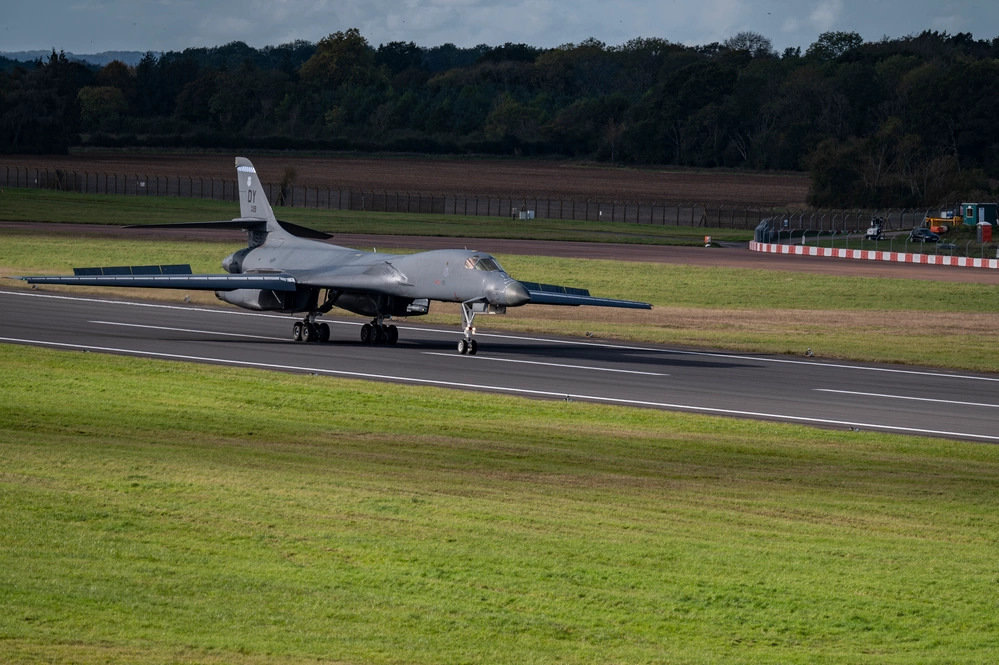
A Pentagon official put the decision on the record after the aircraft were already moving. “While operational security precluded us from confirming the movement of our assets and forces in real-time, we can acknowledge now that all U.S. bombers that were deployed to RAF Fairford have re-deployed to their home stations in the United States,” the official said, according to Reuters. Aviation watchers saw B-1s leaving on Sunday, the Associated Press reported; Britain’s Ministry of Defence declined to comment.
Why this matters
The plot did not detonate a viable explosive. It did not destroy an aircraft, penetrate the base or kill an airman. Yet a week later, America’s entire deployed B-1 force at Fairford was thousands of miles farther from its targets. That is the strategic paradox at the heart of this episode: a failed operation can still succeed in changing an adversary’s behavior.
The real payload of the Fairford plot was therefore not the material police found in three vans. It was uncertainty. Once commanders could no longer treat the perimeter, nearby roads and local support network as routine security questions, the base itself became part of the risk calculation. A forward bomber hub is valuable because it shortens missions, simplifies maintenance cycles and reduces dependence on aerial refueling. If defending that hub begins to consume the freedom of action it was meant to provide, planners have to choose between accepting the vulnerability and surrendering some of the operational advantage.
The United States chose distance. That does not mean the B-1B has ceased to be usable against Iran; long-range aviation is designed precisely to operate from far away. It does mean base security has now helped dictate strike posture. The movement turns a local British counterterrorism case into a concrete change in the geography of American power. For Tehran, London and Washington, that is a larger consequence than the initial police drama suggested.
How we got here
Fairford had become the forward center of the U.S. bomber campaign against Iranian missile sites that were menacing commercial and military shipping through the Strait of Hormuz. Twelve B-1s at the Gloucestershire base gave commanders a powerful conventional strike package within roughly 3,400 miles of Iran, according to the deployment details reported by Reuters. The aircraft’s presence also made a British installation a highly visible part of the Iran war.
On Sunday, September 27, British police arrested five men in their 20s near three vans on suspicion of terrorism and explosives offenses. The items initially described as explosives were later found not to be viable, but authorities evacuated 85 households in Whelford while the investigation unfolded. All five men were released on police bail under stringent conditions. Concrete blocks appeared at the base’s main gate on Thursday, October 1. The sequence — and the distinction between an alarming plan and non-viable material — is detailed in The Times and in Signal Post News’ earlier report on the Fairford arrests and explosives inquiry.
A sixth suspect, a 25-year-old dual British-Iranian national, was arrested in central London on Thursday and released on bail Saturday, the Associated Press reported. That development is covered separately in Signal Post News’ report on the Westminster arrest and Fairford investigation.
Prime Minister Andy Burnham said Wednesday there were “strong indications” of Iranian involvement. Iran rejected the accusation as baseless, summoned the British ambassador and escalated the public dispute: Foreign Minister Abbas Araghchi wrote on X that Burnham was “barking up the wrong tree.” Secretary of State Marco Rubio said Tuesday that the plot “clearly involves the hand of a foreign actor.” Prime Minister Benjamin Netanyahu told Fox News on Thursday that Israel had supplied Britain intelligence about an “Iranian-sponsored attack” before the incident.

The most detailed accusation came from a senior U.S. official cited by The Wall Street Journal, which first reported that all of the bombers were returning. The official said the United States was aware of an Iran-linked plan to attack bomber aircraft and kill base personnel, and alleged that a branch of the Islamic Revolutionary Guard Corps recruited British nationals for a multi-step operation that included a neighborhood diversion. Some British officials, however, have questioned how sophisticated the plot really was. Those accounts are not mutually exclusive: a plot can have foreign direction and still be ineptly executed. But neither claim should be presented as a concluded judicial fact while the suspects remain uncharged and on bail.
What each side says
The Pentagon’s message is that the relocation does not diminish American reach. “The Airmen that operate America’s bomber force, including B-1s, B-2s, and B-52s, remain ready to deliver precision global strike capabilities — including through operations that launch and recover from the continental United States — anywhere, anytime,” the department said in a statement quoted by The Times.
That assurance is operationally credible, but physics still charges a price. A bomber leaving South Dakota can reach the same target as one leaving Britain; it simply spends longer in transit, burns more fuel, needs more tanker support and places additional demands on crews and maintenance. “Anywhere, anytime” describes capability, not equal cost or equal tempo from every starting point.
President Trump focused on the British decision to release the suspects. He said the plotters planned “big damage,” described himself as “disappointed” by the bail decisions and added, “I would not have released them.” He also said, “We were involved in” the investigation, remarks reported by The Wall Street Journal and corroborated by the New York Post. Bail is not an acquittal; under British procedure it can permit investigators to continue work while imposing conditions. Yet the optics are difficult for an administration that has just removed a strategic force from the threatened base.
Britain’s public position is more cautious. Burnham and Rubio have spoken of foreign involvement, and Netanyahu has described intelligence shared with London. At the same time, British officials quoted in reporting have questioned the operation’s sophistication, and prosecutors have not announced charges. Iran, for its part, denies responsibility and says the allegations are unfounded. Tehran has also said that bases used to attack Iran are legitimate targets, according to the Associated Press. The verified facts are the arrests, releases, security response and bomber departure. Attribution remains a claim under investigation.
Who benefits, who loses
If an Iranian proxy network directed the plot, Tehran gains the kind of asymmetric return such networks are built to seek: maximum strategic effect for minimum material cost. Twelve bombers moved without a successful blast. U.S. planners absorbed longer routes and more complicated support demands. Britain had to harden a base, evacuate nearby residents and defend the integrity of its own counterterrorism system. Even if the plot was crude, the response teaches hostile planners that threatening the logistics around a forward base can matter almost as much as penetrating the flight line.
The United States loses convenience, sortie efficiency and some political control of the story. Pulling the bombers can be described as prudent force protection, but it is also an admission that the deployment’s risk profile changed. That is embarrassing at a moment when Washington wants to project pressure on Iran. The shift follows Trump’s statement on Saturday that the next move on Iran would come “the easy way, or the hard way”; Signal Post News has a separate analysis of what that Iran decision could mean.
Britain faces a different loss: the sovereignty question. RAF Fairford is a British base hosting American combat power, but the perceived threat arose from a war in which that base enabled U.S. strikes. London must now explain whether its citizens were exposed to retaliation through decisions made jointly, chiefly in Washington or somewhere in between. At the same time, Britain cannot simply disown the alliance benefit. Hosting U.S. bombers strengthens NATO’s reach and Britain’s strategic relevance. The policy argument is not whether Fairford should matter; it is whether the security and democratic accountability around that role kept pace with how much it mattered.
What the numbers mean
Twelve aircraft is not a symbolic detachment. It is a substantial portion of the deployable B-1B fleet gathered at one forward hub. The bomber can reach about Mach 1.25 and carry roughly 75,000 pounds of conventional weapons, the largest conventional payload in the U.S. Air Force inventory. In practical terms, a dozen aircraft offer commanders both mass and flexibility: several can fly while others refuel, undergo maintenance or stand alert.
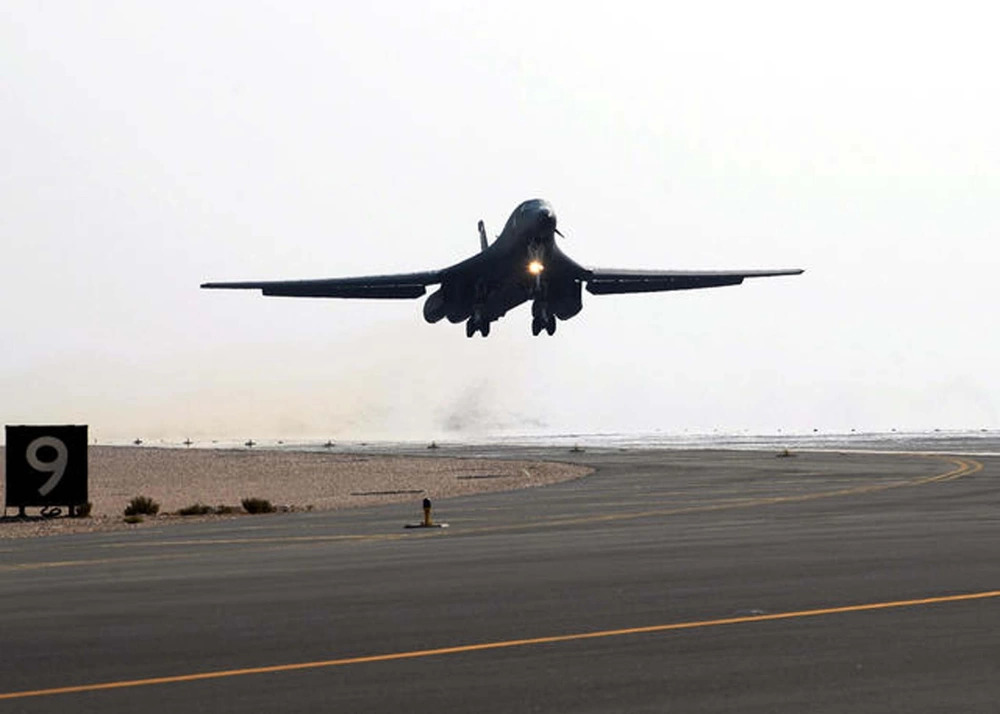
Distance explains why Fairford was useful. The straight-line journey from Fairford to Iran is about 3,400 miles. From Ellsworth Air Force Base in South Dakota, a principal B-1 home station, it is more than 7,000 miles — roughly twice as far before routing, weather and airspace restrictions are considered. A continental-U.S. launch therefore requires a far larger aerial-refueling plan and reduces the number of sorties that can be sustained with the same aircraft and crews. The bomber’s speed does not erase tanker scheduling, crew duty limits or maintenance hours.
The smaller numbers reveal the domestic cost. Eighty-five households were evacuated near the base while police assessed the suspected explosives. Six people were arrested across the investigation, and all six were later released on bail. Those facts do not prove either innocence or guilt. They do show why the public debate has split: one side sees the absence of viable explosives and the bail decisions as evidence of a less mature plan; the other sees a suspected plot whose intended target was important enough that the United States promptly moved every deployed bomber.
What happens next
The first scenario is a return. The Pentagon said the bombers had “re-deployed” to home stations, not that Fairford had been abandoned or the deployment permanently ended. If investigators contain the network, if new security measures satisfy U.S. commanders and if the operational need remains, B-1s could come back. The concrete blocks at the gate suggest the base is already being adapted rather than written off.
The second scenario is a lasting posture shift toward missions launched and recovered from the continental United States. That would lean into the bomber force’s defining strength — global reach — while trading away forward efficiency. Tanker demand would rise, missions would be longer and the campaign could become more expensive, but the aircraft would spend less time exposed at a known overseas hub. The Pentagon’s emphasis on continental-U.S. operations may be reassurance for today and a preview of tomorrow’s doctrine.
The third scenario is escalation if investigators produce persuasive evidence of Iranian direction. A demonstrated IRGC role would convert a British terrorism case into a state-linked attack on a base supporting U.S. combat operations. Washington and London would then face pressure for sanctions, expulsions, prosecutions or military retaliation. That is precisely why the current gap between official allegation and proved attribution matters. Moving aircraft is reversible; retaliating against a state is not.
Finally, Fairford remains visible. Iran says bases used to attack it are legitimate targets. Emptying the B-1 ramp reduces the immediate prize but does not erase the installation from Tehran’s strategic map, and it does not remove other personnel, infrastructure or alliance obligations. The next test is therefore broader than whether the bombers return. It is whether the United States and Britain can protect a forward base without allowing every credible threat to dictate where American air power can operate.
Sources and reporting notes
- Reuters: US removes B-1 bombers from UK base amid security concerns (October 4, 2026)
- The Wall Street Journal: All B-1 Bombers Returning to U.S. From U.K. Base (October 4, 2026)
- The Times: US pulls B-1 bombers from RAF Fairford over suspected terror plot (October 4, 2026)
- Associated Press via WDRB: US Air Force removes all bombers from British air base targeted by suspected terror attack (October 4, 2026)
- New York Post: US yanks all B-1 bombers from UK base targeted in foiled terror plot (October 4, 2026)
Reporting note: statements about Iranian or IRGC involvement are attributed allegations, not judicial findings. Distances are approximate great-circle figures; actual missions depend on routing, airspace, weather, payload and tanker plans. Analysis of strategic effects and future scenarios is interpretation, not a claim of confirmed intent.