War · Iran · Ballistic Missiles
Iran has formally ended the self-imposed 2,000-kilometre ceiling on its ballistic missile ranges, the IRGC confirmed in Tehran on Saturday — a doctrine change that retires a nine-year-old reassurance aimed at Europe. But the Guards’ own spokesman was careful to add the sentence that matters most: the new reach has to be demonstrated in practice, not merely announced.
Track it live: Iran war tracker and wars tracker
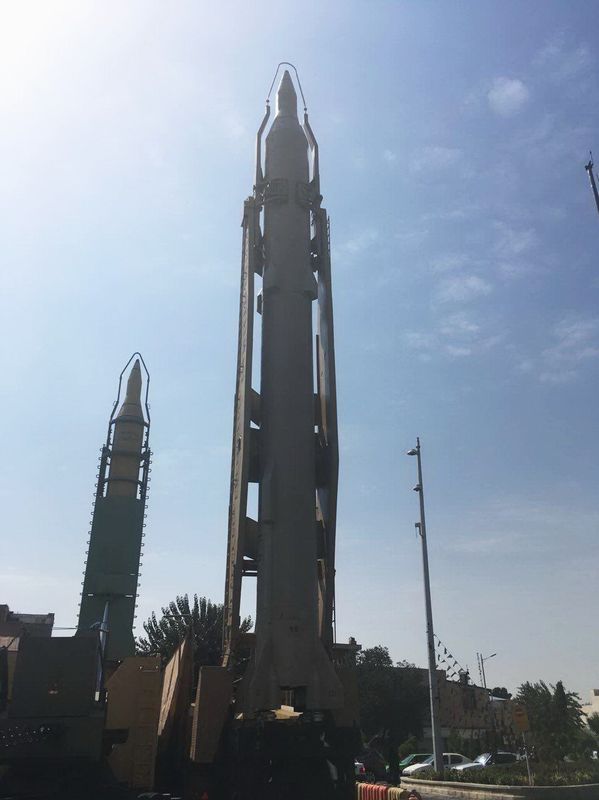
TEHRAN, November 7, 2026 — The announcement took up only a few sentences of a long press conference, but it retires one of the most consequential numbers in Middle East security. Asked on Saturday whether Iran’s ballistic missile ranges were still bound by the self-imposed limit of about 2,000 kilometres (about 1,240 miles), the spokesman of the Islamic Revolutionary Guard Corps, Brigadier General Hossein Mohebbi, answered that the restriction “has been lifted for us.” The exchange, at a press conference in Tehran marking IRGC Aerospace Week, was reported by the Associated Press and by the Iranian state-linked outlets Tasnim, Mehr and ISNA. With it, a ceiling that had defined the outer edge of Iran’s missile programme since 2017 — and that Tehran had long presented as proof it did not seek to threaten deeper Europe — formally ceased to exist as a matter of declared policy.
Mohebbi attached a caveat that deserves to travel with the headline wherever it goes. Capability, he said, must be demonstrated in practice — on the battlefield — and not merely claimed in statements beforehand; the Guards’ duty, in his telling, is to show what they can do rather than announce it in advance. He also said work on range is constantly improving, with no pause. Those two sentences frame the honest reading of Saturday’s news: this was a change of doctrine and of declared intent, delivered by the force that owns the missiles. It was not, and on the spokesman’s own account was not meant to be read as, the unveiling of a weapon.
What was actually said in Tehran
The sequence matters. Mohebbi’s answer did not arrive in isolation; it followed remarks by Supreme Leader Mojtaba Khamenei ordering an immediate and effective response to any threat against Iran, without geographical limits. The spokesman was asked, in effect, whether that order meant the old range ceiling had gone — and he confirmed that it had. Tasnim reported in parallel that Iran’s military target lists are being reviewed and updated, covering United States and Israeli physical and non-physical assets alike. Read together, the elements form a single message rather than three separate ones: the political authority has removed the geographic condition, the target planners are redrawing their lists accordingly, and the missile force is publicly released from the number that used to bound its work.
It is equally important to say what Saturday was not. Iranian officials had already spoken, in earlier reporting over recent weeks, of a shift away from the cap — parliamentarians and former commanders had trailed the idea publicly, and the possibility had been debated in Iranian media. November 7 should therefore be read as the IRGC spokesman’s formal public confirmation of the change, delivered on the record at Aerospace Week, rather than a revelation that arrived from nowhere. Formality is not a small thing in a system where missile policy is set at the top: a spokesman’s confirmation converts weeks of signalling into declared doctrine, and it is the declared doctrine — not the hints — that foreign ministries, general staffs and markets now have to price.
The precision point: a policy change is not a new missile
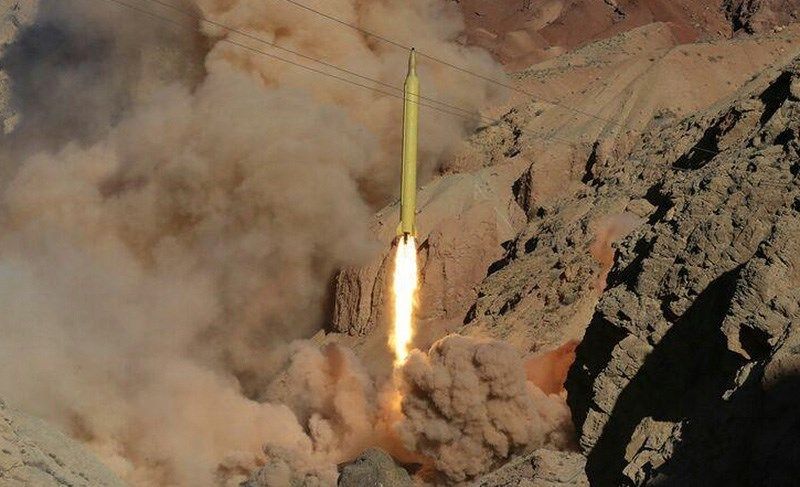
Signal Post News wants to hold one line brightly, because much of the reaction to Saturday’s announcement will blur it. There is no evidence that Iran currently possesses, or has demonstrated, an operational ballistic missile that exceeds the former 2,000-kilometre limit. No test flight beyond the old range has been announced or independently observed in connection with this decision. Iran’s longest declared systems — led by the Khorramshahr-4, also known as Kheibar — are credited at or near 2,000 kilometres, which is to say at the old ceiling, not beyond it. What changed on Saturday is the rule, not the demonstrated arsenal. Mohebbi’s own insistence that capability must be proven in practice is, in effect, an acknowledgement of exactly that gap: between a restriction lifted on paper and a longer reach shown in the air, there remains a distance that only hardware can close.
That gap cuts in both directions, and honest analysis has to say so. A cap can be lifted years before the engineering catches up; equally, outside assessors have long noted that a political ceiling is not the same as a technical one, and that some Iranian systems were assessed as capable of flying farther with lighter payloads. Neither proposition is evidence about what Iran can field today. The verified position is narrow: the policy has changed, the demonstration has not happened, and the first flight test beyond 2,000 kilometres — if and when it comes — will be the event that converts Saturday’s sentences into a new military fact.
Why this matters
The 2,000-kilometre figure was never just an engineering specification. For nine years it functioned as a diplomatic instrument: a number Tehran could point to when it told European governments that its missiles were a regional deterrent, not a threat to their capitals. Removing it therefore does three things at once. First, it retires the reassurance — every European defence ministry now has to plan against a declared policy that no longer stops at the old line. Second, it converts missile range from a settled background fact into an active bargaining variable in any future negotiation with Washington: a concession Tehran has already spent, publicly, is one it can offer to re-impose only at a price. Third, it lands in the middle of a war scare. The announcement came a day after American strikes on an Iranian air-defence system and amid stalled diplomacy, which means it will be read in Washington and Jerusalem not as a peacetime programme update but as a move inside an escalating exchange — whatever Tehran’s intent in choosing the timing.
Background: how the 2,000-kilometre cap came to be
The ceiling dated to 2017, set under the former supreme leader, Ali Khamenei. Iranian officials described it at the time, and consistently afterwards, as deliberate: a self-restraint chosen by Tehran, not imposed by treaty or negotiation. Its logic, as officials explained it, was reassurance with an address. At 2,000 kilometres, Iran’s missiles covered the targets Tehran said they existed for — Israel and American facilities across the Gulf and the wider region — while stopping short of the ranges that would put deeper Europe in reach. The message to European capitals was explicit in the design: your cities are outside the circle, so keep your distance from Washington’s pressure campaign. Foreign Minister Abbas Araghchi restated the policy in those terms as recently as the period before Saturday’s announcement, describing the 2,000-kilometre figure as a deliberate limit Iran had set for itself.
The cap always sat on top of a programme far older than the number. Iran built its missile forces out of the experience of the Iran-Iraq war, when Iraqi missiles struck Iranian cities and Tehran had little with which to answer; the arsenal that resulted — liquid- and solid-fuel systems in the Shahab, Ghadr, Emad, Sejjil and Khorramshahr lines — became the backbone of Iranian deterrence precisely because sanctions and isolation left the country’s air force ageing and outmatched. Within that history, the 2017 ceiling was the exception, not the rule: a political governor fitted to a programme whose institutional instinct, voiced by its commanders for years, was that range work should never stop. Mohebbi’s remark that improvement continues “with no pause” is that instinct speaking in the present tense.
The order behind the announcement
Mohebbi framed his answer as downstream of the supreme leader’s instruction. Mojtaba Khamenei had ordered that any threat against Iran receive an immediate and effective response without geographical limits — language that, taken literally, cannot coexist with a self-imposed ceiling whose entire purpose was geographic. The spokesman’s confirmation was the administrative consequence of that order: if responses may not be geographically limited, then the instrument of response cannot be either. Tasnim’s report of a review and update of target lists — covering American and Israeli physical and non-physical assets — supplies the operational counterpart. Target lists are where doctrine becomes coordinates; updating them to match an unbounded response order is the unglamorous paperwork of escalation, and it is already under way, on Tehran’s own telling.
Our earlier coverage this week traced the threat environment into which that order was issued, including Tehran’s warning that Iran would put Europe in its missile sights if America struck first from European bases. Saturday’s announcement generalises that conditional warning into standing policy: range is no longer the constraint, so the only remaining constraints are the ones Tehran chooses in the moment — capability, and the political decision to fire.
The nuclear remark — conditional, and only conditional
The same press conference produced a second headline, and it requires even more careful handling than the first. Mohebbi said the Guards would prepare for a shift in Iran’s nuclear doctrine if the country’s leadership ordered one. That is a statement about readiness to comply with a hypothetical instruction. It is not a decision to change doctrine, not an announcement of a weapons programme, and not a claim that any such order has been given. Signal Post News states that plainly because the conditional will predictably be stripped away as the remark travels: what the spokesman described was a military force saying it would be ready if its political masters ever decided — a posture statement, delivered in the subjunctive, at a moment chosen to maximise the pressure the subjunctive creates. Readers should file it exactly there, and nowhere further.
The backdrop: Qeshm, a stalled track, and a war that never quite stopped
The timing was not a vacuum. A day earlier, the United States carried out limited strikes against an air-defence system on Iran’s Qeshm Island; President Donald Trump characterised them as minor, saying the installation was knocked out within minutes of being built, while Iranian state media reported two explosions near Suza, on the island’s northern shore. We covered that episode, and the decision it feeds into in Washington, in our report on the Qeshm Island explosions and Trump’s war decision. Behind the exchange sits the larger stalemate: a war that began with joint American-Israeli strikes in February, a collapsed memorandum, a reimposed blockade, and negotiations that have stalled while both sides calibrate limited force. In that setting, an announcement about missile range is not programme news. It is a move in the bargaining — and in the deterrence contest — that the stalemate consists of.
What the satellites show — and what the Guards claim
One day before Mohebbi spoke, an investigation by BBC Verify, published on November 6 and summarised by Iran International, offered an independent look at the physical state of the programme the spokesman was describing. Using satellite imagery reviewed by analysts at the British intelligence-analysis firm MAIAR, the investigation found significant excavation and construction at two major missile facilities — the Garmdareh base in Karaj, near Tehran, and the Shahroud base in the north — and signs of repair work at at least 12 other military installations, including missile complexes and airbases damaged in months of American and Israeli strikes. Analysts quoted in the investigation described new roofs over destroyed buildings at the Kermanshah missile base, cleared debris and a repaired, concrete-reinforced underground bunker at the Parchin complex’s Taleghan-2 facility, and what appeared to be a new portal for an underground facility at Karaj — a pattern, MAIAR noted, of moving infrastructure underground to protect it from further strikes. Whatever Saturday’s doctrine says, the imagery describes the programme’s material priority of the moment: survival and reconstruction, conducted at a pace visible from orbit.
Against that documented picture, Mohebbi also offered claims of a different evidentiary status. He credited the Guards with advances in air defences and in underground missile production after the recent fighting, including claims about enemy aircraft and drones being brought down. Those claims are unverified: they were not accompanied by evidence that independent observers have confirmed, and Signal Post News presents them as the spokesman’s assertions, not as established fact. The distinction is the same one that applies to the range announcement itself — Tehran’s statements describe what Tehran says; the satellites, and any future test flight, will describe what is.
The distance question: what 2,000 kilometres did and did not cover
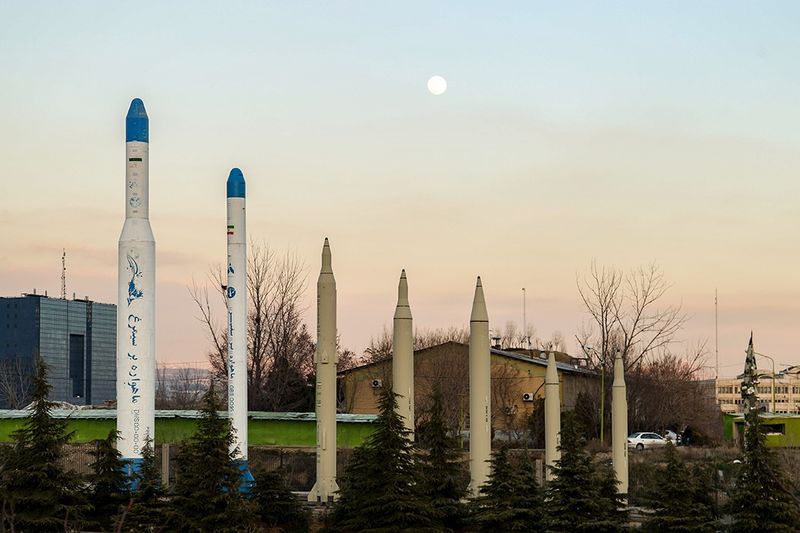
Range arguments are won and lost on maps, so the numbers deserve their own section. All figures below are approximate great-circle distances of the kind used in our earlier Europe-bases coverage, measured from Iran’s northwestern border region — the closest Iranian territory to Europe — and they describe geography, not any demonstrated missile.
- The old ceiling: about 2,000 km (about 1,240 miles) — the declared maximum range of Iran’s arsenal from 2017 until Saturday.
- Longest declared system: the Khorramshahr-4 (Kheibar), credited at or near 2,000 km — at the old ceiling, not beyond it.
- Nearer American facilities: United States installations in Cyprus, Greece and south-east Europe sit at or near the old 2,000 km range from northwestern Iran — inside, or on the edge of, the circle the cap already drew.
- Ramstein Air Base, Germany: roughly 3,100 km — about 1,100 km beyond the old ceiling.
- Aviano Air Base, Italy: roughly 3,300 km — about 1,300 km beyond the old ceiling, and the farthest of the major American hubs in southern Europe.
The arithmetic explains both sides of the argument that follows. Under the cap, the declared arsenal could hold at risk the regional target set and the nearest American facilities in the eastern Mediterranean — which is precisely the deterrent Tehran said it wanted. What the cap excluded, on declared numbers, was the deeper European base network from which American airpower could operate in a sustained campaign. Saturday’s decision does not move a single one of those bases a kilometre closer, and it does not give Iran a demonstrated missile that reaches them. What it removes is Tehran’s own promise not to try.

Two readings of the same announcement
Tehran’s framing is deterrence, stated as conditional response. In the official telling, Iran does not threaten first strikes: it promises that if it is attacked — including, officials have said this week, by aircraft operating from European bases — its answer will no longer be bounded by a geography it imposed on itself in calmer times. The lifted cap is presented as the removal of an asymmetry: adversaries may strike Iran from any distance, so Iran declines to keep one hand tied by a number. Supporters of the decision inside Iran add a sovereignty argument — no other state accepts a foreign-audited ceiling on its defences — and a negotiating one: a restraint given away free for nine years bought Tehran nothing it can still spend.
The critics’ framing, voiced in Washington, Jerusalem and European capitals whenever the cap has been debated, reads the same act from the receiving end. On this view, the 2,000-kilometre ceiling was the single most valuable confidence-building fact in the missile file — the one verifiable-by-design feature that let European governments argue Iran’s programme was regionally bounded. Removing it, critics say, is escalation in declarative form: it forces Europe into the target set, strengthens the case for expanded missile defence and for treating the missile programme as a first-order file in any future diplomacy, and does so at the moment of maximum tension, which they read as the point. Signal Post News presents both readings without adopting either; what is not in dispute is the act itself, or that its meaning will be settled less by Saturday’s words than by what Iran’s engineers do next.
Who benefits, who loses
Analysis, labelled as such. In Tehran, the decision benefits the Guards institutionally — Aerospace Week is their showcase, and the announcement places their programme at the centre of national strategy — and it benefits negotiators who prefer to bargain from declared strength. It benefits, too, those in Washington and Jerusalem who have argued that pressure must widen to the missile file: Tehran has now handed them the argument that the file was never settled. The losers are equally identifiable. European governments lose a reassurance they relied on and gain a defence-planning problem. Advocates of revived diplomacy lose their easiest exhibit — the cap was the standing proof that Iran could accept a verifiable restraint — and inherit a harder one: any future limit must now be re-bought. And the region’s publics, as after Qeshm on Friday, are left pricing the distance between a spokesman’s sentence and a test flight, with oil markets doing the same arithmetic in public.
What happens next: three scenarios
Scenario one: the demonstration. Iran conducts a test flight — a space-launch-profile shot or a declared missile test — that travels materially beyond 2,000 kilometres. This is the proof point Mohebbi himself nominated (“in practice”), and it would convert doctrine into capability in a single morning, triggering the European missile-defence debate in earnest and resetting every negotiation baseline. Scenario two: the leverage play. No test follows; instead the lifted cap is banked as a bargaining asset, to be traded — re-imposition of a ceiling in exchange for sanctions relief or security guarantees — in any revived talks with Washington. In this scenario Saturday’s announcement is best understood as the minting of a coin Tehran intends to spend, and its value depends on never having to prove it is solid. Scenario three: the slow build. Range work proceeds the way the BBC Verify imagery suggests the wider programme now proceeds — underground, incremental, deniable in its particulars — while the doctrine statement does the deterrent work alone. Each passing month without a demonstration slightly discounts the announcement; each repair completed at Karaj, Shahroud and Kermanshah slightly raises the cost of the strikes that would be needed to reverse it.
What to watch is concrete. A NOTAM or maritime warning closing airspace and sea lanes east or south of Iran on unusual profiles would be the first public hint of a long-range test. Statements from European governments — and any acceleration of missile-defence procurement or of American deployments to Ramstein and Aviano — would mark the announcement’s arrival in allied planning. Movement in the Doha channel would test the leverage scenario. And on the ground, the satellite record will keep its own ledger: the same imagery that found excavation at two missile sites on Friday can measure, month by month, whether the programme behind Saturday’s words is being rebuilt to fly farther — or simply to survive. Until one of those markers appears, the precise summary of November 7 is the one the spokesman himself supplied: the restriction has been lifted; the proof, by Tehran’s own standard, is still to come.
Sources: Associated Press, “Iran says it has lifted its self-imposed limit on missile ranges” (November 7, 2026), reporting Mohebbi’s Aerospace Week press conference in Tehran; Tasnim News Agency, “Restrictions on Range of Iranian Missiles Lifted: IRGC Spokesman” (November 7, 2026), including the target-list review; BBC Verify, “Major construction ongoing near Iran missile bases, satellite images suggest” (November 6, 2026), the satellite-imagery investigation based on analysis by MAIAR and summarised by Iran International. Mohebbi’s claims regarding air defences and underground production are reported as his claims and are unverified; distances are approximate and drawn from Signal Post News’ earlier Europe-bases coverage.