War · Yemen · United Nations · Red Sea
UN Yemen sanctions renewed: the UN Security Council voted unanimously on Thursday, November 12, 2026, to adopt Resolution 2837, the UK-drafted text that extends the Yemen sanctions regime for another year — asset freezes and travel bans now run to November 14, 2027, and the Panel of Experts that monitors them grows from four members to six, with dedicated maritime-security expertise — as the Council strongly condemned Houthi military escalation, cross-border attacks on Saudi Arabia and threats to commercial shipping in the Red Sea, and demanded an immediate and unconditional halt.
Track it live: Live Global Trackers — Wars & Conflicts
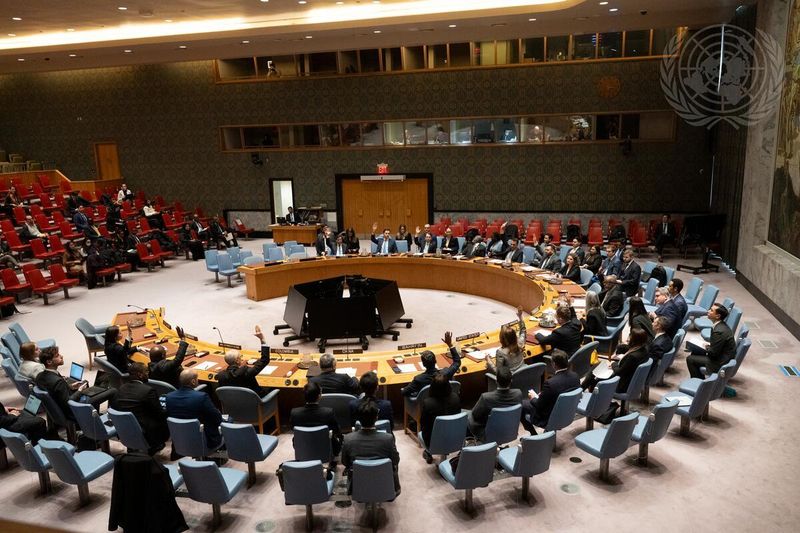
NEW YORK, November 12, 2026 — The vote at the Council’s 10270th meeting was unanimous, and the text the United Kingdom put on the table did three things at once. It renewed the targeted measures of the 2140 sanctions regime — the asset freezes and travel bans applied to individuals and entities designated by the Council’s Yemen Sanctions Committee — for twelve more months, to November 14, 2027. It extended the mandate of the Panel of Experts that assists the committee for thirteen months, to December 15, 2027, and asked the Secretary-General to expand the panel from four members to six, adding dedicated maritime-security expertise for the first time. And it set a deadline the Council has not set before: a decision by January 11, 2027, on whether to act against the dual-use components and precursor chemicals that feed Houthi weapons production. Around those mechanics sits the language that gives the resolution its political weight: the Council strongly condemned the Houthis’ military escalation in Yemen, their cross-border attacks on Saudi Arabia and their threats to commercial shipping, and demanded that the group immediately and unconditionally cease the escalation and the attacks.
What follows separates the record from the argument. The facts of the vote are set out first, drawn from the UN’s own meeting coverage and the reporting around it. The claims made on the same day by the Saudi-led coalition and by the Houthis are presented as claims, attributed to the officials who made them, because Signal Post News cannot independently verify either side’s account of Thursday’s skies. Analysis is labelled as analysis, in the “Why this matters” section below.
What Resolution 2837 actually does
The mechanics matter, because sanctions resolutions are mostly mechanics. Under Resolution 2837, as the UN’s meeting coverage records, the travel-ban and asset-freeze measures imposed on designated individuals and entities in Yemen are renewed for twelve months. The Panel of Experts — the small investigative body that documents sanctions violations, traces weapons flows and reports to the 2140 Committee — is extended for thirteen months, to December 15, 2027, two months longer than the measures it monitors, the standard drafting device that lets a panel finish its work after the regime it serves comes up for renewal again. The panel must deliver its final report to the Council no later than October 15, 2027, a month before the sanctions themselves expire, so that members negotiate next year’s renewal with the evidence in hand. Yemen Monitor’s account of the adoption matches the UN record on each of those dates.
The expansion from four experts to six is the resolution’s clearest operational change, and its composition is the point. The two new seats carry dedicated maritime-security expertise — a direct response to a war whose centre of gravity has moved offshore. The Houthis’ campaign against commercial shipping in the Red Sea and the Bab al-Mandab strait, and the smuggling routes that move weapons and components into Yemen by sea, are now the regime’s central enforcement problem, and until Thursday the panel had no member whose brief was the water. Anadolu’s reporting, carried by The Tower Post, likewise records that the Council asked the Secretary-General to expand the panel to six members including maritime expertise.
The January 11 decision on dual-use components
The newest idea in the text is also the one the Council postponed. Rather than acting immediately on the dual-use components and precursor chemicals used in Houthi weapons production, Resolution 2837 records the Council’s intention to decide by January 11, 2027, on measures concerning specified components identified in the experts’ reporting. Security Council Report, the independent research service that tracks Council negotiations, describes that formulation as the compromise that got the text adopted: the question of components needed more discussion, with China and Russia among the members wanting further deliberation before the Council moved. The United Kingdom made no secret of why it wanted the provision. In her explanation of the vote, UK Ambassador Sarah MacIntosh linked the components question directly to the Houthis’ growing ability to manufacture weapons inside Yemen — drones and missiles assembled domestically from imported parts are harder to interdict than finished weapons, which is precisely why the supply of parts has become the argument. January 11 is now the date on which that argument resumes, with a deadline attached.
The detainees and the humanitarian paragraphs
The resolution also carries the Council’s continuing demands on the humanitarian file. Members called again for the release of the roughly 70 detained UN, aid and diplomatic staff held by the Houthis, and the text sits against a deteriorating relief picture that the UK’s own statement quantified: more than 22.3 million people in Yemen need humanitarian assistance. The UN humanitarian coordination office, OCHA, counts 333,000 people displaced since early August, with 24,000 of them displaced in the past week alone — a rate of flight that describes a war still expanding geographically even as its sanctions regime is renewed on schedule.
What the Council did not renew: the arms embargo that never expires
The most common misunderstanding of Thursday’s vote is that the Council renewed the arms embargo on the Houthis. It did not, because it did not need to. The targeted arms embargo was imposed by Resolution 2216 in April 2015, and unlike the 2140 financial and travel measures, it was written without an expiry date: it is open-ended, and it continues in force whether or not the Council ever votes on Yemen again. Security Council Report’s pre-vote analysis makes the point explicitly, noting that the embargo established through Resolution 2216 is open-ended while the 2140 measures require annual renewal. So the annual November ritual in the Council chamber concerns only part of the architecture — the money, the travel and the monitors. The embargo, the measure most directly aimed at the Houthis’ arsenal, simply carries on, which also means its effectiveness is never itself put to a vote. Critics of the regime, including voices who note how much weaponry has reached the Houthis despite eleven years of embargo, argue that this design lets the Council renew the appearance of pressure annually while the hardest question — why interdiction keeps failing — stays off the agenda. Supporters answer that an open-ended embargo is a feature, not a bug: it cannot lapse in a bad negotiating year, and Thursday’s new focus on components and maritime monitoring is aimed at the enforcement gap rather than the legal one.
Background: a sanctions regime built in two layers
The regime renewed on Thursday was built in two layers, a year apart, for two different wars. Resolution 2140, adopted in February 2014, belonged to Yemen’s political transition: it created the sanctions committee and the Panel of Experts, and armed the Council with asset freezes and travel bans against individuals and entities judged to be threatening Yemen’s peace, security or stability, at a moment when the threat envisaged was obstruction of a negotiated transition. Resolution 2216, adopted in April 2015, belonged to the war that replaced the transition: as the Houthis held Sanaa and the Saudi-led coalition intervened, it layered the targeted arms embargo on top of the 2140 machinery and demanded the Houthis withdraw from seized territory. Every November since, the Council has renewed the 2140 layer and its panel, while the 2216 layer runs on underneath, unvoted and unexpired. Resolution 2837 is the latest turn of that cycle — and, with its maritime expansion and its January components deadline, the first in several cycles to change the machinery rather than merely extend its lease.
The same day’s claims, stated as claims
Thursday produced two rival accounts of violence, and both are claims, attributed here to their makers and not endorsed as fact. The Saudi-led coalition said it had intercepted suspected Houthi drones over the Riyadh region and the Eastern Province; the statement was carried by the Saudi Press Agency and attributed to the coalition spokesman, Major General Turki al-Maliki. Separately, Houthi military spokesman Yahya Saree claimed Houthi strikes on a pumping station of the East-West Pipeline and on an oil facility at Yanbu, on Saudi Arabia’s Red Sea coast. Riyadh’s own published figures say roughly 4 million barrels a day of Saudi crude can be rerouted through the East-West Pipeline to Yanbu, which is what makes the pipeline and the port strategically significant: they are the kingdom’s bypass around the Strait of Hormuz. Neither the coalition’s interception account nor the Houthis’ strike claims could be independently verified by Signal Post News at the time of publication, and the two statements are not necessarily irreconcilable — interceptions and claimed launches can describe the same night from opposite ends. What is documented, by the Council itself, is the pattern the resolution condemns: cross-border attacks and threats to shipping serious enough to anchor a unanimous text.
The day after: the UN counts the civilian cost
On Friday, November 13, the UN Secretariat’s regular briefing added the civilian ledger that sanctions language tends to abstract. Deputy spokesperson Farhan Haq told reporters that drones, missiles, airstrikes and shelling are increasingly hitting civilians and civilian infrastructure across Yemen — hospitals, markets and homes among them. UN human rights chief Volker Türk used the same news cycle to demand the return of the body of Mohammed Ibrahim Al-Shami, the UN staff member who died in Houthi custody, to his family. The detained-staff issue is therefore not a formula in a resolution: it is an open file with a name on it, and the roughly 70 detained UN, aid and diplomatic personnel the Council wants released include colleagues of the man whose body has not been returned. For wider context, The New Humanitarian’s coverage of the escalation, citing the World Health Organization, reports rising casualties since the September escalation — a figure Signal Post News attributes to WHO via that reporting, and which is separate from anything the Council voted on Thursday.
On the ground, the humanitarian numbers frame the limits of what was decided in New York. The 333,000 people OCHA counts as displaced since early August, and the 24,000 added in a single week, are moving inside a country where, on the UK’s figure, more than 22.3 million people already need aid. The hospitals absorbing the casualties of the current fighting are the subject of Signal Post News’ earlier reporting from Taiz, where front-line hospitals have treated hundreds of war wounded in a week — the receiving end of the escalation the Council condemned.
Reactions: regret from Washington and Sanaa’s rivals, caution from Moscow
Unanimity at adoption did not mean satisfaction around the table. The United States and Yemen both expressed regret that the resolution contains no terrorist designation of the Houthis — the step each has argued would sharpen the regime’s financial and legal bite, and the step whose absence defines the boundary of what the Council would agree to on Thursday. Russia, from the other direction, cautioned against excessive sanctions pressure, the recurring argument from Moscow that piling measures on the Houthis hardens the conflict and complicates the political track the Council simultaneously says it wants. Both objections can be true descriptions of the same text: Resolution 2837 was drafted, as UK-led texts on Yemen usually are, to be adoptable by all fifteen members, and the price of consensus was a designation left out and a components decision deferred to January. The death in custody that Türk raised on Friday is covered in Signal Post News’ reporting on the UN human rights staffer who died in Houthi custody, and the cross-border campaign behind Thursday’s claims in the reporting on the Houthis’ claimed ballistic-missile strike on Riyadh airport and their “last warning” to airlines.
Why this matters
A unanimous vote is itself the news
Analysis: in a Council that has spent 2026 divided over nearly every other file, a Yemen sanctions text adopted by consensus, without a veto or an abstention, is a data point about where agreement remains possible. Yemen is one of the few dossiers on which Washington, London, Moscow and Beijing still vote the same way — not because their interests align, but because the text is engineered to stay inside the overlap: pressure on the Houthis that stops short of designation, enforcement language that stops short of new obligations, and the one genuinely new question, components, deferred to a dated decision rather than forced. Readers should therefore resist reading unanimity as unity of purpose. It is better read as proof that the floor of agreement still exists, and Thursday’s text maps exactly where that floor lies.
The maritime turn follows the war
The panel’s two new maritime seats are an institutional admission that the Yemen war’s decisive theatre is now the sea. The Houthi Red Sea shipping attacks have made the Bab al-Mandab a global economic variable: every diverted container ship and tanker reprices trade between Asia and Europe, and every component smuggled ashore by sea extends the arsenal that sanctions exist to shrink. A panel of four generalists could document that world; a panel of six with dedicated maritime expertise is built to interdict it on paper — tracing the dhows, the transhipments and the component supply chains that the January 11 decision will then have to address. Whether two experts can change interdiction outcomes is unproven; that the Council has finally staffed the problem it keeps condemning is, on the record of its own votes, new.
Who gains, who loses, and what the critics say
The clearest gainers are the monitors and the penholder: the Panel of Experts emerges larger and better matched to its brief, and the United Kingdom keeps ownership of a file it has drafted for years, with a January deadline that keeps London at the centre of the next negotiation. The Houthis lose marginally on paper — another year of designations, a bigger panel watching their supply lines, a components decision hanging over their domestic weapons production — but they will note, as their same-day claims were designed to show, that a unanimous Council still did not designate them terrorists, and that the embargo they have operated under since 2015 did not prevent Thursday’s launches, whatever their outcome. The critics’ case comes in two versions that oppose each other. From one side, the US and Yemeni complaint: without a designation, the regime pressures individuals while the organisation’s finances and legitimacy escape the sharpest tools available. From the other, the Russian caution, echoed by humanitarian voices whenever sanctions widen: measures that raise the cost of moving money and goods around Yemen land in an economy where 22.3 million people need aid, and pressure that does not change behaviour becomes part of the war’s furniture. The data available on Thursday supports neither side conclusively — attacks rose in the year the previous resolution was in force, and displacement rose with them — which is why the January decision, and the panel’s October 2027 final report, matter more than the renewal itself: they are the two moments when evidence, rather than drafting, gets a vote.
What happens next
The calendar the Council set for itself is unusually specific. On January 11, 2027, members intend to decide on the dual-use components and precursor chemicals question — the deferred heart of Resolution 2837, and the first real test of whether the consensus of November survives contact with the file China and Russia wanted longer to study. Through 2027, the enlarged Panel of Experts will work to its December 15 mandate, filing the reporting on which any components regime, and any future designations, will depend. Its final report is due by October 15, 2027. The sanctions themselves expire on November 14, 2027, when the Council will do this again — unless the war, the shipping campaign or the detained-staff file forces it back to the Yemen file sooner. The forward-looking judgment Signal Post News offers is narrow: Thursday’s vote bought the regime a year and bought the monitors two new seats; it did not buy a decision on the components that build the weapons, and everything about the next twelve months of this sanctions regime runs through the January date on which that decision is now owed.
Sources
United Nations meeting coverage, “The situation in the Middle East — Security Council, 10270th meeting” (Nov. 12, 2026), media.un.org; Anadolu Agency reporting via The Tower Post, “UN Renews Yemen Sanctions and Expands Maritime Monitoring” (Nov. 13, 2026), tower-post.com; Yemen Monitor, “UN Security Council Extends Yemen Sanctions, Renews Mandate of Panel of Experts, and Condemns Houthi Escalation” (Nov. 12, 2026), yemenmonitor.com; Security Council Report, “What’s In Blue: Yemen — Vote on a Draft Resolution Renewing the Sanctions Regime” (Nov. 12, 2026), securitycouncilreport.org. Same-day interception and strike claims are attributed to the Saudi-led coalition via the Saudi Press Agency (Maj. Gen. Turki al-Maliki) and to Houthi spokesman Yahya Saree respectively, and are reported as claims only; neither account has been independently verified. Humanitarian figures: UK explanation of vote (22.3 million in need) and OCHA displacement figures as reported in the coverage above; WHO casualty context via The New Humanitarian. Photo: UN Photo, via media.un.org; file photo from an earlier Council meeting on Yemen.