War · Ukraine · Astrakhan · Oryol
Ukraine strikes Akhtubinsk airfield — home of Russia’s 929th State Flight Test Centre, where its newest jets are proven — and a drone facility in Oryol, the General Staff says. A missile-components warehouse detonated and a radar was hit, Kyiv says; how much damage was done, no one outside the two militaries yet knows.
Track it live: Ukraine war map
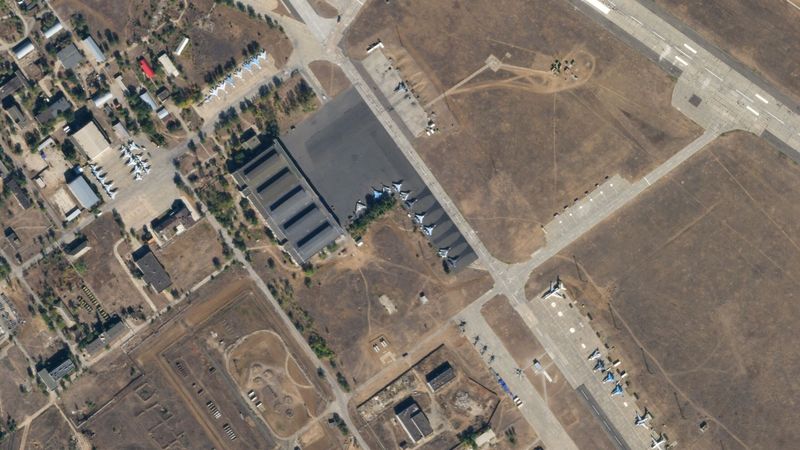
KYIV, Ukraine, November 15, 2026 — Ukraine strikes Akhtubinsk airfield, one of the most sensitive military sites in Russia, its General Staff confirmed on Sunday. Ukrainian forces struck the Akhtubinsk military airfield in Russia’s Astrakhan region and a drone facility near the village of Tsimbulovo in Oryol region overnight on November 14–15, the General Staff said, in reporting carried by UNITED24 Media and Ukraine’s combat-operations wires. At Akhtubinsk, the General Staff said, the strike caused a powerful secondary detonation at a warehouse storing components for guided air-launched missiles, and a PRV-13 mobile radar altimeter at the facility was also struck. The targets, Kyiv said, were used for Russian long-range attacks and housed aircraft, guided munitions, radar equipment and strike drones. Astrakhan Governor Igor Babushkin said 31 drones were destroyed in the northern part of his region overnight — a Russian official claim, attributed as such. No casualties from the Akhtubinsk strike were reported in the sources checked, and this article makes no claim that any aircraft were destroyed on November 15: the General Staff claimed a warehouse detonation and a radar hit, and nothing more specific. The extent of the damage is not independently verified.
What the General Staff says happened
The sequence of Sunday’s reporting matters, because it changed. The first accounts of an Akhtubinsk strike came from Exilenova+, a Ukrainian monitoring channel, which reported at least 30 explosions at the airfield, with aircraft parking areas and ammunition depots targeted. The Kyiv Independent’s first report, published at 10:14 UTC, was careful: it said it could not independently confirm the strike. Later on Sunday, the General Staff itself confirmed the operation — reported at 13:22 UTC via the h.ua combat-operations wire and by UNITED24 Media — and supplied the target details: the guided-missile components warehouse and its secondary detonation, the PRV-13 radar altimeter, and the second strike on the drone facility and port near Tsimbulovo (also transliterated Tsymbulova) in Oryol region. The General Staff’s confirmation settles the question of whether Ukraine says it struck the base. It does not settle what the strike achieved, and the distinction runs through everything below.
The choice of claimed targets is itself informative. A warehouse of components for guided air-launched missiles is not a runway or a parked jet; it is a stockpile feeding the production and preparation of the weapons Russian aircraft carry to the launch lines. A PRV-13 is a height-finding radar — part of the sensor picture that lets air defences see incoming drones and assign interceptors. Striking the two together, on the General Staff’s account, is an attempt to degrade both the sword and the shield at the same address: fewer missile components moving toward the front, and a thinner radar picture over the base the next time drones come. Whether either effect was achieved depends on what actually burned and what was actually destroyed, which neither side has documented publicly.
What is not yet verified
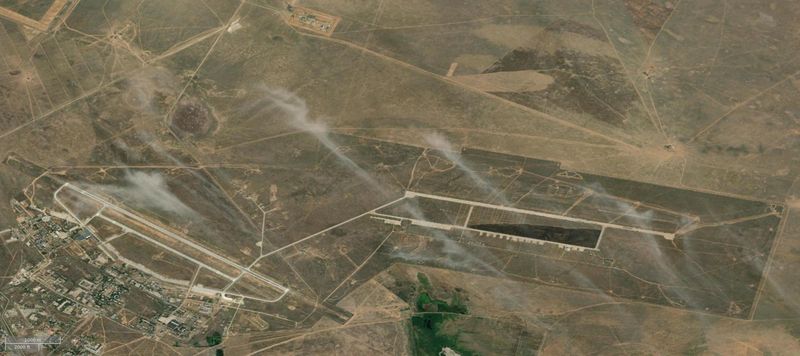
Three gaps should be held clearly. First, the damage: beyond the General Staff’s claims and Exilenova+’s count of explosions, there is no independently verified assessment of what was destroyed at Akhtubinsk — no published satellite pass, no geolocated aftermath imagery, no Russian statement describing the facility’s losses. Airfield strikes in this war have repeatedly looked different in the first announcement than in the first satellite image, in both directions. Second, the aircraft question: early social-media speculation reached, as it always does at this base, for the Su-57s. Nothing in the General Staff’s statement claims an aircraft destroyed on November 15, and readers should treat any report that says otherwise as going beyond the sourcing. Third, the Oryol strike: the Tsimbulovo facility has been struck before — Signal Post News covered the September 2026 strike on the same drone base — and Sunday’s claim arrives with even less supporting detail than Akhtubinsk’s. It is reported here as the General Staff stated it: a drone facility and port near Tsimbulovo, struck the same night.
Governor Babushkin’s figure — 31 drones destroyed in the north of Astrakhan region — belongs to the same ledger of claims. Russian regional governors have become the war’s routine reporters of incoming attacks, and their interception counts are official statements to be weighed, not audited facts. If 31 drones were indeed engaged over the region, the number also says something about the scale of the package Ukraine sent 650 kilometres to reach this one base — but the arithmetic of interceptions, as ever, is supplied by the side doing the intercepting.
The base: Russia’s flight-test heart
Akhtubinsk is not an ordinary airfield, and its ordinariness deficit is the reason Ukraine keeps flying to it. The base lies roughly 650 kilometres (about 404 miles) from the front line, some 30 kilometres west of the Kazakhstan border, in the steppe of Astrakhan region. It hosts the Russian Defence Ministry’s 929th State Flight Test Centre, named for the test pilot V. P. Chkalov — the institution where new Russian military aircraft and weapons are tested and proven before they enter service. The Su-57, Russia’s fifth-generation stealth fighter, has been tested and based there; Su-34 fighter-bombers operating from the area launch guided bombs against Ukraine. A strike on Akhtubinsk therefore reaches past the operational air force into the machinery that creates its future one: test programmes, evaluation schedules and the specialist infrastructure that cannot simply be reconstituted at another runway.
A base that has been struck before
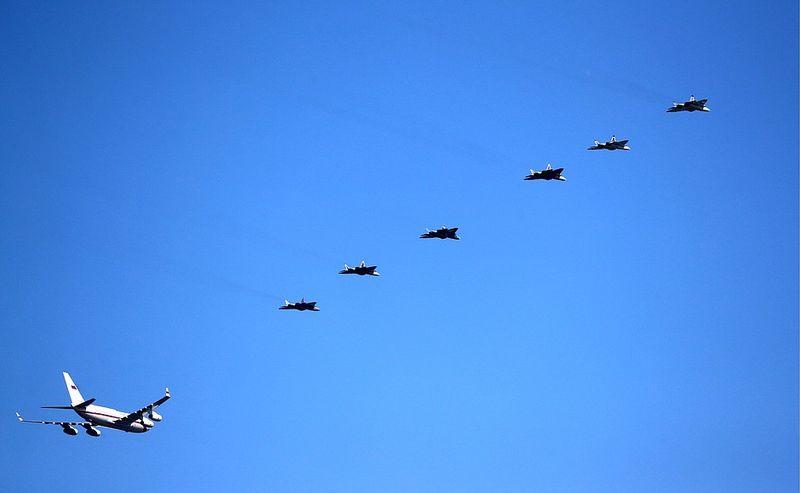
Sunday’s strike is at least the fourth publicly reported attack on Akhtubinsk, and the earlier three explain the base’s hardening and Ukraine’s persistence alike. On June 9, 2024, Ukraine’s military intelligence agency, HUR, claimed that two Su-57s were damaged at the base — the first strike on Russia’s stealth fighter of the war, and a propaganda prize for Kyiv precisely because the aircraft were at the test centre rather than a front-line regiment. On August 20, 2026, the General Staff said a Su-34 was damaged at Akhtubinsk and fuel was spilled. On October 29, 2026, HUR confirmed a Su-57 was damaged at the base; separate open-source reporting the same day described an Su-57 burning in an engine-start fire — two accounts of damage on one day that this article keeps distinct, because they have never been publicly reconciled and may describe different events. After the earlier strikes, satellite imagery showed reinforced aircraft shelters under construction at the base — the visible signature of a lesson being learned. November 15 tests whether the lesson was learned fast enough, and its claimed targets — a warehouse and a radar rather than the sheltered aprons — suggest Ukraine has adjusted its aim to the base’s new shape.
Why this matters
Analysis, labelled as such. The first reason Akhtubinsk matters is what it reveals about the reach and the patience of Ukraine’s deep-strike campaign. Six hundred and fifty kilometres is not a border raid; it is a flight across the breadth of Russia’s south, past the layered air defences of the Volga and the Caspian steppe, to a target whose value is measured in programmes rather than sorties. The same weekend saw the campaign working at the other end of the industrial spectrum, in the strikes on the Nizhnekamsk petrochemical complex and TAIF-NK refinery in Tatarstan and, a day earlier, the Samara oil hub and Lipetsk-2 airbase. Read together, the target list is a single argument made in three places: oil, chemicals and now the flight-test establishment — the systems that fund the war, feed it and equip its future.
Second, the pairing with Oryol is deliberate in kind. Tsimbulovo is drone infrastructure — part of the apparatus that assembles and launches the strike drones Russia sends against Ukraine nightly. Akhtubinsk is the opposite pole of Russian air power: its most advanced manned aviation. Striking both in one night presents the campaign as comprehensive rather than opportunistic, and it forces Russian air-defence planners to defend the whole depth of the country at once — test centres near Kazakhstan, drone bases in Oryol, refineries on the Volga — with a finite inventory of radars, interceptors and crews. Every axis opened is an axis that must be covered or conceded.
Third, there is the question of what a test-centre strike does beyond the fence line. Flight-test programmes run on schedules, instrumentation and a small cadre of specialist aircraft and people. Even a strike that destroys no aircraft can consume the scarcest resource in such a programme — time — if it damages the warehouses, radars and support equipment the programme depends on, or forces the centre to disperse its work. That is the strategic logic Kyiv is pursuing, and it is also why the verification gap matters so much here: the difference between a spectacular claim and a programme actually delayed is precisely the difference the missing satellite imagery would settle.
The data in context
The verifiable skeleton of November 14–15, on the Akhtubinsk axis, is short enough to state in one paragraph. Distance: about 650 kilometres from the front line to the base, which sits some 30 kilometres from the Kazakhstan border. Claims: one warehouse detonation and one radar hit at Akhtubinsk, per the General Staff; one drone facility struck in Oryol, per the same source; at least 30 explosions at the airfield, per the Exilenova+ monitoring channel; 31 drones destroyed over the region, per Governor Babushkin. Casualties: none reported. Aircraft destroyed: none claimed by the General Staff. Cadence: this is at least the fourth publicly reported strike on this single base — June 2024, August 2026, October 2026 and now November 2026 — a tempo that has quickened from a sixteen-month gap to a roughly monthly one, and that has been answered, on the satellite evidence of the intervening months, with concrete shelters rising over the aprons. Everything beyond that skeleton — tonnage destroyed, programme delay, the radar’s condition — awaits evidence that has not yet been published, and this article has left it unpublished rather than fill it from either capital’s script.
What happens next
The next evidence will come from orbit. Commercial satellite imagery of Akhtubinsk has settled the argument after each previous strike on the base — showing the damaged Su-57s of 2024, the shelter construction that followed, the spilled fuel of August — and a pass over the warehouse area and the radar site will do the same for November 15, one way or the other. Watch also for the Russian response in kind: dispersal of test aircraft, more shelters, thicker air defence over Astrakhan — each itself a cost imposed by a strike whose physical toll is still unproven. And watch Oryol: the Tsimbulovo facility has now been struck at least twice in three months, and drone infrastructure, unlike a test centre, is rebuilt quickly and attacked again just as quickly. The honest summary of Sunday is the narrow one: Ukraine says it struck the flight-test heart of Russian aviation and a drone base in Oryol; a governor says 31 drones were destroyed; a warehouse is said to have detonated and a radar to have been hit; and the damage — the only part that will matter in a month — awaits its first independent witness. Signal Post News will update this article when that imagery appears.
Sources
- Ukraine’s General Staff confirmation, via the h.ua combat-operations wire, November 15, 2026 (13:22 UTC) — the strikes on Akhtubinsk airfield and the Tsimbulovo drone facility, and the targets’ use for Russian long-range attacks.
- UNITED24 Media, via EuropeSays, November 15, 2026 — the secondary detonation at the warehouse storing components for guided air-launched missiles and the PRV-13 radar altimeter hit at Akhtubinsk.
- The Kyiv Independent, via EuropeSays, November 15, 2026 (10:14 UTC) — the first report of the strike via Exilenova+ (at least 30 explosions reported), the Kyiv Independent’s initial inability to independently confirm it, Governor Babushkin’s 31-drone claim and the base’s prior-strike history.
- Kyiv Post, via its Mastodon mirror, November 15, 2026 — the 30 explosions and the aircraft parking areas and ammunition depots reported targeted.
- Akhtubinsk Air Base — reference background — the 929th State Flight Test Centre, the base’s role in testing new military aircraft including the Su-57, and its location in Astrakhan region.
- Photos: Planet satellite imagery of Akhtubinsk air base via Breaking Defense; NASA FIRMS imagery of the base area (August 8, 2025) via Wikimedia Commons; Su-57 formation via Wikimedia Commons — each credited in its caption, and none depicting the November 15, 2026 strike.