War · Ukraine · Samara · Lipetsk
Ukraine strikes Samara oil hub targets again: long-range drones hit the Prosvet dispatch station that blends Russia’s Urals export crude and, the same night, the Lipetsk-2 military airfield — the sixth reported strike on the Samara site since October 2, in a campaign that is now measured in tank farms, not headlines.
Track it live: Ukraine war map
KYIV, Ukraine, November 14, 2026 — Ukraine strikes Samara oil hub infrastructure deep inside Russia for at least the sixth time in six weeks. Ukraine’s General Staff announced on Saturday that Ukrainian forces struck the Samara linear production dispatch station (LPDS) near the village of Prosvet in Russia’s Samara Oblast on November 13, setting multiple crude oil storage tanks ablaze roughly 950 kilometres east of Ukrainian-controlled territory, and confirmed a second strike the same day on the Lipetsk-2 military airfield in Lipetsk Oblast, more than 340 kilometres east of the Ukrainian border. Samara Governor Vyacheslav Fedorishchev reported four people killed and others injured in the November 13 drone attack on his region. Russia had issued no detailed public assessment of the Samara damage by the time of reporting. What follows separates what each side has actually said from what the numbers suggest — because at Prosvet, the numbers are the story.
What Ukraine says happened at Prosvet
The General Staff’s account, announced on November 14 and reported by the Kyiv Post, is specific about the target and the visible result: a fire at the Samara LPDS near Prosvet, with several crude oil storage tanks burning. The station is not a refinery. It is a dispatch and blending hub — a place where crude arriving by pipeline from Tatarstan, Western Siberia and other producing regions is received, held in tanks, blended to specification and sent onward. Its product, in effect, is Urals, Russia’s flagship export blend, and the General Staff has said oil passing through the node also supplies the Russian military — a claim that, as with most targeting justifications in this war, is asserted by the side that struck it and has not been independently verified.
The Security Service of Ukraine (SBU) gave a parallel account of the same attack. The SBU said its Alpha special operations centre used long-range drones against the Samara station on November 13, with preliminary reports of hits on storage tanks, in reporting carried by the Ukrainian outlet Militarnyj and relayed by Security Signal. Two Ukrainian institutions describing the same strike in matching terms is corroboration of the claim’s origin, not independent confirmation of its effect: both accounts trace to Kyiv. The physical fact of a major fire at the site is consistent across the Ukrainian statements and the governor’s casualty report, but the extent of the damage to the tank system had not been established by any source outside the belligerents at publication.
The governor’s toll — and what Moscow has not said
The human cost, as reported, comes from the Russian side of the line. Samara Governor Vyacheslav Fedorishchev reported four people killed and others injured in the November 13 drone attack — a figure attributed here to the governor, as he gave it, without independent confirmation of the identities of the dead or the precise location at which they were killed. Governors in Russia’s border and near-border regions have become the war’s routine casualty reporters, and their figures are official Russian statements, to be weighed as such: neither dismissed nor treated as audited fact.
Equally notable is the silence around the facility itself. Russia had not issued a detailed public assessment of the damage at the Samara station at the time of reporting — no statement from the pipeline operator on tank losses, throughput or repair timelines, and no detailed Defence Ministry account of the Prosvet strike in the reporting available on Saturday. That pattern is familiar from earlier rounds of the oil campaign: Moscow comments on interceptions in general terms, regional officials report casualties and fires, and the industrial damage is left to satellite imagery and Ukrainian counts to describe, days later and from a distance.
Lipetsk-2: the second target, and the limits of the picture
The same announcement covered a second, quite different target. The General Staff confirmed a November 13 strike on the Lipetsk-2 military airfield in Lipetsk Oblast, over 340 kilometres east of the Ukrainian border, stating that a hangar storing specialised aircraft maintenance equipment, aviation fuel tanks and the airfield’s central command-and-control post were hit. Lipetsk is one of the Russian Aerospace Forces’ principal training and basing hubs, and a strike on its command post and maintenance infrastructure is aimed at the machinery that keeps aircraft flying rather than at the aircraft themselves — if the Ukrainian account is accurate.
That conditional matters, and this article keeps it in place deliberately: there is no independent imagery confirming the extent of the Lipetsk-2 damage. No satellite photographs, geolocated video or Russian official assessment of the airfield strike had entered the public record at publication. The target list — hangar, fuel tanks, command post — is the General Staff’s list, reported as such. Airfield strikes in this war have repeatedly looked different in the first announcement than in the first satellite pass, in both directions, and Lipetsk-2 should be held to the same standard: claimed, plausible in kind, unconfirmed in degree.
A hub built to blend Urals: the arithmetic of Prosvet
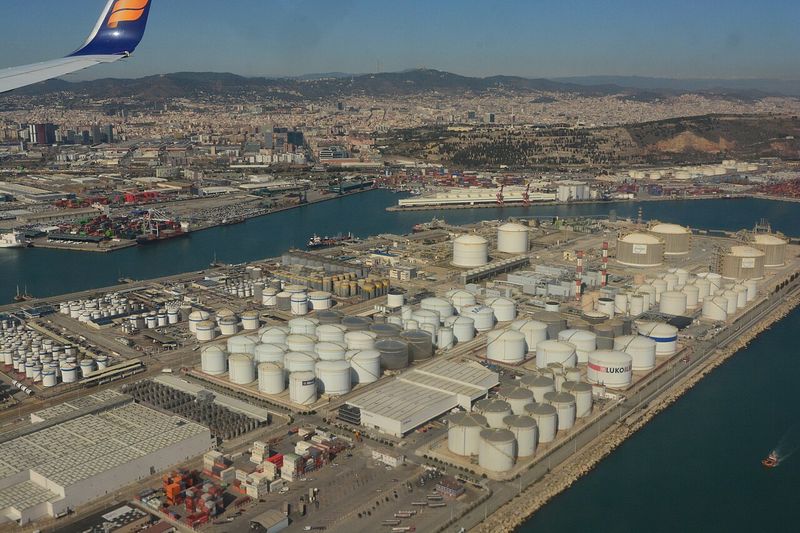
To understand why Ukraine keeps flying 950 kilometres to the same address, start with the facility’s dimensions as reported by Militarnyj: the Samara station covers more than 216 hectares — roughly 300 football pitches — and holds 71 storage tanks with a combined capacity exceeding 1.6 million cubic metres. Converted, that is on the order of ten million barrels of tankage: not a depot, but one of the load-bearing nodes of the Russian crude system, the point at which streams of different quality from Tatarstan, Western Siberia and elsewhere are gathered and blended into the consistent export grade the market knows as Urals.
Blending hubs occupy a particular place in a pipeline network. A refinery can, in principle, be bypassed, repaired unit by unit, or fed from storage; a dispatch station where multiple trunk lines meet is closer to a junction box — damage there does not merely destroy product, it interrupts the scheduling of everything upstream and downstream of it. That is the logic Kyiv states openly: the SBU has argued that strikes on such nodes complicate the preparation of crude for export and create problems for its transport and storage. Whether any single strike achieves that effect depends on which tanks, pumps and manifolds burned — detail neither side has published for November 13 — but the choice of target class is itself the strategy, and it has been consistent for months, as Signal Post News reported when Ukraine struck Samara oil targets at the start of October.
Six strikes in six weeks, by the Ukrainian count
The cadence is the second half of the arithmetic. Militarnyj reported that the site was previously struck on October 2, 7, 10 and 11, and that around 40 percent of its tank system had been damaged or destroyed as of October 11 — figures this article presents as a Ukrainian count, not settled fact, because they originate with Ukrainian outlets and officials and have not been independently audited tank by tank. Reporting since then has recorded at least one further hit on the station in early November, which makes November 13 at least the sixth reported strike on the Samara LPDS since October 2. A site struck six times in six weeks is not being attacked opportunistically; it is being worked, the way artillery works a position — return visits timed to repairs, each new fire resetting the work of restoring the last one.
The pattern also has a recent political history. In late October, Ukraine’s refinery campaign ran through a very public argument about pauses, pressure and Patriots — the sequence Signal Post News covered in Zelenskyy’s account of Patriots offered alongside a one-month refinery-strike pause — and then resumed at full tempo, as our report on the Novokuybyshevsk refinery strike in Samara Oblast that ended the pause documented on October 30. Prosvet on November 13 is what the resumed campaign looks like two weeks on: not a single symbolic deep strike, but a return to a target already hit five times.
The same night, in the other direction
Brief context, kept brief because the exchange is now routine in both directions: on the same night of November 13–14, Russia launched 96 Shahed-type drones at Ukraine, of which Ukraine’s Air Force said 81 were intercepted. The figures are the Air Force’s, stated as it gave them. The two campaigns — Russia’s nightly drone waves against Ukrainian cities and infrastructure, Ukraine’s long-range strikes against Russian oil and military depth — are not symmetrical in aim or in effect, but they now run on the same clock, and each side’s morning statement is, in part, an answer to the other’s.
Why this matters
Analysis, labelled as such. The first reason Prosvet matters is what it reveals about where the war’s centre of gravity has moved. Ukraine cannot match Russia’s missile inventory or its nightly drone volume, so it has built a campaign against the one Russian system that is simultaneously military, economic and export-facing: oil. A blending and dispatch hub is all three at once — it schedules crude that earns export revenue, and, on Kyiv’s account, feeds military supply. Striking it six times is a statement that the campaign is not a series of demonstrations but an attempt at cumulative industrial effect, measured in the unglamorous units of tankage offline and repair crews re-tasked.
Second, the pairing of targets in a single announcement is instructive. Prosvet is economic depth; Lipetsk-2 is operational depth — a command post and maintenance hangar at a major air base. Announcing them together presents the deep-strike programme as one instrument with two registers, and it complicates Russian air defence planning in a way single-target strikes do not: the same night’s drones must be hunted over oil country in the Volga region and over airfields far to the west of it, 600 kilometres apart. Air defence is a finite inventory of radars, interceptors and crews; every axis Ukraine opens is an axis Russia must either cover or concede.
Third, the verification gap is itself a fact of the campaign, and readers should hold it clearly. For Prosvet, there are Ukrainian claims of hits and fire, a Russian governor’s report of four dead, and no detailed Russian industrial assessment. For Lipetsk-2, there is a Ukrainian target list and nothing else. The 40-percent tank-damage figure is a Ukrainian count. None of this makes the strikes doubtful — the governor’s casualties and the repeated, specific Ukrainian announcements establish that the attacks happened — but the difference between a strike that happened and a strike that achieved its aim is precisely the difference the missing evidence would settle, and honest reporting keeps that gap open rather than filling it from either capital’s script.
Who gains, who pays — and the critics
The gains, on Kyiv’s theory, accrue slowly and indirectly: export crude made harder to blend, schedule and ship; repair capacity consumed; air defences pulled deep; and a domestic audience shown that the war’s costs travel east as well as west. Ukraine’s supporters add a fiscal argument — that sustained damage to oil infrastructure is one of the few levers that touches the revenue base funding Russia’s war without requiring anyone’s permission in Washington or Brussels. The costs are also real, and they are not only Russia’s: four people are reported dead in Samara Oblast, by the governor’s account, and every deep-strike night invites the retaliation cycle that Ukrainian cities absorb the following evening — 96 drones on this occasion, by Kyiv’s own count.
Critics of the campaign, including voices in Western capitals at various points this autumn, have argued versions of three objections: that oil-infrastructure strikes risk energy-price spikes that punish Ukraine’s own backers; that their military effect is unproven while their escalatory signalling is not; and that repeated strikes on the same industrial sites harden Russian public support rather than weakening the state’s capacity to fight. Defenders answer that the price effects have been modest, that the alternative — leaving Russia’s export machine untouched — is its own kind of subsidy, and that the tank-by-tank Ukrainian counts, even discounted, describe a repair burden no pipeline operator would choose. Both cases are arguments about cumulative effects that will only be fully legible in throughput and export data that neither side publishes promptly — which is why this article has kept the claims and the arithmetic in separate paragraphs.
What happens next
Three scenarios frame the weeks ahead, and they are scenarios, not predictions. In the first, the cadence holds: Prosvet and sites like it are revisited on the October–November rhythm, roughly weekly, with each strike’s effect compounding the repair backlog — the outcome Kyiv’s target selection seems designed to produce. Watch for satellite imagery of the tank farm, which has settled arguments after earlier strikes and is the likeliest source of a damage picture independent of either government.
In the second, Russia adapts: more air defence around the Volga oil corridor, faster tank repair and dispersal of blending operations across alternative nodes — each adaptation itself a cost, and each observable in where interceptors and construction crews appear. In the third, the campaign becomes a bargaining variable again, as it briefly was in late October: a pause offered, priced and argued over in the diplomacy that continues around the war. The late-October precedent suggests any pause would be measured in weeks and would end the way the last one did — with a refinery or a hub burning in Samara Oblast. What would change the picture is not a single night’s strike, but evidence — in imagery, in export schedules, in a Russian official assessment that has not yet come — of whether six visits to Prosvet have actually bent the flow of Urals. Until that evidence arrives, the honest summary of November 13 is the narrow one: Ukraine struck, tanks burned, four people were reported killed, an airfield was claimed hit, and the campaign’s central question remains open.
Sources
- Kyiv Post, “Ukraine Strikes Samara Urals Oil Hub and Lipetsk-2 Airbase” (November 14, 2026) — the General Staff’s November 14 announcement: the fire at the Samara LPDS near Prosvet, the 950-kilometre distance, and the Lipetsk-2 target list (maintenance hangar, aviation fuel tanks, central command-and-control post).
- EuropeSays, syndicating the Kyiv Independent, “Ukraine hits key Russian oil hub, military airbase in latest long-range strikes” (November 14, 2026) — corroborating account of the General Staff announcement for both the Samara hub and the Lipetsk-2 airfield strike.
- Security Signal, reporting the SBU via Militarnyj, “Ukraine’s SBU strikes Samara oil hub in Russia with long-range drones” (November 14, 2026) — the SBU Alpha centre’s long-range drone account; the facility’s 216 hectares, 71 tanks and 1.6 million cubic metres; the October 2, 7, 10 and 11 strike dates and the roughly 40 percent tank-system damage figure as of October 11, presented in this article as a Ukrainian count.
- DeepStrike.info (Demilitarizator), reports on strikes against Russian targets, November 14, 2026 report — the open-source strike-tracking record for the Lipetsk-2 and Samara reports of November 13–14, including its caution that Ukrainian counts are not independently confirmed and that no independent picture of the Lipetsk-2 damage exists.
- Samara Governor Vyacheslav Fedorishchev’s report of four people killed and others injured in the November 13 drone attack, and Ukraine’s Air Force account of 96 Russian Shahed-type drones launched on the night of November 13–14, 81 of them intercepted — each attributed in the text to the official who gave it.