War · Ukraine · Russia
The Ukraine drone wave Volgograd woke to on Friday was, by Russia’s own account, the largest of the war: the regional governor said four plant workers were killed in the city’s industrial zone and two more were injured, in what he described as the deadliest attack on Volgograd so far. Hours earlier, American envoys had been sitting with Vladimir Putin in the Kremlin.
Track it live: Ukraine war map — Live Global Trackers
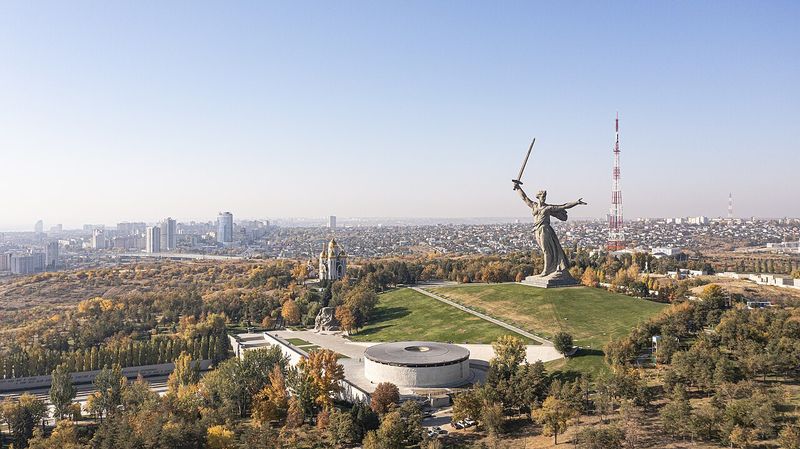
VOLGOGRAD, Russia, November 13, 2026 — A Ukrainian drone attack on the industrial zone of Volgograd killed four people and injured two in the early hours of Friday, the governor of the Volgograd region, Andrei Bocharov, said — the deadliest single attack on the southern Russian city since the full-scale war began. The dead were workers at the plant that was struck, Bocharov said. His account, carried by Russian state media and reported by Reuters and AFP, is the confirmed spine of a night that both capitals spent counting drones in the hundreds: Russia’s Defence Ministry claimed its air defences intercepted 1,198 Ukrainian drones overnight across more than 15 regions, while Ukraine’s Air Force said Russia launched 117 drones at Ukraine and that 80 were downed, with lethal consequences from Kyiv to Odesa. Every figure in this story belongs to the side that issued it, and each is attributed accordingly, because on a night like this the numbers are themselves a contested front.
Volgograd is not a frontline city. It sits on the west bank of the Volga, deep inside Russia, and its industrial south — refineries, chemical plants and the infrastructure around them — has been a recurring target of Ukraine’s long-range drone campaign against the Russian oil industry. What changed on Friday was not the targeting but the toll: previous strikes had started fires and shut in production, but Bocharov’s statement made this the first to kill workers in numbers — the deadliest attack on Volgograd so far, in the governor’s own framing. Ukrainian officials did not immediately confirm or detail the strike; Kyiv generally acknowledges its deep-strike campaign in general terms while declining to discuss individual operations.
The deadliest night Volgograd has seen
What is known comes principally from Bocharov’s statement and the Russian official reporting around it. A drone attack struck the city’s industrial zone; four people were killed, all of them workers at the plant; two more were injured. The governor did not, in the reporting available by Friday morning, dwell on the physical damage beyond the casualties, and no independent assessment of what exactly burned, or for how long, had been published. That restraint matters, because the gap between the confirmed core — an industrial site hit, four workers dead — and the much larger claims circulating online was, within hours, the defining feature of the story.
The human arithmetic deserves a pause. Industrial-zone strikes in this campaign have usually been timed and aimed to burn equipment rather than people, and both sides have traded on that distinction: Kyiv presents refinery attacks as strikes on the machinery of war finance, Moscow presents the same attacks as terrorism against civilian industry. Four dead workers collapse that distinction in the way casualties always do. The men and women who staff a refinery at night are civilians in any ordinary sense, whatever the strategic status of the plant they run; equally, a plant refining fuel for a war economy is not a purely civilian object in the framing Kyiv uses, and it is the framing each side will now prosecute. Signal Post News reports both framings because both are genuinely held and both shape what happens next — but neither changes the confirmed fact at the centre: four workers in Volgograd did not come home from a night shift, and two more are in hospital.
The refinery video Moscow has not confirmed
Within hours of the attack, video began circulating widely on social media purporting to show a large fire at Volgograd’s oil refinery — the Lukoil-operated complex that is the city’s best-known industrial site and the presumed centrepiece of Ukraine’s targeting there. That video is unconfirmed. It has not been verified as showing the refinery, this attack, or this night; Lukoil had not commented by Friday morning; and no Russian official statement available at publish time said the refinery itself was hit. Readers should hold the distinction firmly, because it is the distinction this war’s information battle is designed to blur: the industrial zone of Volgograd was attacked and four workers were killed there, on the governor’s account. Whether the refinery was among the facilities struck is, at this hour, unknown — and any account that tells you otherwise is ahead of its evidence.
Refinery fires are the scoreboard of Ukraine’s deep-strike campaign, and both sides know it: a burning distillation column is worth more, in narrative terms, than a damaged warehouse, which is precisely why unverified fire footage travels faster than verified casualty statements. The discipline that applies to the interception totals below applies here too: claims are reported as claims, footage as footage, and the two are never silently fused into a fact.
Samara: a separate attack, a separate toll
Some 800 kilometres northeast of Volgograd, a second Ukrainian strike on the morning of November 13 killed four people at an industrial facility in the Samara region, according to that region’s governor, Vyacheslav Fedorishchev, as reported by Reuters and corroborated in Meduza and Times reporting. This was a distinct attack, in a distinct region, reported by a distinct official — and it is recorded here in its own section for exactly that reason. The two tolls are not one toll, and they are not combined anywhere in this report.
The Samara account is thinner than the Volgograd one, and its limits should be stated plainly. Fedorishchev said four people were killed in a strike on an industrial facility in the region on Friday morning. The facility was not named in the governor’s statement as reported, and there has been no independent confirmation of what the target was. One claim circulating in Ukrainian open-source channels, reported by Meduza, identified the target as an LPDS oil pumping station; that identification is an unconfirmed claim, not an established fact, and Signal Post News presents it only as such. Samara region hosts major refining and petrochemical capacity and has been struck before in the refinery campaign — context that explains why the region is targeted, without settling what was hit on Friday. What is established is narrow: the governor reported four dead at an industrial facility, and no authority had, by Friday, published more that could be independently checked.
Russia’s numbers: 1,198 claimed downed
Russia’s Defence Ministry claimed that air defences intercepted 1,198 Ukrainian drones overnight, across more than 15 regions — a figure that, if the claim is taken at face value, would make this the largest single Ukrainian drone wave of the war. It is a claim, and it is reported as one: interception totals issued by a belligerent’s defence ministry in the middle of a war cannot be independently verified in real time, and both Moscow and Kyiv have institutional reasons to shape them. For scale rather than proof, the figure sits just below the 1,214 drones Russia claimed to have downed on October 29 — which tells its own story about the plateau this campaign has reached: waves that would have been unthinkable in 2023 are now, on Russia’s own accounting, a twice-a-month occurrence.
Within the national claim, Moscow’s mayor, Sergei Sobyanin, said 144 drones were downed while flying toward the capital — again, a figure sourced to Sobyanin and reported as his. The Moscow number matters beyond its size. A wave that sends well over a hundred drones at the capital region alone forces air-defence expenditure, airport closures and public alarm on a scale that smaller raids cannot, whatever the interception rate. Analysts who study this campaign make a point that applies to every total in this section: the strategic effect of a drone wave is not measured only by what gets through. It is measured by what the defence must spend — interceptors, flight hours, closed airspace, disrupted industry — to keep what gets through as low as it does. A claimed 1,198 interceptions is, among other things, an admission that 1,198 drones were in Russian airspace in one night.
The same night, over Ukraine
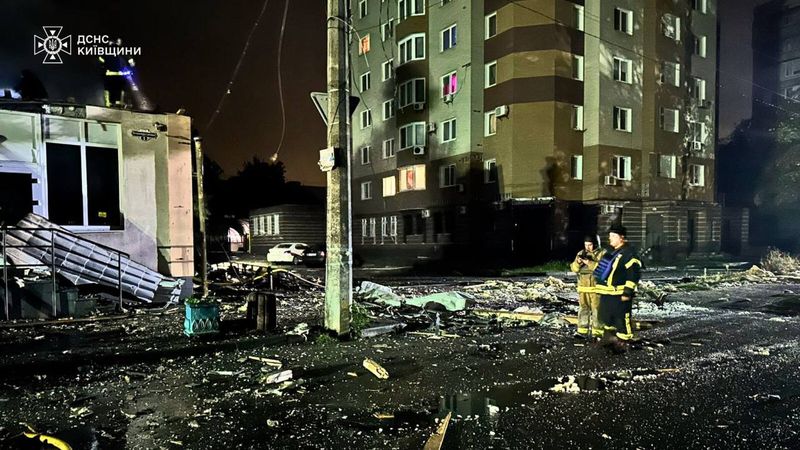
The exchange ran in both directions, and Ukraine’s night was also lethal. Ukraine’s Air Force said Russia launched 117 drones and that 80 were downed — figures attributed, like Moscow’s, to the military that issued them. In Kyiv, falling debris set fire to a medical facility in the Shevchenkivskyi district, in the centre of the capital. The State Emergency Service (DSNS) said one person was injured, seven people were rescued and 30 were evacuated from the building; The Kyiv Independent reported three injured. Those accounts differ, and both are reported here as their sources gave them; casualty counts in the first hours of an incident routinely diverge before hospitals and services reconcile them.
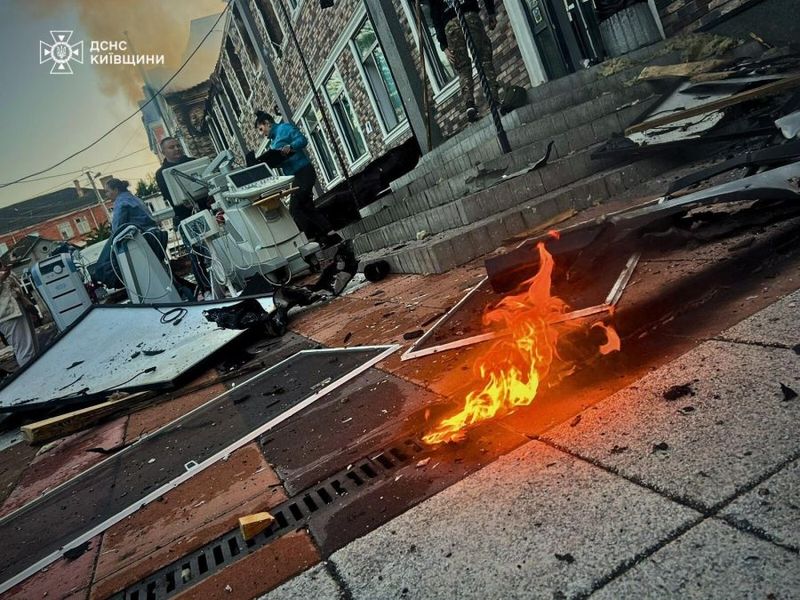
Elsewhere in Ukraine the toll was heavier. In the Odesa region, Governor Oleh Kiper said two people were killed and five wounded. In the Zaporizhzhia region, a 17-year-old was killed: the Associated Press reported one person killed in the region, while the Times reported two — a discrepancy this report attributes rather than settles, because the underlying official counts were still moving. In the Vinnytsia region, two women were wounded. UNITED24, Ukraine’s state media platform, put the Ukraine-side total at at least five killed and 18 injured. Set beside the Russian regional tolls — four dead in Volgograd on Bocharov’s account, four dead in Samara on Fedorishchev’s, each reported separately above — the night’s symmetry is bleak and exact: a drone war that now kills plant workers in the Volga basin and patients’ neighbours in Kyiv in the same hours, prosecuted by both sides as a campaign against the other’s war economy.
Hours after the Kremlin talks
The timing was not incidental, and neither side pretended otherwise. The wave came hours after Steve Witkoff and Jared Kushner, President Trump’s envoys, met Vladimir Putin in Moscow on November 12 — the latest round of an American-led diplomatic effort that has repeatedly collided with the air war’s own calendar. The pattern is now familiar enough to have a rhythm: talks convene, expectations are managed, and within a day the skies produce the largest barrage of the month, as if each side were filing its real position in drones. Signal Post News has tracked the parallel track all autumn, including the week Kyiv counted 115 missiles and more than 3,000 drones in seven days — the tempo against which a single night of 1,198 claimed interceptions, enormous as it sounds, is an escalation of degree rather than of kind.
What the juxtaposition means depends on the reading. In one, the barrages are leverage: each side demonstrating, while terms are discussed, that it can impose costs the other cannot stop, and therefore cannot be dictated to. In another, they are proof that neither capital is yet negotiating in the shadow of a settlement it expects to keep. Either way, the diplomacy and the drone war are now the same conversation held in two registers — and Friday’s register was the louder one.
The refinery campaign behind the wave
Volgograd and Samara are not random points on a map; they are nodes in the campaign Ukraine has run against Russian oil refining since late October, after President Trump’s push for an energy ceasefire failed to produce one. The tempo since then has been relentless and geographically widening — from the giant NORSI complex at Kstovo, struck by more than 100 drones at the start of November in an attack Signal Post News covered as Ukraine’s drone strike on the NORSI refinery, to Friday’s twin tolls on the Volga. The campaign’s strategic premise is economic: refining capacity knocked out is fuel the Russian military and economy must replace, import or do without, and it is revenue the Kremlin cannot spend.
By the measure that matters most, the campaign is biting. Two industry sources told Reuters that roughly 30% of Russian refining capacity has been temporarily reduced by Ukrainian attacks — a figure attributed here to those sources, as Reuters reported it, and one that no Russian official body has confirmed. Kyiv, for its part, has publicly linked the campaign’s future to Moscow’s behaviour: President Zelenskyy has offered to pause refinery strikes in exchange for air defence and a halt to Russian energy attacks, the bargain Signal Post News examined in Zelenskyy’s Patriots-for-a-pause offer to Trump. Friday’s wave is what the absence of that bargain looks like.
Why this matters
Three things changed on Friday, and they compound. First, the human threshold: Ukraine’s deep-strike campaign, prosecuted for months as an attack on machines and margins, killed workers in two Russian regions in a single morning’s reporting — four in Volgograd and, separately, four in Samara, each on their own governor’s word — and a campaign that kills workers acquires a different politics in Russia, and a different scrutiny abroad, than one that only burns columns. Second, the scale threshold: a claimed 1,198-drone wave, following a claimed 1,214 in October, normalises a magnitude of nightly effort that strains any air-defence economy and makes the interception percentage, rather than the fact of penetration, the real contest. Third, the diplomatic threshold: the largest wave of the war arriving hours after Kremlin talks tells every negotiator in the Witkoff–Kushner channel that the air war will not pause while they talk — it will punctuate.
There is a harder question underneath, and it belongs to both capitals. A strategy of striking the other side’s energy economy works, if it works, by imposing costs faster than they can be absorbed. On Friday’s evidence the costs are being absorbed — refineries repair, air defences reload, governors read out tolls — while the dying distributes itself among refinery workers in Volgograd, a teenager in Zaporizhzhia and the evacuated patients of a Kyiv hospital. Whether that ledger eventually forces a negotiation or merely funds the next, larger wave is the question the whole war now turns on.
What happens next
In the immediate term, expect the verification battle to run ahead of the physical one: geolocated footage and satellite imagery will test the claims around Volgograd’s industrial zone over the coming days, Lukoil’s silence will either hold or break, and Samara’s unnamed facility will either be identified by evidence or remain a governor’s sentence. Russia’s response pattern after large Ukrainian waves is retaliation in kind within days, aimed at Ukrainian energy infrastructure as winter deepens — which makes Ukraine’s repair crews and air-defence magazines the next numbers to watch. Diplomatically, the Witkoff–Kushner channel faces its hardest test: whether a process that continued through October’s record wave can survive November’s.
What do you think — does a drone campaign that now kills workers change the politics of the refinery war, or is Friday simply the new scale of it? Like, follow Signal Post News for the verification of the Volgograd footage, the Samara identification and the next round of talks, and share your thoughts in the comments below.
Related coverage: Russia Missiles Drones Ukraine Week: 115 Missiles, 1,900 Guided Bombs and 3,000 Drones in Seven Days, Kyiv Says · More Than 100 Drones Over Nizhny Novgorod: Ukraine Strikes Russia’s Giant NORSI Refinery at Kstovo Again · Zelenskyy Offers Trump a Swap: Patriots for One Month, and Ukraine Pauses Refinery Strikes
Sources
Sources: Volgograd region Governor Andrei Bocharov, statement of November 13, 2026 (four killed, two injured, industrial zone of Volgograd), as reported by Reuters, AFP and TASS; Russia’s Defence Ministry claim of November 13, 2026 (1,198 Ukrainian drones intercepted across more than 15 regions; 1,214 claimed on October 29, 2026) — reported as a claim; Moscow Mayor Sergei Sobyanin (144 drones downed en route to Moscow), as reported; Samara region Governor Vyacheslav Fedorishchev (four killed at an industrial facility, morning of November 13, 2026), via Reuters reporting carried by Devdiscourse, corroborated by Meduza and the Times; the LPDS pumping-station identification is an unconfirmed claim reported by Meduza from Ukrainian open-source channels; Ukraine’s Air Force, November 13, 2026 (117 Russian drones launched, 80 downed); State Emergency Service of Ukraine (DSNS) on the Kyiv medical facility fire, Shevchenkivskyi district (one injured, seven rescued, 30 evacuated); The Kyiv Independent (three injured in Kyiv) — differing counts attributed as given; Odesa region Governor Oleh Kiper (two killed, five wounded); Associated Press and the Times on Zaporizhzhia (one killed; two killed) — attributed, not reconciled; UNITED24 (at least five killed and 18 injured in Ukraine); Reuters reporting on the refinery campaign and the estimate from two industry sources that roughly 30% of Russian refining capacity has been temporarily reduced. The widely shared video of a fire at the Volgograd refinery is unconfirmed; Lukoil had not commented at publish time. Photos: Wikimedia Commons; State Emergency Service of Ukraine (DSNS) — file photos, as credited in the captions.