War · Ukraine · Russia
Russia says its air defences downed 1,336 Ukrainian drones overnight — the largest single-night barrage of the war, surpassing the record set barely two weeks ago — and the governor of Crimea says the Kerch Strait bridge, Vladimir Putin’s signature link between Russia and the annexed peninsula, was struck for the fourth time. The Kremlin calls the bridge damage minor. Kyiv has not claimed the bridge, and the drone count is Moscow’s own figure, reported by Reuters and not independently verified.
Track it live: Ukraine war map tracker
KYIV, November 16, 2026 — The Ukraine drone attack Moscow Crimea bridge story that Russian officials told on Monday morning is, on its own terms, a story about scale. The Russian Defence Ministry said air defences destroyed 1,336 Ukrainian drones overnight across 16 regions, with some intercepted over Crimea and over the waters of the Sea of Azov and the Black Sea, according to Reuters. If the ministry’s count is taken at face value, it was the biggest overnight drone attack since Russia’s full-scale invasion began in 2022, surpassing the previous record of 1,254 drones reported on October 29 — a record that stood for less than three weeks. And inside that barrage, according to Crimea’s Russian-installed governor, one target mattered more than all the others: the Kerch Strait bridge.
Two cautions belong at the top of this story, because they shape everything below it. The first is attribution. The figure of 1,336 is a Russian Defence Ministry claim carried by Reuters; it has not been independently verified, and wartime interception counts from either capital have consistently run ahead of what outside observers can confirm. The second is proportion. Whatever happened at the bridge on Monday, Russian officials themselves described the damage as minor, road traffic was suspended for repairs rather than ended, and trains were still running. This was not the bridge’s destruction. It was something subtler and, for Kyiv’s purposes, perhaps nearly as useful: proof, delivered three days before the leaders of the United States, China and Russia meet in Shenzhen, that Ukraine can still reach the most heavily defended structure in Russia’s war.
What Russia says happened overnight
The Defence Ministry’s account, as reported by Reuters on November 16, describes a barrage spread across 16 Russian regions — a geographic breadth that is itself part of the claim. A raid concentrated on one or two oblasts can be met by concentrating defences. A raid spread across sixteen, with additional drones intercepted over Crimea and over the Azov and Black Sea waters, forces a defender to be strong everywhere at once, and to spend interceptors everywhere at once. The ministry said all 1,336 drones were downed. It did not, in the reporting available on Monday, publish a region-by-region breakdown that would allow the claim to be tested, and Reuters could not independently verify the total.
The arithmetic of the record matters more than the record itself. The previous high, 1,254 drones on October 29, was reported less than three weeks ago. Two four-figure nights in under three weeks describe a production and launch tempo, not a one-off surge: whatever Ukraine’s drone industry and its partners have built, it can now generate a thousand-plus-drone night as a repeatable operation rather than a culminating effort. Whether every drone was intercepted is, in a sense, the least important question about such a night. A defence that must engage 1,336 targets has spent the night doing so — radars lit, interceptor stocks drawn down, crews exhausted — whether or not a single airframe got through.
President Volodymyr Zelenskyy added a second claim on Sunday night, hours before the barrage figures emerged. He said that Ukraine’s campaign against Russian refineries, running since late October, had knocked out more than half of Russia’s refining capacity. Reuters reported the claim and stated plainly that it could not independently verify it. It is carried here in exactly that form: as a claim by the Ukrainian president about the cumulative effect of a campaign whose individual strikes have been documented but whose aggregate effect on Russian refining has not been confirmed by independent assessment. Readers should hold the two numbers in this story to the same standard. Moscow’s 1,336 and Kyiv’s “more than half” are both official wartime figures, both plausible in direction, and neither verified.
The bridge: struck again
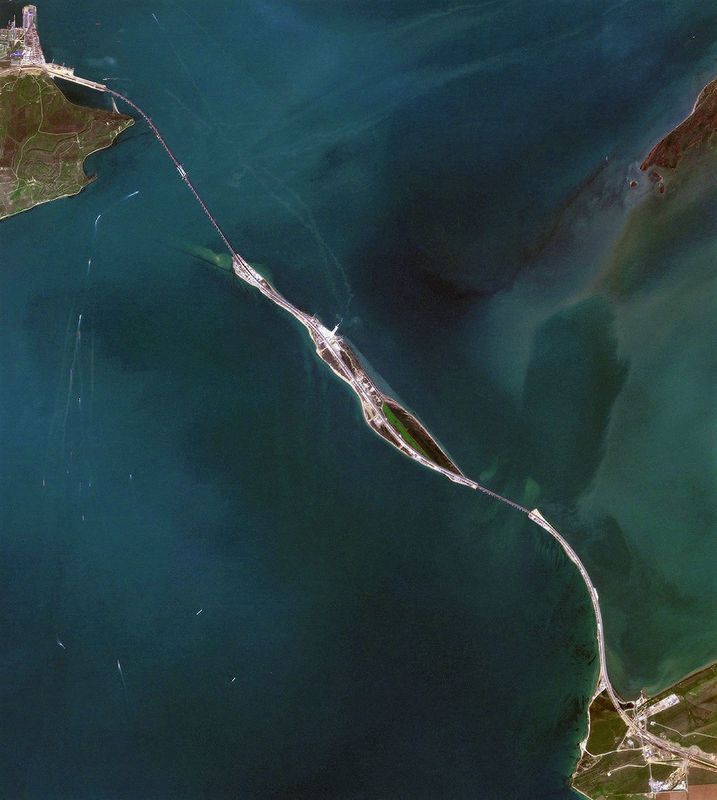
Sergei Aksyonov, the Russian-installed governor of Crimea, said Ukraine had struck the road-and-rail bridge across the Kerch Strait, which links the peninsula to Russia’s Krasnodar region. In his first statements he gave no details of damage. He said traffic across the bridge would be limited until midday on Monday, and he set up an operational headquarters in Kerch to manage the response. The Kremlin characterised the damage as minor. Russia’s transport ministry said road traffic had been temporarily suspended for repairs, while rail traffic continued as normal. No casualties were reported.
Secondary reporting, attributed here as such, fills in some of the morning’s texture. The Kerch Bridge operational channel on Telegram, via the Kyiv Post, put the halt at around 02:22 Moscow time. Grand Service Express, the rail operator, via Interfax and the Kyiv Post, reported four trains delayed: two from Moscow, one from Adler and one from St Petersburg. Those details come from operational and operator channels rather than from the Reuters wire, and they are consistent with the official picture of a road closure measured in hours and a railway that kept moving. Nothing in the verified reporting supports a stronger description. The bridge was struck; the bridge was not destroyed, severed or indefinitely closed, and any account that says otherwise is ahead of the evidence available on Monday.
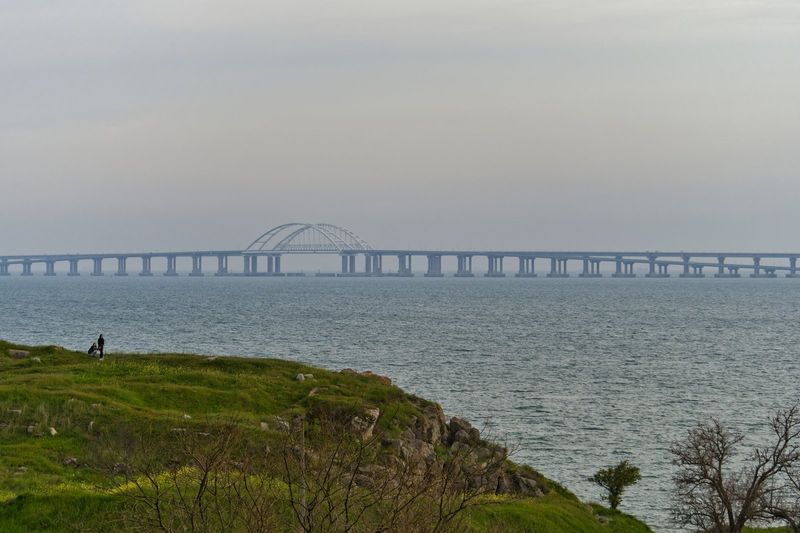
The bridge’s biography explains why a minor-damage strike still leads a news day. It is, at 19 kilometres, the longest bridge in Europe. It opened in 2018 as the signature infrastructure project of Vladimir Putin’s presidency — the physical answer to the question of whether Crimea, seized and annexed by Russia in 2014 in a move not recognised internationally, could be tied to the Russian mainland. It carries the road and rail traffic that supply the peninsula and, through it, Russian forces in southern Ukraine. Monday’s strike was the fourth of the war. A truck bomb in October 2022 killed four people and limited the bridge’s capacity for months. It was struck again in July 2023, and again in June 2025. Each attack has been repaired. Each repair has been followed, eventually, by another attack — which is precisely the rhythm Kyiv wants Moscow, and everyone watching this week, to notice.
Why this matters
Three logics converge in a single night’s barrage. The first is economic, and it is the drone war’s central equation: mass against interception. A long-range drone costs a fraction of the surface-to-air missile used to kill it, and even cheap gun and electronic defences are finite on any given night. A 1,336-drone raid does not need to leak to succeed. It needs to be answered, 1,336 times, by systems that are more expensive than what they are shooting at and that cannot be in sixteen regions at full strength simultaneously. Every record night resets the defender’s planning assumption about what the next night might require.
The second logic is the bridge itself, which is both a logistics artery and a symbol, and is targeted as both. As logistics, even a half-day road closure and a morning of delayed trains impose friction on the supply of a peninsula and a front. As symbol, the bridge is the one structure whose vulnerability Russians were promised, by its very existence, not to have to think about. A strike that the Kremlin must publicly minimise is a strike that has already done its communicative work.
The third logic is timing. The barrage came days before November 19, when Donald Trump, Xi Jinping and Vladimir Putin are scheduled to meet in Shenzhen — a trilateral at which, by the White House’s own account, Ukraine is not the focus. Kyiv was not invited to that table. A record drone night and a fourth bridge strike, delivered in the same news cycle in which UN Secretary-General António Guterres, speaking in Manila, called for an immediate and unconditional ceasefire, amount to Ukraine imposing itself on an agenda that was being arranged without it: a reminder, addressed to all three capitals, that the war’s tempo is still set in part by the country the Shenzhen meeting is not about.
Context: the bridge war and the drone war
Neither half of Monday’s story is new; both halves are escalations of campaigns already under way. Russia, for its part, has intensified strikes on bridges inside Ukraine in recent months, including in and around Kyiv, according to Reuters — attacking the connective infrastructure of Ukrainian logistics and civilian life with the same theory Ukraine applies at Kerch: that a bridge is a bottleneck that cannot be moved, hidden or quickly replaced. The two campaigns mirror each other, and Monday’s Ukrainian barrage is best read as the larger, longer-ranged counterpart of a bridge war Russia has also chosen to fight.
The drone war’s trajectory is visible in the records themselves. Through most of the war, a three-figure overnight raid was a major event. The October 29 figure of 1,254 reset the scale; Monday’s reported 1,336 reset it again, by a margin small enough to suggest not a breakthrough but a production line running at its new normal. Layered over it is the refinery campaign Zelenskyy described on Sunday: since late October, Ukrainian drones have systematically targeted the refining system that turns Russian crude into fuel for the Russian economy and military. Kyiv claims the cumulative effect exceeds half of national refining capacity. The claim is unverified. The campaign itself is not in dispute.
Europe, meanwhile, is preparing the money that keeps Ukraine’s war economy funded while the drone war expands. The Financial Times, citing four people briefed on the plan, reported that the European Commission will propose a €45 billion loan for Ukraine raised against the EU’s shared budget, to be shared with member states on Wednesday. The mechanism follows last year’s €90 billion package. The sequencing is not coincidental: a record barrage on Monday, a financing proposal on Wednesday and a great-power meeting on Thursday at which Ukraine is not the focus describe a week in which Kyiv’s supporters are trying to make its staying power a fact the Shenzhen table cannot ignore.
Who gains, who pays, what critics say
Ukraine gains the headline and the signal. A fourth bridge strike and a record drone count, achieved without any reported Ukrainian loss that Kyiv has acknowledged, demonstrate reach at the moment of maximum diplomatic risk — the week its fate is discussed in rooms it is not in. Russia gains a narrower, defensive version of the same night: an interception claim of 1,336 for 1,336, a bridge damaged only “minorly,” trains running by morning. If Moscow’s figures are accurate, its air defence absorbed the largest attack of the war without a catastrophic failure, and its officials will say so.
Who pays is easier to count. Russian air-defence units paid in interceptors and readiness. Travellers paid in a closed bridge road deck and four delayed trains. Russian refining, on Kyiv’s unverified account, has been paying since October. And the critics of both capitals’ numbers have a point that this article has tried to honour throughout: a war in which the two biggest figures of the day — 1,336 drones downed, half of refining capacity gone — are both single-source official claims is a war being narrated by its combatants. The verifiable core is smaller and still significant: a very large barrage happened, the Kerch bridge was hit for a fourth time, road traffic stopped for repairs, and no one was reported killed.
What the numbers actually mean
Start with the headline figure. 1,336 against the previous record of 1,254 is an increase of 82 drones, or about 6.5 percent. As a record, that is modest. As a pattern — a second four-figure night in under three weeks — it is the story: the threshold that defined an exceptional night in October had become, by mid-November, a threshold Ukraine could cross again on demand. Interceptor economics compound the point. Even at the cheapest end of air defence, answering four-figure raids twice a month is a budget line; at the missile end, it is a stockpile problem.
The European numbers describe the same war from the financing side. €45 billion is exactly half of last year’s €90 billion package — a second tranche, not a replacement, raised against the shared EU budget because the mechanism of last resort has become the mechanism of routine. And the bridge’s number is the oldest in the story: 19 kilometres of road and rail across a strait, a single point of failure that Russia must defend every night and Ukraine must only reach occasionally. Four strikes in three years is that asymmetry, expressed as a schedule.
What happens next
The immediate questions are forensic. Russia’s damage assessment at the bridge, and the actual hour at which road traffic resumes against Aksyonov’s midday guidance, will calibrate how much of Monday’s story was effect and how much was demonstration. A resumption on schedule supports the Kremlin’s “minor” characterisation; slippage would not. Ukraine’s own account — whether Kyiv claims the bridge strike, and what it says about the barrage’s targets and results — will fill in the other half of a picture currently drawn entirely by Moscow.
Then the week takes over. On Wednesday, the European Commission’s €45 billion loan proposal goes to member states, a vote on whether Europe’s financing keeps pace with Ukraine’s production. On Thursday, November 19, Trump, Xi and Putin meet in Shenzhen, with Ukraine reportedly not a focus — a formulation Monday’s barrage reads as a direct reply to. And somewhere in the days after, precedent suggests, Russia will answer in kind, as it has after each previous bridge strike and each previous record night. The drone war’s records have not lasted long this autumn. There is no reason to expect this one to be the exception.
Related reading: Russia Missiles Drones Ukraine Week: 115 Missiles, 1,900 Guided Bombs and 3,000 Drones in Seven Days, Kyiv Says · Ukraine Strikes Tatarstan Petrochemical Hub and TAIF-NK Refinery in Nizhnekamsk · Zelenskyy: US Floated Donbas Withdrawal for NATO Membership · Track it live: Ukraine war map tracker
Update: Azov injuries, the Moscow airports and the Kerch reports
Update, November 16. Further attributed details of the night have since been reported. In the Rostov region, Governor Vasily Slyusar reported that three people were injured and fires broke out in the Azov area, according to the governor’s account carried in the France 24 wire chain — a regional figure given by the governor, alongside the reports of industrial sites ablaze there. Of the overall barrage, roughly 600 of the drones were directed toward the Moscow region, according to the attributed Russian accounts of the attack; that is a claim about the attack’s shape, not an independently verified count, and every interception figure in this reporting remains Russia’s Defence Ministry’s claim, attributed as such. Two Moscow airports temporarily suspended operations during the attack, according to Ukrainska Pravda reporting carried by EuropeSays. And in Kerch itself, the Crimean Wind monitoring outlet reported jet drones and explosions in the city — an unverified monitoring-outlet report, which has not been independently confirmed and is recorded here as such, alongside the confirmed halt to bridge traffic and the four delayed passenger trains — two from Moscow, one from Adler and one from St Petersburg — reported by the operator Grand Service Express via Interfax and the Kyiv Post. As the Kyiv Post’s tally of the bridge’s history notes, Monday’s strike was not the first: the crossing was previously struck in October 2022, in July 2023 and in June 2025.
Sources
Reuters, November 16, 2026 — “Ukraine launches biggest drone attack on Russia since war began, defence ministry says” (https://www.reuters.com/world/europe/ukraine-launches-biggest-drone-attack-russia-since-war-began-defence-ministry-2026-11-16/): the Defence Ministry figure of 1,336 drones downed across 16 regions, some over Crimea and the Sea of Azov and Black Sea; the October 29 record of 1,254; Zelenskyy’s Sunday claim that the refinery campaign since late October had knocked out more than half of Russia’s refining capacity, which Reuters could not independently verify. Reuters, November 16, 2026 — “Ukraine hits key Crimean bridge, curbing traffic, Russian governor says” (https://www.reuters.com/world/ukraine-hits-key-crimean-bridge-curbing-traffic-russian-governor-says-2026-11-16/): Aksyonov’s statement that the Kerch Strait bridge was struck, traffic limited until midday Monday, the Kremlin’s “minor damage” characterisation, the transport ministry’s suspension of road traffic for repairs with rail continuing, and Russia’s intensified strikes on bridges inside Ukraine including Kyiv. France 24, November 16, 2026 — wire coverage of the barrage and the bridge strike. Kyiv Post, reporting the Kerch Bridge operational Telegram channel (the approximately 02:22 Moscow time halt) and Interfax / Grand Service Express (four trains delayed: two from Moscow, one from Adler, one from St Petersburg) — carried as secondary, attributed reporting. Financial Times, via four people briefed — the European Commission’s planned €45 billion loan proposal against the EU shared budget, following last year’s €90 billion package. All drone counts and damage characterisations in this article are Russian official claims reported by Reuters and are not independently verified; President Zelenskyy’s refining-capacity claim is likewise unverified. Photographs are file photos via Wikimedia Commons and do not depict Monday’s attack.