War · Iran · U.S. Politics
Will Trump hold off Iran attacks? Three people familiar with his recent discussions say the president has told senior advisers he may do exactly that — if Tehran and the Houthis offer no new provocations. It is a leaning described by anonymous sources, not a decision, and it sits alongside carriers still moving, options still ready, and a president publicly promising to strike “without hesitation” if US allies or vessels are threatened.
Track it live: Live Global Trackers — Iran War · Live Global Trackers — Wars & Conflicts · Live Global Trackers — Oil Price Forecast
WASHINGTON, November 14, 2026 — The question of whether Trump will hold off Iran attacks has moved, in recent days, from speculation to reported deliberation. President Donald Trump has told senior advisers that he may hold off on attacking Iran if there are no new provocations from Tehran or from the Houthis, according to three people familiar with the matter who spoke to Reuters on condition of anonymity. In National Security Council meetings following intelligence briefings, the president said he was considering holding off, and he has sounded sympathetic to allies who are asking him not to return to full-fledged war. That is the whole of what the reporting establishes, and this article will not inflate it: officials say Trump has not made up his mind, he has made no commitment, and the same week produced public statements pointing in the opposite direction. What has changed is the centre of gravity inside the deliberation — and the reasons, laid out below, run from allied phone calls and an intelligence assessment that more bombing would buy little, to depleted munitions stockpiles, a war the public has soured on, and a secretary of state now saying the fight is “militarily effectively over.”
What the sources say — a leaning, not a decision
Three people familiar, one consistent account
Reuters’ account, published Saturday, rests on three people familiar with the president’s recent discussions. Their version is narrow and specific: in recent days, in and around National Security Council meetings that followed intelligence briefings, Trump said he was considering holding off on further attacks, conditioned on the absence of new provocations from Iran or the Houthis. He was, the sources said, sympathetic to allies pressing him not to resume a full-fledged war. Nothing in the reporting describes an order, a directive, a timeline or a communicated policy. The New York Post’s Saturday reporting added corroborating colour to the same picture of a president weighing restraint against readiness. The White House, for its part, declined to be pinned down. “As Commander-in-Chief, President Trump is the architect and sole decision-maker who holds all the cards,” a White House official said. “The United States is in a very strong position with control of the Strait of Hormuz and the Iranian economy collapsing. Only President Trump knows what he will do, and when.” The CIA and the Office of the Director of National Intelligence offered no comment, Reuters reported, and Saudi Arabia’s foreign ministry did not respond to a request for comment.
The calls: bin Salman and Erdogan urge no resumption
Two weeks of canvassing the region’s heavyweights
Over the past two weeks, Trump has canvassed the two regional leaders whose exposure to a renewed war is greatest: Saudi Crown Prince Mohammed bin Salman and Turkish President Tayyip Erdogan. Both, according to the reporting, urged him not to resume attacks — and neither received a commitment. The Saudi track has a revealing earlier chapter that should not be blurred into the recent adviser discussions. On October 31, Trump told bin Salman that he planned to attack Iran after the elections; the crown prince pleaded with him to hold off, arguing that sanctions were working. That was a president announcing an intention and an ally arguing against it. The recent-days conversations with advisers are a different event: a president, after the elections and after fresh intelligence briefings, voicing openness to the allies’ case. Erdogan’s lobbying has been sustained — three calls since October 28 — and a Turkish readout of the November 7 call stressed that US–Iran tensions need to end. Allied pressure alone rarely moves this president, but the reporting suggests it has landed on prepared ground: an intelligence assessment that gives him an analytical reason to agree with it.
The intelligence assessment: pressure works, more strikes would not
Blockade and sanctions are hurting; bombing would not shift Tehran’s demands
Two US officials described the intelligence picture underpinning the deliberation. The naval blockade and sanctions are, on this assessment, hurting Iran’s economy, and the pressure continues without new strikes. The sharper finding is the second one: renewed strikes, analysts judge, would not significantly shift Iran’s negotiating demands. That assessment cuts the strategic case for another bombing campaign at its root — if the purpose of striking is leverage, and the leverage would not move, the strikes become cost without purchase. Alongside the blockade at sea, the US military is also moving to block weapons and sanctioned material entering Iran by land and via the Caspian Sea, tightening the same economic vice by other routes. None of this amounts to de-escalation in any formal sense; it is a strategy of pressure that its advocates argue is already delivering what bombs were supposed to deliver, more slowly and at far lower risk.
The military options stay on the table — and the stockpile problem
A third aircraft carrier, underground targets, and worrying drawdowns
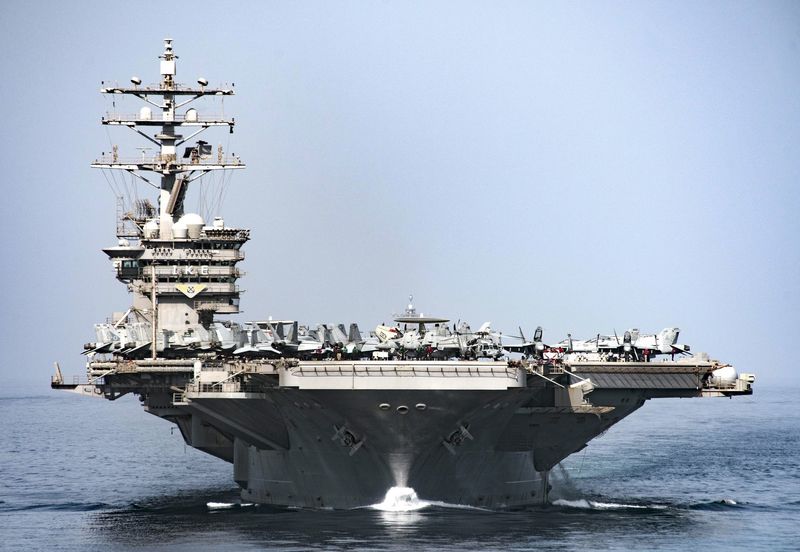
Holding off, if it happens, will not be because the United States lacks the means to strike. Three people familiar with the planning say the military is ready to escalate, and a third aircraft carrier is moving into the Middle East in the coming days to replace one of the two now in the region — with the option, notably, that all three stay. Among the options is bombing Iran’s underground nuclear facilities, which have already been struck, with further success uncertain. Against that readiness sits a constraint the deliberation cannot ignore: Trump has been briefed that some US weapon stockpiles have been drawn down to worrying levels, and Reuters reported in August that the United States had used “virtually all” of its long-range precision munitions, which had not been replenished, according to a person briefed on the matter. The White House publicly disputes any suggestion of shortage: “The United States Military has enough munitions and ammo to serve all of the Commander-in-Chief’s strategic goals and beyond,” its official said. Both claims are on the record here as claims; what is not in dispute is that stockpile arithmetic now features in the president’s briefings, and arithmetic argues for a strategy — blockade and sanctions — that consumes no precision munitions at all.
Israeli pressure one way, Rubio the other
Lobbying for another campaign, and a secretary of state declaring the war effectively over
The deliberation has a counterweight, and it is not in Riyadh or Ankara. Israeli officials have continued lobbying for another military campaign against Iran, according to a US official — a reminder that the coalition that launched the war in February is not unified on pausing it. Inside the administration itself, however, the most striking public signal of the week came from Secretary of State Marco Rubio. Speaking at the Federalist Society on Friday, Rubio described the war as “militarily effectively over,” arguing that “the economic pain that we are inflicting on that regime is so great that there’s no need for military action because we’ve weakened them so much,” and defining the objective in terms that require no further bombing: “victory is ensuring that they never have a nuclear weapon.” When the secretary of state makes the restraint case in public, in the language of victory rather than concession, he is building the political scaffolding a hold-off decision would need — whether or not the president ever uses it.
Trump’s mixed public signals
“A bit more civilly” on Thursday; “without hesitation” the same day
Anyone reading the president’s public words this week for a settled policy will find two of them. In a Thursday interview with Stephen A. Smith, Trump said of Iran: “I could end it immediately, but at the request of the nations that I am looking to protect, we are doing it a little bit longer way, a bit more civilly.” The same day, on the Salem News Channel, he said he would hit Iran “without hesitation” if it threatens US allies or vessels. A week ago, he confirmed “minor strikes” on Iranian defence facilities on Qeshm island. And on Truth Social on Thursday, he posted: “We don’t need a deal with Iran… We’ve got their money, Hundreds of Billions of Dollars, and we’ve got their Strait!” Read together, the statements are less contradictory than they first appear: they describe a conditional posture — no appetite for resuming the campaign, an explicit tripwire if Tehran or its partners provoke, and a conviction that time and pressure favour Washington. But a posture voiced by anonymous sources and talk-show answers is not a policy, and the condition — no new provocations — is one that events in the Gulf have a habit of testing.
Iran’s warning, and the politics at home
Tehran promises an “immediate and decisive response”; Washington counts the cost
Tehran, for its part, is not behaving like a capital that believes the war is over. At the UN Security Council on Friday, Iran’s deputy UN envoy, Gholamhossein Darzi, warned of an “immediate and decisive response” to any renewed US or Israeli attack. Qatari and other intermediary negotiations continue in the background, so far without fruit. The domestic politics push in the restraint direction. The war, launched in February alongside Israel, drove fuel prices up; a Reuters/Ipsos poll before the November 3 elections found 55% of Americans saying the war was not worth the cost. Vice President JD Vance has cited the war as a reason Republicans lost Congress in the midterms, and opponents of the war in the new Congress are threatening to cut its funding. A president weighing whether to resume bombing is also weighing that ledger.
Why this matters
Oil, Hormuz and the difference between a pause and a posture
The stakes of the distinction this article has been careful to keep — deliberation versus decision — are concrete. For energy markets, a genuine hold-off posture lowers the tail risk of a renewed campaign against Iranian infrastructure and of the retaliation cycle that has repeatedly threatened shipping through the Strait of Hormuz, the chokepoint the White House now claims to control; traders will nonetheless price the tripwire, because the same reporting that describes restraint also describes a president one provocation away from striking. For negotiations, the intelligence judgement that bombing would not move Tehran’s demands reframes the diplomatic problem: if leverage now comes from the blockade, the sanctions and the land and Caspian interdictions, then any eventual settlement will be negotiated on economic terms, and Iran’s “decisive response” warning is best read as deterrence against the one thing that could restart the shooting — a strike Tehran chooses to answer. For the region’s governments, the Saudi and Turkish calls mark a rare public alignment of the Gulf’s and NATO’s regional heavyweights behind restraint, even as Israel lobbies the other way; whoever prevails in that argument shapes whether the February war becomes a closed chapter or an intermission. And for the administration’s critics on both flanks — those who call the war an open-ended drain the voters have rejected, and those who argue that pausing now strands the nuclear objective half-finished — Rubio’s “effectively over” formulation is the tell: the administration is testing whether it can declare the economic campaign the war’s final phase, and be believed.
Background: from the February war to Qeshm
How the US Iran war latest news arrived at this fork
The United States and Israel launched the war on Iran in February. Its course since — strike campaigns, the naval blockade of the Strait of Hormuz, sanctions tightened to the point the White House describes Iran’s economy as collapsing — has been tracked day by day on this site, including this week’s contested Iranian claims about tankers and mines in the strait and the president’s own statement, reported here days ago, that he planned no strikes after the midterms, while insisting a deal could still happen. The “minor strikes” on Qeshm island defence facilities that Trump confirmed a week ago show how blurred the line between campaign and posture has already become: episodic, limited attacks continuing inside a broader argument about whether the campaign itself should resume. Saturday’s reporting is best understood against that background — not as a peace story, but as the first sourced account of the president leaning, in private, toward the position his allies, his intelligence briefers and his secretary of state have each, for their own reasons, been urging on him.
What happens next
Three scenarios, and the tripwire that decides between them
The first scenario is the quiet hold: no new provocations occur, no new strikes are ordered, the blockade and sanctions grind on, the third carrier arrives and the posture hardens into an undeclared policy. In that world, the test of the strategy is time — whether Tehran’s economic position deteriorates into negotiating movement that bombing, on the intelligence assessment, could not have produced. The second scenario is the tripwire: an attack on a US vessel, an ally or a partner force — by Iran or by the Houthis — that the president reads as the provocation his condition names. His own words promise the response would be immediate and unhesitating, and the forces to deliver it are being kept conspicuously in place. The third scenario is drift: no decision is ever announced, limited actions like the Qeshm strikes continue at a low level, intermediaries keep shuttling without a deal, and the war remains what Rubio called it — effectively over, formally unresolved. Each scenario turns on the same unstable variable, which is not in Washington’s control: what Tehran, and the Houthis, do next.
Related coverage: Trump Says ‘No’ to Iran Strikes After the Midterms — and That a Deal ‘Could Happen’ · Iran Says Hormuz Could Reopen in Two Days as Doha Talks Produce a Draft · Iran’s Guards Say They Struck a US Radar in Bahrain as Hormuz Tanker Claims Mount
Sources
- Reuters, November 14, 2026 — “Trump tells advisers he may hold off Iran attacks barring new provocations” (reporting by Banco, Pamuk, Stewart and Azhari): the exclusive account, from three people familiar with the discussions, of Trump telling advisers he may hold off absent provocations; the bin Salman and Erdogan calls; the intelligence assessment; the carrier movement and stockpile briefing; the White House statement; and Iran’s Security Council warning.
- New York Post, November 14, 2026 — “President Trump tells top aides he may hold off on striking Iran”: corroborating reporting on the deliberation and the administration’s public posture.
- Signal Post News — Live Global Trackers: Iran War, Wars & Conflicts and Oil Price Forecast: this newsroom’s running trackers for the war, the wider conflicts ledger and oil prices.