
Seoul’s first domestically developed hypersonic glide vehicle hit its target after maneuvering through descent. The achievement strengthens South Korea’s conventional deterrent — and makes the peninsula’s missile competition faster, harder to read and more dangerous.
SEOUL — South Korea has crossed a technological threshold that its northern rival reached first. On Thursday, October 8, Seoul flight-tested its first homegrown hypersonic glide vehicle, a maneuvering weapon built to travel at least five times the speed of sound and complicate the calculations of missile-defense crews.
President Lee Jae Myung attended the undisclosed test site and described the event as a major step toward a stronger conventional defense. His blunt message — South Korea “must secure our security through our own strength” — was aimed beyond the launch range. It was reassurance to a public living under a nuclear-armed neighbor, a signal to Pyongyang and a reminder to Washington that Seoul intends to bring more of its own capability to the alliance.
According to the presidential statement, the vehicle separated from its booster at the planned altitude, descended, maneuvered vertically and horizontally, and struck its test target. Officials said the flight validated ultra-high-temperature materials, guidance and control, and irregular low-altitude hypersonic flight. Those details matter more than the label. A fast object following a predictable ballistic arc is difficult but familiar; a fast object changing direction during flight compresses the defender’s decision window while making the interception point harder to calculate.
Why the South Korea hypersonic missile test matters
The immediate significance is not that one test overturns the military balance. It does not. The larger shift is that South Korea is building a conventional strike layer designed for the most demanding phase of a crisis: the minutes in which commanders would try to find and hit mobile launchers, command sites or hardened facilities before they can be used.
Seoul calls the South Korea hypersonic weapon “a key strategic asset capable of changing the course of the battlefield.” That phrase carries both promise and danger. A weapon optimized for surprise strikes against critical targets can strengthen deterrence if an adversary believes aggression will be answered quickly. It can also increase pressure to act early in a confrontation because both sides fear that waiting will leave their most valuable systems exposed.
This is the strategic paradox at the center of the Korea hypersonic arms race: weapons intended to make war less attractive can make a fast-moving crisis less stable. Speed shortens time for verification. Maneuverability makes tracking harder. Ambiguity about payload and target can push leaders toward worst-case assumptions before they know whether a launch is a test, a warning or the start of an attack.
What the test appears to have proved
A hypersonic glide vehicle, not merely a fast missile
A hypersonic glide vehicle is carried upward by a rocket booster, separates at altitude, then glides through the atmosphere toward its target. Unlike a conventional ballistic warhead, which generally follows a more predictable path after boost, the glide vehicle can maneuver. That combination of velocity and course changes is what creates the operational challenge.
The threshold usually attached to a hypersonic missile — Mach 5 speed — means at least five times the speed of sound. The exact ground speed varies with altitude and atmospheric conditions, but the public shorthand is useful: at roughly 1.7 kilometers per second near sea level, a weapon could cross 680 kilometers in under seven minutes if it sustained that pace in a straight line. Real trajectories, acceleration, altitude changes and maneuvers make that calculation more complicated, but the strategic lesson is simple. Warning and response time shrink sharply.
Thursday’s official account emphasized three technical achievements. Heat-resistant materials had to survive the enormous temperatures generated in atmospheric flight. Guidance and control had to keep the vehicle on course despite those conditions. And the vehicle had to make irregular vertical and horizontal movements at low altitude before reaching the test target. A first successful integrated flight does not establish combat readiness, but it suggests that South Korean engineers have moved beyond isolated component work.
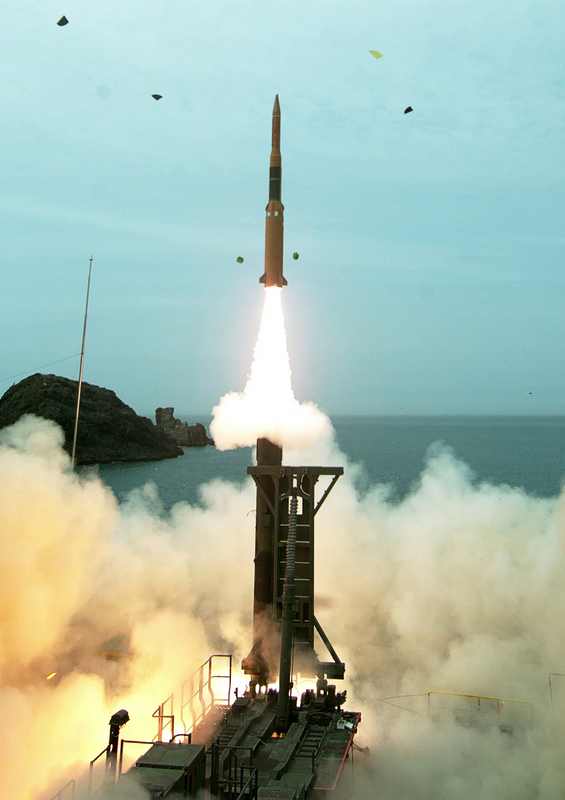
The Hyunmoo-5 missile supplies the other half of the message
Lee’s inspection of the Hyunmoo-5 missile on the same day was not incidental. South Korea’s heavy conventional ballistic missile family is designed around a different solution to the same problem: delivering a very large conventional warhead against buried or hardened targets. The new glide vehicle emphasizes speed, maneuver and penetration of defenses; Hyunmoo-5 emphasizes destructive force and the ability to hold underground facilities at risk.
Together, they point toward a layered conventional strategy. One system can complicate interception and strike fleeting targets. The other can threaten bunkers and fixed infrastructure. For South Korean planners, that mix may reduce dependence on a single weapon type and make North Korea spread its defenses across more missions.
For critics, however, the pairing also sharpens fears about pre-emption. A force built to strike leadership facilities and missile sites quickly can look defensive in Seoul and offensively destabilizing in Pyongyang. The distinction depends heavily on doctrine, alert status, command safeguards and whether the two governments retain channels capable of preventing a test or exercise from being misread.
North Korea’s test set the clock
The timing gave Thursday’s flight its political charge. One week earlier, North Korea tested what it described as a hypersonic missile in a “drill,” language meant to signal that the system was moving from development toward operational deterrence. The missile landed near Japan’s waters.
Pyongyang claimed a range of 1,000 kilometers, evasive maneuvers and assistance from artificial intelligence. South Korea and Japan estimated that the weapon traveled roughly 680 to 700 kilometers and rejected the claim that their forces lost track of it. The gap is substantial: 1,000 kilometers is about 43% to 47% farther than the outside estimates. That does not by itself prove either account, because states can test on depressed or shaped trajectories, but it shows why independent tracking data matters more than promotional language.
The North Korea AI missile claim should also be treated cautiously. “AI” can describe anything from software-assisted target selection to adaptive flight-control functions, and Pyongyang offered no public technical evidence sufficient to establish how artificial intelligence was used. The operational question is not the branding. It is whether the weapon can repeatedly maneuver with enough accuracy to defeat layered defenses under realistic conditions.
North Korea’s advancing nuclear program raises the stakes further. A North Korea hypersonic missile could carry either a conventional or nuclear payload, leaving defenders to make rapid judgments with incomplete information. South Korea’s tested system is presented as a conventional weapon, but its arrival creates a more symmetric contest in delivery technology even as the two states remain asymmetric in nuclear status.
From deterrence by alliance to deterrence by capability
For decades, South Korea’s security architecture rested on a combination of its own conventional forces, the U.S. troop presence and Washington’s extended nuclear deterrent. The new test does not replace that alliance. It changes Seoul’s bargaining position within it.
A more capable South Korean strike force can make the alliance more credible by adding sensors, launchers and weapons tailored to the peninsula. It can also answer a recurring political anxiety: whether the United States would accept the risk of escalation on behalf of Seoul during a sudden crisis. Lee’s emphasis on security through South Korea’s own strength speaks directly to that uncertainty without formally distancing his government from Washington.
The historical parallel is the long cycle of missile competition that followed the Korean War armistice. Each side has repeatedly justified new capabilities as a response to the other’s advances. Ballistic missiles produced missile defenses; missile defenses encouraged maneuvering warheads and decoys; hardened facilities encouraged heavier penetrators. Hypersonic systems are the next turn of that spiral, not a clean break from it.
Who benefits, who loses and what critics will watch
Seoul gains options and industrial leverage
South Korea gains a potential conventional response that is faster and less dependent on foreign production. Its defense companies also gain knowledge in propulsion, heat protection, control systems and advanced materials that could support other missile and aerospace programs. If the technology matures, Seoul may become a more consequential supplier to partners seeking non-nuclear precision strike capability.
Washington gains a stronger ally — with new management problems
The United States benefits when South Korea can shoulder more of the conventional deterrence mission. Yet alliance coordination becomes more complex as Seoul fields systems able to reach critical targets quickly. Rules for launch authority, intelligence sharing and crisis consultation will matter as much as raw performance.
Pyongyang loses some freedom of action
North Korean commanders must now assume that more launch sites, command nodes and hardened targets may be vulnerable to rapid conventional attack. That could force spending on mobility, camouflage, decoys, underground facilities and air defense. It may also encourage North Korea to disperse weapons or place them on higher alert, steps that make surveillance and crisis control harder.
Japan and China face a changed regional geometry
Japan gains from stronger defenses against a shared North Korean threat, but regional planners will scrutinize the new weapon’s range and doctrine. China will view any expansion of South Korean long-range precision strike systems through the wider lens of U.S.-aligned military capacity near its coast. Even a system designed for the Korean Peninsula can influence calculations beyond it.
Arms-control critics will ask whether the program adds security or merely shortens the fuse. A successful prototype may invite public confidence before reliability, accuracy and command systems are proven across repeated trials. It may also accelerate expensive countermeasures that leave every side with more weapons and less time.
Russia’s role changes the technology race
Analysts have said Russia provided North Korea with technological support for hypersonic development, a concern shaped by the deepening military relationship between Moscow and Pyongyang. Russia has used hypersonic missiles in combat since around 2024, giving it operational experience that North Korea could not acquire through testing alone.
The precise scope of any transfer remains difficult to verify publicly. It could involve materials, modeling, guidance, engines, test analysis or broader lessons about production and deployment. Even limited help can shorten development cycles when it addresses a specific engineering bottleneck. That makes South Korea’s domestic success strategically important: Seoul is not only answering North Korean tests but also trying to keep pace with a network of outside assistance.
The border is already under strain
Missile competition is unfolding against a more immediate security backdrop. Three South Korean soldiers were injured last month in land-mine blasts near the border. South Korea and the U.S.-led United Nations Command blamed devices planted by North Korea; Pyongyang denied responsibility. The dispute added another layer of mistrust to a frontier where small incidents can acquire national significance.
That matters because advanced weapons do not operate in a vacuum. A mine blast, drone incursion or disputed artillery event could create the political conditions in which leaders consider signaling with missiles. The more capable and fast those missiles become, the more important it is to preserve independent verification and military-to-military communication.
Hong Sung-pyo, a senior researcher at the Korea Institute for Military Affairs, told AFP that South Korea had devoted considerable effort to the technology and “can be said to have achieved a successful test this time.” The careful phrasing is appropriate. One flight can demonstrate integration; an operational force requires repeat tests, dependable production, trained crews and a command system designed to prevent mistakes under pressure.
What happens next
Scenario 1: Seoul moves rapidly toward deployment
If follow-on trials repeat Thursday’s performance, South Korea could move toward limited operational fielding while continuing to refine range, accuracy and maneuver profiles. The government will likely reveal enough milestones to strengthen deterrence while withholding the test location, detailed trajectory and exact capabilities.
Scenario 2: North Korea answers with another demonstration
Pyongyang has strong incentives to contest Seoul’s narrative of technological parity. A new launch, a claimed AI-enabled maneuver or footage emphasizing operational units could be used to argue that North Korea remains ahead. The risk is a cycle in which each public test creates political pressure for the other side to respond quickly.
Scenario 3: Missile defense and sensors become the real contest
Strike weapons attract attention, but the decisive competition may shift toward satellites, over-the-horizon radar, infrared tracking and networked interceptors. A hypersonic vehicle is useful only if its operators can find the target and guide the weapon; a defense is useful only if it can see the vehicle early enough to act. Investment in detection may therefore grow faster than the number of deployed glide vehicles.
Scenario 4: The alliance writes new rules
South Korea and the United States will need to integrate the new capability into existing plans without creating confusion over who controls which missions. Exercises will test not only hardware but decision chains: how warnings are confirmed, how targets are validated and how leaders distinguish a conventional response from preparations for wider escalation.
The lasting meaning of Thursday’s test will depend on what follows. Repetition would turn a technical achievement into a military capability. Transparent doctrine and reliable crisis channels could make that capability stabilizing. Without them, Mach 5 speed may deliver less security than its advocates promise — because the fastest weapon on the peninsula also gives leaders the least time to be certain they are right.
Related coverage
- North Korea’s intermediate-range missile test and the Wonsan “drill”
- Seoul prepares a response over the North Korean mine-blast dispute
- Ukraine says Russia shared advanced technology with North Korea
Sources
- Associated Press via Military.com — test details, presidential statement and regional context
- Associated Press via NPR Illinois — independent republication of the test report
- AFP via The Peninsula Times — analyst assessment and the technology race
Official claims about range, tracking and artificial-intelligence assistance are attributed to the governments that made them. The test site and full technical specifications were not disclosed.
Independent analysis of a verified test, with disputed claims and strategic uncertainty clearly attributed.