War · Middle East · Yemen · Saudi Arabia
A royal decree in Riyadh moves the coalition’s joint-forces commander into an adviser’s office and hands his command to the chief of the general staff — on the same day Houthi fighters reach Khor Omairh, about 100 kilometres from Aden, and the government Riyadh backs begins fighting for its capital instead of its coastline.
Track it live: Middle East tracker
RIYADH, Saudi Arabia, November 16, 2026 — Saudi Arabia replaces Yemen commander: that is the plain fact inside a royal decree issued on Monday, and the timing is the story. King Salman moved Lieutenant General Fahd bin Hamad Al-Salman, the officer overseeing the Saudi-led coalition fighting Yemen’s Iran-allied Houthis, out of the joint-forces command and into a new post as adviser to the defence minister for military affairs, Saudi state media reported, in a decree carried by Reuters. The chief of the general staff, General Fayyad Al-Ruwaili, was assigned the joint-forces command in addition to his existing job. The change came after Riyadh’s Yemeni allies were forced to withdraw from swathes of territory in a major setback — and on the same day Yemeni military sources said Houthi fighters had advanced to Khor Omairh, about 100 kilometres (62 miles) west of Aden, and stood about 25 kilometres from government lines at Qawah.
Personnel decrees in Riyadh are routine instruments, issued in batches and written in the flat language of administration. This one deserves to be read against the map. A day earlier, the government’s southern forces had announced they were pulling back from the Bab el-Mandeb strait to defend Aden, as Signal Post News reported in its account of how Yemen’s government forces quit Bab el-Mandeb to defend Aden. On Monday the retreat acquired a second data point — Khor Omairh — and Riyadh acquired a new commander. Two Western diplomats told Reuters the change at the top of the coalition was linked directly to the battlefield developments in Yemen and to the Houthi advance. The Saudi government media office did not immediately respond to a request for comment, Reuters reported, so the kingdom has offered no explanation of its own. What it has offered is a sequence: territory lost on Sunday, a commander moved on Monday. In a war Riyadh has directed for more than a decade, sequences like that are rarely coincidence, and the diplomats’ reading — attributed here as their analysis, not as an established motive — is the only one currently on the record.
What changed in Riyadh
The decree itself is narrow, and precision about it matters. Al-Salman was moved, not removed from service: the same instrument that took the joint-forces command from him appointed him adviser to the defence minister for military affairs, a senior post inside the ministry he had served as an operational commander. Nothing in the Saudi state media account of the decree describes a dismissal, a punishment or a disgrace, and this article does not describe one either. What the decree does is concentrate authority. Al-Ruwaili, as chief of the general staff, already sat at the top of the Saudi armed forces’ professional hierarchy; he now also holds, in his own hands, the joint-forces command that runs the Yemen war day to day. The layer between the kingdom’s senior soldier and its most consequential active campaign has been removed. Commands are structured that way when a capital wants faster decisions, tighter control, or a single accountable name — and sometimes when it wants all three at once.
There is a second, quieter signal in the arrangement. An adviser’s appointment keeps Al-Salman’s experience inside the building at the moment the war he ran is being reorganised; whatever Riyadh concluded about his campaign, it did not conclude that his knowledge was worthless. The charitable reading is continuity with a change of hand. The harder reading, and the one the two Western diplomats’ comments support, is accountability administered in the Saudi manner: no announcement of failure, no public reckoning, simply a new commander in the chair while the old one advises from down the corridor. Both readings agree on the underlying fact, which is that the previous arrangement was judged insufficient for the war as it now stands. A coalition that was holding a coastline in October does not restructure its command in November unless the coastline — and the strategy that held it — has been lost.
It is worth pausing on what the joint-forces command actually is, because its holder’s identity shapes everything downstream. The command coordinates the Saudi-led coalition’s support to Yemen’s internationally recognised government: air power, logistics, intelligence, funding and the liaison machinery that connects Riyadh’s war room to Yemeni units that do not always answer to one another. Whoever holds it decides, in practice, how much of the kingdom’s weight is placed behind which Yemeni partner, on which front, at which moment. Giving that discretion to the chief of the general staff personally, rather than to a subordinate theatre commander, raises the war’s priority inside the Saudi system at exactly the moment its Yemeni clients are falling back on their capital. Whether that priority produces reinforcement, reorganisation or a search for an exit is the question the next section’s map begins to answer — because the new commander inherits not a plan but a position, and the position is deteriorating.
The Monday map: Khor Omairh, Qawah and the road to Aden
Yemeni military sources told Reuters on Monday that Houthi fighters had advanced to Khor Omairh, about 100 kilometres west of Aden, and were about 25 kilometres from government lines at Qawah. Those two distances, taken together, describe a coastal front moving east. Khor Omairh sits on the shore west of Aden, along the same littoral the government tried to hold in the autumn campaign for the Bab el-Mandeb; Qawah is the government’s forward line in its path. An advance measured in a single day’s reporting is not a breakthrough by itself — front lines in this war have surged and settled before — but its direction is unambiguous, and it follows Sunday’s withdrawal from Dhubab and the strait rather than preceding it. The Houthis are not raiding the coast. They are walking down it, in sequence, toward the capital.
The government’s response, described to Reuters by three government sources, is a contraction with a stated purpose: secure Aden and Lahj province, redeploy and reorganise the forces that remain, and prepare to recapture the areas that have been seized. Each element of that formula carries weight. Securing Aden is now the first mission, ahead of any coastal ambition. Lahj, the province that forms Aden’s northern and western shield, is named alongside the capital because Aden cannot be held if Lahj is lost — the roads, the highlands and the approaches all run through it. And the promise to prepare a counter-offensive is, for now, a promise about a future army: the present one is described by its own side as reorganising, which is what armies do after they have been moved by an enemy rather than by their own plan. Government forces had shown as recently as October that they could take ground on this coast, when they retook Dhubab and the positions around Bab el-Mandeb; Monday’s map is the measure of how completely that achievement has been reversed in six weeks.

The coastal advance is only one arm of the pressure. The Houthis are also besieging government forces in Taiz, the highland city whose encirclement has been one of the war’s longest-running facts and whose supply lines Signal Post News tracked when the Houthis captured al-Turbah and severed the Taiz–Aden supply route. A government defending Aden, shielding Lahj and relieving Taiz simultaneously would need more coherent force than Yemen’s anti-Houthi camp has fielded at any point in this war. A government doing the first of those three while conceding the initiative on the other two is making triage decisions. Monday’s reporting, read whole, is a portrait of triage: the capital first, the province that guards it second, and everything else — the strait, the coast road, the besieged highlands — thereafter, if at all.
Aden on edge
Inside Aden, the war’s approach is measured in checkpoints. Residents told Reuters there are more of them now, and more identity checks — the small, daily bureaucracy of a city preparing to be defended. The same residents described a population worried about two things at once: the retreat itself, and the prospect of fighting drawing closer to the city they live in. Amin Mahmoud, an Aden resident who spoke to Reuters, offered the detail that captures a capital in this particular limbo: food and fuel are available. The shelves are stocked and the pumps are working; what has changed is not supply but expectation. Cities under approaching threat often pass through exactly this phase, in which ordinary life continues on ordinary terms while everyone quietly recalculates how long those terms will last. Aden has been a refuge and a seat of government for people who fled earlier fronts for a decade. The anxiety Reuters recorded is the anxiety of a place running out of further south to retreat to: behind Aden is the sea.
The checkpoints matter beyond atmosphere. A government reinforcing identity checks in its own capital is screening for infiltration — for the advance parties, informants and sleeper networks that in this war have repeatedly appeared inside cities before the front formally reached them. It is also, unavoidably, tightening control over its own population at the moment it most needs that population’s loyalty. Both purposes are served by the same barrier and the same soldier asking for papers, and Aden’s residents will experience them as one fact. How the government balances them — how frightened it makes the city it is defending, in the name of defending it — will shape whether Aden’s defence is a consolidation or the beginning of a siege mentality in a city that has already endured years of fragmented authority, rival security forces and contested streets.
Why this matters
Analysis, labelled as such. First, the command change is Riyadh’s most legible signal since the war restarted. Saudi Arabia does not explain its decrees, so its personnel choices are its statements. Moving the joint-forces command into the hands of the chief of the general staff, on the day its allies’ retreat reached Khor Omairh, tells every audience — the Houthis, the Yemeni government, the coalition’s other partners and Washington — that the kingdom regards the current course as failed and the war as important enough to run from the very top of its military. That is escalation management in both directions at once: it prepares the machinery for a harder effort, and it centralises the authority that would be needed to negotiate a softer one. Which of those the machinery is used for will not be announced either. It will be visible, as this change was, in appointments, movements and silences.
Second, the geography at stake is worth money on a global scale. The Houthis’ coastal advance restores and extends their leverage over the Bab el-Mandeb, the strait at the Red Sea’s southern mouth through which the Suez route passes. Saudi crude exports are part of that traffic: OilPrice, reporting the same Reuters sourcing on the Khor Omairh advance, noted that Saudi crude shipped from Yanbu, the kingdom’s Red Sea terminal, transits the Bab el-Mandeb — meaning the waterway now overlooked by an advancing adversary carries the exports of the very state whose commander was changed on Monday. A Houthi-held or Houthi-threatened strait does not need to be closed to be expensive; risk reprices faster than blockades form, in insurance premiums, routing decisions and naval deployments. Every kilometre the front moves from Khor Omairh toward Qawah is therefore also a movement in the price of moving oil past Yemen.
Third, Monday strengthened Iran’s position without Iran firing a shot. The Houthis are Tehran’s allies, armed and advised within a regional network whose other fronts have traded fire with the United States and its partners through the summer. A Houthi advance that forces Saudi Arabia to reorganise its coalition command, abandon a strait and defend a client capital is a strategic gain for that network at a client’s price. Reuters’ account of the war’s revival makes the connection explicit: the Yemen front reignited this summer as spillover from the wider U.S.–Iran conflict, and since it restarted, the Houthis have fired ballistic missiles and drones at Saudi airports and oil facilities even while advancing on the ground. Riyadh is thus managing two wars wearing one name — a missile-and-drone defence of its own infrastructure, and a ground war in Yemen it is now visibly losing ground in — and Monday’s decree can be read as an attempt to grip the second before it further feeds the first.
How the war came back
The speed of the reversal is the context that makes a command change explicable. Yemen’s war had been largely dormant since 2022, frozen along lines that left the Houthis holding Sanaa and the north and the recognised government holding Aden and fragments of the south. It reignited this summer as spillover of the U.S.–Iran conflict, and the autumn produced a campaign of genuine movement. In October, government forces retook Dhubab and positions around the Bab el-Mandeb — a real success, and the high-water mark of the counter-offensive. But they could not drive the Houthis away from the strait entirely, and they never retook al-Mocha, the port city further up the coast. An offensive that takes the strait’s overlook but not the coast behind it has taken a position, not a corridor; positions can be isolated, and this one was. Through the autumn the Houthis tightened their siege of government forces in Taiz and kept up missile and drone fire against Saudi airports and oil facilities, stretching the coalition’s attention across two kinds of war at once.
Sunday’s withdrawal from the Bab el-Mandeb area, covered in full in Signal Post News’ report on the retreat from the strait, converted that overstretch into a new map: the strait given up, the fallback organised around Aden. Monday then added the two facts that turn a withdrawal into a crisis of confidence — the enemy’s arrival at Khor Omairh, 25 kilometres from the Qawah lines, and the patron’s decision to change the war’s commander. The diplomatic machinery, it should be noted, has not stopped turning amid the military collapse; the Security Council’s sanctions framework on Yemen was renewed in the resolution Signal Post News covered as the UN renewed its Yemen sanctions in Resolution 2837. But sanctions renewals do not hold coastlines, and the distance between the war’s paperwork and its map has rarely been wider than it is this week.
A government fighting on two fronts — one of them itself
The bleakest assessment in Monday’s reporting came not from the Houthis but from an analyst describing the government’s own side. Mohammed Al-Qadhi told Reuters there is “a serious threat to Aden because they are getting closer and closer,” and summarised the reversal in a single sentence: “It is a major setback. The government was aiming to recapture Sanaa, but now they are defending Aden.” A war aim that has contracted from the enemy’s capital to one’s own, in the space of a season, is the definition of a campaign in collapse — and Al-Qadhi located part of the cause inside the government camp itself, in the fragmentation and infighting that have weakened it. Yemen’s anti-Houthi side is not an army but an archipelago: southern separatist forces whose first loyalty is to the south, government regulars, tribal levies and regionally sponsored units, held together by Saudi money and a shared enemy rather than by a shared command. The Houthis, whatever else is said of them, answer to one leadership. In a contest of coherence, Monday’s map shows which side has it.
That diagnosis also frames what Al-Ruwaili can and cannot fix from Riyadh. A new joint-forces commander can reallocate Saudi air support, money and matériel; he can demand reorganisation, and the government sources’ language on Monday — redeploying, reorganising, preparing — suggests that demand has already been transmitted. What he cannot decree is Yemeni unity. If the forces falling back on Aden and Lahj spend the coming weeks contesting precedence among themselves, no Saudi staff arrangement will save the capital’s approaches; if the emergency finally imposes the discipline that a decade of patronage could not, the line at Qawah may hold long enough for the promised counter-offensive to be more than a formula. The diplomats who linked Monday’s decree to the battlefield were describing a patron intervening in the only layer it fully controls — its own. The layer that decides Aden’s fate is Yemeni, and it is the layer where the war’s fragmentation has always lived.
What happens next
Four tests will show whether Monday was a reset or a prelude. First, the Qawah line: Houthi fighters stood about 25 kilometres from it on Monday, and whether that distance closes, holds or reopens is the single most informative number in Yemen this week. Second, the redeployment itself: the government says its forces are reorganising to secure Aden and Lahj and to prepare to recapture lost ground — a claim that will be verified or falsified by whether the front stabilises west of the capital, and by whether any counter-attack is attempted before the Houthis consolidate the coast they have taken. Third, the strait: shipping, insurers and navies will price the Houthis’ restored position at the Bab el-Mandeb in real time, and any interference with Yanbu-bound or Yanbu-origin crude traffic would convert a Yemeni battlefield story into a global energy story within hours. Fourth, Riyadh’s follow-through: a command change is a signal, not a strategy, and the kingdom’s next signals — reinforcement, mediation feelers, or continued silence from a media office that did not answer Reuters on Monday — will reveal which strategy the signal was serving.
For Aden’s residents, the abstractions resolve into checkpoints, stocked shelves and a question no decree can answer: whether the fighting stops at the approaches or enters the city. For the Houthis, the choice is between pressing toward Aden while the government reorganises and consolidating a coastline that already gives them the strait, the siege of Taiz and the initiative. History in this war counsels against assuming restraint from a side that is winning, and against assuming collapse from a side that has survived a decade of predictions of it. What Monday established, beyond argument, is narrower and harder: the commander is changed, the adviser is appointed, Khor Omairh is reached, and Aden is being defended. Signal Post News will update this article as the Qawah front and Riyadh’s next moves clarify.
Sources
- Reuters, November 16, 2026 (Timour Azhari and Mohammed Ghobari) — Saudi Arabia replaced the commander overseeing its coalition against the Houthis on Monday after its Yemeni allies were forced to withdraw from swathes of territory; the royal decree moving Lt Gen Fahd bin Hamad Al-Salman to adviser to the defence minister for military affairs and assigning Gen Fayyad Al-Ruwaili the joint-forces command in addition to chief of the general staff; two Western diplomats linking the change to the battlefield developments and the Houthi advance; the Saudi government media office not immediately responding to a request for comment; Yemeni military sources on the advance to Khor Omairh, about 100 km west of Aden and about 25 km from government lines at Qawah; three government sources on securing Aden and Lahj and reorganising to recapture seized areas; Aden residents on increased checkpoints and identity checks, and resident Amin Mahmoud on food and fuel remaining available amid worry over the retreat; analyst Mohammed Al-Qadhi on the serious threat to Aden, the major setback and government fragmentation; and the context of the war dormant since 2022, reignited this summer, the October retaking of Dhubab and Bab el-Mandeb positions without retaking al-Mocha, the siege of Taiz and Houthi missile and drone fire at Saudi airports and oil facilities.
- Saudi state media, November 16, 2026, as reported by Reuters — the royal decree by King Salman recording Al-Salman’s appointment as adviser to the defence minister for military affairs and Al-Ruwaili’s assignment to command the joint forces; the primary source for the personnel change.
- OilPrice, November 16, 2026 — the Houthi advance putting Saudi crude exports at risk; five Yemeni military sources to Reuters on Houthi forces reaching Khor Omairh about 100 km west of Aden; and Yanbu crude transiting the Bab el-Mandeb.
- AFP, via Times of Israel, November 16, 2026 — Houthi forces closing on Aden after seizing Red Sea coast districts in Lahj; noted here as corroboration of the advance, with this article using the Reuters distances for Khor Omairh and Qawah throughout.
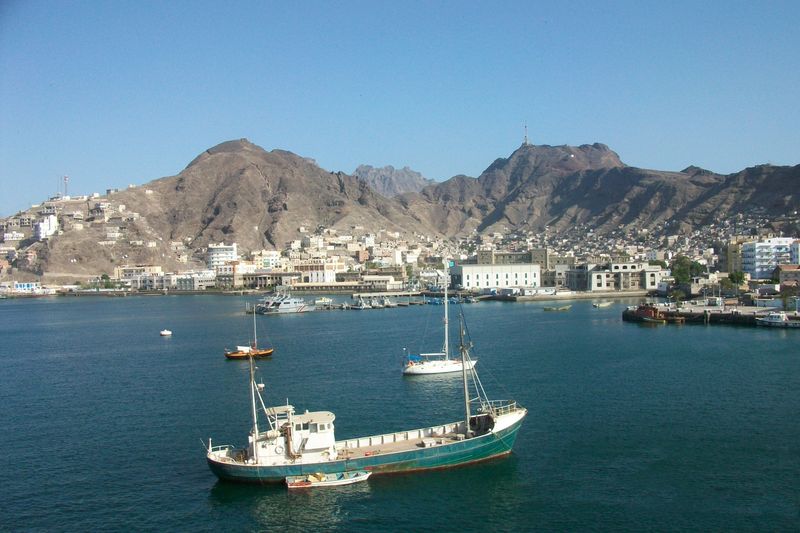
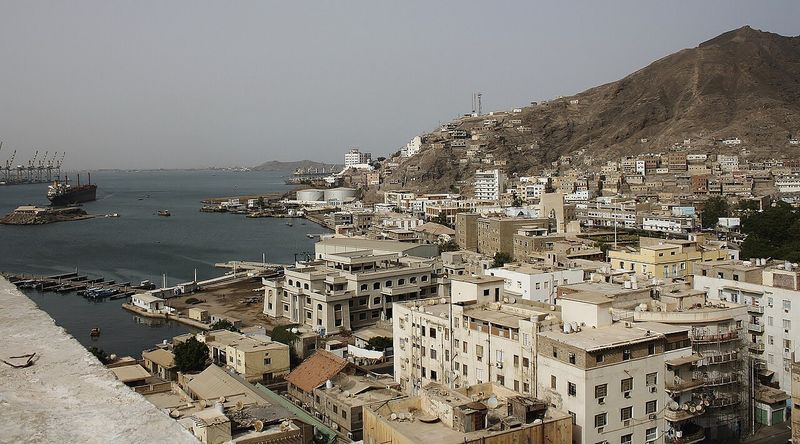
- Photos: Aden harbour by T3n60 (CC BY-SA 3.0) and the Steamer Point waterfront by Brian Harrington Spier (CC BY-SA 2.0), and the Red Sea coast on the Mokha–Taiz shore by Fuad Al-Qrize (CC BY 4.0), all via Wikimedia Commons — each credited in its caption, and none depicting the November 2026 fighting.