U.S. News · Louisiana · Maritime
The New Orleans riverboat collision happened in what should have been the safest place a passenger vessel can be: tied to its own dock, the voyage over, passengers already walking ashore. An asphalt tanker struck the moored American Heritage at the Port of New Orleans on Friday afternoon, and the riverboat rolled over at the pier. Thirty-two people were taken to hospitals, none reported critical. Every passenger was accounted for. No deaths have been reported.
NEW ORLEANS, November 13, 2026 — The New Orleans riverboat collision that rolled a docked paddlewheel cruise boat onto its side at the Port of New Orleans on Friday afternoon sent 32 people to hospitals — and, in the outcome officials returned to again and again as the evening wore on, left every passenger accounted for, with no deaths reported. At about 12:30 p.m. Central time, the Marshall Islands-flagged asphalt tanker Atlantic Asphalt struck the American Heritage, an American Cruise Lines paddlewheeler moored at Mississippi River mile marker 96, below the Crescent City Connection bridge. The riverboat took on water, listed heavily, rolled over and capsized at the dock, coming to rest on its side, partially submerged, against the pier at 1350 Port of New Orleans Place.
The timing is central to everything that followed. The American Heritage had docked about two hours earlier, ending a sailing from Natchez, and its passengers — about 129 of them, plus the vessel’s crew — were in the slow, ordinary process of disembarking when the tanker hit. This was not a collision between two vessels underway in a crowded channel. One of the two ships was not moving at all. The danger arrived at a moored boat, at a working berth, in the middle of the busiest river port in the United States, in broad daylight — and the questions that investigators now have to answer begin with how that is possible.
The two vessels
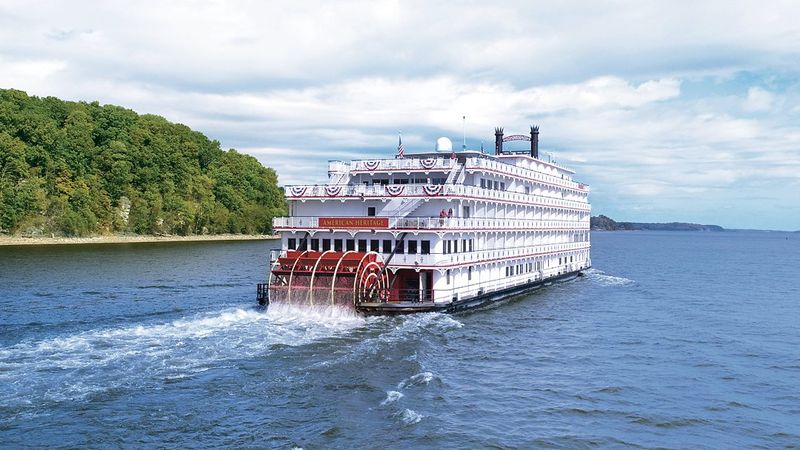
The American Heritage is a familiar sight on the lower Mississippi: a white, multi-deck sternwheeler built in the classic riverboat style, with balconied staterooms wrapped around its decks and a red paddlewheel at the stern. It was built in 2015 by Chesapeake Shipbuilding in Salisbury, Maryland, entered service as the Queen of the Mississippi — the name it carried from 2016 to 2021 — and now sails for American Cruise Lines under the American Heritage name, with New Orleans as its home port. Its stern paddlewheel was renovated in 2022. The boat’s passenger capacity is 150; that figure is a measure of how many people the vessel is certified to carry, not a count of who was aboard on Friday, and it should not be confused with one. About 129 passengers, plus crew, were aboard when it docked.
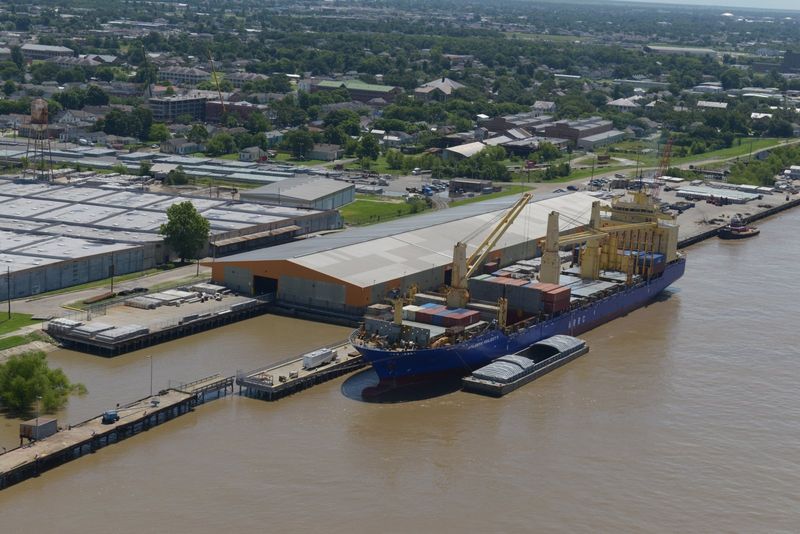
The other vessel, the Atlantic Asphalt, works the opposite end of the river economy. It is a seagoing asphalt tanker, flagged in the Marshall Islands, built to carry liquid asphalt and bitumen in heated tanks between refineries, terminals and road-building supply points. Ships of its type are regular callers on the lower Mississippi, where the cargo is heavy, the margins are industrial and the maneuvering is done in a powerful current, in confined water, surrounded by other traffic. What officials have established about the tanker so far is deliberately narrow: its name, its flag, its trade and the fact of the strike itself. Nothing in the official record released on Friday establishes why it struck a stationary vessel, and this article does not fill that gap with speculation.
The rescue: an accounting that held
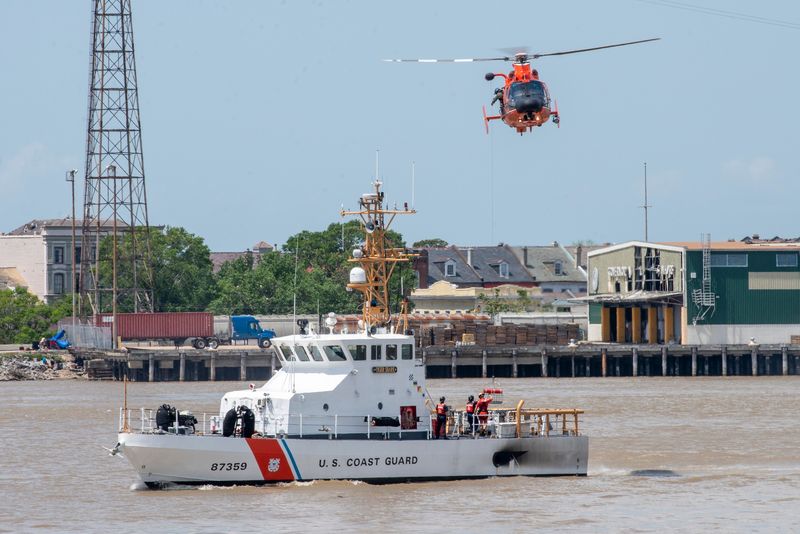
The response converged on the pier from every direction the city and the river allow. The U.S. Coast Guard, the New Orleans Fire Department, the New Orleans Police Department, Emergency Medical Services and the Port of New Orleans Harbor Police all responded, and a triage operation was set up inside the Port Administration Building, turning the port’s own headquarters into the first sorting point for the injured. The fire department’s commitment alone gives a sense of the scale officials feared in the first minutes: 23 units and 57 personnel, according to the department.
By late afternoon, Mayor Helena Moreno could give the city the numbers that mattered. Rescue crews had transported 32 people to hospitals for unspecified injuries, she said at a press conference, and none of them was reported to be in critical condition. And the count that every river disaster is ultimately judged by had closed: all 129 passengers were accounted for — “zero people unaccounted for,” in the mayor’s words — and she called the outcome “a miracle on the Mississippi.” Governor Jeff Landry, who was heading to New Orleans as the accounting firmed up, used almost the same words, calling the rescue “a literal miracle on the Mississippi.” President Trump, posting on Truth Social, praised the first responders, law enforcement and the Coast Guard, writing: “Incredibly, nobody was killed by this major collision. 32 people are in the hospital.” His figure matches the mayor’s confirmed transport count. In the verified record, the position is exactly this: 32 people hospitalized, none reported critical, every passenger accounted for, and no deaths reported.
The river itself underlines how narrow the margin was. The Mississippi at New Orleans was running at about 66 degrees Fahrenheit on Friday, by the NOAA gauge — cold enough that immersion is a medical emergency in its own right, quite apart from injury. A capsize at a dock, with gangways, shore crews, ladders and a building full of responders a few yards away, is a fundamentally different event from the same capsize mid-channel, and Friday’s outcome — a full accounting within hours — cannot be understood without that geography. The boat went over where help already was.
What officials said — and what it does not establish
Two preliminary characterisations were offered on Friday, and both need to be handled with the care their speakers attached to them. Mayor Moreno said the tanker “lost control” before it struck the docked riverboat. Coast Guard Capt. Melanie Burnham said the tanker appeared to have had “some type of loss of steering,” adding, in the same breath: “The exact reason why, we don’t know that.” Those are the words of officials describing, within hours, what the first evidence appeared to show. They are not findings. Neither the mayor nor the Coast Guard has established a cause, the cause of the collision remains under investigation, and the difference between an early characterisation and a probable-cause determination is precisely the work that now begins.
That distinction is not pedantry, and Friday’s readers deserve it stated plainly. A loss of steering, if it is confirmed, is the start of a causal chain, not the end of one: steering systems fail for mechanical, electrical, hydraulic and human reasons, they are backed by redundancies that are themselves part of the inquiry, and what a crew did in the minutes after any failure — the calls made, the anchors considered, the warnings given or not given — is as much a part of causation as the failure itself. It is also possible that the formal investigation lands somewhere else entirely. The honest summary of Friday evening is that officials have described the shape of the event — a tanker that appears to have lost steering control struck a moored riverboat — while the reason remains unknown and unproven.
What is not confirmed
Against that discipline, one early figure needs to be labelled for exactly what it is. WDSU, the local television station, reported early in the response that at least 12 people had gone into the water. That was an early local-TV report, made while the response was still unfolding; it has not been confirmed by the Coast Guard, the city or the port, and officials’ later accounting — every passenger accounted for, 32 transported — was given without endorsing it. It may yet be borne out in part; people can enter the water at a capsizing dock and be recovered without changing the transport count. But as of Friday evening it stands as an attributed, unconfirmed early report, and it is carried here as nothing more.
The same discipline applies to the arithmetic of the day. The number aboard the American Heritage was about 129 passengers plus crew. The vessel’s 150-passenger capacity is not a headcount, and combined figures that blend passengers and crew into a single larger total do not describe what officials have actually confirmed. In a story that will be re-reported for days, those distinctions are where errors breed, and they are worth fixing in print at the start.
The river closed
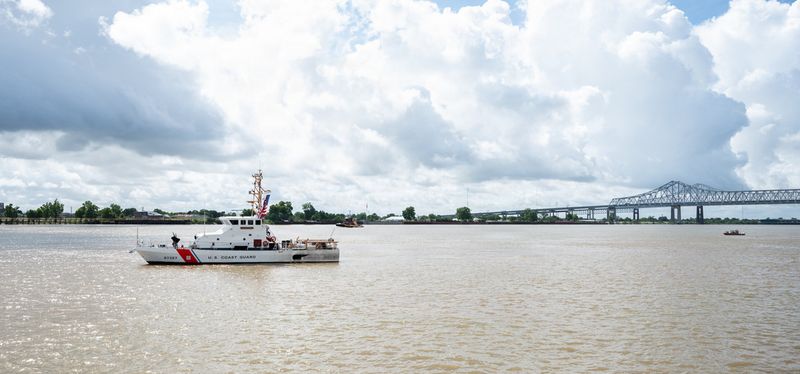
The commercial consequences began within the hour. The Coast Guard closed the Mississippi River to vessel traffic between mile markers 93 and 96 — a three-mile stretch that takes in the scene, at mile marker 96, below the Crescent City Connection — while responders worked and the capsized riverboat lay against the pier. Coast Guard Heartland District spokesperson Tasha Smith confirmed the closure and said the Coast Guard was evaluating how to reopen the river. A closure measured in miles sounds modest until it is placed on this river: the lower Mississippi is the busiest waterway in the United States, the export artery for a large share of the nation’s grain and a central corridor for energy and chemical cargoes, and its traffic does not pause gracefully. Vessels anchor, queues form in both directions, and every hour of closure prices itself into tow schedules, terminal windows and cargo contracts far upriver.
Reopening will not be a single decision but a sequence: the wreck stabilized and surveyed, the channel checked, any pollution contained and accounted for, and traffic released in stages under Coast Guard control. Until then, the capsized riverboat is not only a rescue scene and an investigation site; it is an obstruction in the working channel of the continent’s most important river, and the meter is running for everyone who trades on it.
Two investigations — and a delay that linked two emergencies
On Friday evening, the National Transportation Safety Board announced that it is launching a Go Team to investigate the collision, with the team expected to arrive on Saturday morning, November 14, and Board Member John DeLeeuw serving as the on-scene spokesperson. The Coast Guard, in parallel, will convene a Marine Board of Investigation — its most formal level of casualty inquiry. Between them, the two bodies divide the work the way American marine casualties are always divided: the NTSB, independent and focused on probable cause and safety recommendations; the Coast Guard, the regulator of the waterway itself, examining compliance, licensing and its own oversight as well as the facts.
Their start was complicated by the day’s other emergency. As the Associated Press reported, NTSB investigators were initially unable to reach New Orleans because their travel was grounded by the FAA nationwide ground stop that halted departures across the United States on Friday afternoon — the same aviation failure, unfolding in the same hours, that had already stopped the country’s air network. A marine investigation delayed by an aviation shutdown is a small irony inside a grim day, but it is also a genuinely instructive one: the systems that move Americans by air and by water failed, on Friday, within hours of each other, and each failure reached into the other’s response.
Why this matters
Strip the story down and its uncomfortable core is this: the American Heritage was doing nothing. Moored passenger vessels sit inside a web of assumptions — that traffic will keep to the channel, that steering and propulsion will hold or be caught by tugs and anchors, that the few hundred feet between a moving ship and a fixed berth are protected by competence, machinery and procedure layered together. Friday is what it looks like when those layers are pierced in daylight, beside a dock full of people, on the busiest river in America. That nobody died, on the confirmed record, is the outcome officials kept calling miraculous; the analysis has to add that miracles are not a safety system. The investigations will decide whether Friday was a machinery failure that better maintenance or redundancy could have caught, a maneuvering failure that escort or assist practices should have contained, a communications failure that traffic management should have interrupted — or some braid of all three. Each answer implies a different fix, and the fixes are not interchangeable.
There is a second, quieter stake. River cruising sells safety of a particular kind: slow water, American ports, a boat you can walk off. The American Heritage’s passengers had, in fact, already done the sailing; the voyage from Natchez was complete. What Friday tests is not the romance of the river but the industrial discipline of sharing it — a waterway where a 150-passenger paddlewheeler at its berth and a laden asphalt tanker in the current are separated by nothing more physical than the tanker’s steering gear and its crew’s options when that gear is in doubt.
What investigators will examine
The formal inquiries will work a checklist that marine investigators bring to every allision — the term of art for a moving vessel striking a fixed or moored one — and each item on it maps to a fact not yet public:
- The river itself. The Mississippi’s current at mile marker 96 on Friday — its speed, its set toward the bank, the river’s stage — and what room for maneuver it left a ship in difficulty.
- Propulsion and steering. The Atlantic Asphalt’s steering gear, propulsion and control systems, their maintenance and alarm history, and what the vessel’s own recordings show about the minutes before the strike.
- Tugs and assistance. Whether assist tugs were in attendance or available, what assistance was requested or offered, and whether the practices used for tankers at this reach of the river were followed.
- Communications and traffic management. The radio record between the tanker, other traffic and vessel traffic services; what warnings were broadcast, heard or missed; and whether the moored riverboat had any warning at all.
- The human timeline. Bridge decisions in sequence — the first sign of trouble, the attempts to check the ship’s movement, the use of anchors and engines — reconstructed from recordings, logs and testimony rather than from memory alone.
- The riverboat’s side of the pier. How the American Heritage was moored, how flooding spread once the hull was breached, and how the fact that disembarkation was underway — gangways rigged, passengers in motion between ship and shore — shaped both the danger and the escape.
What happens next
The immediate work is physical: stabilize and then salvage a capsized riverboat lying on its side at a working berth — a righting operation that will be planned in days and executed carefully around fuel, debris and the pier structure itself — while the Coast Guard sequences the reopening of the closed reach of river and the port works through the traffic the closure has stacked up. The human accounting continues in parallel: 32 people in hospitals whose conditions officials will update, and a passenger list that has been closed once, at zero unaccounted for, and will be documented formally by the investigations. The documentary record then takes over: the NTSB typically publishes a preliminary report within weeks, setting out the verified factual spine of the event, long before any probable-cause finding; the Coast Guard’s Marine Board will hear testimony in a process measured in months. Until those records exist, the most accurate sentence available about why an asphalt tanker struck a docked riverboat in New Orleans on Friday is the one Capt. Burnham offered on the day: the exact reason is not yet known — and now two federal investigations exist to find it.
What do you think — should tankers moving past moored passenger vessels on the Mississippi be required to have assist tugs made fast, whatever the cost? Like, follow Signal Post News for the NTSB team’s arrival, the salvage plan and the river’s reopening, and share your thoughts in the comments below.
Related coverage: UAE Coast Guard Rescues 22 Crew From Burning Cargo Ship in Gulf of Oman · Senegal Migrant Boat Sinks Off Kébémer: At Least 35 Dead, One Survivor
Sources
Sources: Port of New Orleans statements and incident information, November 13, 2026; U.S. Coast Guard briefings, November 13, 2026 (Capt. Melanie Burnham; Heartland District spokesperson Tasha Smith on the mile marker 93–96 river closure); City of New Orleans, Mayor Helena Moreno, late-afternoon press conference, November 13, 2026 (32 transported, none reported critical, all 129 passengers accounted for); New Orleans Fire Department response figures (23 units, 57 personnel); National Transportation Safety Board statement, November 13, 2026 (Go Team launch; Board Member John DeLeeuw on-scene spokesperson); Associated Press reporting, November 13, 2026 (including the NTSB travel delay caused by the FAA nationwide ground stop); USA TODAY, CNN, New York Post and gCaptain reporting, November 13, 2026; WDSU early reporting, November 13, 2026 (people in the water — early and unconfirmed, as attributed in the text); NOAA Mississippi River gauge data (water temperature about 66°F). President Trump’s remarks are from his Truth Social post of November 13, 2026, as quoted. Photos: American Cruise Lines via Sometimes Sailing; U.S. Coast Guard via DVIDS; Port of New Orleans — all file or official photos, as credited in the captions; no verified incident-scene photography had been released at publish time.