World · Indo-Pacific
The Japan Russian aircraft airspace violation that Tokyo protested on Tuesday lasted only about three minutes at a time — two brief entries inside a single five-minute window before dawn. But it crossed the line that matters most in the region’s crowded skies: the boundary of sovereign, territorial airspace, entered northwest of Okinoshima in Fukuoka Prefecture by two aircraft Japan believes to be Russian, on the morning Vladimir Putin was due to arrive in China.
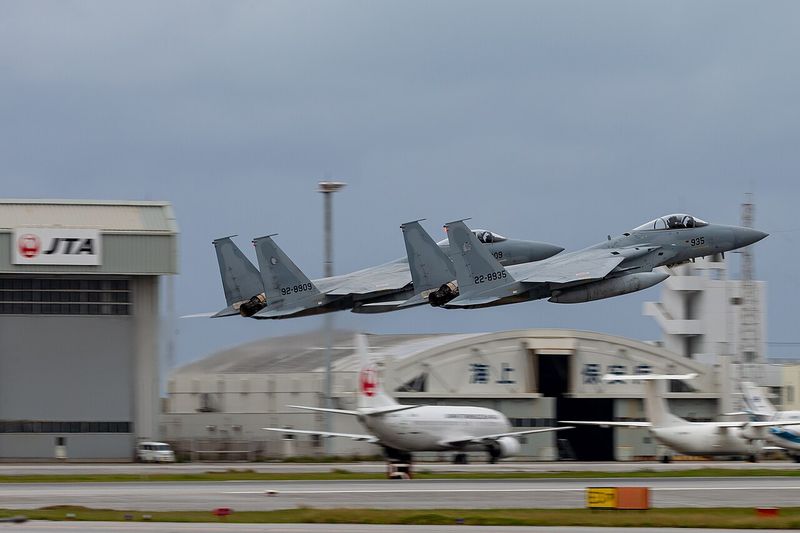
TOKYO, November 17, 2026 — The Japan Russian aircraft airspace violation began, by the Defense Ministry’s clock, at about 4:07 in the morning. Two aircraft that Japan believes to be Russian crossed into the country’s territorial airspace northwest of Okinoshima, a small, sacred island off the coast of Fukuoka Prefecture, and stayed for roughly three minutes each — two entries, overlapping inside a window of about five minutes, over Japanese territorial waters. The Air Self-Defense Force’s Western Air Defense Force scrambled fighter jets in response and issued warnings and notifications by radio. By the time the Japanese government spoke publicly, its language had escalated well beyond the routine phrasing Tokyo uses for the far more common approaches to its air defence identification zone: this, officials said, was a violation of sovereignty itself, and it drew what Defense Minister Shinjiro Koizumi called an extremely stern protest to Moscow.
Track it live: https://signalpostnews.com/tracker/wars
Precision matters in this story, and Signal Post News states it at the outset. Japan has not confirmed the identity of the two aircraft. Officials describe them as suspected Russian aircraft, or aircraft believed to be Russian, and no aircraft types have been identified in any official account — Koizumi did not specify types when he addressed the incident. What Japan is certain about is the category of the event: not a probe of an air defence identification zone, which is international airspace monitored for identification purposes, but an entry into territorial airspace, the sovereign sky above a state’s land and territorial sea, where an uninvited military aircraft has no right to be. It is the rarest and most serious class of aerial incident Japan reports, and on this southwestern route it had not happened, on the confirmed record, since 2013.
What we know
- The violation: two aircraft believed to be Russian entered Japan’s territorial airspace northwest of Okinoshima, Fukuoka Prefecture, over territorial waters on Tuesday, November 17, 2026. Defense Ministry timings reported by Kyodo and Jiji put the first entry at about 04:07–04:10 JST and the second at about 04:09–04:12 JST — roughly three minutes each, overlapping within a combined window of about five minutes.
- The response: the Air Self-Defense Force’s Western Air Defense Force scrambled fighter jets, which issued warnings and notifications. Japan lodged what Defense Minister Shinjiro Koizumi called an “extremely stern protest” through diplomatic channels and strongly demanded that Russia take preventive measures.
- The identity hold: the aircraft are suspected or believed to be Russian; Japan has not confirmed their identity, and no aircraft types have been identified in any official account.
- The route: the aircraft transited the Tsushima Strait and then flew south between Yonaguni Island — about 100 kilometres off Taiwan — and Taiwan itself, into the western Pacific. Japan’s Defense Ministry published a flight-path map of the route.
- The parallel detections, kept distinct: Taiwan’s Defence Ministry detected two Russian military aircraft off its east coast on Tuesday; they exited Taiwan’s air defence identification zone south of Taitung. Separately, South Korea’s Joint Chiefs of Staff said several Russian military aircraft temporarily entered South Korea’s air defence identification zone on Monday, in the Associated Press’s reporting — an ADIZ entry only, with no violation of South Korean sovereign airspace.
- The last precedents: the last confirmed Russian violation of Japanese territorial airspace overall was on September 23, 2024, off Rebun Island, Hokkaido. For this southwestern route, the last confirmed violation was in August 2013.
- The Russian response: no Russian response or comment was reported in the sources checked for this article. Signal Post News does not invent one.
Five minutes over Okinoshima
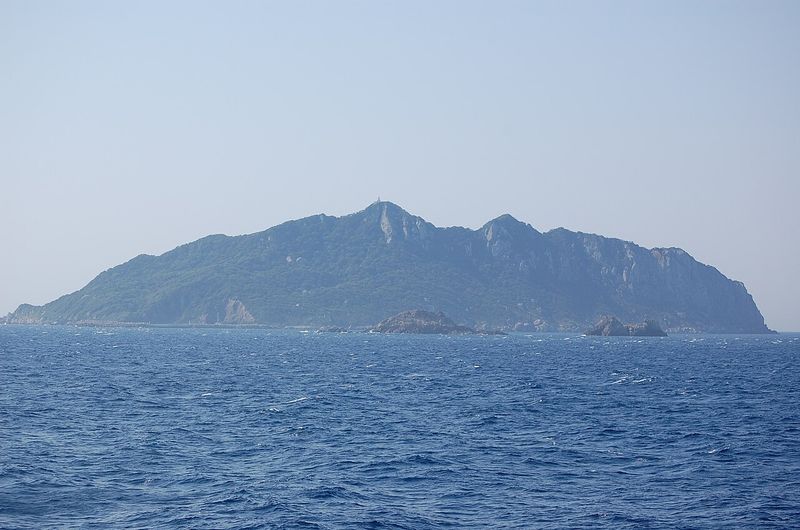
The Defense Ministry’s timings, carried by Kyodo and Jiji, describe an incident that was over almost as soon as it began. At about 4:07 a.m. Japan time — still Monday morning, Pacific Time — the first aircraft crossed into territorial airspace northwest of Okinoshima and remained inside for about three minutes, until roughly 4:10. The second entry began at about 4:09, while the first was still in progress or just ending, and lasted until about 4:12. Two aircraft, two entries, each around three minutes long, nested inside a single five-minute span over the territorial waters off an island that most Japanese know not as a military reference point but as a shrine: Okinoshima, administered by the city of Munakata, is a UNESCO World Heritage site, an island of worship where access has been restricted for centuries.
The military geography is as striking as the cultural one. Okinoshima sits in the Genkai Sea, off Japan’s southwestern main island of Kyushu, near the approaches to the Tsushima Strait — the channel between Japan and the Korean Peninsula through which shipping and aircraft pass between the East China Sea and the Sea of Japan. It falls under the watch of the ASDF’s Western Air Defense Force, the command responsible for Japan’s southwestern skies, and it was that force which scrambled fighters in the dark hours of Tuesday morning and broadcast warnings and notifications to the intruding aircraft. There is no report of flares being fired, of a physical interception manoeuvre, or of any contact beyond the radio calls — a contrast with 2024 that this article returns to below. The aircraft left Japanese airspace, and the flight continued.
‘A serious infringement of Japan’s sovereignty’
Tokyo’s protest was delivered at the top of the government. Chief Cabinet Secretary Minoru Kihara, the government’s chief spokesman, framed the incident in the strongest terms available to it. “The violation of Japan’s airspace by Russian aircraft is a serious infringement of Japan’s sovereignty,” Kihara said, describing the breach as a threat to safety that was “completely unacceptable.” His account of the diplomatic response was equally direct: “We lodged a strong protest with Russia and urged it to prevent a recurrence.” Koizumi, the defense minister, used the still sharper formulation — an “extremely stern protest” — and said Japan had strongly demanded that Moscow adopt preventive measures so that no such flight happens again.
Two features of the official accounts deserve emphasis, because they define what is not known. The first is attribution. Kihara’s statement names Russian aircraft — that is the Japanese government’s characterisation, delivered in a protest addressed to Russia — while the operational reporting, including the Associated Press’s account of Koizumi’s remarks, consistently describes the aircraft as suspected Russian aircraft. Japan has not published an identification: no radar signature release, no visual identification by the scrambling pilots has been described, and no aircraft types have been named. Koizumi, asked in effect what had crossed his country’s border in the dark, did not specify aircraft types. The second is purpose. No official account states why the aircraft flew this route, and any claim about intent — including the suggestion, carried in Japanese commentary and noted by the Japan Times, that such a flight may serve to test the ASDF’s reaction times — is speculation. Signal Post News reports it only as that: a suggestion in circulation, not a finding.
The same sweep: Taiwan and South Korea, two different legal events
Japan was not the only capital watching Russian aircraft on Tuesday. Taiwan’s Defence Ministry said it had detected two Russian military aircraft off the island’s east coast; the aircraft exited Taiwan’s air defence identification zone south of Taitung, the county on Taiwan’s southeastern coast. Japan’s Defense Ministry, for its part, published a flight-path map showing the aircraft that had crossed its own airspace continuing south — through the Tsushima Strait, then through the gap between Yonaguni Island and Taiwan, and on toward Taiwan’s east, heading south into the Pacific. Whether the aircraft Taiwan detected were the same airframes Japan tracked is the natural reading of a single long-range flight profile, but the official accounts stop short of certifying a single continuous track, and this article keeps the reports as their issuers made them: a Japanese territorial violation, and a Taiwanese ADIZ detection off the east coast, with the aircraft types in the Taiwan detection likewise unidentified.
South Korea’s encounter belongs to a different column again. The Associated Press reported that South Korea’s Joint Chiefs of Staff said several Russian military aircraft had temporarily entered the Korea air defence identification zone — the KADIZ — over the waters between the Korean Peninsula and Japan on Monday, and that Seoul had detected them before they entered and scrambled fighter jets of its own. Critically, the South Korean account records no violation of South Korean sovereign airspace: an ADIZ is a monitoring construct in international airspace, not sovereign sky, and entering one without prior notification is a diplomatic irritant, not a breach of sovereignty. The number and types of the aircraft in the South Korean report were not disclosed. Readers should hold the three events apart, because their legal weights differ absolutely: one territorial violation, in Japan; two ADIZ episodes, in Taiwan’s and South Korea’s zones, each reported by a different authority on a different day attribution — Tuesday for Taipei, Monday in Seoul’s account as carried by AP.
The route is the message
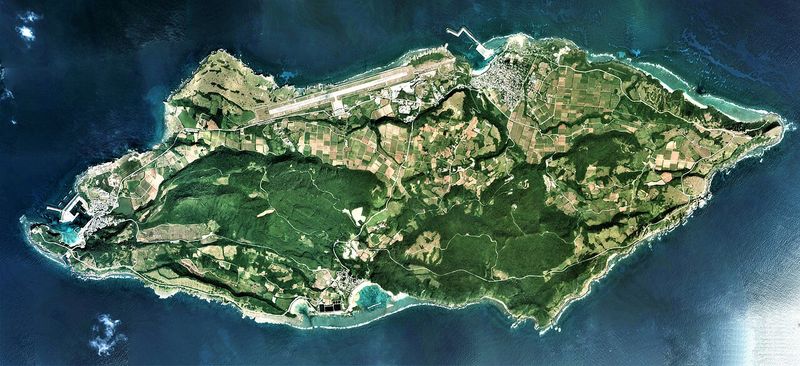
Considered as geography, the flight drew a line down the first island chain. It began in the north, at the Tsushima Strait; it crossed sovereign Japanese sky at the strait’s southwestern approaches; and it then threaded the Yonaguni gap — the roughly 100-kilometre-wide stretch of water between Japan’s westernmost island and Taiwan — before turning into the open Pacific along Taiwan’s east coast. That gap, and the waters beyond it, are among the most closely studied corridors in Indo-Pacific military planning: the route by which air and naval forces move between the East China Sea and the Philippine Sea, and a central piece of geography in any Taiwan contingency. A flight that enters Japanese territorial airspace at one end of that corridor and exits a Taiwanese ADIZ at the other is, whatever its purpose, a flight that rehearses the corridor end to end.
That reading is analysis, and Signal Post News labels it as such. The verified facts are narrower: the route as mapped by Japan’s Defense Ministry, the timings, the three separate official detections, and the protests. What can be said without speculation is that the flight was long, coordinated in its timing with detections by three different militaries, and routed through two of the region’s most sensitive chokepoints in a single sortie window. Navigation error is a difficult explanation for a profile of that shape — but difficulty is not proof, and no government in this story has yet stated the flight’s purpose on the record.
Not an ADIZ probe: the first such breach since 2024, and on this route since 2013
To understand why Tokyo reached for its strongest vocabulary, it helps to place Tuesday morning in the two timelines Japan keeps for incidents of this kind. The first is the overall record of confirmed territorial violations by Russian aircraft. The most recent before this week occurred on September 23, 2024, off Rebun Island in Hokkaido, at the opposite end of the archipelago, when a Russian Il-38 patrol aircraft entered Japanese airspace three times in a single day; Japanese F-15 and F-35 fighters scrambled, and on that occasion the response escalated to the firing of flares as a warning. Tuesday’s incident is, on Japan’s account, the first confirmed violation since Rebun — fourteen months later, and some two thousand kilometres to the southwest.
The second timeline is specific to the route. The Defense Ministry’s account, as summarised in regional reporting of the Kyodo and Jiji timings, identifies Tuesday’s entries as the first confirmed violation along this southwestern route since August 2013, when Russian bombers entered the same airspace — a thirteen-year gap for the Okinoshima corridor. The distinction matters: violations in the far north, around Hokkaido and the disputed Northern Territories — the Kuril Islands chain whose status has prevented Japan and Russia from signing a World War II peace treaty to this day — occur against a standing territorial dispute. The southwestern route has no such dispute attached to it. An entry there cannot be dressed up, by either side, as a disagreement about where a contested border runs. It is simply an entry.
The contrast in responses is also worth recording precisely. At Rebun in 2024, the escalation ladder climbed to flares. Off Okinoshima in 2026, the reported response stopped at a scramble and radio warnings and notifications — followed, at the political level, by the sternest protest language Tokyo deploys. Whether that difference reflects the brevity of the entries, the hour, or a deliberate choice, no official account says. The Associated Press’s reporting placed the incident against a broader backdrop of Japanese concern about growing Russia-China joint military activity around Japan — the context in which Tokyo’s defence establishment now reads every Russian flight near its periphery, and against which a southwestern breach lands with particular weight.
Hours before Shenzhen
The timing gave the incident a second stage. The detections came as Vladimir Putin was set to arrive in China, ahead of this week’s APEC leaders’ summit in Shenzhen — where, on Thursday, November 19, the Russian president is due to sit down with Xi Jinping and Donald Trump in the first-ever trilateral meeting of the three leaders, a encounter the White House has confirmed and Signal Post News has covered in detail: White House Confirms First-Ever Trump–Xi–Putin Meeting in Shenzhen on November 19. Reuters’ account of Tuesday’s events explicitly framed them against that arrival: Taiwan and Japan flagging incursions by Russian aircraft as Putin set to arrive in China.
Analysis, again labelled as such: a state does not usually apologise for its air force’s reach in the same week its leader seeks a peace-talks stage, and the juxtaposition cuts both ways. For Moscow, a long-range flight profile touching Japan, South Korea’s ADIZ and Taiwan’s ADIZ in a single sweep advertises that Russia’s Pacific forces remain active and far-ranging even as its leadership negotiates. For Tokyo, the breach supplies another concrete data point in its running argument — about defence spending, about southwestern-islands readiness, and about the Russia-China joint activity it has repeatedly warned against — delivered, usefully or embarrassingly depending on one’s seat, in the very week of a summit at which Russia’s president will present himself as a peer of the American and Chinese leaders. And for Seoul and Taipei, the morning was a reminder that the region’s ADIZs are now routinely visited by the same aircraft, on the same mornings, as part of the same pattern of flight.
Why this matters
Sovereignty breaches are measured by category, not by duration. Three minutes inside territorial airspace is, legally and politically, a different species of event from three hours inside an air defence identification zone, and every air force in the region understands the distinction even when public commentary blurs it. Japan’s protest language — sovereignty, safety, “completely unacceptable” — was calibrated to the category, and it now sits on the record the next time Tokyo, or any ally, tallies Russian conduct in the Pacific. The incident also stress-tested, in public, the machinery of Japan’s southwestern air defence: detection, a scramble by the Western Air Defense Force, radio warnings, a published flight-path map, and a same-day protest at spokesman and minister level. Whatever the flight’s purpose, that machinery’s timings are now a matter of public record — one reason the speculation about reaction-time testing, attributed above, circulates at all.
Finally, the morning’s three reports, laid side by side, describe the region’s new normal with unusual clarity. Russian military aircraft moved through the skies of Northeast Asia; three separate governments detected them; two scrambled jets; one recorded a violation of its sovereign airspace and protested at the highest level; and all of it happened in the hours before the Russian president’s arrival at a summit meant to showcase great-power management of the world’s crises. The gap between those two pictures — the summit table and the scramble — is the space in which Indo-Pacific security now operates.
What happens next
Three things will show whether Tuesday was an episode or the start of a pattern. The first is Moscow’s voice: no Russian response or comment was reported in the sources checked for this article, and whether Russia acknowledges the protest, disputes the Japanese account, or says nothing will shape how the incident is filed by every chancellery watching it. The second is identification: if Japan’s Defense Ministry publishes aircraft types, or releases imagery from the intercept, the suspected attribution hardens into a named platform with a known mission profile — and if it does not, the restraint itself will be read as a choice. The third is Shenzhen: whether the breach is raised, even obliquely, around the APEC meetings and Thursday’s trilateral, or whether the diplomacy proceeds as if the morning had not happened. A single three-minute entry can be absorbed as an incident. A second one, on the same route, converts it into a route — and routes, once established, are how air forces tell their neighbours what they intend to be able to do.
Sources
- Reuters, November 17, 2026 (Ben Blanchard / Kaori Kaneko, Taipei/Tokyo) — “Taiwan, Japan flag incursions by Russian aircraft as Putin set to arrive in China”: Taiwan’s Defence Ministry detecting two Russian military aircraft off its east coast on Tuesday and their exit from Taiwan’s ADIZ south of Taitung; Japan’s strong protest after two aircraft believed to be Russian violated airspace off Okinoshima, Fukuoka; Chief Cabinet Secretary Minoru Kihara’s statements (“The violation of Japan’s airspace by Russian aircraft is a serious infringement of Japan’s sovereignty”; the safety threat “completely unacceptable”; “We lodged a strong protest with Russia and urged it to prevent a recurrence”); the ASDF scramble and warnings; the route across the Tsushima Strait and between Yonaguni and Taiwan into the Pacific, as shown on the Defense Ministry’s flight-path map; the last confirmed violation off Rebun Island in September 2024; and the context of Putin’s arrival in Shenzhen for the APEC leaders’ summit.
- Associated Press, November 17, 2026 (Tokyo) — Defense Minister Shinjiro Koizumi’s account of the suspected Russian aircraft violating Japanese airspace near Fukuoka, the ASDF scramble and warnings, Japan’s “extremely stern protest” and strong demand for preventive measures, and the fact that Koizumi did not specify aircraft types; the route via the Tsushima Strait and south between Taiwan and Yonaguni; and, separately, South Korea’s Joint Chiefs of Staff reporting that several Russian military aircraft temporarily entered South Korea’s air defence identification zone over waters between the Korean Peninsula and Japan on Monday, without violating South Korean airspace, with Seoul detecting them before entry and scrambling jets and the number and types undisclosed. AP context cited in this article: Japanese concern over growing Russia-China joint military activity around Japan, and the Kuril Islands dispute that has prevented a World War II peace treaty.
- Japan Defense Ministry timings as reported by Kyodo and Jiji and summarised in regional coverage, November 17, 2026 — the first entry at about 04:07–04:10 JST and the second at about 04:09–04:12 JST, northwest of Okinoshima over territorial waters, each about three minutes within a combined window of about five minutes; the Western Air Defense Force scramble; and the assessment that this was the first confirmed violation along a similar southwestern route since Russian bombers entered the same airspace in August 2013. The September 23, 2024 Rebun Island precedent — a Russian Il-38, three entries, F-15/F-35 fighters scrambled and flares fired — is the last confirmed Russian violation of Japanese airspace overall.
- Signal Post News, related coverage: White House Confirms First-Ever Trump–Xi–Putin Meeting in Shenzhen on November 19; Latvia Airspace Intrusion: Unidentified Object Crosses Near the Russia and Belarus Borders, Then Leaves; EU Sanctions Hit Russia’s Banks, Shopping Giants and Disinformation Machine in a Single Day.
- Photos: two JASDF Mitsubishi F-15J fighters taking off at Naha, by Balon Greyjoy via Wikimedia Commons (CC0); Okinoshima seen from the sea, by Indiana jo via Wikimedia Commons (CC BY-SA 4.0); an aerial photograph of Yonaguni Island, by the Geospatial Information Authority of Japan via Wikimedia Commons (CC BY 4.0) — each credited in its caption. All are file photographs; none depicts the events of November 17, 2026 described in this article, and no imagery of the incident itself is embedded.