War · Middle East · Gaza
An Israel drone strike Gaza hospital officials reported on Saturday killed two Palestinians in Jabaliya, in the north of the territory, more than a year into a ceasefire that has never fully stopped the fire. The Israeli military said it struck two Hamas militants; Palestinian reports do not agree even on the second dead man’s name, and the ceasefire’s own death toll now comes in three different versions.
Track it live: Israel war map
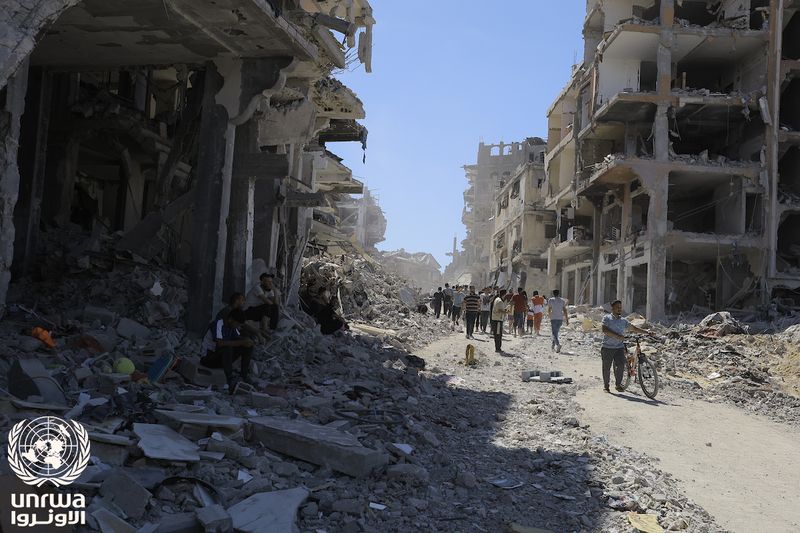
JABALIYA, Gaza Strip, November 15, 2026 — An Israeli drone strike killed two Palestinians in Jabaliya, in northern Gaza, on Saturday, November 14, in the latest of the near-daily incidents of fire that have continued, on the reporting of every wire service covering the territory, for more than a year after the October 2025 ceasefire was supposed to end the war. The two dead were taken to Shifa Hospital in Gaza City. Several other people were wounded, according to an American field hospital working in the territory, which did not provide a number. The Israeli military, asked about the strike, said it had struck two Hamas militants in the area. Beyond that core of agreement — a drone, a strike, two dead, a hospital — the accounts diverge in ways this article keeps separate and attributed, because on the record available on Saturday night, they cannot honestly be merged.
What happened: two accounts of one strike
The Associated Press account: two men walking down a street
In the Associated Press account, the drone struck two Palestinians who were walking down a street in Jabaliya, a built-up area on the northern edge of Gaza City. The source for that description is Mohamed Abu Selmiya, the director of Shifa Hospital in Gaza City, the facility to which the casualties were taken. The AP reported that an American field hospital working in the territory said several other people had been wounded, without giving a figure. The AP did not name the dead, and it carried the Israeli military’s response in a single sentence: asked about the strike, the military said it had struck two Hamas militants in the area.
The Europa Press account: a group at the Abu Sharij roundabout
Europa Press, the Spanish news agency, described a different scene. In its reporting, the strike hit a group of people gathered at the Abu Sharij roundabout — a name also rendered Abu Sharkh in other reporting — west of the Jabalia refugee camp, the dense, decades-old camp that adjoins Jabaliya. Europa Press reported that the bodies of the two dead were taken to Al-Shifa Hospital, the same facility the AP names as Shifa, and it sourced the identification of the dead to Palestinian medical sources and the Palestinian daily Filastin. Tasnim, the Iranian news agency, separately placed the strike at the Abu Sharkh roundabout, consistent with the Europa Press location, though this article treats it as corroboration of place rather than as a lead source.
The difference is not cosmetic. Two men walking down a street and a group gathered at a roundabout are different pictures, with different implications for what a drone operator could have seen, and neither wire’s reporting establishes which picture is complete. The accounts agree on what can be stated plainly: an Israeli drone struck in the Jabaliya area on Saturday; two Palestinians were killed; others were wounded, in a number no source put a figure to; and the dead and wounded went to Shifa Hospital. Everything beyond that is attribution, and this article keeps it that way.
The Israeli military’s claim, and what is not confirmed
The Israeli military’s position, as reported by the AP, is that it struck two Hamas militants in the area. A Times of Israel report added a small amount of detail: the Israel Defense Forces said it had struck two terror operatives, and that the results of the strike were under review. Both formulations are claims by the military that carried out the strike. No independent source available on Saturday confirmed the identity of the two dead men, their status, or any affiliation, and no evidence supporting the military’s characterisation was published alongside it. Equally, the Palestinian accounts — men walking in a street, or a group at a roundabout — do not by themselves establish the dead men’s status either. This article therefore reports that two Palestinians were killed, that Palestinian medical sources described them in civilian terms, and that the Israeli military described them as militants — and it labels neither description as established fact.
That discipline matters more than usual in this case, because the one question that would ordinarily narrow the gap — who the dead men were — is itself in dispute.
The names dispute: even the dead are not agreed
Palestinian sources, cited by Europa Press from the Palestinian daily Filastin, named the two dead men as Momen al Shandaghli and Rayab Rihan. The first name is consistent across the Palestinian reporting, where the fuller form Momen Rizk al-Shandaghli also appears. The second name is not consistent: another Palestinian report names the second dead man as Mohammed Jihad Omar. The two attributions cannot both be right about the same body, and nothing in the reporting available on Saturday resolves which is correct. The AP, notably, named neither man. Signal Post News presents both attributions, from the sources that published them, and settles on neither — and notes the obvious: a dispute over a dead man’s name, unresolved a day later, is itself a measure of how thin verified information out of northern Gaza remains, even in the second year of a ceasefire.
One further same-day death belongs here precisely because it does not belong in the strike toll. Nidal Zaarab died on Saturday at Al-Nasser Hospital of wounds suffered in an Israeli attack about two weeks earlier near Rafah, according to Europa Press. Some roundups therefore spoke of three Palestinians dead on the day — a count that merges two different events, one of them a fortnight old. The Jabaliya strike killed two people.
A day of fire across the territory
The drone strike was not Saturday’s only reported violence. Europa Press reported Israeli artillery fire and the demolition of buildings on Saturday east of Gaza City, in the Bureij refugee camp in central Gaza, and around Khan Younis in the south: not a single front or a declared operation, but dispersed fire at several points of the territory on the same day, each incident small enough to pass without its own headline and cumulatively large enough to keep the ceasefire’s death toll climbing.
Friday’s toll: six killed the day before
Saturday’s strike landed the day after a deadlier one. On Friday, November 13, six Palestinians were killed and about 20 injured in Israeli attacks across Gaza, according to Anadolu Agency, citing medical sources and witnesses; its reporting included an artillery strike east of Deir al-Balah that killed three people, among them a woman and a child. One of Friday’s deaths reached back to the week’s defining incident: Eyad Mohammed al-Jazzar, aged 20, died of wounds suffered in the November 12 strike on the Nasser Medical Complex in Khan Younis — the strike whose condemnation by 18 Arab and Islamic foreign ministers this newsroom reported in its coverage of the ministers’ joint statement warning that the Gaza ceasefire is at risk. A hospital strike on Thursday, a death from it on Friday alongside five other killings, a drone strike on Saturday: together they describe a ceasefire in which a two-death strike is no longer an escalation. It is the background.
The ceasefire death toll, in three conflicting versions
How many Palestinians have been killed since the ceasefire began in October 2025? On Saturday, a reader following the wire reporting in good faith could have assembled three different answers, each attributed to the same ultimate source — Gaza’s Health Ministry — and each different. This article carries all three, because choosing one would be an editorial act disguised as arithmetic.
The Associated Press, citing Gaza’s Health Ministry, reported that at least 1,600 Palestinians have been killed since the ceasefire began, and added the ministry’s breakdown that women and children make up around half of the dead. Anadolu Agency, citing Health Ministry figures, put the ceasefire-period toll at 1,622 killed and 5,878 wounded. Europa Press, citing the Health Ministry’s Saturday update, put it higher again: 1,643 killed and 5,964 wounded since the ceasefire began, with 16 people killed and 68 injured in the previous 48 hours alone.
The gaps are not, on their face, evidence that any figure is fabricated. They are what a running count looks like when republished at different moments: the Saturday update Europa Press carried is later than the figures Anadolu cited, and a ministry that recorded 16 deaths in 48 hours will produce a higher cumulative total on Saturday evening than earlier in the week. The AP’s “at least 1,600” is a rounded floor, consistent with both more precise figures. What the three versions together establish — and all this article claims for them — is the order of magnitude and the direction: more than sixteen hundred Palestinians killed, on the Health Ministry’s count as carried by three separate agencies, during a ceasefire now in its fourteenth month. Israel disputes aspects of the ministry’s counting in the wider war, and the ministry operates in a territory whose health system has been shattered; both caveats are part of the record, and neither changes the fact that the ministry’s figures are the only systematic count being published, and the one every wire service on Saturday chose to carry.
Why this matters: a ceasefire that holds on paper
Analysis. A two-death drone strike does not, by itself, end a ceasefire. What Saturday’s strike illustrates is something harder to photograph and more consequential: the normalisation of lethal fire inside an agreement whose central promise was that the fire would stop. The ceasefire that began in October 2025 — built on the Sharm El-Sheikh Agreement, President Trump’s Comprehensive Plan and UN Security Council Resolution 2803 (2025) — was never a peace treaty. It was a staged framework: an end to the large-scale war, hostages and prisoners exchanged, aid to flow, and the hardest questions deferred to later phases overseen by the United States and the Board of Peace. Thirteen months on, the large-scale war has not resumed; by that measure, the ceasefire holds. But the measure the people inside Gaza experience is the other one: near-daily Israeli fire and airstrikes, in the AP’s summary of the period, and a Health Ministry count of the ceasefire’s dead that has passed 1,600 on every version of the figures published this week.
The erosion mechanism is how ceasefires of this kind usually die — not in a single dramatic breach, but in the steady accumulation of incidents, each individually deniable as an exception. A drone strike on two men the military calls militants. Artillery east of a city. Demolitions around a camp. Each arrives with a military rationale or with no comment at all; each is answered, if at all, in the aggregate rather than the particular. Saturday produced the aggregate answer: on the same day as the Jabaliya strike, 18 Arab and Islamic foreign ministers issued a joint statement condemning continued attacks on Palestinian civilians as inconsistent with the Trump plan and demanding full implementation of the Sharm El-Sheikh Agreement and Resolution 2803. The ministers were responding to Thursday’s hospital strike, not to Jabaliya. But their logic — that the pattern, not any single strike, is the breach — is the logic under which Saturday’s two deaths will be filed in every capital that signed it.
There is a counter-reading, and balanced coverage requires it. On Israel’s account, as expressed in its responses to incidents of this kind throughout the ceasefire period, its forces act against Hamas militants and infrastructure that the framework itself obliges Hamas to dismantle, and a strike on two operatives is enforcement of the agreement’s terms rather than a violation of them. The IDF’s description of Saturday’s dead is exactly that reading applied to this strike. Its weakness, as a matter of public evidence, is the one already recorded: the claim arrives without published evidence, the Palestinian accounts describe a different scene, and even the dead men’s names are disputed. A framework whose enforcement actions cannot be publicly verified runs on the guarantors’ willingness not to look too closely. That willingness is not unlimited — but Saturday gave no sign it has yet run out in Washington, whose response is the one the framework actually runs on.
Context: Jabaliya, Shifa, and the north
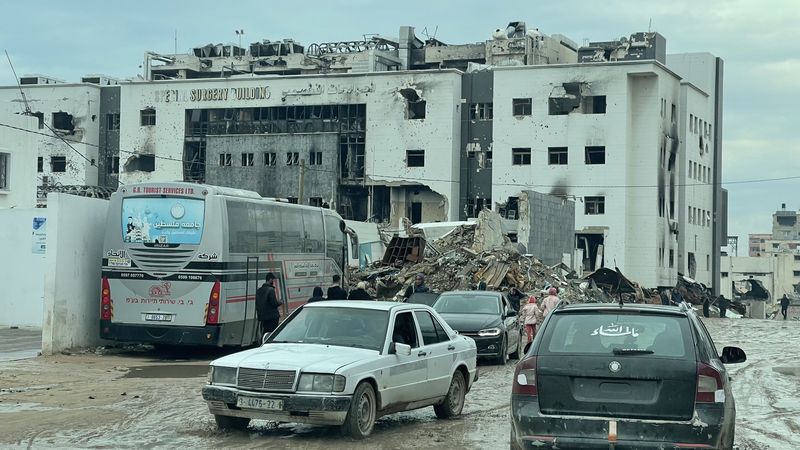
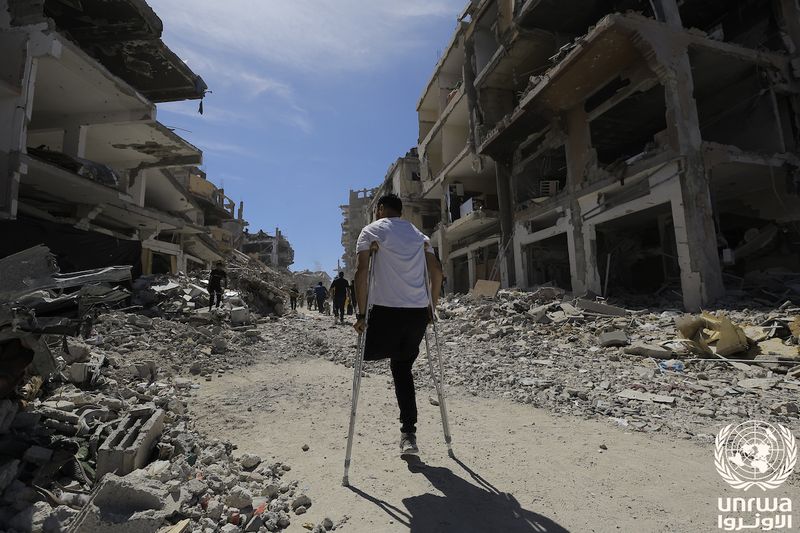
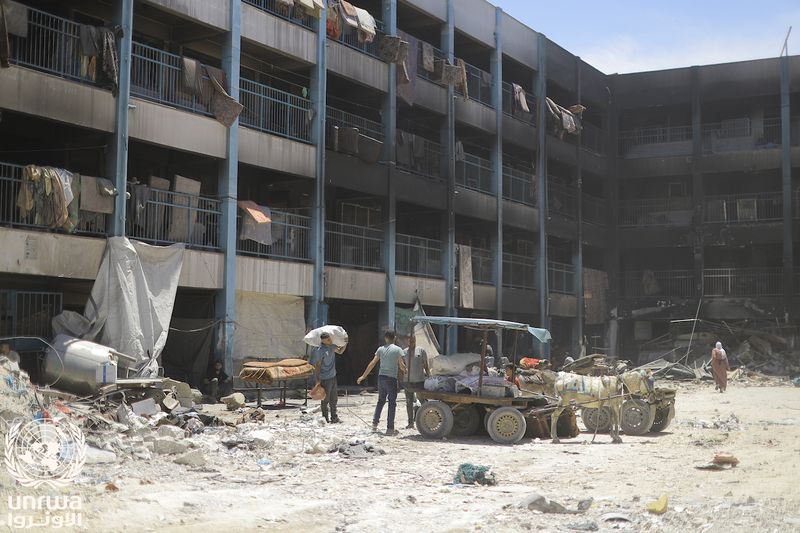
Jabaliya sits at Gaza’s northern end, on the edge of Gaza City, and the Jabalia refugee camp beside it — established in 1948 and grown into one of the most densely populated places on earth — was among the areas most heavily fought over and most thoroughly destroyed in the war that preceded the ceasefire. The population that has returned to the north lives, as the file photographs accompanying this article show, among ruins reconstruction has barely begun to touch. The roundabout named in the Europa Press account, Abu Sharij — also rendered Abu Sharkh — lies west of the camp. Shifa Hospital, to which Saturday’s casualties were taken, is Gaza City’s largest hospital; its director, Mohamed Abu Selmiya, has become one of the most quoted medical voices of the war and the ceasefire alike, because so much of the north’s casualty traffic still runs through his doors.
The strike also lands on a territory entering winter in tents. This newsroom’s reporting on the winter floods that have hit 46,000 displaced families, and the WHO’s warning of a disease surge, describes the same population Saturday’s casualties were drawn from: families in flooded makeshift shelter, a health system the ministers described as strangled by restrictions on medical supplies, and a ceasefire whose second phase — reconstruction and a durable political arrangement — remains, on all public evidence, unbegun. The drone strike and the floods are not the same story. They are the same winter.
What happens next
Analysis — scenarios, not predictions. Four things will determine whether Saturday’s strike becomes a line in a toll or a point of escalation. The first is the IDF’s own review: whether it produces names or evidence will decide whether the “two militants” claim hardens into the public record or remains an assertion. The second is identification: whether the second dead man’s name is settled — Rayab Rihan, as Filastin reported via Europa Press, or Mohammed Jihad Omar, as another Palestinian report has it — because a ceasefire in which the dead cannot be agreed upon is one in which accountability for any strike is structurally out of reach. The third is the guarantors: the ministers addressed their demands to Israel, but also to the United States and the Board of Peace, and any visible American step would signal that their audit is being read in the one capital whose reading matters. The fourth is the arithmetic: at the Health Ministry’s reported pace, the toll will keep climbing by the week, narrowing the distance between a ceasefire that holds on paper and one that no participant still believes in.
For now, the established record of Saturday, November 14, 2026, is this: an Israeli drone struck in Jabaliya; two Palestinians were killed and an uncounted number of others wounded; the casualties were taken to Shifa Hospital, whose director described two men walking down a street; Europa Press described a group at the Abu Sharij roundabout west of the Jabalia camp; the Israeli military said it struck two Hamas militants, and told the Times of Israel it had struck two terror operatives with the results under review; Palestinian sources named one dead man consistently and the second man two different ways; and the ceasefire entered its fourteenth month with its death toll, on the Gaza Health Ministry’s figures as carried by three agencies, somewhere above sixteen hundred and rising. What each of those facts means is contested. That they happened is not.
Related coverage: 18 Arab and Islamic Ministers Condemn Nasser Hospital Strike, Warn Gaza Ceasefire Is at Risk · Gaza Winter Floods Hit 46,000 Displaced Families as WHO Warns of Disease Surge · Zaporizhzhia Strike November 2026: Russia Hits City Again, 22 Injured Including Three Children
Sources
Associated Press — reporting of November 14, 2026: an Israeli drone strike killed two Palestinians in the Gaza Strip on Saturday; the drone struck two Palestinians walking down a street in Jabaliya, on the northern edge of Gaza City, according to Mohamed Abu Selmiya, director of Shifa Hospital, where the casualties were taken; an American field hospital said several other people were wounded, without a number; the Israeli military, asked about the strike, said it had struck two Hamas militants in the area; and, citing Gaza’s Health Ministry, at least 1,600 Palestinians have been killed since the October 2025 ceasefire began, with women and children making up around half of the dead, amid near-daily Israeli fire and airstrikes more than a year into the ceasefire. Europa Press — reporting of November 14, 2026 (via Democrata and Expansion): the strike hit a group gathered at the Abu Sharij roundabout, west of the Jabalia refugee camp; two bodies were taken to Al-Shifa Hospital; Palestinian medical sources via the Palestinian daily Filastin named the dead as Momen al Shandaghli and Rayab Rihan; the Health Ministry’s Saturday update put the toll since the ceasefire began at 1,643 killed and 5,964 wounded, with 16 killed and 68 injured in the previous 48 hours; Israeli artillery and building demolitions were reported the same day east of Gaza City, in Bureij camp and around Khan Younis; and Nidal Zaarab died Saturday at Al-Nasser Hospital of wounds from an Israeli attack about two weeks earlier near Rafah. A separate Palestinian report named the second dead man as Mohammed Jihad Omar; the conflict between that attribution and the Filastin names is presented in this article unresolved, as published. Times of Israel (via Philly Metro Herald) — the IDF said it struck two terror operatives and that the results were under review. Anadolu Agency — Health Ministry figures of 1,622 killed and 5,878 wounded since the ceasefire began, and reporting, via medical sources and witnesses, that six Palestinians were killed and about 20 injured in Israeli attacks across Gaza on Friday, November 13, including an artillery strike east of Deir al-Balah that killed three people including a woman and a child, and the death on Friday of Eyad Mohammed al-Jazzar, 20, from wounds suffered in the November 12 Nasser Hospital strike. Tasnim — corroboration of the Abu Sharkh roundabout location west of the Jabalia camp and of Al-Shifa sourcing. Signal Post News, November 14, 2026 — 18 Arab and Islamic Ministers Condemn Nasser Hospital Strike and Gaza Winter Floods Hit 46,000 Displaced Families as WHO Warns of Disease Surge. Photographs: Hussein Jaber (CC BY-SA 3.0 IGO) and Jaber Jehad Badwan (CC BY-SA 4.0), via Wikimedia Commons — all file photographs, captioned as such, none from the November 14 strike.