Science · India · European Union
The India Horizon Europe association deal concluded this week would make India an associated country in the European Union’s €93.5 billion research and innovation programme — the closest status Horizon Europe offers a country outside the EU. From January 2027, if the agreement is signed and the procedures completed, Indian universities, researchers and companies could receive EU funding directly, lead projects and sit inside European consortia on equal terms.
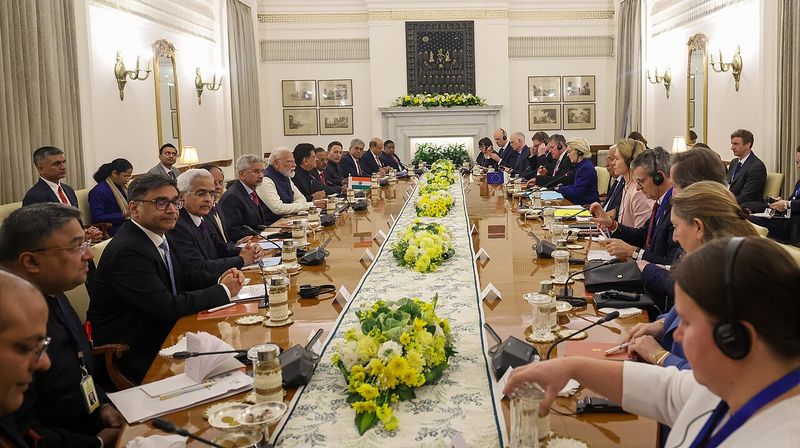
BRUSSELS / NEW DELHI, November 8, 2026 — India and the European Union have concluded negotiations on India’s association to Horizon Europe, the EU’s flagship research and innovation programme, the European Commission announced on November 6, with India’s Ministry of Science and Technology confirming the outcome through the Press Information Bureau on November 7. Association is the closest form of cooperation Horizon Europe offers to a non-EU country. It is envisaged to begin in January 2027 — the programme’s final year — once the agreement is signed and the necessary procedures are completed on both sides. India will pay a financial contribution into the programme; the amount has not been announced.
What changes in practice is the direction of the money and the right to lead. Today, Indian institutions join European projects largely as partners funded from the Indian side, under co-funding arrangements. Under association, researchers, universities, research organisations and businesses in India would be eligible to receive funding directly from Horizon Europe and to lead collaborative projects — under Pillar II of the programme, formally “Global Challenges and European Industrial Competitiveness,” its largest part. The Pillar II clusters are health; digital, industry and space; climate, energy and mobility; and food, bioeconomy, natural resources and agriculture — a list India’s ministry noted aligns closely with India’s own research priorities and scientific strengths. European Commissioner for Startups, Research and Innovation Ekaterina Zaharieva framed the deal in commercial as much as scientific terms: “The agreement opens new opportunities for our businesses. Horizon Europe will help our researchers and innovators work together on what comes next. We want Europe and India to become partners in developing the technologies that will shape our future.”
Background: from a 2001 agreement to a ten-month sprint
The legal roots are old. India and the EU signed their Agreement for Scientific and Technological Cooperation in 2001, and it has been renewed through to 2030 — a framework that produced joint projects but never put Indian researchers inside the EU’s own funding machine. The sprint came this year. An exploration of possible association was launched after the historic India–EU summit of January 27, 2026, which adopted a joint comprehensive strategic agenda towards 2030; exploratory discussions opened in February; and formal negotiations were initiated as an outcome of the ministerial meeting of the India–EU Trade and Technology Council held in Brussels on July 15. From formal talks to a concluded negotiation took under four months — fast by the standards of association agreements, and timed, diplomats on both sides acknowledge, to land ahead of the expected mid-December signing of the India–EU free trade agreement, the much larger commercial prize of the relationship’s year.
The comparative context shows both the club India is joining and its terms of entry. Horizon Europe runs from 2021 to 2027 on a budget of €93.5 billion and currently counts 23 associated non-EU countries — the United Kingdom, Canada, Japan, South Korea, Switzerland, New Zealand, Norway and Ukraine among them, alongside smaller European neighbours and partners from Israel to Tunisia. Each pays a contribution broadly scaled to its economy and draws funding back through competitive calls. Association is not membership of everything: as the Commission set out when talks launched, the Indian agreement covers Pillar II, so Indian institutions would not host European Research Council grants and Indian startups would sit outside European Innovation Council funding under this deal. What India gets is the programme’s collaborative core — the multi-country, multi-institution projects where Europe’s research agenda is actually executed.
Who gains, who loses, who pushes back
Indian researchers and universities are the clearest gainers: direct eligibility for the world’s largest single research funding programme, the right to coordinate projects rather than only join them, and access to European consortia and research infrastructure that India’s ministry explicitly cited. Indian industry gains a route into collaborative technology development in sectors — clean energy, digital, space, health — where the same week’s other news, from the fight over advanced AI chips to Japan’s emergency cybersecurity build-out, shows how strategic research capacity has become. The EU gains scale, talent and a democratic research partner of continental size at a moment when it is deliberately widening Horizon’s circle — Japan’s association was concluded late last year — and when its trade diplomacy with India is approaching a climax.
The caveats are real, and critics name three. First, the calendar: association in the programme’s final year means Indian institutions are buying roughly twelve months of eligibility in Horizon Europe as constituted, with the successor programme’s terms still to be negotiated — the value of this deal depends heavily on a smooth bridge into whatever follows in 2028. Second, the price: India’s financial contribution is unannounced, and associated countries can draw back less than they pay in if their researchers underperform in competitive calls; the UK’s bruising debate over exactly that arithmetic is the standing warning. Third, the exclusions: no ERC hosting and no EIC funding means the deal opens the collaborative core of European science, not its frontier-grant pinnacle. None of that makes the deal small — but it makes January’s signature text, and the contribution figure inside it, documents worth reading closely.
Why this matters
Research money is becoming alliance infrastructure
Read alongside the year’s other Brussels files — including the trade terms Signal Post News covered in the EU’s hybrid-vehicle deal with China — India’s association is part of a pattern: the EU is sorting the world into research insiders and outsiders, and India has just been moved, deliberately and publicly, to the inside. Association status is not a grant; it is a standing invitation to compete for grants as an equal, inside the room where European consortia form. For a country whose strategic doctrine prizes multi-alignment, a seat inside both the EU’s research programme and its imminent free trade agreement is a distinctly European form of partnership — institutional, rules-based and cumulative.
The final-year timing cuts both ways
Joining a €93.5 billion programme in its last year sounds like arriving as the party ends. The counter-reading is stronger: Pillar II calls run on multi-year cycles, projects funded in 2027 will run deep into the next programme period, and India’s negotiators have bought the learning curve — consortium relationships, evaluator familiarity, administrative muscle — at the exact moment the successor programme is being designed, when associated countries get heard. The risk is a contribution priced for a full programme and a harvest gathered from a single year; the opportunity is arriving early to the next one.
What happens next
Three steps remain before a single euro flows: signature of the association agreement, completion of the required procedures on both sides, and publication of India’s financial contribution. The Commission envisages association from January 2027, and reporting in India suggests the formal agreement could be signed around the turn of the year. Beyond Brussels and New Delhi, watch two calendars: the expected mid-December India–EU free trade agreement signing, which will confirm whether 2026 really was the relationship’s step-change year; and the first Horizon Europe calls of 2027, where the earliest Indian-led consortia will test whether association on paper becomes funding in practice. The negotiation took ten months. The proof will take one call cycle.
What do you think — should India pay for a seat in Europe’s research programme in its final year, or is the bridge into the next programme worth the price? Follow Signal Post News for the signature and the contribution figure, and share your thoughts below.
Sources
Sources: Press Information Bureau, Government of India — Ministry of Science and Technology announcement, November 7; European Commission (EURAXESS) — the February launch of exploratory talks and Commissioner Zaharieva’s framing; European Commission announcement of the conclusion of negotiations, November 6, as reported by PTI and ANI wire reporting; Times Higher Education — the Pillar II scope and the ERC/EIC exclusions. Photos: Wikimedia Commons, as credited in the captions.