War · Middle East · Gaza
With the Hamas Rafah brigade commander killed in a street in Mawasi, the southern Gaza city of Khan Younis has lost — on Hamas’s own announcement — the man who commanded its Rafah brigade and helped plan and oversee the October 7, 2023 attack on Israel, thirteen months into a ceasefire that has halted the war’s largest battles without stopping strikes like this one.
Track it live: Israel war map
KHAN YOUNIS, Gaza Strip, November 15, 2026 — The announcement came, as Hamas’s announcements of its dead commanders now do, from the armed wing itself. The Al-Qassam Brigades said on Sunday that Samir Abu Younis, 53, the commander of Hamas’s Rafah brigade, was killed in an Israeli airstrike on Saturday, November 14, in the Mawasi area of Khan Younis, in the southern Gaza Strip, Reuters reported. Medics said Abu Younis was killed and others were wounded in an airstrike that targeted him in a street in Mawasi. The medics did not specify how many others were wounded, and no source in the reporting available on Sunday put a figure to the wounded; this article does not invent one. Israel’s military, for its part, said on Sunday that it had struck a senior commander in Hamas’s armed wing — and did not identify him. The identification of the dead man as Abu Younis rests on Hamas’s statement, and the two statements are kept distinct throughout this report, because that distinction is itself part of the news: one side named its dead commander and buried him; the other confirmed a strike on an unnamed senior commander and, through its defence minister, promised more of them.
What happened in Mawasi
On the account carried by Reuters, the strike targeted Abu Younis in a street in the Mawasi area of Khan Younis on Saturday. Mawasi is the strip of coastal land west of Khan Younis that Israel designated a humanitarian zone during the war; it remains crowded with the tents of families displaced from Rafah, Khan Younis and the north. A strike there, on a named individual in a street, is a precision event inside a dense civilian landscape — the combination that has defined the ceasefire period’s targeted killings.
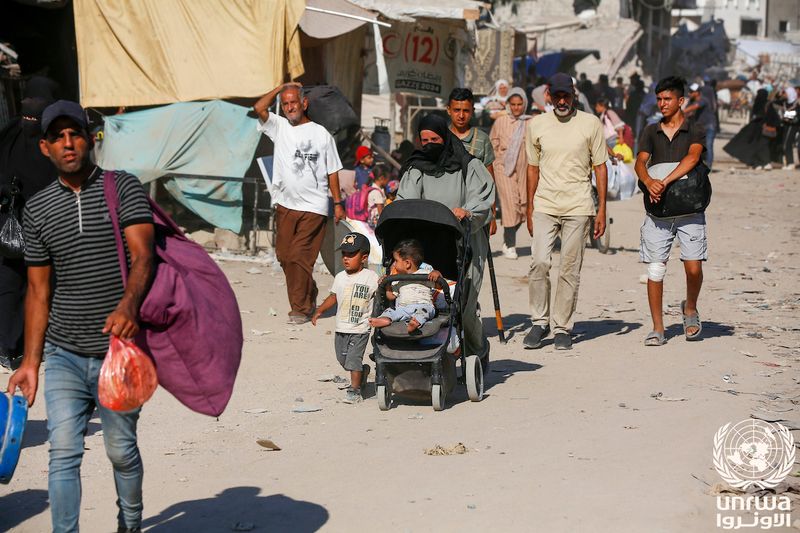
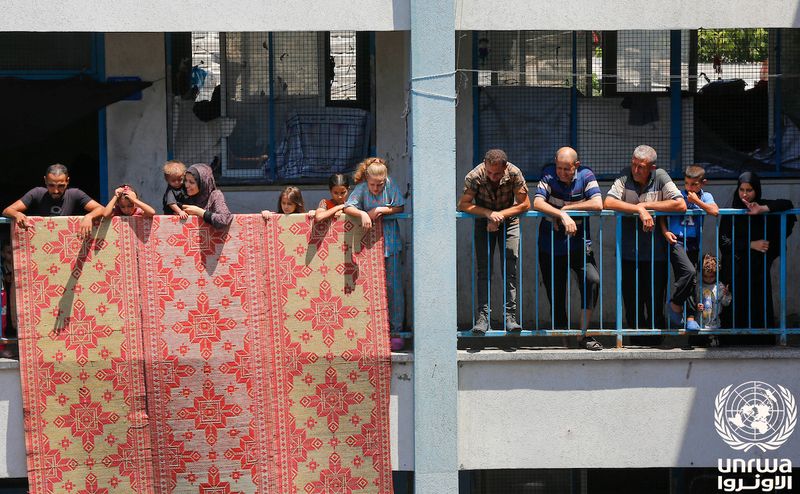
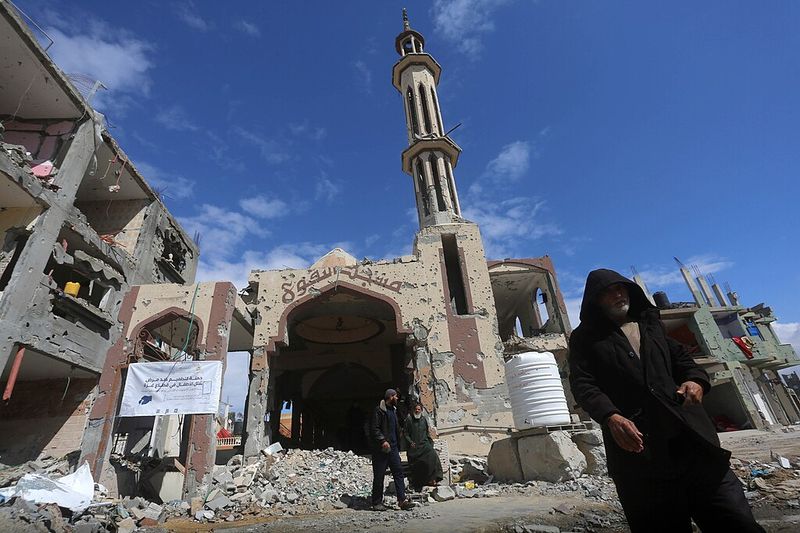
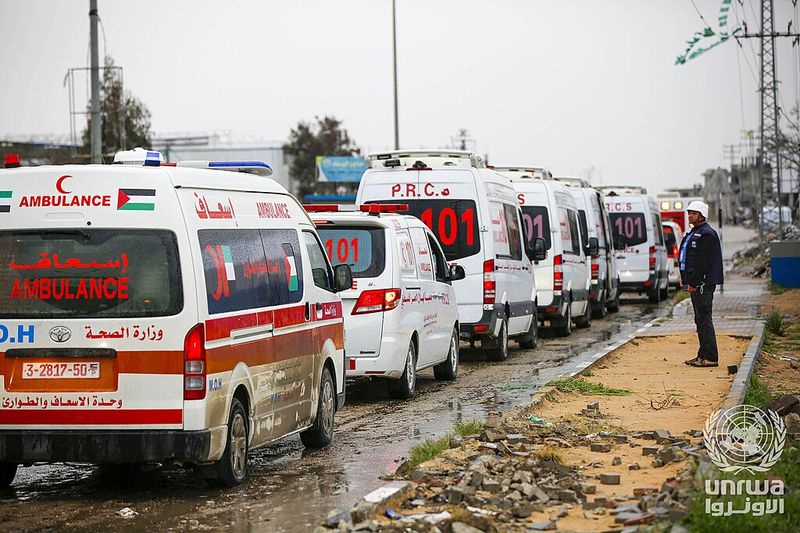
What is established, on the reporting, is narrow and should be stated narrowly. An Israeli airstrike hit a street in Mawasi on Saturday. Medics said Samir Abu Younis was killed and others were wounded; the number of wounded was not specified. Hamas’s armed wing announced his death on Sunday and said his funeral would be held on Sunday afternoon in Khan Younis. No photograph of the strike, and no verified photograph of Abu Younis himself, was available at publication; the photographs with this article are file photographs of Khan Younis and Rafah, captioned as such. Beyond those points, the public record of the strike itself — the munition used, the time of day, who else was in the street — had not been filled in by any source on the record by Sunday.
Two statements, kept apart
Hamas’s statement: a name, a rank and a funeral
The Al-Qassam Brigades, Hamas’s armed wing, said on Sunday that Abu Younis, the commander of its Rafah brigade, had been killed in Saturday’s strike, Reuters reported. In Hamas’s account, he was a commander who helped plan and oversee the October 7, 2023 attack on Israel — the assault that began the war — and his death is therefore announced not as an anonymous casualty but as the loss of a named figure in the movement’s military history. Hamas said he had joined the armed wing in 1991 and had held senior operational roles in Rafah before becoming the brigade’s commander, and it said his funeral would take place on Sunday afternoon in Khan Younis. A funeral announced in advance, in the city where he was killed, is itself a statement: the movement presenting its dead commander publicly, in the south, under a ceasefire in which its public funerals have been among the most closely watched signals of its remaining organisation.
Israel’s statement: a senior commander, unnamed
The Israeli military said on Sunday that it had struck a senior commander in Hamas’s armed wing. It did not identify him. That is the whole of the Israeli statement as reported by Reuters. Israel did not dispute Hamas’s identification; it did not confirm it either. It claimed the operation without adopting the enemy’s obituary. Readers should hold the two pieces separately: that Israel struck a senior Hamas commander is Israel’s statement; that the commander was Samir Abu Younis is Hamas’s. The two are consistent. They are not the same claim, and neither side’s version, on its own, independently verifies the other’s.
One naming note, made once and not repeated: Hamas’s statement, as carried by PressTV, renders the commander’s name as Samir Mahmoud Abu Yunus, known as Abu Mahmoud, and describes him as a member of Hamas’s Military Council. Reuters renders the name Abu Younis, the spelling this article uses. The two renderings are the same man — the Rafah brigade commander whose death Hamas announced on Sunday — not two people, and the difference is one of transliteration between Arabic and English, of the kind that runs through every casualty list and commander biography in this war.
Who Samir Abu Younis was
The biography Hamas published with its announcement, as reported by Reuters, is a movement biography: the dates and postings the organisation chooses to put on the record for a dead commander. Abu Younis was 53. He joined Hamas’s armed wing in 1991 and rose, on Hamas’s account, through senior operational roles in Rafah before becoming the Rafah brigade’s commander. Rafah is not a peripheral posting: the brigade guards the movement’s southern flank — the border with Egypt, the crossing at Rafah, and the tunnel geography beneath it that was, for most of the movement’s history, its supply artery to the outside world.
His defining entry in the record is October 7, 2023. Hamas said, and Reuters reported, that Abu Younis helped plan and oversee the attack on Israel that day — the cross-border assault in which Hamas-led fighters killed some 1,200 people in southern Israel and seized hostages, on Israel’s count, and which began the war that destroyed much of Gaza. That role, as reported by Hamas itself, is the reason his name carries weight beyond a brigade command — and the reason Israel’s campaign against the October 7 commanders, pursued name by name for three years, would have carried his name whether or not its Sunday statement printed it.
The same Saturday, a separate strike in the north
The Mawasi strike was not Saturday’s only reported killing in Gaza, and the distinction matters enough to state plainly. In Jabaliya, in the north of the territory, an Israeli drone strike the same day killed two Palestinians, hospital officials said — the incident this newsroom reported separately in its coverage of the drone strike in Jabaliya and the ceasefire’s mounting death toll. Roundups that merge them into a single toll for a single event misdescribe both. What they share is a date, and a framework: a ceasefire in its fourteenth month, inside which Saturday produced, at opposite ends of Gaza, the two ends of Israel’s continuing campaign’s range — unnamed men in a northern street, and a named commander in a southern one.
Diplomacy and reactions: demilitarisation, and a demand to honour the ceasefire
Israel’s defence minister: the offensive continues
Israel’s Defence Minister, Israel Katz, responded to the killing in terms that placed it inside a continuing campaign rather than a closed incident. “The IDF continues to eliminate Hamas leaders in Gaza, and another one joins his predecessors in the depths of hell,” Katz said, in remarks reported by CNN. “The offensive policy that I am leading together with the Prime Minister and the IDF in Gaza will continue — until Gaza is demilitarized and there is no Hamas.” Read as policy rather than rhetoric, the statement does two things. It claims the strike as one in a series — the elimination of Hamas leaders as an ongoing programme, not a response to a specific provocation. And it restates the campaign’s terminal condition in maximal form: not Hamas’s disarmament as a negotiated step inside the ceasefire’s later phases, but a Gaza demilitarised with no Hamas in it. Between that condition and the framework’s stalled second phase lies the whole of the present stalemate.
Seventeen foreign ministers: honour the ceasefire
The diplomatic counterweight had been published the day before the strike. On Saturday, November 14, Pakistan’s Ministry of Foreign Affairs issued a joint statement — No. 329/2026 — in which the foreign ministers of 17 countries, led by Pakistan, urged Israel to honour the ceasefire. The statement condemned in the strongest terms the Israeli airstrike on the Nasser Medical Complex in Khan Younis earlier in the week, which the ministers said caused casualties among patients and medical personnel in violation of international humanitarian law, and it condemned continued Israeli attacks on Palestinian civilians, including strikes on tents and other sites sheltering displaced people. Such attacks, the ministers said, undermine the ceasefire and efforts to restore security and stability in Gaza and are inconsistent with President Trump’s Comprehensive Plan. The statement expressed grave concern at continued Israeli restrictions on humanitarian aid — including shelter materials such as tents, caravans and mobile homes, and medical supplies — as winter approaches, and called on Israel to fulfil immediately and in full its obligations under the Sharm El-Sheikh Agreement, the Trump plan and UN Security Council Resolution 2803 (2025). This newsroom’s coverage of the ministers’ joint statement and its warning that the Gaza ceasefire is at risk sets out the statement and the hospital strike that prompted it in full.
The sequence is the story. On Thursday, a strike on Khan Younis’s largest hospital killed at least six people, on Palestinian officials’ account. On Saturday, 17 foreign ministers published a statement demanding that Israel honour the ceasefire. The same Saturday, an Israeli airstrike killed Hamas’s Rafah brigade commander in a Khan Younis street, and on Sunday Israel’s defence minister answered in the opposite register: the offensive continues until Gaza is demilitarised. Together they describe a ceasefire whose parties are no longer arguing about whether it is being implemented. They are arguing, in public and on the record, about what it ever required.
Why this matters
Analysis, labelled as such. The first significance of Abu Younis’s death is what it demonstrates about command attrition under a ceasefire. The October 2025 ceasefire halted major fighting, as Reuters’ summary of the period puts it, but it has not stopped Israeli attacks or secured Hamas’s disarmament. Within that suspended war, Israel has continued to work through the list of Hamas commanders it holds responsible for October 7 — by airstrike, one name at a time, each strike small enough to sit inside the ceasefire’s tolerances and cumulatively large enough to keep hollowing out the organisation the ceasefire’s later phases are supposed to negotiate with. A brigade commander is not a symbolic target: he is the level at which a brigade’s battalions, logistics and local knowledge are coordinated, and killing one removes the man in whom its southern network was personally vested, at a moment when Hamas cannot openly convene and parade a successor the way an army at peace would.
The second significance is succession, and it is sharper in Rafah than anywhere else in Gaza. CNN reported that Abu Younis’s killing came only two months after Israel killed his predecessor in the same command. Two commanders of one brigade killed in roughly two months is a command being struck faster than it can settle: each successor is, by definition, a man the previous strikes have already mapped, promoted into the most watched chair in the southern Gaza Strip. Who now commands the Rafah brigade — and whether the brigade, after the destruction of Rafah city, still functions as one in any meaningful sense — are questions Hamas’s announcement does not answer. Its silence on a successor is itself data.
The third significance is the disarmament stalemate, which this killing both reflects and deepens. The ceasefire framework deferred Hamas’s disarmament to later phases that have not begun; the Board of Peace charged with overseeing the plan remains, on the reporting, sidelined, and reconstruction is conditioned by Israel on Hamas fully disarming first. Israel’s position, restated by Katz over this strike, is that the offensive continues until disarmament is a fact rather than a phase. Each targeted killing is, on Israel’s reading, enforcement of the end-state the framework promises; on the reading of the 17 ministers who signed Saturday’s statement, each strike inside the ceasefire is a breach of its terms and a risk to its survival. Abu Younis’s death does not resolve that argument. It is the argument, conducted in its current form: a commander buried in Khan Younis on Sunday afternoon, a defence minister in Jerusalem promising the next one, and a joint statement in Islamabad demanding that the whole pattern stop.
Context: the Rafah brigade and a ceasefire in its fourteenth month
Hamas’s military geography divides Gaza into brigades, and the Rafah brigade has always been the southernmost and, in the movement’s logistics, among the most consequential. Rafah city sits on the Egyptian border; its crossing is Gaza’s only gate that does not pass through Israel, and the ground beneath the border was, for years, cut by the tunnels through which the movement imported what it could not make. The war destroyed much of the city, and the ceasefire left the south in the condition the file photographs with this article record: a population displaced into Mawasi’s tents and Khan Younis’s shelters, and a brigade whose territory is now largely rubble and whose commander was killed not in Rafah at all, but in a street in Mawasi — a geography that tells its own story about where the south’s people, and its commanders, now are.
The ceasefire that frames the killing began in October 2025, built on the Sharm El-Sheikh Agreement, President Trump’s Comprehensive Plan and UN Security Council Resolution 2803 (2025). Its first phase stopped the large-scale war. Its later phases — disarmament, a technocratic administration, a civilian police force, reconstruction — remain, on all public evidence, unbegun, and the toll of the interval keeps rising: Gaza’s Health Ministry figures, as carried by the Associated Press, put the number of Palestinians killed since the ceasefire began above 1,600, a count Israel disputes in method but which no rival systematic count replaces. It is inside that interval — not a war, not a peace — that a brigade commander can be killed in a targeted strike and buried the next afternoon, without any party declaring the ceasefire over.
The south, entering winter
For the population among whom Abu Younis was killed, the strike lands in a season already defined by exposure. Mawasi’s tents stand on open coastal ground; Khan Younis’s shelters hold families displaced two and three times over. This newsroom’s reporting on the winter floods that have hit 46,000 displaced families, and the World Health Organization’s warning of a disease surge, describes the same southern winter the 17 ministers invoked when they demanded that shelter materials — tents, caravans, mobile homes — be allowed in before the cold deepens. A targeted killing is a military event with a military logic, and it is also, in Mawasi in November, an explosion in a street of tents at the start of the rains. Both descriptions are true, and the ceasefire’s politics now run on the friction between them.
What happens next
Analysis — scenarios, not predictions. The immediate watchpoints are three. The first is succession: whether Hamas names a new Rafah brigade commander, and how quickly, will measure how much depth the southern command retains — and any named successor becomes, on the pattern Katz described, a named target. The second is retaliation’s absence or presence: Hamas has generally absorbed targeted killings inside the ceasefire without resuming large-scale fire; a commander of Abu Younis’s seniority tests that calculation more than most, and the funeral in Khan Younis will be the first public reading of the movement’s answer. The third is the guarantors: the ministers’ leverage runs through Washington and the Board of Peace, and any American response to this weekend would signal whether the framework’s overseers intend to police its terms or merely to preserve its name.
Beyond the week, the scenarios narrow to the stalemate itself. In one, the pattern holds: strikes continue at a tempo the ceasefire absorbs, commanders are replaced and replaced again, and the disarmament phase remains unbegun because neither side will move first — Israel will not trade the offensive for a promise, and Hamas will not surrender the arms that are its remaining leverage for a reconstruction it does not control. In another, the accumulation does what accumulation eventually does to ceasefires: a strike with a larger toll, a response that becomes an exchange — and the fourteenth month becomes the last. Nothing in Sunday’s statements points to a third scenario, in which this killing becomes the occasion for the disarmament negotiation the framework promised. Between the two, in a street in Mawasi, the Rafah brigade is burying its second commander of the autumn — and the ceasefire, on paper, holds.
Related coverage: Israel Drone Strike in Gaza Kills Two in Jabaliya as Ceasefire Death Toll Mounts · 18 Arab and Islamic Ministers Condemn Nasser Hospital Strike, Warn Gaza Ceasefire Is at Risk · Gaza Winter Floods Hit 46,000 Displaced Families as WHO Warns of Disease Surge
Sources
- Reuters, November 15, 2026 (reporting by Nidal al-Mughrabi and Yomna Ehab) — the Al-Qassam Brigades said Samir Abu Younis, 53, commander of Hamas’s Rafah brigade, who helped plan and oversee the October 7, 2023 attack, was killed in an Israeli airstrike on Saturday, November 14, 2026; medics said he was killed and others wounded in a strike that targeted him in a street in Mawasi, Khan Younis, the number of wounded not specified; the Israeli military said it had struck a senior commander in Hamas’s armed wing but did not identify him; per Hamas, he joined the armed wing in 1991, held senior operational roles in Rafah before becoming brigade commander, and his funeral was to be held Sunday afternoon in Khan Younis; the October 2025 ceasefire halted major fighting but has not stopped Israeli attacks or secured Hamas’s disarmament.
- Hamas / Al-Qassam Brigades statement, November 15, 2026, as carried by PressTV (November 15, 2026) — the Brigades’ confirmation of the death of Samir Mahmoud Abu Yunus, known as Abu Mahmoud, Rafah Brigade commander, in an airstrike in al-Mawasi, Khan Younis, describing him as a member of Hamas’s Military Council and among the key commanders involved in planning and supervising the October 7 operation. The name rendering and Military Council description are Hamas’s, via PressTV, and are attributed as such in this article; the settled spelling used throughout is Reuters’ “Abu Younis.”
- CNN, November 15, 2026 — Defence Minister Israel Katz: “The IDF continues to eliminate Hamas leaders in Gaza, and another one joins his predecessors in the depths of hell”; “The offensive policy that I am leading together with the Prime Minister and the IDF in Gaza will continue — until Gaza is demilitarized and there is no Hamas”; the killing came two months after Israel killed Abu Younis’s predecessor as Rafah brigade commander; the Board of Peace remains sidelined, unable to make substantive progress on the October 2025 plan; and Israel’s Coordinator for Government Activities in the Territories: reconstruction of Gaza can only begin after Hamas fully disarms.
- Pakistan Ministry of Foreign Affairs, joint statement No. 329/2026, November 14, 2026 — the foreign ministers of 17 countries, led by Pakistan, condemned in the strongest terms the Israeli airstrike on the Nasser Medical Complex in Khan Younis, condemned continued attacks on Palestinian civilians including strikes on tents and sites sheltering displaced people as inconsistent with President Trump’s Comprehensive Plan, expressed grave concern at restrictions on humanitarian aid including shelter materials and medical supplies, and called on Israel to fulfil immediately and in full its obligations under the Sharm El-Sheikh Agreement, the Trump Comprehensive Plan and UN Security Council Resolution 2803 (2025), to uphold the ceasefire and ensure unimpeded aid delivery.
- Associated Press, November 14, 2026, as reported in this newsroom’s Jabaliya coverage — Gaza’s Health Ministry figures putting the number of Palestinians killed since the October 2025 ceasefire began above 1,600, and the November 14 Israeli drone strike in Jabaliya that killed two Palestinians, a separate incident from the Mawasi strike, cross-linked and not merged in this article.
- Signal Post News, November 14–15, 2026 — 18 Arab and Islamic Ministers Condemn Nasser Hospital Strike, Warn Gaza Ceasefire Is at Risk; Israel Drone Strike in Gaza Kills Two in Jabaliya as Ceasefire Death Toll Mounts; Gaza Winter Floods Hit 46,000 Displaced Families as WHO Warns of Disease Surge.
- Photos: file photos by Ashraf Amra (UNRWA), CC BY-SA 3.0 IGO, via Wikimedia Commons, as credited in the captions — displaced families moving through Khan Younis; displaced families on a Khan Younis shelter balcony; a damaged mosque and destroyed buildings in Rafah; and Palestine Red Crescent ambulances at the Rafah crossing. No photograph of the November 14, 2026 Mawasi strike was available at publication, and no verified photograph of Samir Abu Younis was available; none is used, and every image is captioned as a file photo.