World · Egypt · Transport
The Egypt train collision Giza province recorded on Sunday is, in its verified facts, stark: a passenger train ran into the rear of a stationary train standing on the same track near Al-Ayyat, about 32 miles (52 km) south of Cairo, killing seven people and injuring at least 125. Several carriages derailed. It is the deadliest Egyptian rail disaster in years, on a stretch of line with a grim history of its own — and it poses the hardest kind of question a railway can face, because a train that runs into a stopped train in front of it is not, on its face, an unforeseeable accident.
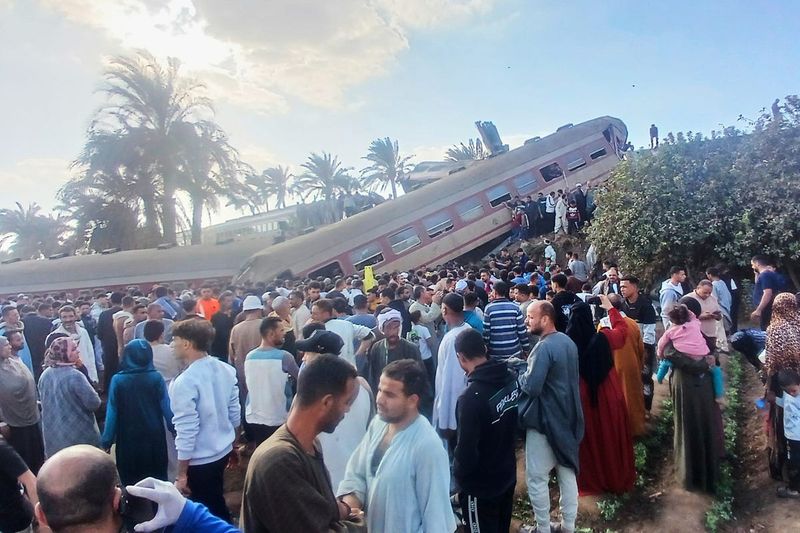
AL-AYYAT, Egypt, November 8, 2026 — Two passenger trains collided on Sunday in the Al-Ayyat district of Giza governorate, south of Cairo, killing at least seven people and injuring more than 100, Egyptian officials said — a rear-end crash on one of the busiest rail corridors in the country that sent several carriages off the track and drew hundreds of local residents to the scene before ambulances could reach it. The collision happened between the stations of Kafr Ammar and Al-Raqqa, on the line that carries trains from the capital toward Upper Egypt. President Abdel Fattah el-Sisi ordered a prompt investigation and said anyone found negligent would be held accountable. Prosecutors were at the site by late Sunday, and the chief prosecutor’s office confirmed the death toll of seven, with the Health Ministry putting the injured at at least 125 by the end of the day.
What is verified can be stated plainly. An inspection by the prosecutor’s office found that a train travelling from Giza toward Fayoum struck the last carriage of a Cairo–Aswan train that was stationary on the same track, travelling in the same direction. The impact derailed several carriages. Dozens of ambulances were dispatched, cranes were brought in to lift the wreckage, and road and rail traffic through the district was disrupted for hours, the Egyptian railway authority said. No cause has been disclosed: authorities have not said why the Cairo–Aswan train was stopped, why the following train reached an occupied track, or what the signalling showed in the minutes before impact. Those questions, examined below, are where the investigation will live.
Two trains, one track: how the collision happened
The mechanics, as officials have described them so far, are those of a rear-end collision — the type of crash that modern railway signalling exists, above all, to prevent. The Cairo–Aswan service, identified in Egyptian reporting as train No. 2010, was standing on the line between Kafr Ammar and Al-Raqqa stations, in the Al-Ayyat district roughly 52 kilometres south of the capital. The Giza–Fayoum train, reported as No. 134, approached from behind on the same track, in the same direction, and struck the rear carriage of the stationary train. The force of the impact pushed carriages off the rails; photographs from the scene show a carriage pitched down an embankment beside fields and palm groves, with crowds of residents gathered around the wreckage and rescue workers picking through the site.
Each element raises its own question. Why was the Cairo–Aswan train stationary between stations — a failure, an unscheduled stop, a signal check? Was its presence known to the line’s dispatchers, and was the block behind it protected by signals showing red? What did the driver of the Giza–Fayoum train see, and when? Rear-end collisions are rarely single-cause events: they emerge from a chain — a stopped train, a signal or communication failure, a human decision, and a following train with too little warning to stop. Prosecutors have disclosed none of those links so far, and Signal Post News is treating every account of cause circulating before they do as speculation, not reporting.
The toll, revised upward through the day
The human cost grew through Sunday in the pattern familiar from every breaking disaster count: an early figure from a chaotic scene, revised upward as hospitals reported and the wreckage was searched. The first official toll, from the Health Ministry and carried by Reuters, was four people killed and 88 injured; initial Egyptian reporting said the driver of one of the trains was among the dead. By later in the day, the Health Ministry’s updated figure, carried by CNN, stood at seven killed and 112 injured, with officials saying 45 of the injured had already been discharged after their conditions improved. Sky News, in its coverage, put the injured at 114 — a variant within the spread of figures officials were giving different outlets through the afternoon. The final accounting of the day, from the chief prosecutor’s office and the Health Ministry and carried by the Associated Press, was seven killed and at least 125 injured, with more than 70 of the injured discharged. Signal Post News is using seven killed and at least 125 injured as the current toll, and showing the earlier figures because the evolution itself is part of the record: it is the difference between a first report from an embankment in Giza and a full count of hospital admissions across the governorate.
Two cautions belong with those numbers. A toll built from hospital reporting can still move: some of the injured were seriously hurt, and officials had not released the dead passengers’ names by late Sunday. And the successive injured figures — 88, then 112, a variant of 114, then at least 125 — reflect reporting times, not contradictions: at every stage after the first, officials agreed seven people had died and well over 100 were injured. The worst of it was in the stationary train’s rear carriage, which took the full force of the impact; it was there, residents said, that rescuers found passengers who could not be saved.
‘The locals rushed in’: the rescue
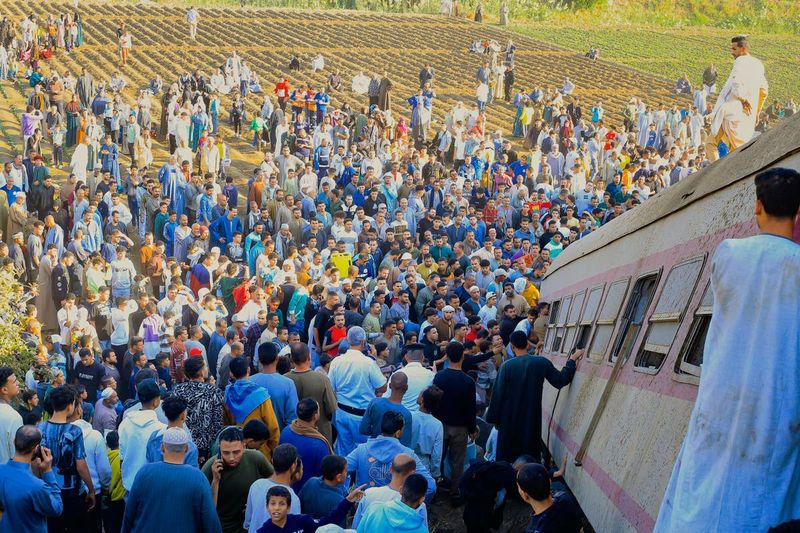
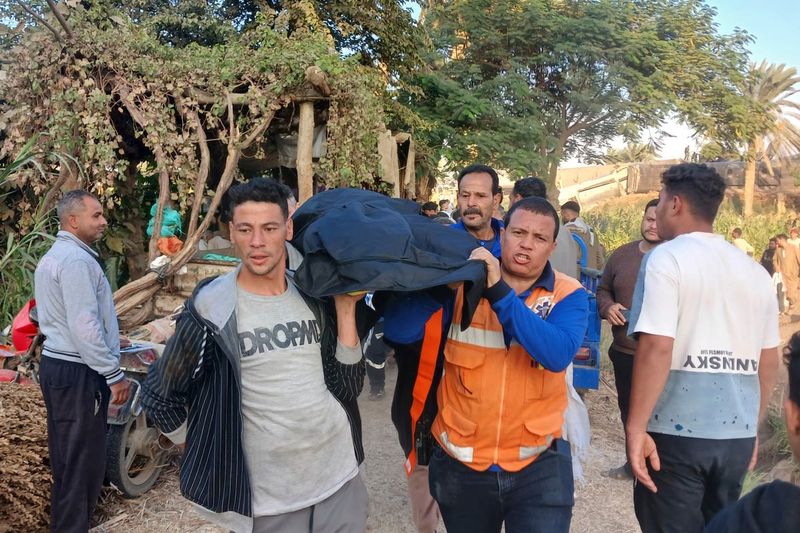
As in so many Egyptian rail disasters, the first emergency service at the scene was the neighbourhood itself. Ayman Gamal, a resident of Kafr Girza, a village near the crash site, described locals rushing to the wreckage as soon as the collision happened, pulling survivors out and carrying the injured clear. Around 80 of the injured were taken away by ambulance once the emergency services arrived in force, he said, but some passengers trapped in the rear carriage of the stationary train were dead when rescuers reached them. Dozens of ambulances were dispatched to the site, the Health Ministry said, and the injured were spread across hospitals in the area — the logistics of a mass-casualty event in a rural district, on a Sunday, some 50 kilometres from the capital’s largest trauma centres.
The railway authority said emergency teams and cranes were sent to clear the wreckage and restore the line — the Cairo–Upper Egypt corridor is the spine of the national network, and every hour of closure strands passengers and freight along the Nile valley. By evening, prosecutors had begun inspecting the wreckage in place: the point at which the official story stops being a sequence of tolls and starts becoming a sequence of findings.
El-Sisi orders an investigation, and promises accountability
President Abdel Fattah el-Sisi responded on social media on Sunday, offering condolences to the families of the dead and ordering a prompt investigation into the collision, with a pledge that anyone found to have been negligent would be held accountable. The chief prosecutor’s office, which confirmed the toll of seven dead and at least 125 injured, sent prosecutors to the scene late on Sunday to inspect the wreckage and begin the formal inquiry. The railway authority, for its part, has so far confined itself to the emergency response — ambulances, cranes, clearance — and has not offered any account of how two trains came to be on the same section of track, one moving and one stopped.
The presidential intervention sets the political frame for everything that follows, and it is worth reading precisely. An investigation ordered from the presidency, with accountability pre-announced for “the negligent,” promises consequences; it does not yet say where in the system those consequences should land. In Egyptian rail disasters, that question — whether blame stops at a driver or a signalman, or travels upward to the management of the network itself — is the question that decides whether an inquiry changes anything. It is a live question in Egyptian politics more broadly: this is the same state apparatus whose parliament was debating the country’s military posture abroad only weeks ago, in the vote authorising defensive support for Saudi Arabia — a reminder that the government’s competence at home, on the railways its citizens ride daily, is judged by a different and harsher standard than its diplomacy.
A railway with a long and deadly record
Egypt’s railways are the oldest in Africa and the Middle East, and for decades they have also been among the most dangerous in the region — a network carrying millions of passengers on infrastructure and rolling stock that critics, including successive Egyptian governments themselves, have described as degraded by years of mismanagement and poor maintenance. Sunday’s collision happened in a district that already holds the worst entry in that record. In 2002, a fire tore through a packed passenger train near Al-Ayyat itself, killing more than 300 people in Egypt’s deadliest rail disaster. The same name — Al-Ayyat — now returns to the top of the story a generation later, in a different kind of crash on the same corridor.
The intervening record is a catalogue that Egyptians know by heart. In 2017, two passenger trains collided near Alexandria, killing more than 40 people. In 2019, a locomotive crashed into a barrier at Cairo’s Ramses station and exploded, killing 25 people in a fire on the platform of the capital’s main terminal — a disaster that cost the transport minister his job within days. Nor is Sunday the first collision in this district in recent memory: last September, two freight trains collided in the same Al-Ayyat area, injuring a driver and his assistant. Against that record, the government has repeatedly announced modernisation programmes — new rolling stock, upgraded lines, overhauled signalling — and Sunday’s crash will be measured against those promises, because this type of collision is precisely the type signalling modernisation is supposed to make impossible.
Comparisons beyond Egypt sharpen the point. In Spain this autumn, a high-speed collision near Urda, in Toledo province, set off the same sequence Cairo is now entering — investigation, political fallout, and a reckoning over how a modern service could fail so completely — as Signal Post News reported in our coverage of the Urda crash, and in the resignation that followed, when Spain’s transport minister stepped down over the disaster. The Spanish and Egyptian systems differ in almost every particular — age, funding, traffic, technology. What they share, after a crash like this, is the question: whether accountability reaches the level of the system, or stops at the level of the individual nearest the controls.
Who gains, who loses, who pushes back
The victims and their families are the losers of Sunday in the only sense that finally matters: seven people dead on a routine journey, more than 125 injured, and a rear carriage whose passengers never had a chance to react. Their advocates’ demand, in the days ahead, will be the one heard after every Egyptian rail disaster — not condolences, but names, findings and consequences. The railway authority and the transport ministry lose standing they could not spare: a rear-end collision with a stationary train, on the flagship corridor south of the capital, in a district with the worst rail history in the country, is the hardest kind of failure to explain as bad luck. President el-Sisi’s government faces both edges of its own response: the swift investigation order projects control, but the crash lands on a modernisation narrative the government itself built, and each day the cause stays undisclosed, the gap between the promised railway and the operating one widens. The pushback will come from the familiar direction — critics, opposition voices and transport experts who argue that Egypt’s rail problem is not money announced but maintenance sustained, signalling completed and a safety culture enforced — and their strongest exhibit is the district itself: Al-Ayyat has now hosted the country’s deadliest rail fire, a freight collision last September, and Sunday’s crash, across twenty-four years of pledges.
Why this matters
A stopped train is the one thing a railway must never hit
Analysis. Strip away every unknown about Sunday and one structural fact remains: a train ran into the back of a stationary train on the same track. Railway safety systems are layered precisely around that scenario. Signalling divides a line into blocks and forbids a second train from entering an occupied one; dispatching exists to keep movements authorised and separated; where those systems are modern, automatic protection can brake a train whose driver misses a signal. For a rear-end collision to happen, every layer between the moving train and the stopped one has to fail, be absent, be overridden or be misread at the same time. That is why the investigation’s real subject is not the final seconds before impact but the state of the layers: what signalling protects the Kafr Ammar–Al-Raqqa section, whether it was working, whether the stopped train’s presence was registered and communicated, and what instructions each driver held. A crash can be one man’s error only in a system that allows one man’s error to be fatal. The prosecutors’ findings on the signalling and dispatch chain — not the wreckage photographs — will decide whether Sunday was a failure of a person or of the network.
Modernisation is measured on the oldest lines, not the newest projects
Egypt has spent recent years announcing the renewal of its railways, and some of that renewal is visible in new trains and rebuilt stations. But a national network’s safety is set by its oldest signalling, its most deferred maintenance and its busiest legacy corridors — and the Cairo–Upper Egypt line through Al-Ayyat is as legacy and as busy as the network gets. The data frame is the accident record itself: more than 300 dead at Al-Ayyat in 2002, more than 40 at Alexandria in 2017, 25 at Ramses in 2019, a freight collision in this same district last September, and now seven more dead and at least 125 injured in a crash type that functioning block signalling is designed to prevent. No single budget line answers that record, and Signal Post News will not invent one: what the record shows is a mismatch between the scale of the modernisation claim and the persistence of the oldest failure modes on the oldest track. Until the signalling and dispatch layer on corridors like this one is demonstrably complete — audited, not announced — every Egyptian passenger on a following train is riding on the vigilance of a single driver at the worst possible moment.
Accountability after Ramses set the precedent — and the test
The 2019 Ramses station fire established the modern Egyptian template: public fury, a ministerial resignation within days, prosecutions of railway staff. Sunday’s crash will test whether that template is a ceiling or a floor. A driver or a signalman charged with negligence would repeat the pattern of individual blame; findings that reach the condition of the signalling system, the management of the block, or the resourcing of the line would break it. El-Sisi’s formulation — the negligent will be held accountable — can honestly cover either outcome, which is why the investigation’s published reasoning matters more than its verdicts. Egypt has held inquiries before. What its passengers have not yet seen, across the twenty-four years between the two Al-Ayyat disasters, is an inquiry whose conclusions visibly rebuilt the system it examined. That, and not the toll alone, is the standard this one will be judged against.
What happens next
Four markers will decide how this story develops. First, the prosecutors’ findings: whether the inquiry publishes a mechanical account of the crash — why the Cairo–Aswan train was stopped, what the signals showed, what the dispatchers ordered — or confines itself to individual fault. Second, the toll and the injured: updates from the Health Ministry on the most seriously hurt among the at-least-125 injured, the release of the dead passengers’ names, and the completion of the discharge count that had already passed 70 by Sunday night. Third, the line itself: how quickly the Cairo–Upper Egypt corridor fully reopens once the wreckage is cleared, and whether the railway authority announces any interim safety measures — speed restrictions, signalling checks, service changes — on the Al-Ayyat section. Fourth, the political cost: whether accountability travels upward from the cab and the signal box toward the ministry, as it did after Ramses in 2019, and whether the government answers with a specific, auditable signalling programme for the southern corridor rather than a general renewal pledge. The funerals in Giza’s villages will not wait for any of it. The answers should not take much longer.
What do you think — when a train hits a stopped train on the same track, where should accountability stop: with the driver, the dispatchers, or the system that let one failure become seven deaths? Follow Signal Post News for the investigation’s findings and the response from Cairo, and share your thoughts below.
Sources
Sources: Associated Press, November 8, 2026 (seven killed and more than 100 injured in the Al-Ayyat district of Giza province, about 32 miles/52 km south of Cairo; the chief prosecutor’s office toll of seven killed and at least 125 injured, with more than 70 discharged; the prosecutors’ inspection finding that the Giza–Fayoum train struck the last carriage of the stationary Cairo–Aswan train on the same track; the account of Kafr Girza resident Ayman Gamal; President el-Sisi’s investigation order; and the historical record — the 2002 Al-Ayyat fire killing more than 300, the 2017 Alexandria collision killing more than 40, and last September’s freight-train collision in the same district). CNN, November 8, 2026 (Health Ministry toll of seven killed and 112 injured; several carriages derailed between Kafr Ammar and Al-Raqqa stations; dozens of ambulances; 45 injured discharged). Reuters, November 8, 2026 (initial Health Ministry toll of four killed and 88 injured; a train driver reported among the dead in initial reports; the trains reported as Giza–Fayoum No. 134 and Cairo–Aswan No. 2010; el-Sisi’s condolences and accountability pledge). Sky News, November 8, 2026 (injured figure of 114, noted as a variant of the official counts). Egyptian railway authority statements, November 8, 2026 (emergency teams and cranes dispatched; traffic disrupted). Photos: AP, as credited in the captions; all three photographs show the Al-Ayyat collision site on November 8, 2026.