War · Ukraine · Crimea
The Crimean Bridge second strike landed in the early hours of Tuesday, a day after the first — and this one went further. Crimea’s Russian-installed head and the governor of Sevastopol both confirmed the attack and the suspension of traffic, CNN has independently geolocated a collapsed road section of the crossing, and Russia’s Defence Ministry claimed a second consecutive record night in the air: 1,441 Ukrainian drones shot down. What officials in Moscow and Crimea have not produced is a single agreed account of the damage — or of whether anyone died.
Track it live: Ukraine war map tracker
KERCH, November 16, 2026 — Ukraine struck the Crimean Bridge for the second time in under 24 hours overnight into Tuesday, November 17, according to the two Russian-installed officials who run Crimea and Sevastopol — and for the second night running, the only direct road and rail link between Russia and the annexed peninsula was closed. Sergey Aksyonov, the Russian-installed head of Crimea, wrote on Telegram at about 1:34 a.m. local time that “the enemy attacked the Crimean Bridge again” and that traffic was currently suspended, asking residents and visitors to stay away from the crossing and to trust only official information. Mikhail Razvozhayev, the Russian-installed governor of Sevastopol, confirmed the same facts on Telegram: the Ukrainian Armed Forces, he said, had once again attacked the Crimean Bridge, traffic had been suspended, and Sevastopol residents planning to reach mainland Russia by the bridge should not travel. The Guardian’s Ukraine war briefing, the Kyiv Independent and Estonian public broadcaster ERR all reported the attack and the closure on the strength of those confirmations.
Update — November 17, 2026: Ukraine has now claimed the strike. President Volodymyr Zelenskyy confirmed the attack on X, saying it answered Russian strikes on Ukrainian infrastructure and bridges and that “war will always return to where it began.” Zelenskyy said the bridge attack was the seventh stage of a weeks-long operation developed and coordinated by Ukraine’s SBU security service and the General Staff, which struck Russian air defence systems, radars and electronic-warfare equipment in stages beforehand (Reuters). Read the full report: Zelenskyy Confirms Crimean Bridge Attack.
One boundary belongs at the top of this story. Ukraine had not officially claimed the second strike at the time (see the November 17 update above). Kyiv’s armed forces and security services had issued no claim of responsibility by the time of publication, and everything reported here about who carried out the attack rests on the statements of Aksyonov and Razvozhayev and the outlets reporting them. That discipline mattered on Monday and it matters more now, because the second night produced something the first did not: independently located imagery of serious damage, casualty claims that flatly contradict each other, and a set of far larger claims circulating on Ukrainian monitoring channels that no independent source has verified. This article keeps those three categories separate, because on a story like this one, the categories are the story.
What CNN’s geolocation shows — and what it does not
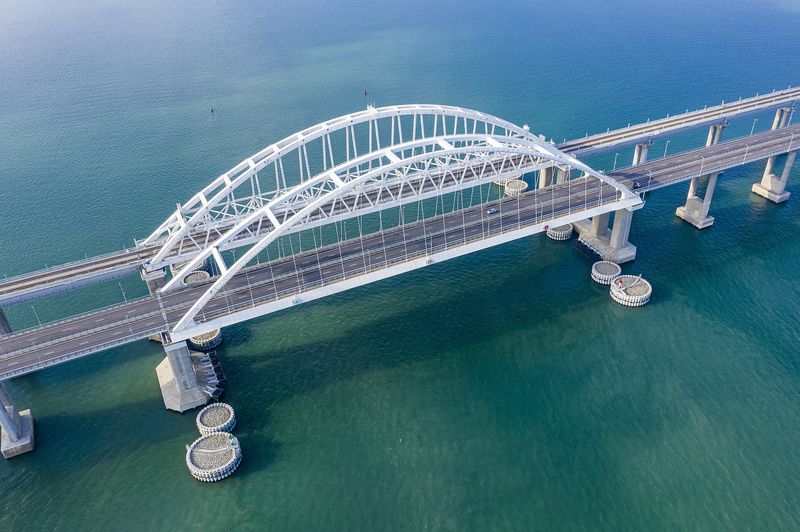
The verified development beyond Monday’s strike comes from CNN, which independently geolocated imagery of the bridge after the overnight attack. What that geolocation establishes is specific, and it is worth stating with precision: a section of the bridge’s road deck has collapsed. The rail section of the crossing is still standing. A fire was burning in the imagery CNN verified. That is a materially worse outcome for Moscow than Monday’s strike produced on the public record — a span element down, not merely a closure for inspection and repair — and it is the first independently verified structural failure attributed to this week’s attacks.
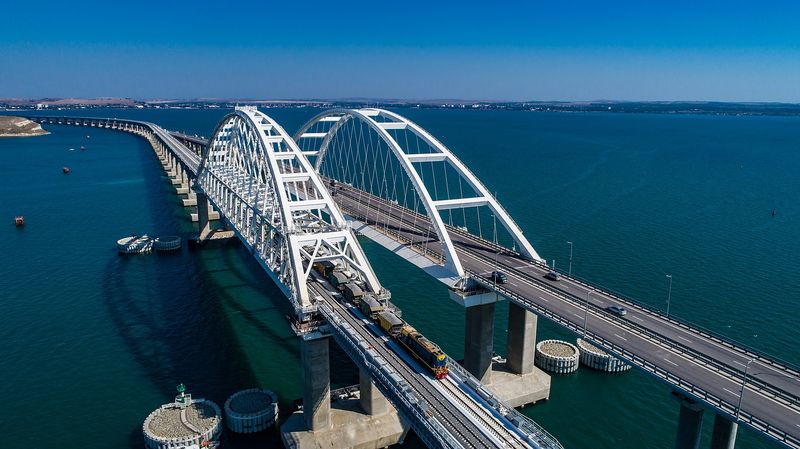
Precision cuts both ways, and it matters here. A collapsed road section is not a collapsed bridge. The Crimean Bridge is not one structure but a pair of parallel crossings — road and rail — carried on separate spans across 19 kilometres of strait, and CNN’s finding concerns the road side. The rail section stands in the verified imagery, and no verified reporting at the time of publication established that rail traffic had been severed, that the navigable arch span had fallen, or that the crossing as a whole had been destroyed. Any account that inflates a collapsed road section into “the bridge collapsed” is saying more than the verified evidence says, and readers should treat it accordingly — including when the inflation comes dressed as celebration.
That caution applies directly to the largest claims now circulating. Ukrainian monitoring and Telegram channels have asserted that the bridge’s road arch sank into the sea and that the crossing was hit by roughly 15 missiles. Those claims are unverified. No independent outlet has confirmed an arch in the water, a missile count, or the munitions used, and neither Aksyonov nor Razvozhayev described damage of that scale in their overnight statements — Aksyonov’s first message reported no damage at all. The War Zone, which has tracked every attack on this bridge since 2022, likewise noted that video purporting to show explosions and fire from the night was of poor quality and that its authenticity and the attack’s outcome could not be discerned from it. The verified position is CNN’s: one road section down, rail standing, fire burning, full extent of the damage not yet established. Everything beyond that is claim, and is labelled as such here.
Two casualty accounts, and they do not agree
The human cost of the second strike is, at the time of publication, the subject of two official Russian accounts that cannot both be right. Aksyonov said that two people were killed in the attack on Crimea, as reported by Reuters on November 17. Russia’s transport ministry, as reported by CNN, said there were no casualties. Signal Post News is presenting both accounts exactly as their sources gave them, attributed, because there is no verified basis on which to merge them, average them, or choose between them — and because the gap between “two killed” and “no casualties” is not a rounding difference. It is a contradiction between two arms of the same state on the central human fact of the night.
Contradictions of this kind are a recurring feature of the first hours after strikes on high-value targets, and they rarely resolve on the timetable of the news cycle. Local and regional officials report what their services find at the scene; ministries in Moscow report what their own chains have confirmed, sometimes more slowly, sometimes more narrowly — a transport ministry, for instance, may be counting only people on the crossing itself, while a regional head counts deaths anywhere in the attack on the region. None of those reconciliations can be assumed here, because none has been offered on the record. What can be said is what has been said, and by whom: two killed, according to Aksyonov via Reuters; no casualties, according to the transport ministry via CNN. If either account is revised, this article will be updated and the revision noted.
A second record claim in the air: 1,441 drones
The bridge was the night’s symbolic centre, but by Moscow’s own telling it was one target inside the largest claimed air battle of the war — for the second night in a row. Russia’s Defence Ministry said its air defences shot down 1,441 Ukrainian drones over 22 regions overnight, a figure reported by both Reuters and CNN. If the ministry’s count is taken at face value, it surpasses the record the same ministry set only a day earlier, when it claimed 1,336 Ukrainian drones downed in Monday’s barrage. Both figures are Russian military claims. Neither has been independently verified, and wartime interception totals from either capital have consistently run ahead of what outside observers can confirm; Reuters and CNN carried Tuesday’s figure as the ministry’s claim, and so does this article.
Read as a claim rather than a count, the number still carries information. A defence ministry that announces 1,441 interceptions across 22 regions is describing — indeed, advertising — a raid of extraordinary geographic breadth, one that forced air defences to engage from Crimea to the capital region simultaneously. Moscow’s mayor, Sergei Sobyanin, said separately that 93 drones flying toward Moscow were shot down overnight, ERR reported — again, a Russian official’s claim, attributed as such. Whether every drone was intercepted is, as with Monday’s record, only part of the operational picture: a defence that must engage well over a thousand targets in a single night has spent the night doing so, radars lit and interceptor stocks drawn down, whatever the final tally of airframes that got through. Two four-figure nights in succession describe a production and launch tempo, not a one-off surge — and the second night’s tempo was aimed, in part, at the same target as the first.
Monday’s first strike, in context
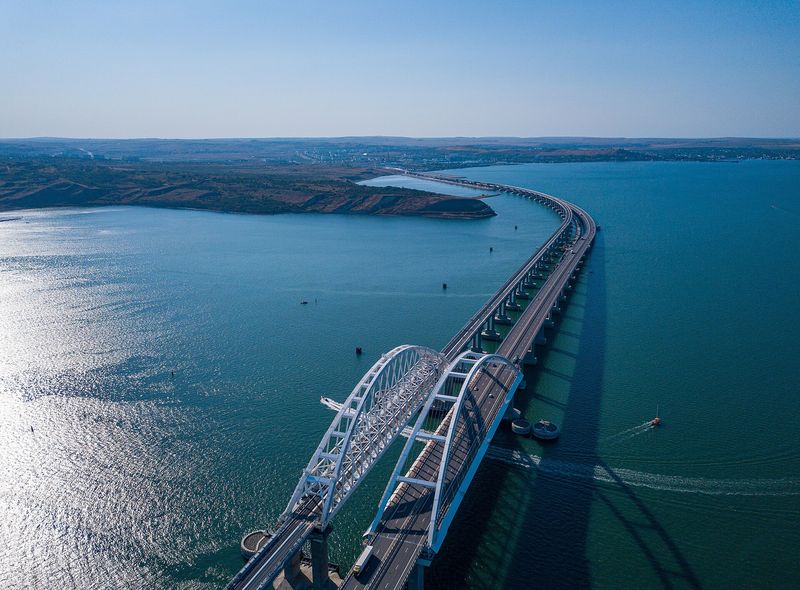
Tuesday’s attack cannot be understood without Monday’s, but Monday’s is context here, not news — Signal Post News reported it in full in our account of how Ukraine’s record drone barrage struck the Crimea Bridge on Monday. The attributed essentials are these. A Ukrainian drone hit an arch of the bridge’s navigable span at about 5:38 a.m. on Monday, according to the Crimean Wind monitoring channel. The Kremlin called the damage from that first attack minor. Road traffic was shut for roughly 17 hours, then reopened in a single alternating lane, while trains kept running, according to Reuters. Queues built regardless: about 2,000 vehicles were reported waiting to cross, according to the Mash Telegram channel as reported by the Kyiv Post and The War Zone. And the night carried Moscow’s then-record claim of 1,336 drones — the figure Tuesday’s claimed 1,441 has now surpassed, on the ministry’s own arithmetic.
The sequence is what elevates the second strike from repetition to strategy. On Monday, the bridge was hit, declared lightly damaged by the Kremlin, and returned to a restricted version of service within the day. Hours after that restricted reopening — with queues of vehicles still working through a single alternating lane — it was hit again, and this time the independently verified outcome is a collapsed road section and a full suspension of traffic with no reopening time announced in the officials’ overnight statements. Striking the same structure twice in two nights, the second time while it is weakened, congested and under repair assessment, is a different proposition from striking it once: it tests whether the first night’s damage was really minor, it compounds whatever structural stress the first hit caused, and it does so in front of the largest audience the war’s diplomacy will assemble this month.
The bridge, and why Kyiv keeps coming back to it
The Crimean Bridge — the Kerch Bridge, for the strait it crosses — runs 19 kilometres (12 miles) between Russia’s Taman Peninsula and Kerch in Crimea, making it the longest bridge in Europe. It is the only direct road and rail link between Russia and the Crimean peninsula, which Moscow annexed from Ukraine in 2014; the road span opened in 2018 and the rail span the following year. It is also the signature infrastructure project of Vladimir Putin’s presidency, opened by Putin personally at the wheel of a truck, and a working military supply route into occupied Crimea — which is why Kyiv has long described it as a legitimate target, and why each successful strike on it carries a symbolic weight out of proportion to the tonnage involved.
The bridge has now been attacked repeatedly across the war. In October 2022, a truck bomb exploded on the road span, collapsing sections of roadway and setting rail fuel tankers ablaze. On July 17, 2023, Ukrainian Sea Baby naval drones struck the road span again, killing two people and forcing another long closure and repair cycle. In June 2025, Ukraine’s SBU security service said it had detonated underwater explosives against the bridge’s supports — the most recent attack before this week, and the reason Monday’s strike was the first in more than a year. Each cycle has followed the same rhythm: strike, closure, Russian assurance that the damage is manageable, restricted reopening, repair. Tuesday’s verified collapsed road section is the most serious confirmed structural outcome since the 2022 and 2023 span failures — and, unlike those attacks, it arrived as the second blow of a two-night sequence rather than a single culminating operation.
The same night, in Kyiv and at the negotiating table
The bridge strike landed in the middle of the war’s most crowded diplomatic week in months: the same night’s reported Russian hits on Kyiv’s North and South bridges are covered in our report on the Zelenskyy, Witkoff and Kushner talks and the warning of major Russian strikes, and the two bridge stories now frame Thursday’s meeting from opposite ends.
That meeting — the first-ever trilateral between U.S. President Donald Trump, Chinese President Xi Jinping and Putin, set for Thursday, November 19, in Shenzhen — hangs over every operational choice both sides are making this week. So does Tuesday’s Ramstein-format meeting, at which Ukraine was due to request interceptors, aircraft ammunition, drone capacity and financing. President Volodymyr Zelenskyy, in his Monday nightly address, had warned Ukrainians to heed missile-danger alerts “tonight, overnight and throughout tomorrow,” and promised that “for every one of their evils there will be our just response” — language the Guardian’s war briefing recorded hours before the second bridge strike was confirmed. In the same address, Zelenskyy said Russia is receiving “dozens of missiles per month” from North Korea, citing Ukrainian military intelligence — his claim, attributed as such, and a reminder that the strike war now runs on supply chains that reach well beyond the two belligerents.
Why this matters
A second consecutive night against the same target is a statement about capacity before it is a statement about damage. One strike on the Kerch Bridge can be read as an opportunistic success — a drone or missile that leaked through the densest air-defence concentration Russia maintains anywhere. Two strikes, on consecutive nights, the second producing a verified collapsed road section while the crossing was already restricted and its defenders fully alerted, is evidence of something harder to dismiss: a repeatable ability to reach the structure, at a tempo Russia’s defences have not yet shown they can break. That is the message Kyiv takes into Shenzhen week and into the Ramstein room — proof of reach, delivered on the eve of talks at which Ukraine’s partners will be asked for interceptors and money, and at which Moscow will argue that Ukraine’s position is weakening. A bridge with a section down argues otherwise, whatever the final repair bill.
For Russia, the costs run in the opposite direction and on several ledgers at once. The practical ledger is logistics: every day the road span is closed or restricted pushes Crimean supply and civilian movement onto ferries, onto the rail span whose status is now the critical open question, and onto the long land corridor through occupied southern Ukraine. The engineering ledger is cumulative: a structure struck in 2022, 2023, 2025 and now twice in two nights, with the second of this week’s hits landing on a span already under assessment from the first, accumulates structural risk even where each individual repair succeeds. And the political ledger is the one Moscow feels most sharply: the bridge is Putin’s project, the physical embodiment of the claim that Crimea is Russia’s permanently, and each closure is a public, photographable refutation of the permanence. A collapsed road section — verified, geolocated, undeniable — is the sharpest such refutation since 2023.
What happens next
Three scenarios now branch from Tuesday’s verified facts, and they diverge on evidence that has not yet arrived. In the first, daylight assessment shows the damage confined to the collapsed road section, rail traffic continues or quickly resumes, and road traffic returns in restricted lanes within days — a symbolic and logistical blow, but one the crossing absorbs as it has absorbed every previous one. In the second, inspection finds that the second strike compounded Monday’s arch damage — that hitting a weakened structure twice in two nights achieved what neither hit could alone — and the closure stretches from days into the kind of repair programme that genuinely reroutes a war’s logistics. In the third, the bridge recedes and the exchange widens: Russia answers with another mass strike night against Kyiv’s infrastructure, continuing the bridge-for-bridge rhythm that began on Monday, and the story becomes the tempo of the exchange rather than the state of any single span.
The evidence that will choose between them is specific and watchable: a daylight damage assessment from either side; the first confirmed statement on rail traffic over the strait; any revision of the two conflicting casualty accounts; and any claim of responsibility — or continued silence — from Kyiv. Until those arrive, the verified core of Tuesday’s story stands on its own: the Crimean Bridge was struck a second time, traffic is suspended, a road section has collapsed while the rail section stands, and the two Russian accounts of whether anyone died do not agree. Follow Signal Post News for updates from Crimea, Kyiv and Shenzhen, and share your thoughts below.
Sources
Reuters, November 17, 2026 — “Russia says Ukraine struck its bridge to Crimea for second day in biggest drone attack of war” (reuters.com): Ukraine struck the Crimea bridge a second time in two days; Aksyonov’s statement that two people were killed in the attack on Crimea and that traffic was suspended; the Defence Ministry’s claim of 1,441 drones shot down over 22 regions, surpassing Monday’s 1,336 figure; the Kremlin’s assessment that Monday’s first attack caused minor damage, with Tuesday’s damage unclear; and the bridge’s 19-kilometre length and status as a Putin signature project. CNN, November 17, 2026, live coverage and geolocation reporting: CNN’s independent geolocation of a collapsed road section of the bridge, with the rail section still standing and a fire burning; the Russian transport ministry’s statement that there were no casualties; and the Defence Ministry’s 1,441-drone claim. The Guardian, Ukraine war briefing (day 1,728), November 17, 2026, via Europe Says (europesays.com): Ukraine struck the bridge for the second day in a row; Aksyonov’s confirmation and the traffic suspension; Monday’s drone hit on an arch; and Zelenskyy’s Monday address, including the missile-alert warning, the “just response” line and the North Korea missiles claim citing HUR. The War Zone, November 17, 2026 — “Kerch Bridge struck for the second time in less than 24 hours” (twz.com): Aksyonov’s Telegram statement at about 1:34 a.m. local time; Razvozhayev’s confirmation; Ukraine having not officially claimed the strike; the poor quality and unverifiable outcome of circulating video; and Monday’s context, including the roughly 17-hour closure and the Mash queue reporting. ERR (Estonian public broadcasting), November 17, 2026, via Reflect (reflect.ee): the overnight attack and the halt to traffic around midnight Moscow time; no damage reported by Aksyonov; the previous night’s attack and near-day-long closure; Sobyanin’s claim of 93 drones downed toward Moscow; and the bridge’s attack history, including the June 2025 SBU underwater operation. Kyiv Independent, November 17, 2026, reporting summarised and claim-checked at Zot News (zot.news): Ukrainian forces reportedly struck the Crimean Bridge on November 17; Aksyonov’s confirmation of the strike and the traffic suspension; and the November 16 strike the day before. Aksyonov’s and Razvozhayev’s Telegram statements are the primary sources underlying the attack and closure reporting. Photographs are file photos via Wikimedia Commons (Rosavtodor, CC BY 4.0), as credited; no verified damage imagery of the second strike is licensed for use, and no file photo in this article depicts tonight’s damage.