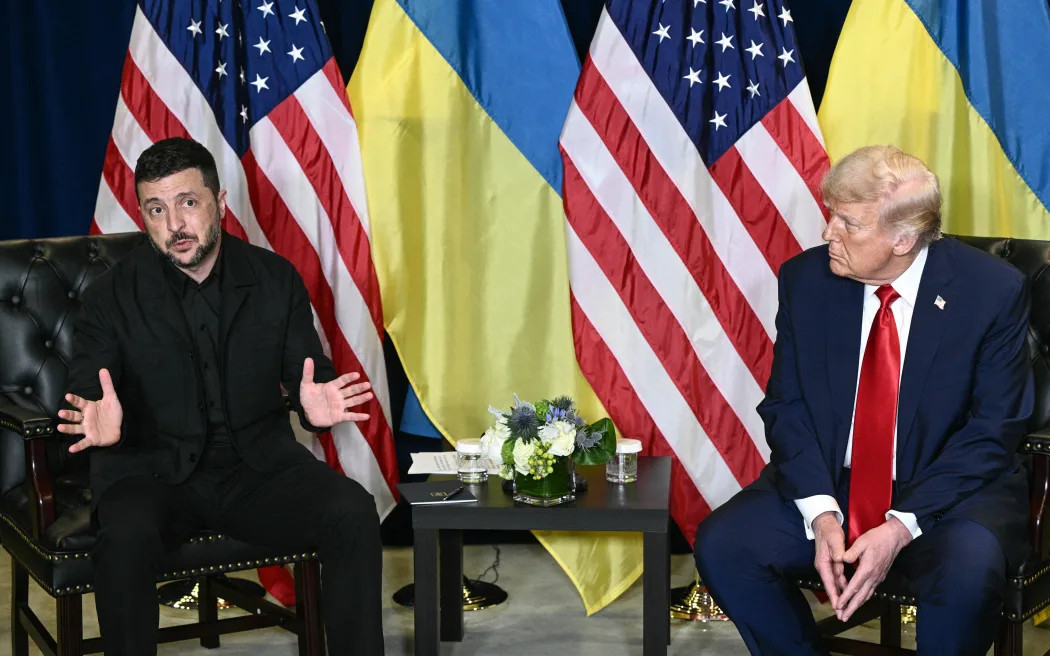
President Donald Trump said on Tuesday that his negotiators held a three-hour meeting with Iranian officials on the sidelines of the United Nations General Assembly — the first known high-level negotiation between the two sides since a cease-fire and memorandum of understanding collapsed in July — revealing the talks during a bilateral meeting with Ukrainian President Volodymyr Zelensky in New York.
What Trump announced
During a press availability alongside Zelensky, Trump told reporters that special envoy Steve Witkoff and his son-in-law Jared Kushner sat down with Iranian officials for about three hours. “It was a meeting that lasted for three hours — very good meeting, as I understand it,” Trump said, adding that another round of talks is scheduled “in the very near future.” The meeting began around 10 a.m. Tuesday, according to the New York Post. Trump declined to say who represented Iran, though Iran’s president Masoud Pezeshkian and foreign minister Abbas Araghchi were both in New York for the assembly, the Post reported. Witkoff, standing beside Trump, offered little beyond saying he felt “very good” after the sit-down. Trump framed Tehran’s choice in stark terms: “In one case, it’s obliteration, and the other alternative is potential greatness.”
Hours after the “annihilate” warning
The revelation landed the same day Trump used his first UN General Assembly address since returning to office to warn that the United States could “annihilate” Iran if diplomacy fails. “I have a big decision to make,” he told world leaders. “Will a deal be made with Iran that lets them rebuild and create a far greater country than it ever was before...? Or do I annihilate the Islamic Republic and do it quickly?” He also asked whether he should “drive them into hell with no chance of survival and no hope of future greatness,” while calling for the Strait of Hormuz to be reopened to commercial shipping. Members of the Iranian and Cuban delegations walked out of the chamber during the speech, the Wall Street Journal reported. Earlier Tuesday, Secretary of State Marco Rubio said Trump was open to meeting Iranian President Masoud Pezeshkian, while cautioning that Iran’s supreme leader remains the ultimate decision-maker. Separately, Reuters reported that Rubio met Iranian Foreign Minister Abbas Araghchi on the UN sidelines — described as the highest-level direct contact between Washington and Tehran since Trump returned to the White House. After a separate meeting with British Prime Minister Andy Burnham, Trump told reporters: “I think that a settlement is going to be reached,” adding, “They have been talking to us, even today they’ve been talking to us... we can’t let them have a nuclear weapon.” Read our earlier report on Trump’s UN address and Iran warning.
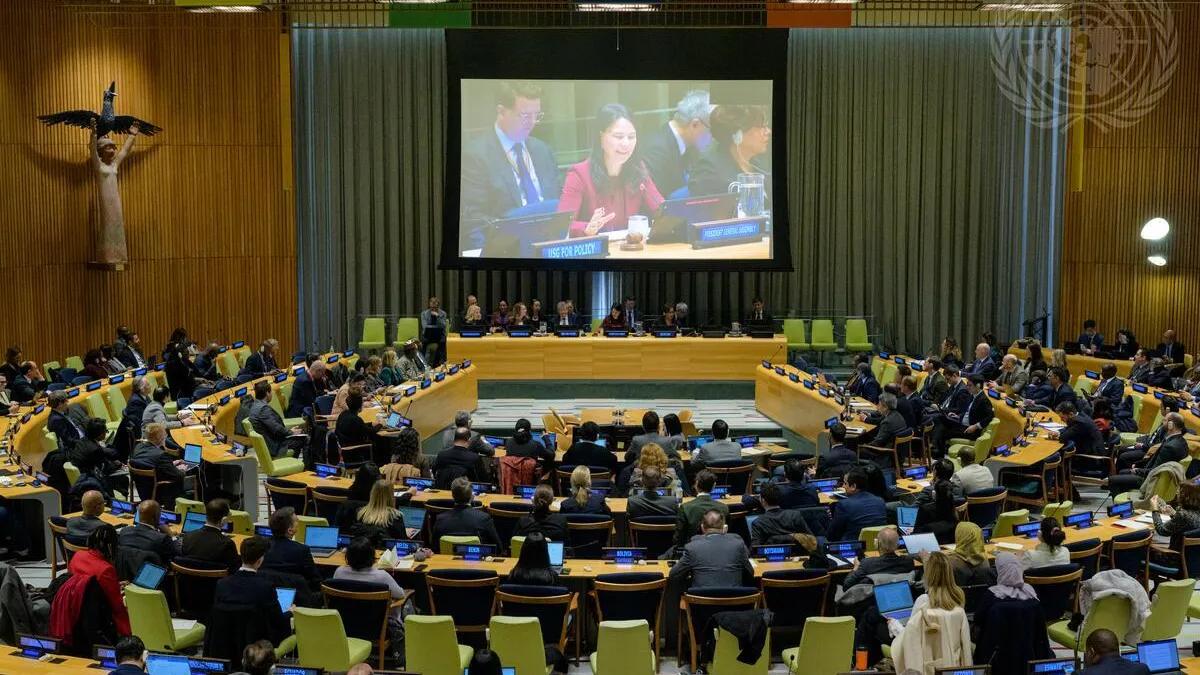
The Zelensky readout: “a really big shift”
The bilateral with Zelensky was the centerpiece of Ukraine’s diplomatic push at the assembly. Afterward, Zelensky said on Telegram that he was “grateful to President Trump for strong cooperation with the United States,” adding that “the president clearly understands the situation and is well informed about all aspects of this war” and that “we highly appreciate his determination to help end this war,” according to Reuters-credited reporting. Speaking to reporters, Zelensky described Trump’s shift as “a big shift, a really big shift,” and when asked whether a recent Trump social media post was a “game changer” for the war, answered: “Trump is a game changer by himself.” In that post, Trump had suggested Ukraine could win back territory and called Russia a “paper tiger” after more than three years of war. Kremlin spokesman Dmitry Peskov rejected the characterization, telling the RBC news agency: “Russia is not a tiger; Russia is more closely associated with a bear. There are no paper bears. Russia is a real bear.”
The energy ceasefire campaign
Behind the pageantry, the substance of the US-Ukraine conversation centered on energy. Trump has been pressing Zelensky to halt Ukrainian drone strikes on Russian oil refineries: a source familiar with their Sunday phone call told Axios that “the word diesel came up many times,” and the Financial Times reported Trump’s message was “diesel, diesel, diesel.” Secretary of State Marco Rubio publicly backed the idea on Fox News, saying an “energy infrastructure ceasefire” would be “a great idea.” Zelensky has said Ukraine would take matching de-escalation steps if Russia stops striking Ukrainian energy infrastructure and food exports. Russia has not publicly signaled it will pause its air campaign. The urgency is seasonal: Ukrainians fear Russia will pound heating and power facilities this winter, and overnight on September 22 Russia fired 212 drones and multiple missiles at Ukrainian industrial and energy sites while Ukraine struck Russia’s Samara region. Read our earlier coverage of the proposed energy ceasefire, the overnight strikes on Ukraine and the Samara drone strike.
Background: two wars converging on energy
The diplomacy unfolds against two grinding conflicts. The US–Iran war is nearly seven months old, per the Wall Street Journal, with Iran threatening the Strait of Hormuz — a vital oil shipping route — and global energy prices spiking since the July collapse of the cease-fire. In Ukraine, the war is in its fifth year; both sides have increasingly struck economic targets. Ukraine has hit Russian refineries at Syzran, Yaroslavl, Moscow and Kuybyshev, and the International Energy Agency says Russian oil refining output has fallen to its lowest level in more than 20 years, with a refinery hit on average once every three days in the first eight months of 2026, according to The Times. Trump has blamed Kyiv’s refinery campaign in part for rising fuel prices at home.
Why this matters
A direct US–Iran negotiating channel, if real and sustained, would be the first crack in a wall that has held since July — and it would matter far beyond the two capitals. The Strait of Hormuz carries a large share of the world’s seaborne oil; any credible path to de-escalation there moves global energy prices, shipping insurance rates and inflation expectations in dozens of countries. For Ukraine, the Zelensky meeting’s value is less any single commitment than the visible alignment: a US president publicly weighing a “new phase” of the war after the November midterms while his envoys shuttle between Kyiv and — now — Tehran. The energy ceasefire idea, modest as it sounds, would be the first mutually observed restraint on strikes since the war’s early months, and a test of whether either side can keep a limited bargain.
Who benefits, who loses, what critics say
Kyiv benefits most from the optics: Zelensky leaves New York able to tell Europeans and his public that Washington is engaged and, in his telling, better informed. US domestic fuel consumers could benefit if refinery strikes ease, though analysts note, as the Journal did of a separate Venezuela oil deal, that decrepit infrastructure takes years and billions to revive — quick price relief is unlikely. Russia loses leverage if an energy truce holds, which is why, analysts say, Moscow has shown no interest; people familiar with the Kremlin’s position told the Financial Times that President Vladimir Putin sees winter strikes on energy as leverage over Kyiv. Iran’s hardliners lose if talks advance, while its reformist president gains room to maneuver. Critics of Trump’s approach argue the “obliteration or greatness” framing is coercive diplomacy that risks miscalculation; supporters call it leverage that forced Tehran back to the table. On Ukraine, critics warn that pressing Kyiv to stop refinery strikes trades away one of its few asymmetric tools for an unenforceable promise.
What the numbers imply
The IEA’s refining data is the quiet bombshell underneath the diplomacy: a refinery hit roughly every three days for eight months has pushed Russian output to a two-decade low — evidence that Ukraine’s long-range drone campaign is imposing real economic costs, not just headlines. That is precisely why Trump wants it paused and why Putin is reluctant to reciprocate: the side absorbing the economic damage has the least incentive to formalize a truce that freezes its disadvantage. The 212-drone Russian barrage on September 22, meanwhile, shows Moscow can still mass-fire at scale despite its refining troubles — a reminder that air campaigns and economic warfare run on separate tracks.
Brent crude traded around $100.22 a barrel as the diplomatic signals emerged. That price does not prove traders expect a deal; it measures how tightly war risk, Hormuz access and already-constrained refining capacity are bound together. Even a limited, credible reduction in shipping risk could remove part of the geopolitical premium, while a failed follow-up meeting or renewed threat to the strait could restore it quickly.
What happens next
Three near-term tests will show whether Tuesday was theater or turning point. First, Secretary of State Rubio meets Russian Foreign Minister Sergei Lavrov on Wednesday — the channel through which any energy truce would have to be negotiated with Moscow. Second, the follow-up US–Iran session Trump promised “in the very near future” must actually happen, with named participants and an agenda. Third, Trump’s three-day state visit from Chinese President Xi Jinping begins Wednesday, adding Beijing — a major buyer of both Russian and Iranian oil — to the diplomatic geometry. Longer term, Trump’s remark about a “new phase” of the Ukraine war after the November midterms puts a clock on the diplomacy: both Kyiv and Moscow will read every move between now and November as positioning for whatever comes after.
Sources
- New York Post: “US holds three hours of talks with Iran on sidelines of UN after Trump threatened to ‘drive them into hell’ during speech”
- USA Today live updates: “Trump says aides had ‘very good meeting’ with Iranians”
- Washington Examiner: “Trump says his negotiators met with Iran for three hours on outskirts of UN General Assembly”
- Wall Street Journal: “Trump Threatens to Annihilate Iran as He Lays Out Foreign-Policy Vision at U.N.”
- Reuters: “Trump says talks with Iran continue and he thinks settlement will be reached”
- Reuters: “Zelenskiy to meet Trump at UN in push for energy truce with Russia”
- The Times: “Trump ‘tells Zelensky to stop hitting Putin’s oil refineries’”
- Reuters: “Russia strikes Ukraine industrial sites, killing three, officials say”
- Associated Press: reporting on the Russia–Ukraine drone war during UN General Assembly week
- Reuters: “Russia says Ukrainian drone attack kills one in its Samara region”
Reporting cutoff: September 22, 2026. Claims about the talks, military activity and diplomatic positions are attributed to the officials and publications reporting them. Analysis is Signal Post News’s synthesis of the cited reporting.