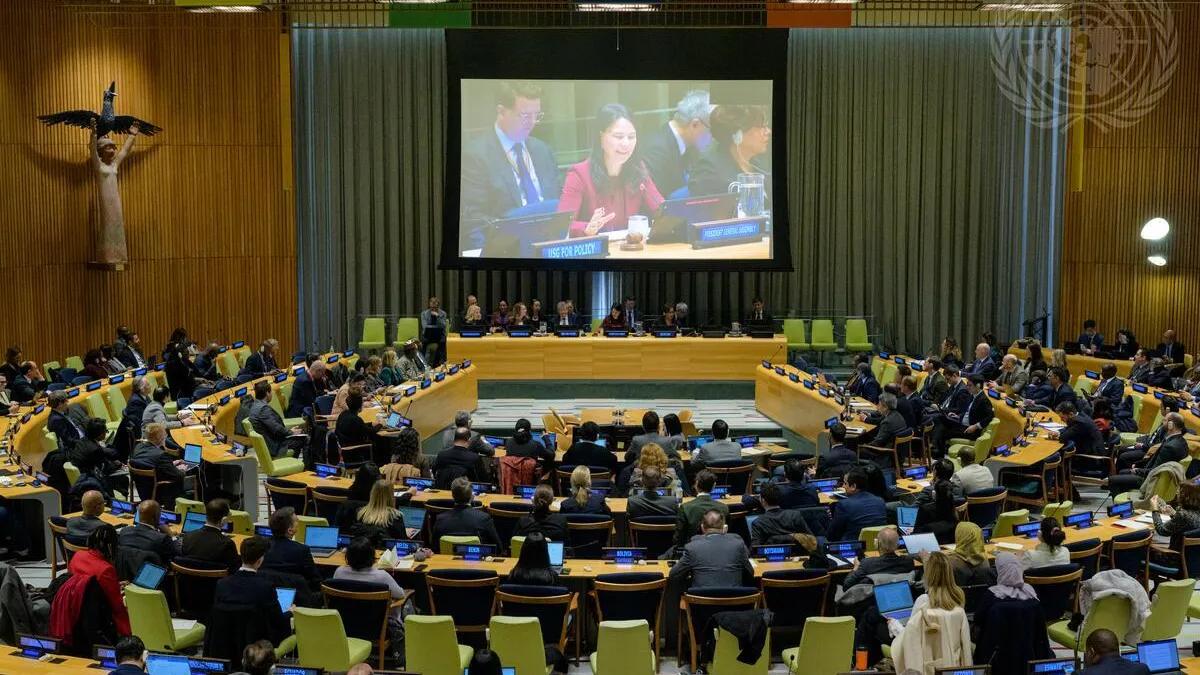
President Donald Trump used the United Nations’ central diplomatic stage on Tuesday, September 22, to warn that he could “annihilate the Islamic Republic” of Iran if no peace agreement is reached, while predicting that Tehran would make a deal after the November 3 U.S. midterm elections. The threat, delivered during a 37-minute address to the General Assembly’s 81st session, was conditional; it was not an announcement of a new military operation. But it placed the possibility of further escalation at the center of a speech heard by leaders gathered from around the world.
Trump defended the U.S.-Israeli military campaign against Iran and said it had prevented Iran from obtaining a nuclear weapon. That is the president’s characterization of the campaign’s result. Iran has long said its nuclear program is for peaceful purposes, while the United States, Israel and other governments have disputed Tehran’s intentions and capabilities. The speech did not present independently verifiable evidence establishing that the current war had permanently removed Iran’s ability to pursue a weapon.
“Do I drive them into hell with no chance of survival and no hope of future greatness?” Trump asked, according to USA Today’s live report from the General Assembly. He then said: “I believe we’ll make a deal right after the election because it doesn’t make sense for them not to.” Trump also called on other countries to join the United States in what he described as the complete economic isolation of Iran until Tehran ended attacks on commercial shipping, abandoned nuclear ambitions and stopped support for groups Washington designates as terrorist organizations.
The rest of the address widened the frame. Trump said he expected progress on Russia’s war in Ukraine, urged countries to leave the International Criminal Court, praised reductions in the United Nations budget, attacked a proposed global maritime carbon tax, defended U.S. action against drug cartels, predicted the fall of Cuba’s government and described artificial intelligence safety warnings as a hoax. Reuters’ account of the speech reported those themes as the principal elements of the address.
Why this matters
A sitting U.S. president threatening a country’s annihilation from the UN rostrum is an escalation signal even when the language is conditional. It tells Iran that Washington wants the costs of rejecting a deal to appear existential, while telling U.S. allies and Israel that the administration is prepared to keep military force in the negotiating equation. It also raises a practical question the speech did not answer: what action or threshold would move the administration from pressure to another strike.
The timing of Trump’s forecast matters just as much as the threat. By predicting a deal “right after” the November 3 midterms, he fused an external war negotiation with a domestic political calendar. Trump insisted that he was not personally on the ballot and said political considerations did not drive his Iran decisions. Even so, saying that Tehran is waiting to see how his party performs makes the composition of Congress part of the diplomatic narrative. Iran may read the election as a test of Trump’s leverage; U.S. voters may read the war and fuel-price consequences as part of their choice.
The address also showed how the administration connects otherwise separate disputes. Iran, Ukraine, the ICC, cartels, Cuba, the UN budget, carbon pricing and AI were presented through the same sovereignty-centered lens: the United States would use national power and resist institutions Trump said constrain it. Supporters see that as directness and leverage. Critics argue that it can make U.S. commitments harder for allies to predict and weaken institutions Washington may later need to organize coalitions.
Iran: military pressure, economic isolation and a post-election forecast
Trump’s Iran section paired a defense of past action with a warning about future action. He said the U.S.-Israeli campaign had stopped Iran from becoming nuclear-armed and portrayed a negotiated settlement as the alternative to destruction. The formulation offered Tehran a route to talks, but on terms presented under extreme coercion.
His call for economic isolation attempts to broaden the pressure beyond the United States and Israel. Participation by shipping states, energy buyers, insurers and financial centers would determine whether that appeal changes Iran’s access to trade. A presidential speech cannot by itself compel those governments or companies to join. Some may share U.S. concerns about nuclear proliferation and maritime attacks while opposing language or policies they believe increase the risk of a wider regional war.
For Tehran, accepting negotiations could preserve infrastructure and reduce economic pressure, but it could also be presented domestically as yielding under threat. Rejecting talks could preserve a posture of defiance while increasing the danger of further strikes and isolation. The speech did not disclose new negotiating terms, a verification framework or an agreed diplomatic channel. The next meaningful evidence will be whether U.S. and Iranian officials, directly or through intermediaries, begin discussing specific obligations and sanctions relief.
Ukraine: Trump says a settlement could come faster than expected
On Ukraine, Trump said: “We’re working very closely with the leaders of Russia and Ukraine, and we will get that one done,” adding, “It’s going to happen, I think, more quickly than people understand,” according to Reuters. On arrival at the UN, he told reporters that his message to Russian President Vladimir Putin was to “settle the war.” Those statements expressed confidence; they did not announce an agreement.
Trump was scheduled to meet Ukrainian President Volodymyr Zelenskyy later Tuesday. Secretary of State Marco Rubio had told Fox News that a reciprocal “energy infrastructure ceasefire” would be an “ideal outcome,” according to The Times’ reporting on the proposed energy truce. The proposal would require Ukraine to stop attacks on Russian energy facilities while Russia spared Ukrainian energy infrastructure. As of the reporting cutoff for this article, no such agreement had been announced.
Zelenskyy enters the meeting seeking protection for Ukraine’s grid and leverage against continued Russian attacks. Russia would have to accept and observe any reciprocal arrangement for it to function. Critics who see Trump’s emphasis on Ukraine as a way to redirect attention from the Iran war point to the contrast between confident language about a faster settlement and the absence of a verified deal. That criticism is an interpretation; the operational test is whether Tuesday’s meeting produces terms both Kyiv and Moscow can accept.
The ICC, cartels, Cuba and Venezuela
Trump urged member countries of the International Criminal Court to withdraw, although he used the word “resign.” He called the court “an out of control institution” and “an evil group of people,” and said the United States would not permit its service members to face what he called “show trials” before an anti-American tribunal. Those descriptions are Trump’s. The ICC says it is an independent court of last resort for genocide, war crimes, crimes against humanity and aggression when national systems are unwilling or unable to act.
The United States is not an ICC member. Trump’s appeal therefore targeted countries that have accepted the court’s jurisdiction. Governments sympathetic to U.S. objections may welcome pressure on investigations involving Americans or allied officials. The court and its supporters warn that political retaliation can obstruct accountability and make evidence, banking and travel more difficult for investigators and staff.
On drug cartels, Trump highlighted the U.S. designation of groups as terrorist organizations. “Like ISIS, they should be killed, exiled or detained as enemy combatants without the possibility of release,” he said, according to Reuters. The statement described the administration’s preferred treatment of designated cartels. It did not explain how suspects would be identified, what legal process would apply or how the approach would interact with other countries’ sovereignty.
Trump called Cuba “an absolutely failed state,” adding: “It’s failing like never before, and it will fall.” Members of Cuba’s UN delegation walked out during the speech, USA Today reported. The walkout made visible the diplomatic cost of the address’s confrontational language, while the prediction itself remains a political forecast rather than an established outcome.
On Venezuela, Trump described U.S. action as a war and linked it to oil. “It was a war, but it’s perhaps the biggest deal ever made,” he said. “To the victor belong the spoils.” He also claimed the result was the largest oil deal ever made. Those are Trump’s claims and framing; the speech did not provide a full contract, valuation or independent basis for comparing the arrangement with every previous oil agreement.
The United Nations, carbon taxes and “super intelligence”
Trump said his administration had helped cut the UN budget by 15% and eliminate 4,000 jobs. He presented those reductions as proof that pressure can force reform. For UN agencies and employees, the same figures imply fewer staff and resources at a time when the organization is managing wars, displacement and humanitarian emergencies. Whether the cuts represent efficiency or diminished capacity depends on which programs lost funding and what work goes undone.
He also attacked the International Maritime Organization over a proposed global carbon tax, arguing that it would increase shipping costs, and declared that there would be no global taxes while he was president. Supporters of the proposed levy say maritime emissions require coordinated rules because shipping crosses national jurisdictions. Opponents argue that a global charge would raise transport costs and reduce national control over taxation.
On artificial intelligence, Trump said the U.S. government would use the term “super intelligence” and again dismissed AI safety warnings as a hoax. He said he would not stifle a technology he predicted would be bigger than the Industrial Revolution and claimed the United States was leading China “by a lot.” The comparative claim was not accompanied by a metric in the speech. The disagreement over AI safety is not only semantic: it concerns how governments weigh growth against the risk of misuse, job displacement, unreliable systems and loss of human control.
Background: two wars and a combative UN strategy
The speech came during an ongoing U.S.-Israeli war against Iran whose consequences extend beyond the battlefield. Attacks, sanctions, shipping risk and uncertainty around energy supply have pushed fuel costs into domestic politics and raised costs for countries that import oil and refined products. Trump’s promise that an Iran deal would follow the midterms therefore connects foreign policy, household prices and congressional power.
Ukraine diplomacy has followed a repeated cycle of Trump announcing confidence, direct contacts with leaders and narrower proposals that stop short of a comprehensive settlement. The current energy-infrastructure concept is one such proposal: potentially valuable if reciprocal and verified, but unable by itself to end fighting along the front or attacks on targets outside the agreement.
The address also continued Trump’s combative approach at the previous year’s General Assembly, where he used the multilateral stage less to celebrate institutions than to challenge them. The 2026 version broadened that confrontation. Instead of focusing on one conflict, Trump placed wars, courts, climate policy, regional security and technology inside a single argument against external constraints on U.S. action.
UN Secretary-General António Guterres opened the session with a sharply different emphasis. He said “faultlines in our world are widening” and said Israeli actions in the occupied West Bank were “bulldozing the path to peace.” Those remarks framed the week around collective risk and international law; Trump framed it around sovereign power and negotiated outcomes backed by American leverage.
Who benefits, who loses — and what critics say
Israeli officials and U.S. Iran hawks may benefit from language that keeps maximum pressure and possible further strikes on the table. It strengthens their argument that Tehran will compromise only when the cost of refusal is unmistakable. Iran’s government loses diplomatic room if other countries answer Trump’s call for economic isolation, while Iranian civilians remain exposed to the effects of war, sanctions and higher prices.
Trump benefits domestically if voters see the speech as proof of strength and if he can convert the promise of post-election diplomacy into a deal. The risk is that the election becomes a deadline he does not control. Tehran could wait, reject the premise or interpret the political calendar differently. A separate Reuters/Ipsos poll put Trump’s approval at 32%, an all-time low in that survey series, increasing the political pressure around both the war and the economy.
Allies face a mixed calculation. Some share Washington’s stated objectives on Iran, shipping security and nuclear proliferation. Reuters and USA Today reported a widening view among allies that U.S. commitments are less reliable. A threat-heavy speech can reinforce deterrence, but it can also heighten concern that policy will change with U.S. domestic politics or that partners will be asked to absorb consequences without controlling escalation.
Cuba’s delegation used its walkout to reject Trump’s forecast for the island. The ICC faces direct pressure on its membership and operations. Ukraine may gain U.S. attention for a limited truce, but Zelenskyy also faces pressure to surrender a form of battlefield leverage before there is evidence Russia will reciprocate. Critics of the administration argue that the Ukraine optimism deflects from the costs and uncertainty of the Iran war; supporters counter that a president can pursue more than one negotiation at a time.
What the numbers imply
Thirty-seven minutes gave Trump time to move beyond a single-war address and lay out a broad doctrine. The length also increased the number of separate commitments and forecasts against which his administration can be measured.
The 81st session and roughly 130 heads of state made the venue consequential. The audience was not only American voters or Iran’s leadership; it included governments whose cooperation would be required for economic isolation, shipping rules, UN budgets and ICC policy.
Thirty-two percent approval places the speech in a difficult domestic environment. Foreign-policy language can rally supporters, but the Reuters/Ipsos number suggests the administration cannot assume broad public confidence, especially when the Iran war and fuel costs are part of the midterm debate.
A 15% budget reduction and 4,000 jobs are large enough to change operations, not merely symbolism. The administration cites the cuts as discipline; the UN and affected programs must show which functions can still be delivered with fewer resources.
November 3 is now both an election date and a marker in Trump’s Iran forecast. Past presidents have used UN speeches for ultimatums, alliance-building and public red lines. What is unusual here is the explicit linkage between the expected timing of a foreign agreement and the result of a midterm election in which the president is not on the ballot.
What happens next
The first test comes Tuesday afternoon in Trump’s meeting with Zelenskyy. Watch for specific language on an energy-infrastructure ceasefire: which facilities would be protected, when a pause would start, how Russia would be brought in and who would investigate alleged violations. A statement of intent is not the same as an operational agreement.
The next Iran signal will be Tehran’s response. Iran could reject the threat, communicate through intermediaries or propose conditions for talks. Governments Trump asked to join economic isolation will also reveal whether the speech built a coalition or merely restated a U.S. position. Markets will watch shipping routes, fuel prices and any indication that rhetoric is being converted into military orders.
After returning to Washington, Trump is expected to host Chinese President Xi Jinping for a state visit, according to USA Today. That meeting will test the same doctrine in a different relationship: whether personal diplomacy and leverage can produce defined agreements between major powers while disputes over trade, technology and security remain.
The central uncertainty is whether the Iran language is intended primarily to frighten Tehran into negotiations or to prepare the public and allies for more strikes. Those paths are not mutually exclusive, and governments often use military pressure to shape talks. Evidence will come from force movements, sanctions, diplomatic contacts and the terms Washington is willing to put on paper—not from the intensity of the speech alone.
The address therefore leaves the world with a clear warning but no settled outcome. Trump said the United States can force movement on Iran and Ukraine while rejecting constraints from the ICC, the UN and other international bodies. The coming meetings and responses will show whether that combination produces agreements, deeper isolation or further escalation.
Sources and reporting notes
- Reuters, September 22, 2026: 37-minute speech, Iran and Ukraine remarks, ICC, cartels, Cuba, Venezuela, UN reform and AI
- USA Today live coverage, September 22, 2026: direct quotations, Iran isolation call, Cuba walkout, UN budget, maritime carbon tax and Xi visit context
- The Times: Rubio’s “ideal outcome” description of a reciprocal energy-infrastructure ceasefire and Ukraine diplomacy context
Reporting cutoff: September 22, 2026, before the scheduled Trump–Zelenskyy meeting concluded. Direct quotations and factual accounts are attributed to Reuters, USA Today or The Times. Trump’s claims about military results, future deals, Venezuela, Cuba, the ICC and U.S. technological leadership are presented as his statements, not independently established facts. Analysis is Signal Post News’s.