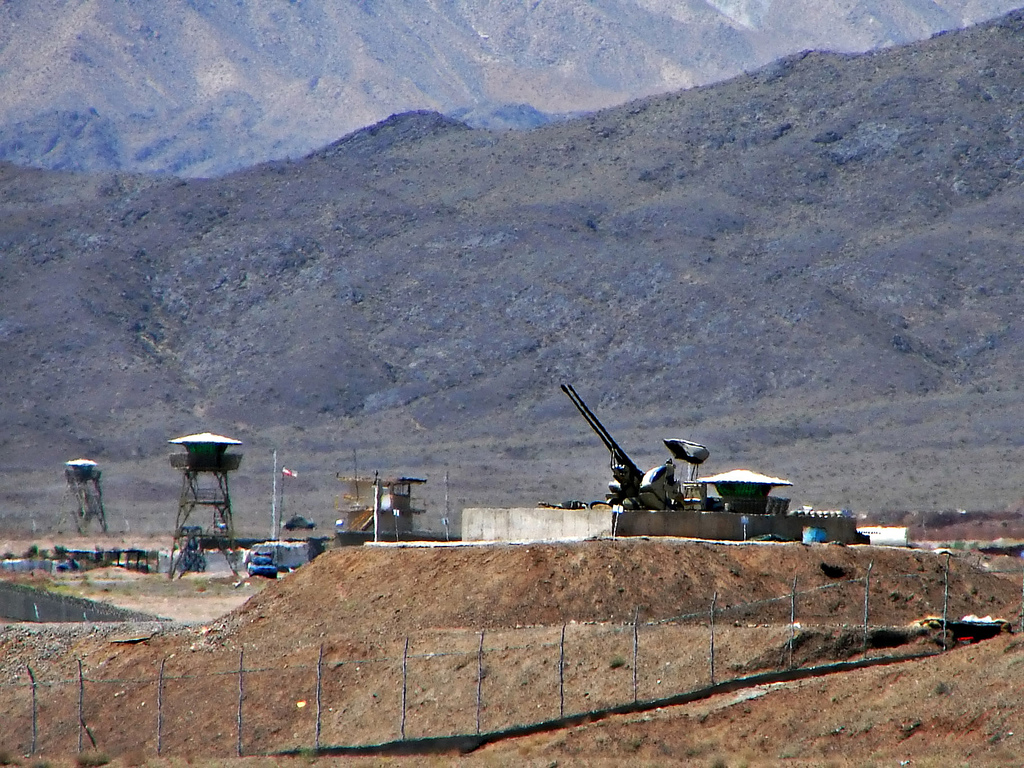
Lead
Iran is fortifying the entrances to one of its most sensitive nuclear-linked sites — and daring Washington to do something about it. Satellite imagery from September 11, analyzed by the Institute for Science and International Security (ISIS), shows earthen roadblocks still in place on the roads leading to Pickaxe Mountain's western tunnel portals near the Natanz nuclear complex, with additional soil piled over one western portal and over a nearby cluster of entrances first built in 2007. The institute assesses that the added earth hardens the entrances against aerial bombardment, that the facility is not in normal operations, and that valuable equipment or materials likely remain inside.
The findings, reported by the New York Post on September 17, landed one week after President Donald Trump issued his latest warning over the site: "We notice there's a little activity at Pickaxe. I would advise Iran not to get cute because we will have to hit them very hard." Trump has repeatedly raised the possibility of striking Pickaxe, telling Fox & Friends in July that the U.S. was watching it closely and knew "exactly what's going on," and that Washington could "take out Pickaxe" if diplomacy failed.
What happened
The September 14 report documents a steady program of access denial. Earthen piles were placed across the roads to the western tunnel entrances in late July and early August 2026, and imagery confirms they remained in place on September 11. Earlier imagery from April and May showed the pair of eastern tunnel portals partially filled with dirt. With both western vehicle access blocked and eastern portals filled, the institute concludes Iran currently cannot enter the underground facility with vehicles — and would need to clear the roadblocks to resume construction or other activity inside.
Pickaxe Mountain sits roughly two kilometers from Natanz and contains multiple tunnel entrances into a deeply buried underground complex. Construction began in 2020, after sabotage damaged an advanced centrifuge assembly facility at Natanz; Iranian officials subsequently said a replacement underground facility was being built for advanced centrifuge production. Analysts estimate portions of the complex lie at least 100 meters beneath the mountain. The roadblocks followed July reporting that Iran had moved centrifuges into the facility after the June 2025 war, alongside Trump's comments about potential U.S. attacks.
The fortification is part of a wider pattern. In a separate September 17 report, the institute said Iran was "rapidly moving forward" with reconstruction of Taleghan 2 at the Parchin military complex southeast of Tehran: September 13 imagery showed a tarp erected over the destroyed hardened facility to obscure work underneath, with dump trucks, bulldozers, concrete equipment and cranes active around the site. Taleghan 2 was struck by Israel in October 2024 and again in March 2026 after Iran had rebuilt and hardened it.
Why it matters
Pickaxe is the hardest target in Iran's nuclear architecture — and both sides know it. Behnam Ben Taleblu of the Foundation for Defense of Democracies told Fox News Digital that some analysts believe "the window to strike Pickaxe Mountain has already expired because the regime has dug an underground nuclear facility several times deeper than Fordow." His assessment of Washington's remaining option is blunt: "bury their entrances and raise the political cost" of digging out. Every new layer of earth Iran piles on makes the military math worse and the diplomatic math more urgent.
The site sits at the intersection of the week's two biggest Iran storylines. At the U.N., Russia and China vetoed a U.S.-drafted Security Council resolution that would have extended the mandate of the Panel of Experts monitoring Iran sanctions — the measure got 11 votes in favor, with Pakistan and Somalia abstaining. U.S. Ambassador Mike Waltz insists "snapback" sanctions were legally restored; Moscow and Beijing reject that. The veto removes a layer of international monitoring just as satellite analysts are documenting reconstruction at sensitive sites. An independent U.N. fact-finding mission separately found reasonable grounds that two U.S. strikes on civilian sites in Iran in February were war crimes, and that Iranian authorities committed crimes against humanity in their protest crackdown.
For the negotiations resuming on the UNGA sidelines, Pickaxe is the facility Washington most wants visibility into — and the one Tehran is most actively sealing.
What the numbers mean
The depth figures tell the story. Natanz's known enrichment halls sit about three floors underground beneath reinforced concrete and 22 meters of earth. Pickaxe's tunnel complex is assessed to run far deeper — "several times deeper than Fordow," per the FDD analysis — in rock that conventional bunker-busters cannot reliably penetrate. That is why the ISIS report's observation about soil matters: even marginal increases in overburden at the portals raise the difficulty of the one strike option analysts consider realistic, which is collapsing or burying the entrances rather than destroying the complex itself.
The timeline matters too. Roadblocks went up in late July and early August; they were still there September 11. That is six-plus weeks of deliberate access denial — consistent with a decision, not a construction pause. The institute's read is that the facility is not in normal operations but retains "valuable equipment or materials" inside, a formulation that keeps open every interpretation from stored centrifuges to enriched uranium.
What happens next
Trump's "don't get cute" warning sets up a direct test: continued fortification at Pickaxe is precisely the activity he said would trigger a strike. Whether the administration treats the September imagery as provocation or as background noise will signal — watch for any U.S. statement specifically naming Pickaxe in the coming days — and for the next ISIS imagery update, which will show whether the roadblocks are being cleared (preparing the site for use) or reinforced (preparing it for attack).
The veto at the Security Council means the next phase of this contest will play out with less international monitoring and more unilateral intelligence claims — satellite photos from think tanks on one side, state media denials on the other.
Sources and reporting notes
- New York Post, Sept 17 2026: ISIS Pickaxe findings; Trump "don't get cute" warning; Russia-China UNSC veto; Taleghan 2 reconstruction
- Institute for Science and International Security, Sept 14 2026: earthen roadblocks since late July/early August; eastern portals partially filled; assessment of non-normal operations with valuable equipment inside
Reporting cutoff: September 22, 2026. All Pickaxe findings are the assessments of the Institute for Science and International Security, a private research organization, based on commercial satellite imagery — not IAEA inspections. Iran states there is no nuclear activity at the site; Western intelligence characterizations of its purpose are unverified. The U.N. fact-finding mission's findings are investigative, not judicial. The Fox News Digital original of the Ben Taleblu interview was reported via the New York Post's account.