NATO shoot down Russian planes

One year ago this week, in September 2025 — not 2026 — Donald Trump, Mark Rutte, NATO diplomats and Russian Ambassador Alexey Meshkov traded warnings over when allied pilots could fire on intruding aircraft, while Hungarian Gripens intercepted five Russian warplanes near Latvia. The NATO shoot down Russian planes debate began then. September 2026 has brought a fresh wave of airspace incidents, from a drone destroyed over Lithuania to new scrambles over Poland, Romania and the Gulf of Finland, showing that the operational question behind last year's rhetoric remains unresolved.
What happened in September 2025
Trump and Rutte backed force when “necessary”
On September 23, 2025, Trump — meeting Volodymyr Zelenskyy on the sidelines of the UN General Assembly in New York — was asked whether NATO countries should shoot down Russian aircraft that enter their airspace. “Yes, I do,” Trump replied, adding that direct U.S. backup would depend “on the circumstance.” That exchange was recorded in our account of the Rubio–Lavrov UNGA meeting and Trump's shift on Russia.
On September 25, 2025, Rutte said on Fox News' “Fox & Friends”: “If so necessary. So I totally agree here with President Trump: if so necessary.” Reuters reported that Rutte also stressed the case-by-case judgment involved: NATO militaries are trained to evaluate the threat in real time and decide whether to escort an aircraft away or take further action. His statement was political backing, not a new alliance-wide order to fire.
European diplomats warned Moscow privately
In September 2025, Bloomberg reported that British, French and German diplomats told Russian counterparts in a tense meeting that NATO was prepared to respond with force to further airspace violations. The Europeans said they believed the September 19 Estonian incident, involving three Russian MiG-31 fighters, was “a deliberate tactic ordered by Russian commanders.”
Russian diplomats disputed that account. They argued that Russian flights were responses to Ukrainian actions against annexed Crimea and that NATO support for Kyiv had brought Europe into direct confrontation with Moscow. Bloomberg's account, carried by The Moscow Times, said Russian delegates took extensive notes; European officials interpreted that as preparation for a detailed report to Moscow, an inference that could not be independently verified.
Peskov and Meshkov answered with escalation warnings
Also in September 2025, Kremlin spokesman Dmitry Peskov called the shoot-down discussion “reckless, irresponsible” and warned of “dangerous consequences,” according to The Moscow Times. He said Estonia had offered “no evidence” for its MiG-31 account and described Tallinn's language as an escalation. Estonia maintained that its airspace had been violated; Russia denied it.
In a late-September 2025 interview with France's RTL, Russian Ambassador to France Alexey Meshkov said that NATO shooting down a Russian aircraft over an alleged violation “would be war.” The statement defined Moscow's public position at the time, but it did not specify how Russia would respond to different circumstances, such as an armed aircraft threatening civilians versus a brief or disputed incursion.
Hungarian Gripens intercepted five Russian aircraft
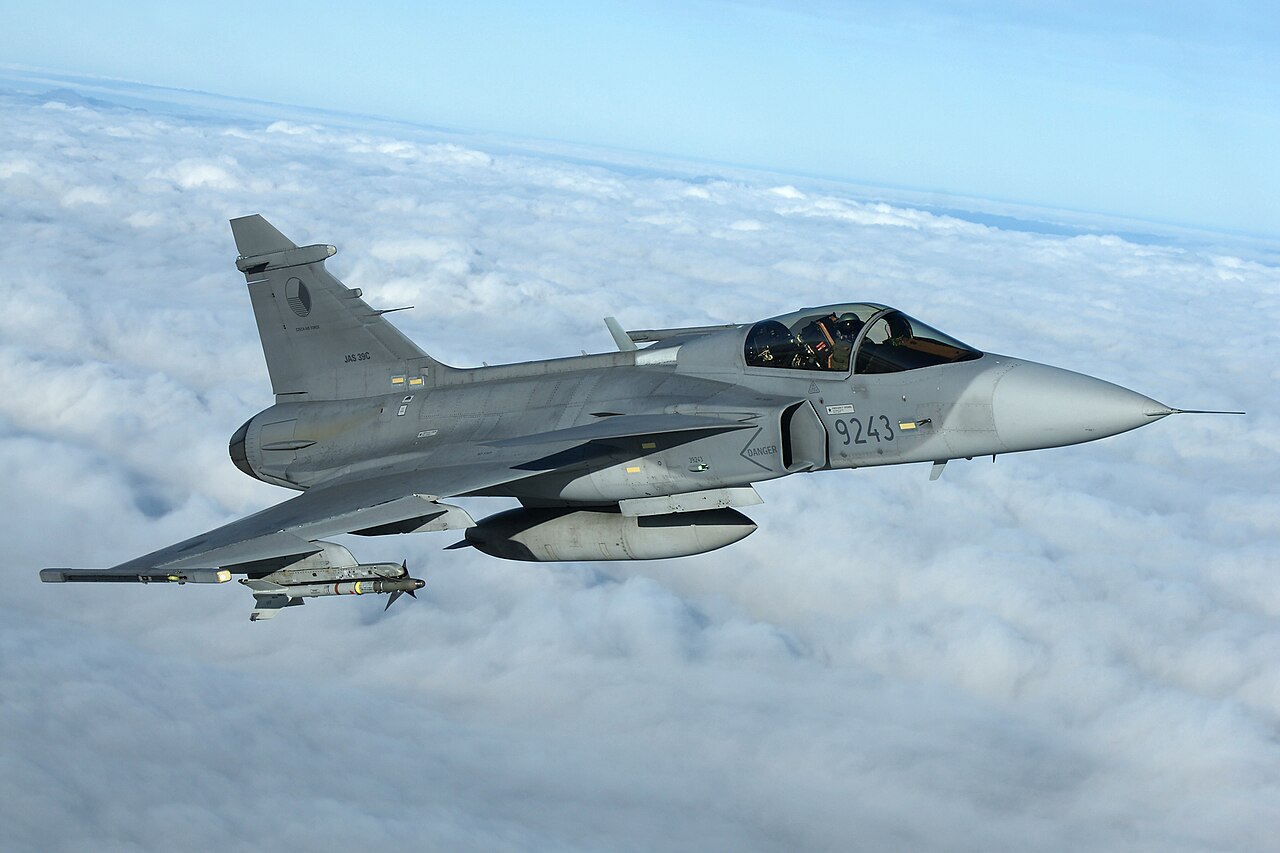
On September 25, 2025, NATO Air Command said two Hungarian JAS 39 Gripens assigned to Baltic Air Policing scrambled from Šiauliai Air Base in Lithuania to identify five Russian military aircraft — a Su-30, a Su-35 and three MiG-31s — flying close to Latvian airspace.
NATO said the Russian formation had no filed flight plan, was not using transponders and had no radio contact with civilian air traffic control. The Hungarian aircraft visually identified and escorted the formation before returning safely to base. No shots were fired, and NATO did not say the Russian aircraft crossed into Latvian airspace.
One year later: September 2026's crowded skies
Lithuania recorded a drone shoot-down and a reported jet incursion
On September 15, 2026, an Italian fighter operating for NATO shot down a drone in Lithuanian airspace near Pratkūnai village, according to Lithuania's national crisis management center and Reuters. It was the first confirmed NATO shoot-down of a Russian-linked drone over Lithuania. Initial reporting said the drone's origin was still under investigation; Lithuanian authorities later described it as a Russian-made Gerbera-2 likely bound for Ukraine, so the public evidence did not establish that Lithuania itself was the intended target. Reuters separately quoted Rutte saying Russia was “growing increasingly reckless” as the war spilled toward allied territory.
On September 17, 2026, two Russian military jets reportedly crossed into Lithuanian airspace and two Italian Eurofighter F-2000s scrambled from Šiauliai, according to an ANSA report cited by AirMedia24. Neither the types of the Russian aircraft nor the duration of the reported crossing were publicly confirmed at the time, and the account should therefore be read as a reported incident rather than a fully documented NATO finding.
Poland and Romania scrambled aircraft on successive days
On September 23, 2026, a Russian Mi-8 helicopter from Kaliningrad entered Polish airspace for about 42 seconds and penetrated roughly 300 metres, Poland's Operational Command said. Poland scrambled fighters and put ground-based forces on standby. The command assessed that the flight was testing its air defenses; Russia's embassy did not immediately comment to Reuters. The episode is examined in our report on the Russian helicopter incursion into Poland.
On September 24, 2026, Romania scrambled two F-16s after its defense ministry said an unidentified aerial target crossed from Ukrainian airspace into northern Romania. Spanish F-18s stationed in Romania also scrambled after radar detected a separate group of aerial targets near the Ukrainian border, the ministry said. The available statements attributed the alerts to radar contacts; they did not publicly establish the identity or intent of every object. The wider pattern is covered in our report on NATO jets scrambling over Poland and Romania.
Finland and Sweden carried out their first joint identification mission
On September 25, 2026, Finland and Sweden announced that their quick-reaction fighters had carried out their first joint operational identification mission the previous day. The Finnish Air Force said Finnish F/A-18 Hornets and Swedish JAS 39 Gripens identified a Russian Tu-134 transport aircraft, MiG-31s and Su-30s in international airspace over the Gulf of Finland. Reuters reported that Swedish Prime Minister Ulf Kristersson highlighted the mission on X as evidence of deeper Nordic and NATO cooperation. The Russian aircraft were reported in international airspace, not as violating Finnish or Swedish territory.
Denmark sharpened the strategic warning
On September 25, 2026, Reuters reported Danish Defence Intelligence Service chief Thomas Ahrenkiel's warning of a “low but growing risk” that Russia could launch a limited military attack against one or more NATO countries bordering Russia. The service still judged an outright invasion “highly unlikely.” That distinction matters: the assessment described a contingency and a trajectory, not evidence of an imminent attack, as detailed in our analysis of Denmark's limited-attack warning.
Why this matters one year on
The credibility trap is still unresolved
The dilemma identified in September 2025 remains intact. If an allied government says it will shoot down a violator but then only escorts the next aircraft away, Moscow may interpret restraint as hesitation. If a pilot fires, Russia has already framed that possibility as war. NATO's actual practice continues to rely on national rules of engagement and a threat assessment made in the moment, leaving deliberate ambiguity between an air-policing intercept and an act of force.
The contrast in Rutte's language captures the change in emphasis. In 2025 he said force could be used “if so necessary,” a formula that preserved discretion. In September 2026 he called Russia “growing increasingly reckless,” according to Reuters. The words are firmer, but they still do not answer the doctrine question: which combination of intent, trajectory, armament and risk is enough to trigger a shot?
The 2026 incidents show that the probing has continued
The September 2026 sequence spans different categories: a drone destroyed over Lithuania, a reported jet crossing, a 42-second helicopter incursion, unidentified radar contacts near Romania and a lawful identification mission over international waters. Treating them as identical would be misleading. Taken together, however, they show how frequently NATO air crews now have to distinguish accident, spillover, reconnaissance and potential attack under time pressure.
The next scramble that the 2025 debate anticipated has already happened repeatedly. The operational burden now falls on pilots and commanders who must apply case-specific rules before politicians have resolved the public doctrine.
Background: how we got here
September 2025's airspace incidents
On the night of September 9–10, 2025, Russian drones entered Polish airspace during a strike on Ukraine; NATO aircraft scrambled and Poland sought Article 4 consultations. Later in September 2025, Romania reported a drone entering its airspace during another Russian strike on Ukraine. On September 19, 2025, Estonia said three Russian MiG-31s spent about 12 minutes in its airspace near Vaindloo island in the Gulf of Finland.
Russia denied Estonia's September 2025 account, saying the aircraft followed a scheduled route to Kaliningrad over international waters. NATO launched Operation Eastern Sentry on September 12, 2025, adding allied air and surveillance assets along the eastern flank. The incidents accelerated national debates about how quickly commanders could authorize defensive action.
From Article 4 to “if so necessary”
NATO's formal position in September 2025 was that each member had the right to defend its airspace and that engagement decisions belonged to national commanders responding to the circumstances. Article 4 consultations produced statements of solidarity, not a single automatic shoot-down rule. Trump's “Yes, I do,” Rutte's “I totally agree” and the private warning attributed to European diplomats hardened the political signal without creating a public alliance-wide doctrine.
That ambiguity was deliberate. It allowed NATO to threaten consequences while retaining the option to escort, monitor or engage according to risk. It also left room for competing interpretations of restraint, which is why the same debate has returned with each 2026 incident.
The German money question
In September 2025, German Chancellor Friedrich Merz backed a proposal to mobilize up to €140 billion in frozen Russian assets to finance Ukraine, Reuters reported. The proposal sat beneath the air-defense debate: sustained patrols, interceptors, radar coverage and missile stocks require long-term funding. Whether and how those assets could lawfully be used remained subject to European negotiations.
Multiple angles — who gains, who loses, what is disputed
The winners: the eastern flank, and Kyiv
In September 2025, Poland, the Baltic states and Romania gained stronger political backing for warnings they had issued for years. Kyiv also benefited from a NATO debate that placed more costs and uncertainty on Russian military aviation near allied borders. In 2026, each new scramble reinforces eastern members' case for more aircraft, sensors and delegated authority, even when the incident ends without a violation or a shot.
The losers: de-escalation and civil aviation
In 2025, diplomats seeking a negotiated end to the Ukraine war faced a more hostile atmosphere as NATO and Moscow traded public warnings. That cost persists in 2026. Civil aviation also remains exposed to risk when military aircraft fly near busy corridors without transponders or radio contact, while defensive scrambles add more fast-moving aircraft to already crowded airspace.
What critics say
Moscow argued in 2025 that the shoot-down discussion was “reckless” and that NATO states had not publicly proved deliberate Russian violations in every case. Western skeptics made a different criticism: not every incursion presents the same threat, and a rule that treats a lost drone, a brief helicopter crossing and an armed fighter formation alike would raise the risk of an unnecessary escalation.
That caution remains relevant in 2026. Lithuania's drone was Russian-made, according to Lithuanian authorities, but was described as likely intended for Ukraine; the Finnish-Swedish mission identified Russian aircraft in international airspace. Attribution, intent and legal location still determine what response is proportionate.
What is genuinely disputed
The core dispute is whether the pattern represents deliberate probing, navigational error, electronic-warfare spillover or some combination of all three. Poland's command said the Mi-8 flight tested its defenses; Russia did not immediately answer that specific claim. European officials have described earlier activity as deliberate, while Moscow has denied violations and accused NATO of escalating rhetoric.
Public evidence does not resolve intent across every event. What is clear from official and attributed reporting is that allied aircraft are scrambling more often, more countries are participating and commanders are making distinctions that political slogans cannot capture.
What happens next
Scenario one: managed deterrence
The next scramble already happened in September 2026 — several times. Managed deterrence would mean the pattern continues without weapons fire: radar detection, quick-reaction launches, visual identification and escort or monitoring. The key signal will be whether NATO defense ministers describe common engagement criteria more specifically while preserving national command authority.
Scenario two: an accident or misread maneuver
A transponder-off formation, a crowded civilian corridor or a radar contact that changes direction can force a decision in seconds. The 2026 incidents illustrate how many such decisions now occur. Even without deliberate aggression, a collision, mistaken identification or misunderstood warning could narrow the space for de-escalation.
Scenario three: a deliberate test
If Russia deliberately crosses allied airspace with a manned aircraft and lingers, a NATO member could decide that “if so necessary” has been met. Meshkov's 2025 “would be war” statement would then face an operational test. Russia could respond militarily or asymmetrically, or it could limit its reaction; public statements do not establish which course Moscow would choose.
What to watch
Watch the language NATO defense ministers use for engagement criteria, especially whether they distinguish drones, helicopters and armed combat aircraft. Watch whether Russia pauses the probing after the September 2026 responses or continues to test reaction times. Watch, too, for official evidence on disputed incidents: flight tracks, wreckage analysis and air-traffic records matter more than political shorthand.
Sources and further reading
- Reuters, September 25, 2025 — “NATO's Rutte: members can target Russian aircraft entering NATO space when necessary”
- The Moscow Times, citing Bloomberg, September 2025 — “Kremlin Slams Idea of NATO Downing Russian Planes”
- NATO Air Command post of September 25, 2025, quoted by Defense Feeds — Hungarian Gripen intercept near Latvia
- Hungarian Conservative, September 2025 — Hungarian Gripens scramble over the Baltic
- Defense Feeds, September 2025 — Hungarian Gripen jets intercept Russian fighters
- Reuters via SRN News, September 15, 2026 — Italian NATO fighter shoots down a drone in Lithuania
- ANSA, as cited by AirMedia24, September 17, 2026 — reported Russian-jet incursion and Italian Eurofighter scramble
- Polish Operational Command, quoted by Reuters, September 23, 2026 — Russian Mi-8 incursion
- Romanian Ministry of National Defence statement, September 24, 2026 — Romanian and Spanish fighter scrambles
- Reuters, September 25, 2026 — Swedish and Finnish fighters identify Russian military aircraft
- Finnish Air Force, September 25, 2026 — first joint operational identification mission with Sweden
- Swedish Prime Minister Ulf Kristersson's statement on X, quoted by Reuters, September 25, 2026
- Danish Defence Intelligence Service, quoted by Reuters via WNCY, September 24, 2026 — updated Russia threat assessment
Reporting basis: Fixed September 25, 2026 snapshot. The shoot-down debate, diplomatic warnings and Hungarian Gripen intercept occurred in September 2025. The 2026 incidents are attributed to the named authorities and reports; intent remains disputed, and some aircraft were identified in international airspace rather than inside NATO territory.