Anne Carson Wins 2026 Nobel Prize in Literature: The Genre-Defying Poet Who Reinvented the Classics
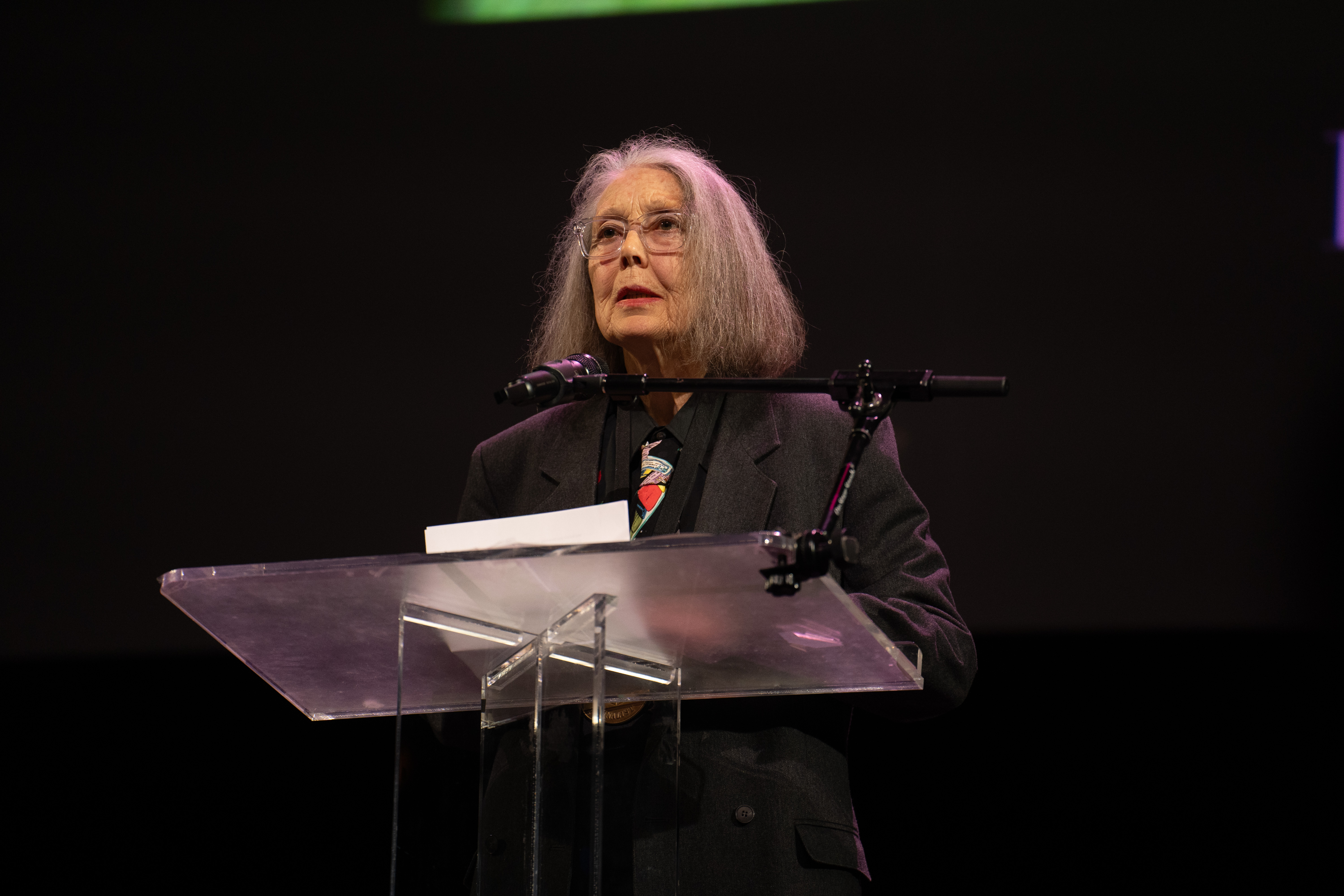
Anne Carson Nobel Prize literature: Anne Carson, the Canadian poet, essayist, classicist and translator whose work dissolves the borders between verse, prose, scholarship and performance, has won the 2026 Nobel Prize in Literature. The Swedish Academy announced the prize in Stockholm on Thursday, October 8, honoring Carson “for her bold and inventive oeuvre that, in playful dialogue with the classical tradition, has created new forms for contemporary literature.”
Carson, 76, was not in Stockholm, or Toronto, or anywhere the literary world expected. She was in Iceland — the island where she keeps a home and has spent part of every year since 2008 — and, as the Academy’s permanent secretary Ingrid Carlberg told the press conference, she was taken completely by surprise by the call. “All she had time to tell me was that she is for the moment in Iceland, where she’s listening to the wind,” Carlberg said. Asked by Icelandic broadcaster RUV how she felt, Carson answered in the deadpan that has become her signature: “Crazy, I think they’re all crazy.” Then, with the practicality of a woman who has spent forty years bending genres to her will: “I’ll get a sticker on the front of my book.”
The prize carries 12 million Swedish crowns — roughly $1.2 million — but its real currency is attention. And this year’s choice directs the world’s attention somewhere it rarely goes: to a writer who treats a 2,600-year-old Greek fragment and a Marilyn Monroe performance piece as equally serious material, and who has spent her career insisting that the boundary between “scholarship” and “poetry” is a fiction nobody was obliged to believe.
Who is Anne Carson? The poet’s biography in brief
Anne Carson was born June 21, 1950, in Toronto, Ontario. The fascination with the ancient world that would define her work began, by her own account, in high school, when a Latin teacher introduced her to Greek during lunch hours — an encounter she later described as a revelation, “like a harbor always welcoming. Strange, but welcoming.” She enrolled at St. Michael’s College at the University of Toronto, left twice — once, famously, over a required course on Milton — and eventually returned to earn her B.A. in 1974, M.A. in 1975 and Ph.D. in 1981.
Before she was a writer, she was a Hellenist. Carson taught classics at McGill University, the University of Michigan and Princeton, and her first book was not poetry at all but scholarship: Eros the Bittersweet (1986), a study of desire in ancient Greek literature that already blurred the line between academic prose and lyric essay. The awards followed her across every category she touched: a Guggenheim Fellowship in 1998, a MacArthur “genius” grant in 2000, the Griffin Poetry Prize and the T.S. Eliot Prize. Harold Bloom, not a man given to understatement, compared her to Geoffrey Hill and John Ashbery as a writer of “palpable genius.” She is, in the phrase the literary world settled on years ago, a poet’s poet — the writer other writers read to remember what language can do.
The Anne Carson books that built the case
No single book won Carson the Nobel; the Academy honored the oeuvre. But a reader coming to her for the first time has an unusually clear map, because each of her major works invented the form its subject required.
Autobiography of Red (1998) — the verse novel
The book that made her name. Carson took a fragment of the ancient Greek poet Stesichorus — the story of Geryon, the winged red monster slain by Heracles — and recast it as a contemporary coming-of-age story: Geryon as a queer teenager with “little red wings,” tender, devoted to his mother, destroyed and remade by desire. The Nobel committee itself singled out the move, noting how her long narrative verse is framed by an erudite, enigmatic meditation on Stesichorus himself. It remains the purest demonstration of her method: the ancient and the modern not as past and present but as two rooms in the same house.
Eros the Bittersweet (1986) — the lyric essay
Her first book and still her most influential piece of criticism: an investigation of desire as the Greeks understood it, beginning from Sappho’s coinage glukupikron — “sweet-bitter.” Carson argued that eros lives in the interval — between reach and grasp, glance and counterglance — and the book’s own form performs the argument, sliding between scholarship and poetry until the distinction stops mattering.
The Beauty of the Husband (2001), Nox (2009), and the later experiments
The Beauty of the Husband tells the story of a marriage in 29 tangos. Nox — an elegy for her estranged brother built around her translation of Catullus’s poem 101 — is printed as a single long folded page in a box, a scrapbook of photographs, letters and dictionary definitions. Antigonick (2012) renders Sophocles in hand-lettered capitals interspersed with vellum pages; Float (2016) arrives as twenty-two chapbooks in a transparent case, to be read in no fixed order; Norma Jeane Baker of Troy (2019) fuses Euripides’ Helen with Marilyn Monroe as a performance text. Her translations of Greek tragedy — collected in Grief Lessons (2006) — the Academy noted, “may be regarded as independent works in their own right.”
Why this matters: what the Academy is really saying
Nobel citations are diplomatic documents; read closely, this one is a manifesto. “Almost all her literary production has centred upon the intersection between the philologist’s obsession with words and the poet’s desire for new meaning,” the Academy said, and praised her exploration of “the possibilities of writing, a process by which the literary sketch has become of particular value to her.” Translation: the prize is going not to a novelist or a poet in any conventional sense, but to someone who treats form itself as the subject — who asks, with every book, what a book is allowed to be.
That is a deliberate signal at a deliberate moment. The literature prize has in recent years honored the novelist’s novelist (Han Kang), the dramatist’s dramatist (Jon Fosse), the maximalist (László Krasznahorkai). Carson is something else: a writer whose medium is the space between genres. In an era when publishing sorts every book into a marketing category before it is even written, the Academy has rewarded the career built on refusing categories — and in doing so, has told every young writer working in the margins that the center is allowed to move.
There is a second, quieter statement. Carson becomes only the second Canadian to win the literature prize, thirteen years after Alice Munro in 2013 — and, as Le Monde observed, one might speak of a “Greek-Canadian dual nationality,” so thoroughly does the classical world inhabit her work. Canada’s prime minister Mark Carney said she had “reimagined the classics with wit, imagination and a style entirely her own” and “brought ancient stories to new audiences.” For a country whose literature has long lived in the shadow of its southern neighbor, two Nobels in thirteen years is a statement of arrival.
Who wins, who loses, what the skeptics say
Poetry wins — decisively. The literature Nobel has always been a novelist’s prize with occasional exceptions. A win for a writer the Times calls a “poet’s poet” redirects prestige — and, soon, sales — toward the genre publishing treats as charity work. Expect Autobiography of Red and Eros the Bittersweet to do in a month what decades of advocacy could not.
Translators and classicists win. The Academy’s explicit praise of her Greek translations as “independent works in their own right” is the most institutionally significant sentence in the citation. Translation has always been literature’s invisible labor; a Nobel that names it as art changes the argument about what counts as original work.
Small and adventurous presses win. Carson’s books — accordion-folded elegies, boxed chapbook collections, hand-lettered tragedies — are objects that only exist because publishers were willing to manufacture difficulty. The prize is a commercial vindication of the idea that readers will follow a writer anywhere, including into a box.
Who loses? The betting markets and the pundit class — deservedly. Every October the same ritual: shortlists, odds, confident predictions, and Margaret Atwood’s name. This year the two most-cited Canadians were Atwood and Carson, and the Academy chose the less famous one — the writer Le Monde noted remains unfamiliar to many foreign audiences. The skeptics’ fair point: the Nobel loves a surprise that flatters its own discernment, and crowning the insider’s favorite lets the Academy look brave while choosing someone the literary establishment already adored.
The deeper skeptical case: that the prize rewards difficulty as such — that Carson’s erudition, her Greek, her typographical games, speak to a narrow, highly educated readership, and that the Nobel has once again mistaken the avant-garde for the universal. The honest answer is that her books keep selling to people without Greek, because desire and grief and wit need no footnotes. But the tension — between the poet’s poet and the people’s poet — is real, and the next year of Carson discourse will be fought on exactly that ground.
What the numbers actually say
12 million. The prize in Swedish crowns — about $1.2 million — unchanged in recent years, and still the richest literary award on earth by an order of magnitude.
76. Carson’s age, making her one of the older laureates of the decade — and a reminder that the Academy honored a lifetime’s arc, not a debut. Her first book appeared when she was 36; the Nobel comes forty years later.
2. Canadians to win the literature prize: Alice Munro (2013) and now Carson — thirteen years apart, both women, both masters of the short form in the broadest sense.
29. The tangos of The Beauty of the Husband; 22, the chapbooks of Float; 1, the folded page of Nox. Her bibliography reads like a dare to the concept of “the book” — which is precisely what the Academy just rewarded.
2000. The year of her MacArthur Fellowship — twenty-six years before Stockholm caught up. The lag between the culture’s recognition and the Academy’s is itself a datum: the Nobel confirms; it rarely discovers.
What happens next
The Nobel effect, immediately. Publishers will rush reprints; Autobiography of Red will acquire, as Carson predicted, its sticker. Her backlist — much of it in print but rarely promoted — is about to become the best-stocked section in every serious bookstore. Translation rights into dozens of languages will be renegotiated at Nobel multiples.
December in Stockholm. Carson will deliver her Nobel lecture and receive the prize from the King of Sweden on December 10, the anniversary of Alfred Nobel’s death. Given that her recent work includes a piece narrated by the sky itself (Wrong Norma, 2024), expectations for the lecture should be set accordingly: it will not be a conventional speech.
The longer bet: the classroom. The most durable consequence of a Carson Nobel may be curricular. Her work — which treats translation as creation, the fragment as a form, and the dictionary as a lyric instrument — is already taught in creative writing programs; a Nobel makes her unavoidable in classics departments too. A generation of students will now encounter Sappho through Carson’s brackets and Stesichorus through her red-winged teenager. The classical tradition she has spent her life in dialogue with is about to get a great deal more crowded — and more playful.
She is, for the moment, in Iceland, listening to the wind. The sticker can wait.
Sources
- Reuters — “Genre-defying Canadian poet Anne Carson wins 2026 Nobel Prize in Literature,” October 8, 2026
- CNN — “Anne Carson, the genre-bending Canadian writer, wins Nobel Prize in literature,” October 8, 2026
- Le Monde — “Canadian writer Anne Carson awarded 2026 Nobel Prize in literature,” October 8, 2026
- NPR — “Poet and essayist Anne Carson wins 2026 Nobel Prize in literature,” October 8, 2026
- Smithsonian Magazine — “Canadian Poet Anne Carson Brings Ancient Wisdom to Modern Audiences. Now, She’s a Nobel Laureate in Literature,” October 8, 2026