2026 Nobel Prize Physics winner
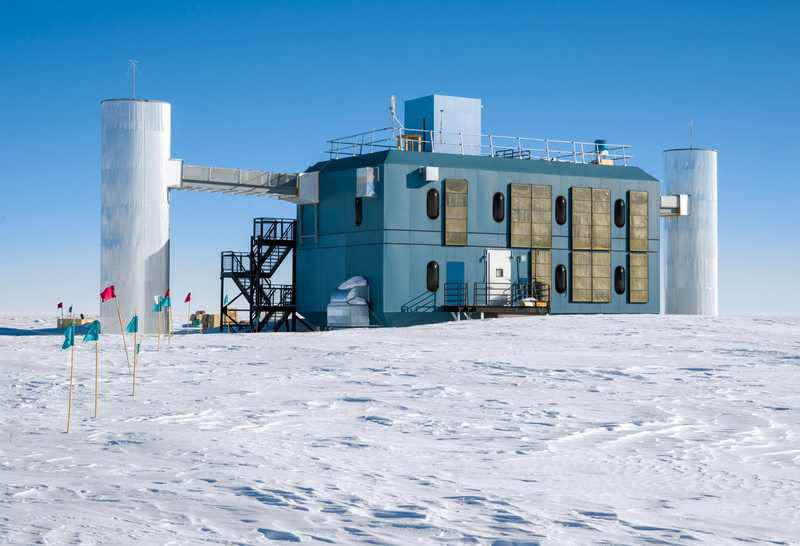
STOCKHOLM— The Royal Swedish Academy of Sciences awarded the 2026 Nobel Prize in Physics to Halzen, 82, on Tuesday for “decisive contributions to the IceCube Neutrino Observatory and the discovery of high-energy neutrinos of astrophysical origin.” He is the sole recipient of this year's physics award and will receive the medal from King Carl XVI Gustaf in Stockholm on December 10.
The award carries 12 million Swedish kronor, about $1.2 million at the exchange rate cited by Reuters. Because Halzen holds the full prize share, it will not be divided among co-laureates. The sum is also historically notable: the Nobel Foundation raised the award from 11 million kronor for its 125th anniversary year, after cutting it to 8 million in 2012 while strengthening its finances.
Halzen was in Italy for a committee meeting when the call arrived. He described the news as a major surprise. The reaction fit a project that spent decades appearing improbable: drill deep into one of Earth's most inaccessible places, freeze thousands of light detectors into the ice, and wait for particles that almost never touch anything.
Why this matters: astronomy gained a messenger that can escape the hidden universe
Most astronomy begins with light—visible, radio, infrared, X-ray or gamma-ray. Light is extraordinarily informative, but it can be absorbed by dust, scattered by matter or produced far from the mechanism scientists actually want to understand. Charged cosmic rays preserve their energy but not their address; magnetic fields bend their paths across the galaxy.
Neutrinos offer a different bargain. With no electric charge and almost no mass, they travel nearly straight from their sources and pass through environments that block light. That makes them unusually faithful couriers from the engines of exploding stars, feeding black holes and other extreme accelerators. Mark Pearce, chair of the Nobel Committee for Physics, called them “ghost-like messengers from the cosmos.”
The consequence is not that optical telescopes have become obsolete. It is that astronomers now have another channel to compare with photons, cosmic rays and gravitational waves. When several messengers point to the same event, each fills in information the others cannot carry. That is the foundation of modern multi-messenger astronomy—and the deeper reason Halzen's instrument, not merely one detection, received the prize.
Francis Halzen biography: from Tienen to a telescope beneath the ice
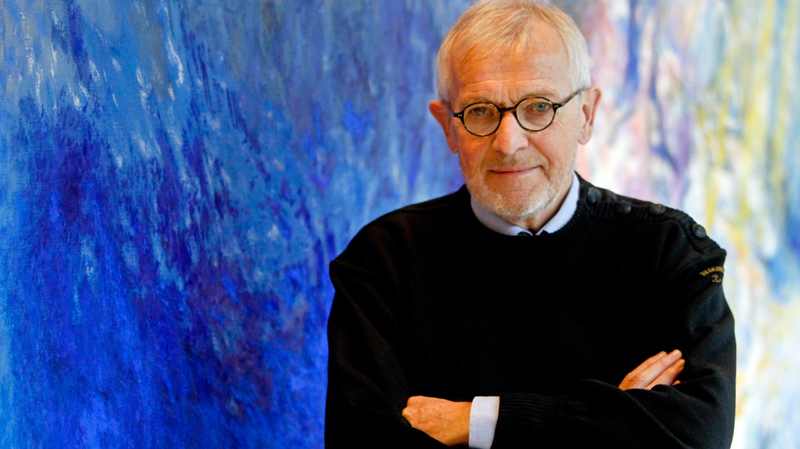
Francis Halzen was born March 23, 1944, in Tienen, Belgium. He earned his doctorate from KU Leuven in 1969 and built his career at the University of Wisconsin–Madison, where he is a professor of physics and principal investigator of IceCube.
His decisive conceptual move came in 1988, when he and John G. Learned presented the idea of using deep Antarctic ice as the detection medium for high-energy astrophysical neutrinos. Water had long been considered useful because a rare neutrino collision can produce a charged particle and a detectable flash. Halzen's gamble was that the glacier itself could supply the enormous, dark, transparent volume the problem required.
The first major South Pole effort, AMANDA, exposed both the flaw and the opportunity. Air bubbles in the upper ice scattered light and blurred direction. Deeper than roughly 1,400 meters, however, the ice proved exceptionally clear. AMANDA, completed in 2000, was too small to capture the sought-after cosmic population at the necessary rate, but it established the engineering and optical case for something larger. Calling it simply a failure misses its role as a prototype.
The South Pole IceCube telescope by the numbers
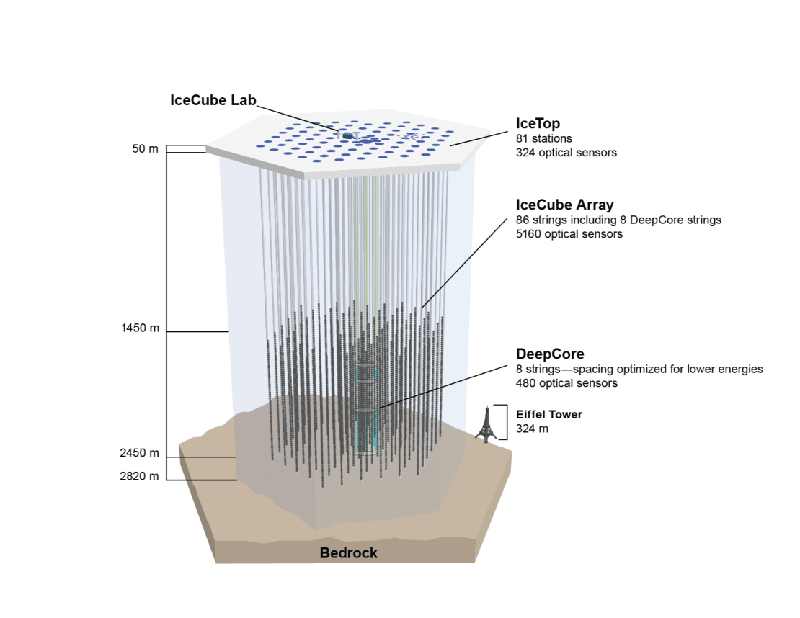
Completed at full scale in 2011, the IceCube neutrino observatory deploys 5,160 digital optical modules along 86 strings. The sensors begin about 1,450 meters below the surface and extend to roughly 2,450 meters, instrumenting a cubic kilometer of ice. UW–Madison is the lead institution; the collaboration now includes about 450 scientists at 58 institutions in 14 countries.
Scale is the central technology. About 100 trillion neutrinos pass through a human body each second, according to IceCube's published quick facts, yet almost all continue without interacting. A detector must watch an immense target volume to catch the rare collision. When one occurs, the secondary charged particle can move through the ice faster than light travels through that medium, producing a cone of faint blue Cherenkov light. Tiny differences in arrival time across neighboring sensors allow scientists to estimate the neutrino's direction and energy.
What are neutrinos? Ghost particles explained without the mystique
Wolfgang Pauli proposed the neutral particle in 1930 to rescue energy conservation in radioactive beta decay. Clyde Cowan, Frederick Reines and their colleagues first detected reactor antineutrinos in 1956. The nickname “ghost particle” describes weak interaction, not supernatural behavior: neutrinos obey physical laws but couple so rarely with ordinary matter that direct observation demands extreme patience and scale.
Energy comparisons require care. IceCube's landmark events reached the petaelectronvolt range, while the Large Hadron Collider operates in the tens-of-teraelectronvolt range for proton-proton collisions. A 1 PeV neutrino therefore carries roughly 74 times the LHC's 13.6 TeV collision energy—not automatically 1,000 times. Still more energetic neutrinos and cosmic rays push the gap much higher. The comparison is illustrative rather than apples-to-apples because a neutrino striking a stationary target does not deposit all of its energy as a collider does.
The cosmic neutrinos discovery: from a diffuse signal to TXS 0506+056
In 2013, IceCube reported the first evidence for high-energy neutrinos arriving from beyond the solar system. That result addressed part of a century-old cosmic-ray mystery: nature accelerates particles to energies beyond terrestrial machines, but the charged particles' paths are scrambled by magnetic fields. Neutrinos, born in many of the same violent processes, can point back toward the accelerators.
The blazar TXS 0506+056 and the promise of multi-messenger astronomy
On September 22, 2017, IceCube sent a real-time alert after detecting an exceptionally energetic neutrino. Gamma-ray and other telescopes found a flaring blazar, TXS 0506+056, aligned with the neutrino's direction. The coordinated observation made the galaxy—roughly 4 billion light-years away—a compelling source candidate and showed how one neutrino could trigger a global campaign across the electromagnetic spectrum.
That moment changed the operating model of neutrino astronomy. Instead of accumulating anonymous events for years, IceCube could tell other observatories where to look almost immediately. The value lay as much in the network as in the detector: orbital and ground-based telescopes could test whether a high-energy neutrino arrived with light from an active cosmic engine.
One Nobel winner, hundreds of builders
The decision to name Halzen alone will sharpen a familiar Nobel debate. The prize recognizes at most three people in a scientific category, while frontier experiments now depend on hundreds or thousands. IceCube was designed, drilled, calibrated, operated and analyzed by a multinational collaboration. The official IceCube account credits about 450 scientists today, alongside engineers, Antarctic crews, data specialists and earlier AMANDA teams.
The case for a sole award is that Halzen supplied the initiating vision and remained the principal catalyst across decades. The case for discomfort is equally real: an idea cannot become a cubic-kilometer observatory through vision alone. Halzen himself used his first public statement to redirect attention to the collaboration's work. Both readings can be true. The Nobel identifies intellectual leadership; it does not provide a complete ledger of scientific labor.
Who benefits from the recognition? Particle physicists gain validation for risky, large-scale instruments outside conventional accelerators. Astronomers gain pressure and funding to coordinate rapid follow-up observations. Universities and public agencies gain a powerful example of long-horizon research paying off. The direct commercial beneficiaries are fewer; this is infrastructure for knowledge, not a near-term consumer technology.
What critics say: neutrino astronomy has opened, but the map is still sparse
The strongest skeptical argument is not that IceCube failed. It is that “new astronomy” can sound more mature than the evidence. The vast majority of IceCube's astrophysical neutrinos still have no identified source. TXS 0506+056 rests on a rare event plus supporting archival and multi-wavelength evidence. The Nobel Committee itself says evidence for another candidate, the active galaxy NGC 1068, is not yet robust enough for definitive identification.
That limitation matters. A mature observatory is expected to build populations, not only memorable outliers. Researchers still debate which classes of objects dominate the diffuse neutrino background and how those sources relate to the highest-energy cosmic rays. More detections could strengthen current candidates, distribute the signal across several source types or overturn today's leading models.
Yet scarcity is also the engineering premise of IceCube. The detector was built because the particles are rare and hard to localize. Its critics are right to demand repeated, statistically persuasive source identifications. Its advocates are right that opening a channel usually precedes filling the catalog. The honest assessment is transitional: neutrino astronomy has demonstrated that it works, but not yet that it can routinely explain the high-energy sky.
What comes next: IceCube-Gen2, KM3NeT and a global neutrino network
The proposed IceCube-Gen2 would expand the instrumented optical volume to about eight cubic kilometers and add radio detection for still higher energies. A larger array would catch more events and improve the odds of resolving individual sources. But Gen2 remains a proposal, so funding, final design and construction timing are uncertainties rather than settled outcomes.
Competition will be complementary. KM3NeT is building water-based detector arrays in the Mediterranean, while Baikal-GVD operates in Lake Baikal and other concepts are planned in the Pacific and South China Sea. Water and ice scatter and absorb light differently; northern and southern sites also view different parts of the sky. Agreement among independent detectors would make candidate sources far more convincing.
The strategic scenario is a network that behaves like a global early-warning system. A neutrino alert from Antarctica or the Mediterranean could cue gamma-ray, X-ray, radio and optical instruments within minutes. In the best case, the field moves from isolated associations to a population map of cosmic accelerators. In a slower case, the detections remain diffuse and theory must explain why the sources resist identification. Either outcome would be scientifically useful.
Nobel Prize winners 2026 list: what happens after physics
Physics was the second announcement of Nobel week. Monday's medicine prize went to Karl Deisseroth, Peter Hegemann and Georg Nagel for the discoveries behind optogenetics; read Signal Post News's full analysis of the 2026 Nobel Prize in Medicine. Chemistry follows October 7, literature October 8, peace October 9 and economic sciences October 12.
Last year's physics prize went to John Clarke, Michel Devoret and John Martinis for demonstrating macroscopic quantum mechanical tunneling and energy quantization in an electrical circuit. The contrast is instructive: one prize recognized quantum behavior engineered on a chip; this one recognizes a telescope made from Antarctic geology.
Halzen will receive his medal in Stockholm on December 10, the anniversary of Alfred Nobel's death. The ceremony will formalize an individual award. The science it celebrates will remain collective, distributed across the South Pole, Wisconsin and observatories around the world.
The lasting achievement
Halzen's breakthrough was not merely detecting a difficult particle. It was turning a physical obstacle—the remoteness and immensity of Antarctic ice—into the instrument itself. The result transformed neutrinos from rare laboratory curiosities into directional evidence about violent processes across the universe.
The story is therefore less a tale of sudden inspiration than of disciplined persistence. The 1988 proposal led to imperfect early ice, a proving-ground detector, thousands of sensors, years of background filtering and finally a cosmic signal. IceCube has not solved the origin of every high-energy particle. It has made the mystery observable. That is why the 2026 Nobel Prize Physics winner stands for both a personal scientific vision and a collaborative machine built to see what light cannot.
Sources and reporting notes
- Reuters: Francis Halzen wins the 2026 Nobel Prize in Physics
- CNN: Nobel physics prize awarded for ghost-particle observatory
- Astronomy: Francis Halzen and the IceCube breakthrough
- Nobel Prize: official 2026 physics press release
- Royal Swedish Academy of Sciences: scientific background
- IceCube Collaboration: award announcement and project facts
- IceCube Collaboration: detector quick facts
- CERN: the neutrino from Pauli's proposal to the 1956 detection