U.S. · Alaska · 2026 Midterms
The Alaska governor election results 2026 delivered the state’s biggest political upset in a generation. Jonathan Kreiss-Tomkins, a 37-year-old former state lawmaker from Sitka, took an outright majority of first-choice votes against three Republicans — becoming the first Democrat elected governor of Alaska since Tony Knowles won in 1998, and the youngest governor in the state’s history.

JUNEAU, Alaska, November 14, 2026 — The Alaska governor election results 2026 produced the result almost no national forecaster had at the top of the board: Alaska, a state Donald Trump carried by 13.1 points two years ago, has elected a Democratic governor for the first time since 1998. The Associated Press called the race for Jonathan Kreiss-Tomkins at 12:01 a.m. ET on Saturday, and NBC News also projected his victory, Reuters reported. Kreiss-Tomkins, 37, a former state lawmaker from Sitka, won 139,293 first-choice votes — 50.8% of the total — an outright majority that settled the contest without any ranked-choice redistribution. Behind him, the Republican vote split three ways: Bernadette Wilson, the candidate endorsed by President Donald Trump, took 77,110 votes (28.1%); Dave Bronson won 37,252 (13.6%); and Treg Taylor won 19,709 (7.2%). The margin — 22.7 points for the Democrat in a state Trump won by 13 — is a swing of roughly 35.8 points, and it makes Kreiss-Tomkins, on December 7, both the first Democrat to hold the governor’s office since Tony Knowles left it in 2002 and the youngest governor Alaska has ever had.
The count
An outright majority of first-choice votes
The figures below are the Associated Press results with about 96% of the expected vote counted and 386 of Alaska’s 403 precincts reporting. They are unofficial until the state certifies them.
| Candidate | Party | First-choice votes | Share |
|---|---|---|---|
| Jonathan Kreiss-Tomkins | Democrat | 139,293 | 50.8% |
| Bernadette Wilson | Republican | 77,110 | 28.1% |
| Dave Bronson | Republican | 37,252 | 13.6% |
| Treg Taylor | Republican | 19,709 | 7.2% |
| Write-ins | — | 783 | 0.3% |
The 50.8% figure is the mechanical heart of the story. Alaska’s top-four, ranked-choice system redistributes ballots only when no candidate clears a majority of first-choice votes; Kreiss-Tomkins cleared it, so the race the AP called in the small hours of Saturday was decided on first preferences alone — there was no instant-runoff count left to save the Republican field, and no plausible one: even a perfectly unified Republican second-preference vote would have had to overcome a first-round gap of more than 62,000 votes over the strongest single Republican. His running mate, Zac Johnson — an independent and a nonpartisan member of the Anchorage Assembly — will serve as lieutenant governor, a ticket construction that itself tells you how this coalition was built.
Unofficial until November 25 — and the dates that follow
Three dates now govern the transition. Final ballot counting is scheduled for November 18. The Alaska Division of Elections certifies the result on November 25, and until that certification the outcome remains, in the state’s own terms, unofficial — a formality given the margin, but a real one, and this article treats the numbers accordingly. Kreiss-Tomkins then takes office at noon on December 7, 2026, succeeding Republican Mike Dunleavy, governor since 2018 and barred by term limits from seeking a third consecutive term.
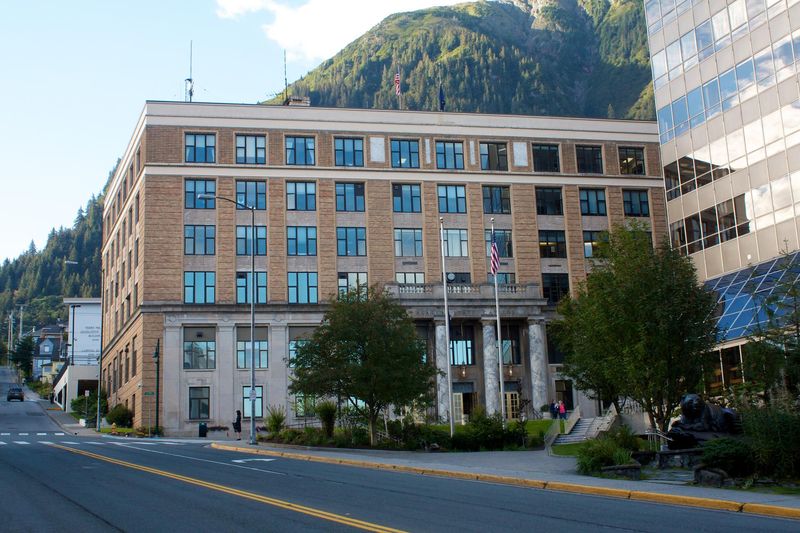
How a Democrat won Alaska
First in the primary, alone in his party in the general
Start with the structure, because Alaska’s system wrote half of this result before a single general-election ballot was cast. Under the state’s top-four open primary, all candidates run on one August ballot and the top four advance. Kreiss-Tomkins finished first in that primary — the Kreiss-Tomkins/Johnson ticket took 37,006 votes, 22.52% — ahead of fellow Democrat Tom Begich. But Begich did not advance into a November slot that mattered, and in the general election Kreiss-Tomkins stood as the only Democrat facing three Republicans. The right of Alaska politics, which in an ordinary year consolidates behind a single nominee, instead spent the autumn divided among Wilson, Bronson and Taylor — three campaigns competing for substantially the same voters while the Democrat assembled everyone else. A divided field does not by itself elect a Democrat in Alaska; the state has held its Republican lean through divided fields before. What turned structure into victory was the breadth of the coalition Kreiss-Tomkins built on top of it.
The Murkowski endorsements, and a platform built for crossover voters
The signal event of the campaign was an endorsement that crossed the aisle at the highest level: Republican U.S. Senator Lisa Murkowski backed Kreiss-Tomkins — one of the few Republicans, as Reuters noted, willing to break with Trump — and her father, former Senator and Governor Frank Murkowski, endorsed him separately. In a state where the Murkowski name is close to a second ballot line, those endorsements did practical work: they gave Republican and independent voters explicit permission to cross over, from the two people least likely to be dismissed as partisan actors for granting it. The platform was built to receive those voters. Kreiss-Tomkins campaigned on cutting the cost of living, full funding for public schools, and regulating the construction of data centers — an agenda of kitchen-table costs and local control rather than national party combat — and he emphasised working across party lines throughout, pledging a Cabinet of Republicans, Democrats and independents, as the AP reported. The arithmetic underneath explains why he had to run that way: registered Democrats are only about 11% of Alaska’s electorate. A Democrat who wins 50.8% of the vote in Alaska has not mobilised a Democratic majority — there isn’t one. He has built a coalition that is mostly independents, undeclared voters and crossover Republicans, and governed his campaign accordingly from the first day.
Why this matters
Analysis. A single governorship, in a state of some 740,000 people, would not normally lead a national midterm post-mortem. This one earns the attention four ways.
Thirty governorships: the map underneath the midterms
First, the aggregate. With Alaska called, Democrats will hold 30 governorships next year, having flipped offices held by Republicans for years in states including Iowa, Georgia, Ohio and Texas. Governorships are the least glamorous and most consequential prizes in American politics, because statehouses run the machinery the national argument is about: election administration and the rules under which the 2028 presidential vote will be counted; energy permitting; abortion and health policy; and redistricting, where a governor’s veto pen can decide a decade of congressional maps. Thirty Democratic governors also means thirty potential national figures with executive records — and, in the near term, thirty administrations that can litigate, regulate and refuse in ways a congressional minority cannot. Alaska’s flip is the most improbable tile in that mosaic, and for that reason the most instructive: it shows the 2026 Democratic coalition was not confined to suburbs and swing states, but reached a resource-state electorate that had voted Republican for president by 13 points.
Oil, the dividend, and a surplus with strings
Second, the Alaska-specific stakes, which are unlike those of any other state. Alaska’s budget runs on oil revenue, and its most sensitive political instrument is the Permanent Fund dividend — the annual payment to residents that functions as a third rail no governor touches carelessly. Kreiss-Tomkins inherits an unusual opening: coverage of the race noted an expected short-term budget surplus, after a period of high oil prices during the Iran war swelled state revenue. That surplus will let him fund his first priorities — schools above all — without an immediate fiscal fight. But it also sets the trap. A governor who campaigned on fully funding public schools and on regulating data-center construction, in a state whose economy is energy development, will spend his surplus once and face the structural argument forever after: how much of the oil windfall goes to the dividend, how much to services, and how much to save. Every Alaska governor since statehood has eventually been defined by that triangle. Kreiss-Tomkins will be no exception, and his December 7 start means his first budget — written against a one-time surplus — is where his governing theory meets it.
The Trump endorsement, measured
Third, the data point Republicans will study longest. President Trump endorsed Bernadette Wilson. She finished second — 22.7 points behind — in a state Trump himself carried by 13.1 points in 2024. Endorsements are not transferable property, and a three-way Republican split plainly did much of the work; a united Republican field might well have won. But the Alaska result sits in a midterm pattern in which the president’s backing repeatedly failed to consolidate even Republican voters, and it will be cited in every 2027 argument about what a Trump endorsement is now worth in a general election: decisive in a primary, evidently, and something considerably less than that in November.
Ranked choice rewarded the coalition candidate
Fourth, the mechanism. Alaska’s top-four primary and ranked-choice general election were designed, after 2020, to reward candidates who appeal beyond a party base — and this is the result the designers would have drawn on the whiteboard. The irony is that the ranked-choice machinery itself proved unnecessary: Kreiss-Tomkins won a majority of first-choice votes, so nothing was redistributed. The system’s real effect happened earlier and quieter — a single open primary in which he could finish first without winning a party nomination fight, and a general-election ballot on which three Republicans competed for the same half of the state while he consolidated the rest. Opponents of the system will note that a candidate backed by 11%-registration party now governs; supporters will answer that 50.8% of first-choice votes is a majority by any definition ever used in American elections. Both are describing the same number.
The context: Alaska’s independent streak
Knowles, Walker, and the exceptions that frame the rule
To see why 1998 is the right measuring post, recall the shape of modern Alaska politics. Tony Knowles, the last Democrat elected governor, won his second term that year and left office in 2002; no Democrat has held the office since. The one other modern interruption of Republican rule came from outside the party system altogether — independent Bill Walker’s victory in 2014. Between and around those exceptions runs the Dunleavy era: Mike Dunleavy, elected in 2018 and re-elected in 2022, governed as a conservative Republican through oil booms, dividend fights and a recall attempt, and leaves office only because term limits bar a third consecutive run. Alaska, in other words, does not elect Democrats — it makes rare, candidate-specific exceptions to Republican government, usually for figures who run as something other than party standard-bearers. Kreiss-Tomkins, the cross-party cabinet pledge and all, ran squarely in that exception tradition, whether or not he would describe it that way.
Ticket-splitters, and a comeback from Sitka
The electorate that made him the exception has form. This is the state that re-elected Lisa Murkowski in 2010 on a write-in campaign after she lost her own party’s primary — perhaps the purest ticket-splitting feat in modern Senate history — and that has spent decades sending Republicans to Juneau and Washington while reserving the right to defect for individuals it trusts. Kreiss-Tomkins is built for that electorate. A Sitka native, he was first elected to the Alaska House in 2012 at 25 and served a decade there, chairing the House State Affairs Committee; he left the House three years ago, and Saturday’s victory completes a political comeback conducted almost entirely outside the national party spotlight. Known widely by his initials, JKT, he will take the oath at 37 — the youngest governor in Alaska state history — with a biography that reads less like a party insurgency than like the state’s own political class producing, this once, a Democrat it could vote for.

Who gains, who loses — and the caveats
Analysis. The beneficiaries are easy to list. Democrats nationally gain the 30th governorship and the cycle’s best proof that their coalition can still grow in red, rural, resource country. Lisa Murkowski gains most of all among individuals: she spent her bipartisan brand on this race, against her own president’s endorsed candidate, and won — her cross-party standing in Alaska, already the foundation of her career, is now the single most valuable political asset in the state. School-funding advocates gain a governor who made full funding a headline promise, with a surplus to start paying for it. The losers are equally clear: the president’s endorsement operation, whose Alaska pick finished a distant second; the three Republican campaigns, whose combined 48.9% would not have won even if perfectly pooled — a fact that should discipline the party’s post-mortem away from pure vote-splitting explanations, since the split explains the size of the defeat better than the fact of it; and the assumption, embedded in a decade of Alaska commentary, that the state’s independent streak had permanently settled on the right.
The caveats deserve equal billing. The result is unofficial until certification on November 25. Kreiss-Tomkins will govern with a Republican-leaning legislature whose members owe him nothing and whose districts he mostly did not carry; his cross-party Cabinet is a pledge, not yet a government. And the coalition arithmetic that elected him cuts both ways in office: a 50.8% first-choice majority is a genuine majority, but it is broad rather than deep — assembled from independents and crossover Republicans who agreed on the candidate more than on any programme, and who can disassemble at the first dividend fight or the first hard budget. Alaska has seen broadly elected governors narrow quickly before.
What happens next
Analysis — scenarios, not predictions. The transition runs on the dates in the count above: final counting on November 18, certification on November 25, and the inauguration at noon on December 7. Watch, first, the Cabinet: Kreiss-Tomkins promised Republicans, Democrats and independents in the same administration, and the names — particularly any Republican of standing who accepts — will be the first hard test of whether the Murkowski coalition was a campaign device or a governing structure. Watch, second, the first budget, where the oil-driven surplus meets the triangle every Alaska governor faces: the size of the Permanent Fund dividend, the school-funding formula he campaigned on, and how much of a one-time windfall he banks. Watch, third, the fights queued behind the budget — the data-center rules he promised to write, education funding beyond year one, and energy leasing, where a governor elected by an environmental-leaning coalition governs a state whose revenues are oil. And watch, finally, the state’s other unfinished count: Alaska’s U.S. Senate race remains uncalled, with former Congresswoman Mary Peltola leading narrowly in late counting — a race this article does not call, and whose resolution will decide whether Saturday was a single upset or the start of a genuine Alaska realignment.
For now, the established record of Saturday, November 14, is this: at 12:01 a.m. ET the Associated Press called Alaska’s governorship for a 37-year-old Democrat from Sitka who won a majority of first-choice votes against three Republicans, in a state his party’s registered voters make up barely a ninth of, and which had not elected a Democrat governor since 1998. The coalition that did it — Murkowski Republicans, independents, and the 11% — now has to become a government. That, more than the call itself, is the story December will tell.
Related coverage: Heating Oil Above $6 a Gallon Becomes a Senate-Race Issue in Maine, New Hampshire and Alaska · Texas Governor Election Results 2026: Gina Hinojosa Defeats Greg Abbott · Keisha Lance Bottoms Wins Georgia Governor’s Race, a First for a Black Woman
Sources
- Reuters, November 14, 2026 — “Alaska elects first Democratic governor since 1998, US media project”: the wire report of the AP call at 12:01 a.m. ET and the NBC News projection, the result’s place in the 30-governorship map, the campaign themes and the Murkowski endorsements.
- Associated Press, via Scripps News/TMJ4 and via KCAU, November 14, 2026 — “Kreiss-Tomkins becomes first Democrat since 1998 elected governor in Alaska”: the AP report of the call, the cross-party Cabinet pledge and the campaign’s emphasis on working across party lines.
- Associated Press election results — Alaska Governor, November 2026: the vote totals and shares in the table above (Kreiss-Tomkins 139,293 first-choice votes, 50.8%; Wilson 77,110, 28.1%; Bronson 37,252, 13.6%; Taylor 19,709, 7.2%; write-ins 783, 0.3%), with about 96% of the expected vote counted and 386 of 403 precincts reporting, and the AP county and margin trackers behind the 22.7-point margin and the roughly 35.8-point swing from 2024.
- Alaska Division of Elections — 2026 General Election unofficial results and the August 2026 primary official summary: the source of the unofficial status of the general-election figures, the November 18 final count and November 25 certification dates, and the August top-four primary result (Kreiss-Tomkins/Johnson first, 37,006 votes, 22.52%).
- NPR / Alaska Public Media (Eric Stone), November 14, 2026: Alaska reporting on the race, the December 7 swearing-in and the youngest-governor-in-state-history distinction.