Updated Oct. 1, 2026, 11:50 p.m. PDT
what ship were the Marines on in Hormuz
Topics: what ship were the Marines on in Hormuz · Marines Hormuz attack mystery vessel · Iranian missile attack Hormuz Marines · non-commissioned commercial vessel Marines · battalion landing team Hormuz · Strait of Hormuz Marines injured September 14 · St Helena floating armory speculation · Pentagon undisclosed Hormuz attack · NBC Marines injured Hormuz · embarked Marines VBSS mission
WASHINGTON — Of all the unanswered questions from the secret Hormuz attack that injured eight U.S. Marines, one towers over the rest: what ship were the Marines on? On September 14, an Iranian anti-ship cruise missile struck a vessel transiting the Strait of Hormuz. Eight Marines — seven enlisted personnel and one officer, operating as a battalion landing team — suffered smoke inhalation and possible traumatic brain injuries. None were critically hurt, and all returned to duty. The Pentagon did not disclose the attack at the time; NBC News, citing three U.S. officials, revealed it two weeks later, on September 28.
What officials would not say is as telling as what they did. The Marines were not aboard a U.S. Navy ship, the officials said — but they declined to identify the vessel, referring to it only as “a maritime vessel” and, in some accounts, a “non-commissioned commercial vessel.” The Pentagon has never named the hull. When the defense trade press asked, the Pentagon referred questions to U.S. Central Command — and CENTCOM declined to comment. Three days after the disclosure, the single biggest fact about an attack on American troops in wartime remains officially secret: the ship.
What is verified about the September 14 attack
Strip away the speculation and the verified record is narrow but solid, built on NBC’s reporting of three U.S. officials and trade-press follow-ups. The strike occurred on Monday, September 14, in the Strait of Hormuz. The weapon was an Iranian anti-ship cruise missile — a sea-skimming weapon designed to exploit the compressed detection times of maritime defenses. The vessel was not a commissioned Navy warship. The eight injured Marines belonged to a battalion landing team: seven enlisted, one officer. Their injuries were smoke inhalation and concussion-like symptoms, including headaches, with possible traumatic brain injuries — the kind of neurological effects that can emerge days after a blast, which one U.S. official cited in explaining the reporting delay.
The injuries entered the Pentagon’s Defense Casualty Analysis System, known as DCAS, roughly ten days after the strike. As of the week of the disclosure, DCAS listed 861 U.S. service members as wounded in the Iran war, which began February 28 and is now in its seventh month. What no official source has provided — not NBC’s officials, not the Pentagon, not CENTCOM — is the vessel’s name, its owner, or the mission that put a Marine battalion landing team aboard a non-Navy hull in the world’s most contested chokepoint.
“A maritime vessel”: what the Pentagon’s wording actually means
The phrase “non-commissioned” is doing precise legal work. A commissioned warship — a USS vessel — is a sovereign warship of the United States Navy, commanded by a commissioned officer. A non-commissioned vessel is everything else the U.S. government operates or charters: USNS ships run by Military Sealift Command with civilian mariners, chartered commercial hulls, and contracted support vessels. They fly the U.S. flag and serve military missions, but they are not warships in the legal sense — a distinction that matters enormously in the laws of naval warfare and in how an adversary reads a target.
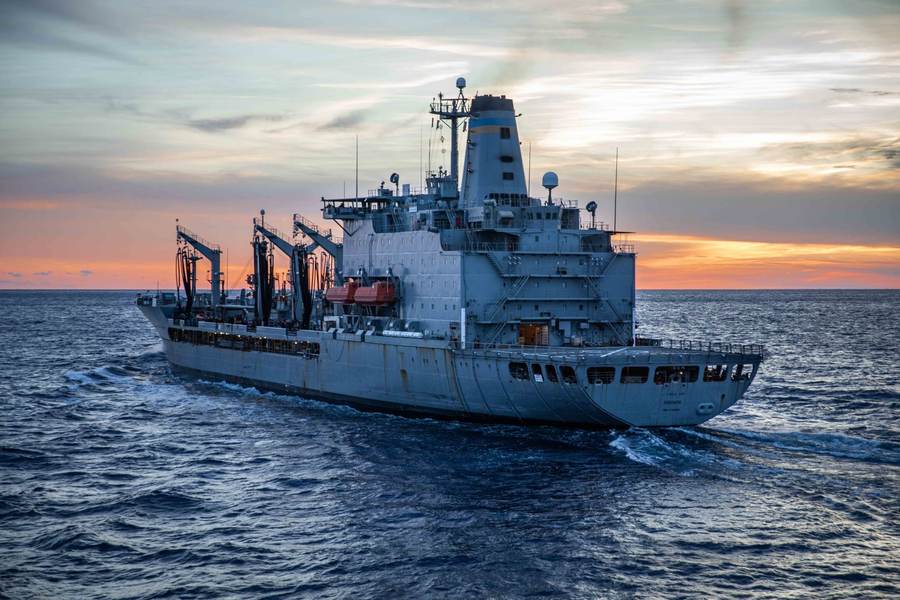
Why would a battalion landing team — roughly 1,000 to 1,200 Marines built around a reinforced infantry battalion — be embarked on such a hull? Because seven months of war stretch every fleet. The Navy’s amphibious ships are finite, and the missions in Hormuz have multiplied: escorting commercial traffic, boarding suspect vessels, and holding the strait open. A commercial or support hull carrying Marines is what a long war looks like when the purpose-built ships are committed elsewhere.
What is unusual is the silence. The Pentagon routinely names ships involved in incidents at sea. Here, officials offered a category (“maritime vessel”) instead of a name, and CENTCOM — the command responsible for the region — declined to comment at all when asked by the defense press. That silence is the vacuum the speculation rushed to fill.
What embarked Marines do at sea
To understand why Marines were on a mystery ship, it helps to understand what embarked Marines do. A battalion landing team is the ground-combat element of a Marine expeditionary unit, and its at-sea missions in a conflict like this one include visit, board, search and seizure (VBSS) — boarding merchant vessels to inspect cargo and enforce a blockade — maritime interdiction, convoy escort through threatened waters, and the defense of chokepoints. These are boarding-party and escort missions, not amphibious assaults; they are conducted from whatever deck is available, Navy or otherwise.
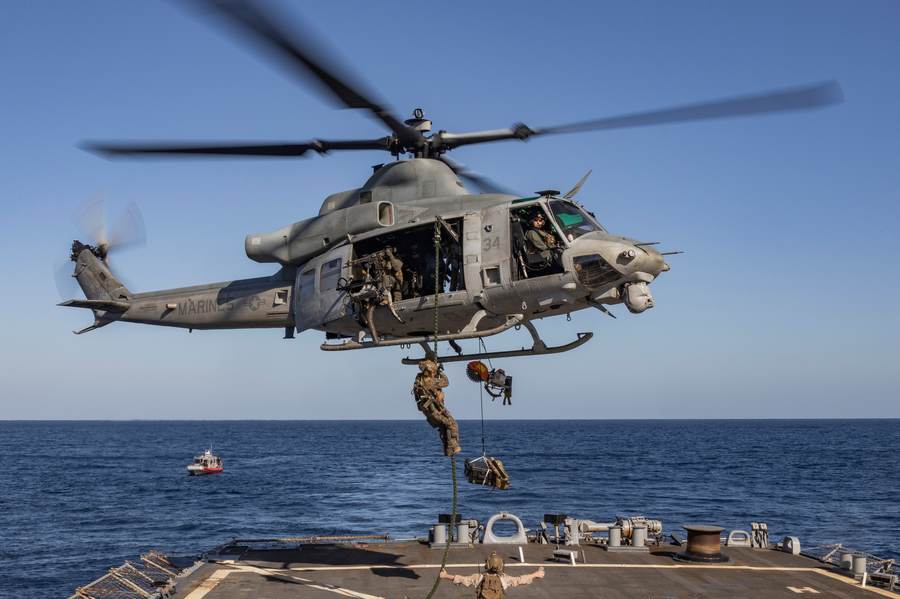
The Strait of Hormuz is where that work is most dangerous. Roughly a fifth of the world’s petroleum liquids normally transits the strait, and since the war began the corridor has become a shooting gallery of missiles, drones and mines. Marines riding a commercial-pattern hull through it would be doing exactly what the traffic needs: putting armed boarding teams where the threat to shipping is highest.
The St Helena theory — and why it remains unconfirmed
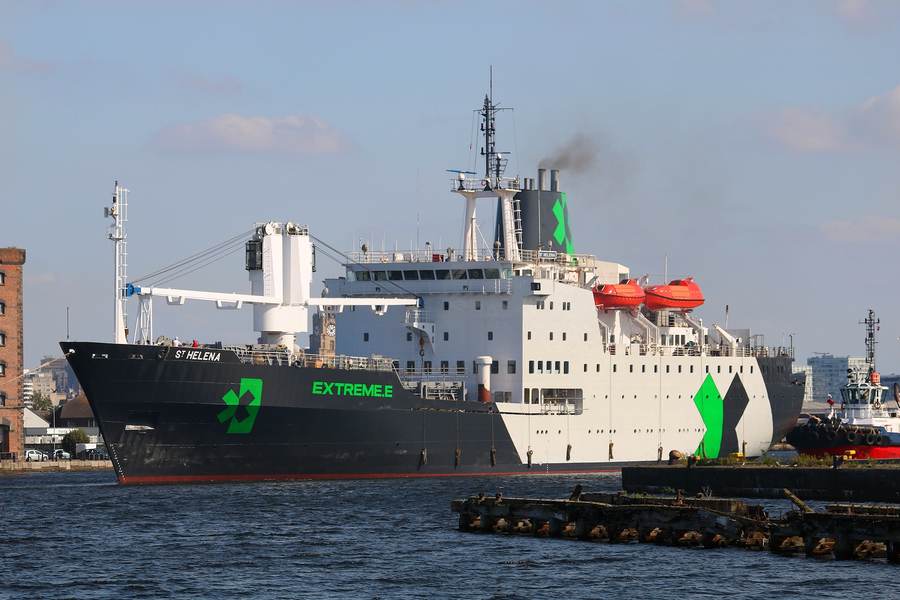
Within days of NBC’s disclosure, the maritime press had a candidate. The United Kingdom Maritime Trade Operations center — the Royal Navy-run reporting hub for merchant shipping — logged a projectile strike on a vessel in the strait on the evening of September 14. According to the defense outlet The War Zone, there was only one vessel known to have been struck that day, and several maritime media outlets identified it as the M/V St Helena: a 6,800-gross-ton vessel built in 1989, once the world’s last commercial deepwater Royal Mail Ship, later reported as being converted into a floating armory — a privately operated vessel that stores weapons and houses embarked security teams for anti-piracy work. Maritime publications including gCaptain and Marine Insight have long documented the floating-armory model, in which converted commercial ships support armed guards across high-risk waters.
The St Helena’s reported profile fits the Pentagon’s wording with eerie neatness: a commercial hull, a security-ship conversion, a vessel that could plausibly carry an embarked force. TradeWinds reported the ship had been trapped in the Middle East Gulf with its last known position off Dubai, unable to take up a previously arranged Antarctic charter.
But “fits” is not confirmation, and the responsible outlets say so explicitly. The War Zone states it cannot independently confirm that Marines were aboard the St Helena or that they were injured. The Pentagon referred the outlet to CENTCOM, and CENTCOM declined comment. No U.S. official has named the St Helena. A further claim circulating online — that the vessel is owned by the maritime security firm Ambrey — comes from a single blogger and is entirely unverified; it should be treated as speculation, not reporting. Likewise the nickname “USS St Helena” seen in some posts is pure invention: there is no evidence the ship was commissioned, Navy-flagged, or designated USS in any formal sense.
To be blunt about the ledger: the verified facts are NBC’s — date, weapon, strait, eight Marines, battalion landing team, non-Navy vessel, injuries, recovery, delayed disclosure. The St Helena identification is maritime-press reporting built on a single UKMTO incident log — plausible, widely repeated, and unconfirmed. The Ambrey ownership claim is single-source blogger speculation and should not be repeated as fact. Anyone asserting the vessel’s identity as settled is getting ahead of the evidence.
Why the secrecy matters
The mystery ship is not just a curiosity — it sits at the center of the war’s most corrosive domestic argument: whether the Pentagon is telling the public the true cost of the fighting. The September 14 attack went undisclosed for two weeks. The injuries took roughly ten more days to reach DCAS. The Washington Post, citing unnamed officials, has reported the death toll may be higher than the Pentagon’s public count — a claim Defense Secretary Pete Hegseth rejected. CBS News has reported wounded troops complaining that serious injuries were initially described as minor. The Pentagon insists its categories have precise technical meanings and rejects any deliberate downplaying.
Against that backdrop, refusing to name the vessel reads, to critics, as part of a pattern: an attack on Americans, kept from the public, aboard a ship the public is not allowed to identify. To the Pentagon’s defenders, operational security in an active missile environment justifies withholding the hull — naming it could reveal embarkation patterns, charter arrangements, and force-protection details useful to Iran. Both readings can be true at once: secrecy can be operationally justified and corrosive to public trust, particularly when the casualty system already lags events by days or weeks.
There is also a legal dimension. If U.S. Marines are embarked on commercial or contracted hulls in a zone of hostilities, adversaries, insurers, and international lawyers will all ask what status those vessels hold — and what protections their civilian crews are owed. Those questions sharpen when the vessel’s identity is withheld.
What happens next
The most likely next step is also the simplest: someone names the ship. Congressional oversight — already engaged on casualty reporting, with lawmakers questioning defense officials on the record — has the tools to compel the hull’s identity in closed session, and leaks have a way of following. Alternatively, the Pentagon could declassify the vessel’s identity once the embarked force rotates out or the charter ends, on the theory that the operational sensitivity has passed.
Until then, the mystery endures as a case study in modern war reporting: a strike everyone can describe except for the one noun that matters most. Eight Marines were hurt aboard a ship. The Pentagon knows which one. The public does not. In a seven-month war being fought in significant part over a 21-mile-wide strait, that gap between what is known and what is said is itself the story.
Sources and reporting notes
This article is built on Military.com’s September 28, 2026 report of NBC News’ disclosure (three U.S. officials), The War Zone’s follow-up on the St Helena identification (which it explicitly could not confirm), and TradeWinds’ casualty reporting on the St Helena strike. Background on floating armories draws on the maritime trade press, including gCaptain and Marine Insight. UKMTO incident logs are the primary public record of the September 14 strike. The Ambrey-ownership claim traces to a single independent blogger and is flagged here as unverified speculation. Casualty figures are drawn from the Pentagon’s Defense Casualty Analysis System as reported in the week of September 28; the system is not updated in real time and figures shift as cases are processed.
Internal links
- Iranian Missile Attack Hormuz Marines: 8 Hurt in Undisclosed Strike
- USS Makin Island: F-35B ‘Lightning Carrier’ Bound for the Middle East
- Trump Iran Strikes: Third Carrier and 10,000 Troops Head to Middle East
Reporting cutoff: October 1, 2026. The vessel’s identity has not been confirmed by the Pentagon or CENTCOM as of publication. Troop and casualty figures shift as the Pentagon processes cases; this article will be updated if the vessel is officially identified.