Updated October 1, 2026 at 3:10 p.m. PDT
Trump Iran strikes third carrier
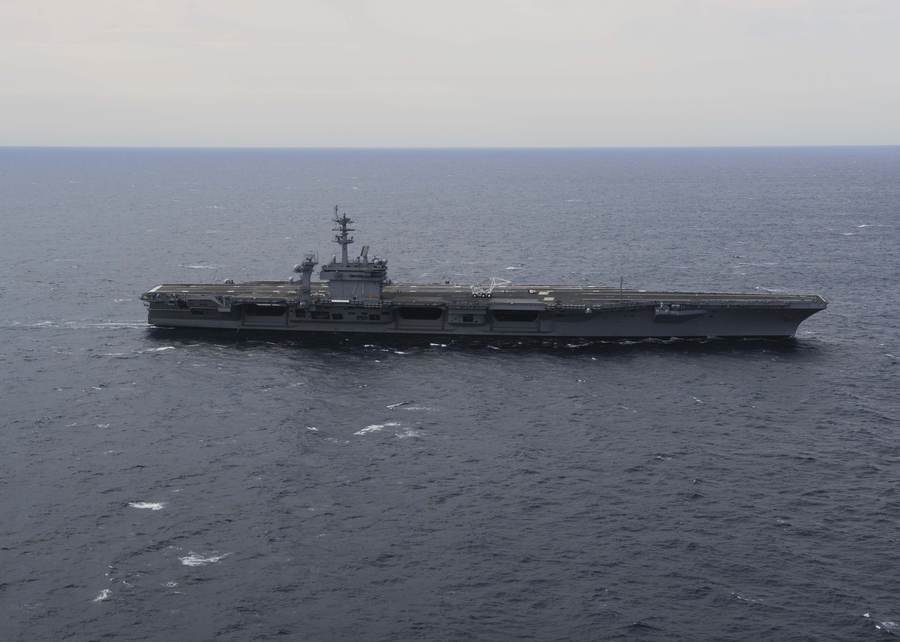
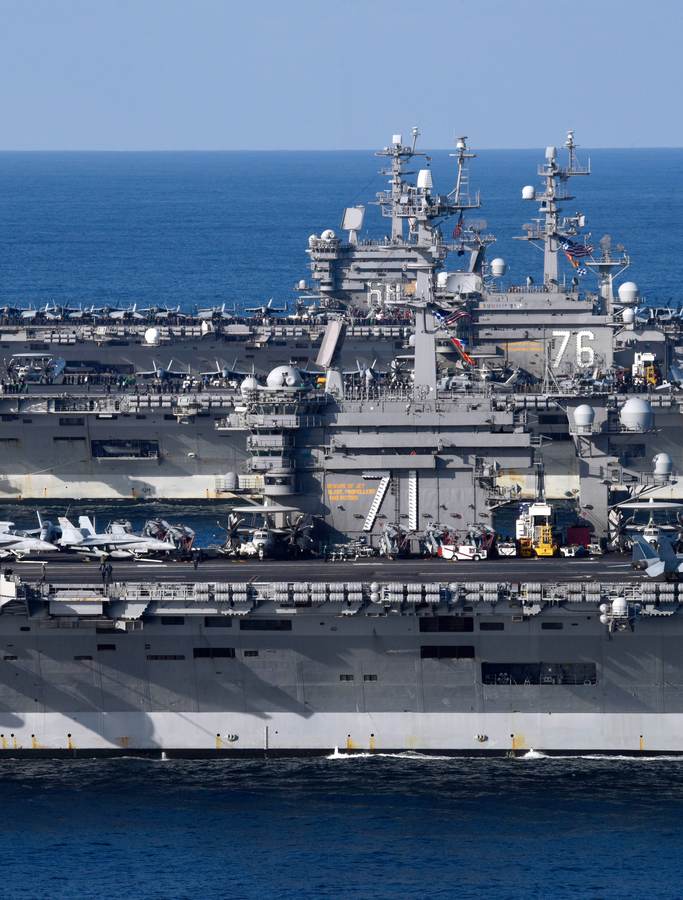
Trump Iran strikes third carrier — the Pentagon is sending the USS Theodore Roosevelt carrier strike group and the USS Makin Island amphibious ready group to the Middle East, adding roughly 9,000 to 10,000 sailors and Marines to a region that already holds more than 50,000 American troops. If the USS George Washington stays in the region when the Roosevelt arrives, three U.S. carrier strike groups will be operating there at once for the first time since April — as President Donald Trump warns anew that renewed strikes on Iran are on the horizon.
The Associated Press, citing a U.S. official who spoke on condition of anonymity to discuss sensitive military operations, reported Thursday that the ships now en route carry more than 7,000 sailors and 2,000 Marines. The Wall Street Journal, citing U.S. officials, put the figure at 9,000 to 10,000 troops and reported the ships, jet fighters, Marines and sailors will arrive in the region by the end of November. Neither the White House nor the Pentagon responded to requests for comment.
Why this matters
The number that matters here is not 10,000 — it is three. A carrier strike group is the most flexible instrument of American power projection ever built: roughly 70 aircraft, guided-missile escorts, and the ability to conduct sustained strike operations without asking any ally for a runway. Two carriers in one theater is a signal. Three is a campaign posture. The last time the Navy stacked three carriers around the Middle East was April, at the height of the fighting that began February 28 — and the fragile ceasefire that followed has since collapsed into the sporadic fighting that has defined the last several months. Restoring that posture now, weeks before the November midterms, tells Tehran that Washington is rebuilding the option it used before — and tells the American public the war is not winding down. It also matters because it fuses the military timeline to the electoral one: the Journal reports Trump told aides he expects to resume bombing Iran after the November elections, and this week he told Time magazine it is "possible" he will ramp up bombing after November 3. The ships sailing out of San Diego are the hardware behind that sentence.
What is sailing toward the Middle East
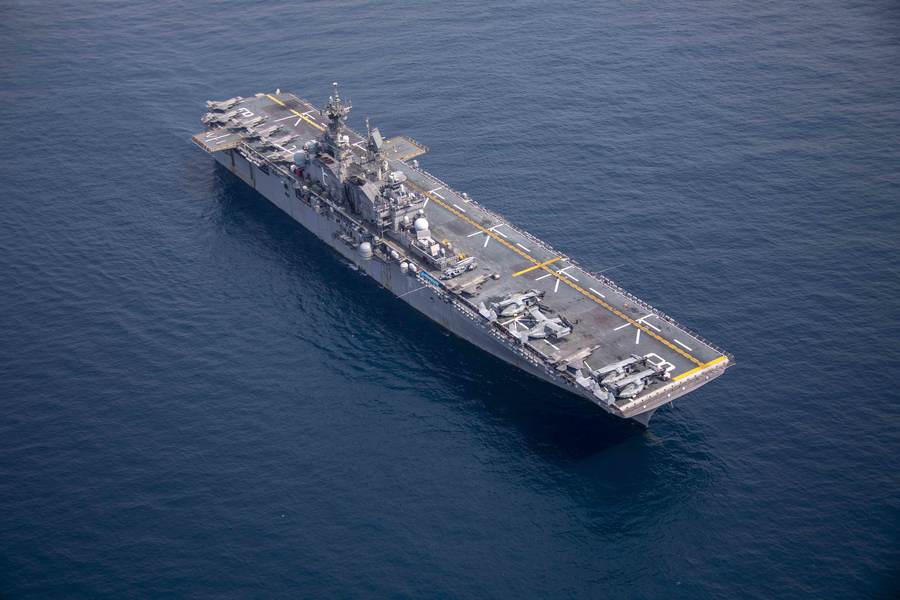
The Roosevelt group left San Diego on Sunday: the nuclear-powered carrier itself plus its escorts, including the cruiser USS Chosin. On Monday the Makin Island amphibious ready group followed — three amphibious ships, including the amphibious transport dock USS John P. Murtha and the amphibious dock landing ship USS Anchorage, carrying Marines from the 13th Marine Expeditionary Unit. An amphibious ready group is not a sideshow to a carrier: it puts a Marine expeditionary unit — infantry, tilt-rotor aircraft, landing craft, attack helicopters — within striking distance of shore, the force you send when you want options between airstrikes and nothing. Already in the region are the carriers USS George H.W. Bush and USS George Washington, plus ships from the USS Boxer amphibious ready group. The Washington is normally a Pacific carrier; it moved to the Middle East to relieve the USS Abraham Lincoln, whose crew spent more than 260 days straight at sea. The AP reports the buildup would bring the U.S. naval presence to an unusually high level: more than 20,000 sailors and Marines and hundreds of aircraft. One caveat, from the Journal: the Washington could yet rotate home to Japan, which would drop the count back to two carriers.
What three carriers actually buy Washington
Start with sortie math. A single carrier air wing can generate dozens of strike sorties a day, sustained for weeks. Two wings complicate an adversary's air defenses. Three wings, with the Aegis escorts of three strike groups layered over the Gulf, the Red Sea and the eastern Mediterranean, can hold at risk essentially every fixed military target in Iran simultaneously — airfields, missile batteries, naval bases, nuclear sites — while keeping enough aircraft in reserve for fleet defense. That is the posture you build when you want to be able to reopen the Strait of Hormuz by force, or to punish a provocation within hours rather than days. It is also the posture you build when you want the other side to believe you could. The coercive value may exceed the military value: every week those flight decks sit within range of Bandar Abbas, Tehran's cost-benefit math on escalation shifts. But there is a cost, and the Journal's own sourcing names it: officials stressed the administration wants to conserve dwindling munitions for other contingencies. Three carriers are a statement of intent; the munitions stockpile is the fine print. A threat that cannot be sustained is a bluff, and both sides' planners know it.
Trump's warnings: the Time interview and the Flydubai claim
Trump has not been subtle about the timeline. In a Time magazine interview published Thursday, conducted Monday, he said it is "possible" he will ramp up bombing in Iran after the November 3 elections, and explained his rejection of Tehran's latest ceasefire proposal: "things that I wouldn't have approved a year ago I wouldn't have today." Iran, he said, had offered to "open up" the Strait of Hormuz, but the overall proposal was "not good enough." That tracks the Journal's earlier reporting that Trump told aides he expects bombing to resume after the midterms — and it confirms the pattern of this war: maximalist public rhetoric layered over private scheduling. Then came the more explosive claim. Asked by reporters at the White House on Thursday whether there was any link between Tehran and the Flydubai co-pilot who stabbed his captain and tried to crash an Israel-bound flight on Wednesday, Trump said: "I would say the answer, based on what I'm hearing, is 'yes,' but we're working on it right now" — offering no details, no evidence, no named source. He added that if the link is established, Iran would pay: "Oh they'll be hit, very hard, don't worry. You just ask them. They know what happened. They'll be hit very hard." Treat this with the care it demands: it is the president's claim, not an established fact. No U.S. agency has publicly confirmed an Iranian link, and no evidence has been presented. But claims from this president about Iran have a history of preceding action — and a new casus belli, real or asserted, is exactly the kind of development that turns a carrier deployment from deterrence into a war plan.
Who wins and who loses
Tehran's hard-liners gain leverage at home; its economy keeps bleeding
For Iran's leadership, the deployment is both a threat and a gift. The threat is obvious: three carriers shrink the regime's margin for miscalculation to near zero, and any harassment of shipping in the strait now risks the kind of response the last seven months have shown Trump is willing to order. The gift is political: nothing unifies a fractured elite like an American armada on the horizon. The moderates around President Masoud Pezeshkian, who staked credibility on diplomacy and watched Trump reject the latest proposal as "not good enough," are weakened; the Revolutionary Guard commanders who argued the Americans only understand force are vindicated. Meanwhile the blockade grinds on, oil revenues stay strangled, and every week of confrontation without a deal deepens the economic crisis — leverage Tehran cannot spend, bleeding it cannot stop.
Gulf Arab states get the shield they asked for
Saudi Arabia and the UAE have been urging Trump to hold the line on Iran — and a three-carrier posture is the most visible possible answer. For Riyadh, still managing Houthi pressure from Yemen, and for Abu Dhabi, American carriers are a security guarantee written in steel. The risk they inherit is being downstream of American decisions: if Trump orders post-midterm strikes, Iranian retaliation has historically reached for Gulf targets first.
Oil markets and Asian importers pay the uncertainty tax
The Strait of Hormuz normally carries about 20 million barrels of oil and petroleum products a day — roughly a quarter of seaborne oil trade. With Brent crude trading below $97 and U.S. retail diesel at a record $6.53 a gallon, energy markets are already pricing a fragile equilibrium: cheap enough to suggest traders still expect the waterway to stay open, expensive enough to reflect the risk that it won't. A third carrier reprices that risk upward. Japan, South Korea, India and China — the great buyers of Gulf crude — now face a winter of contingency planning around three futures: a negotiated reopening, a forced reopening by American power, or a shooting war in the strait. Their refiners, shippers and insurers will price all three.
The Pentagon gets options; the troops get another deployment
For the Navy, this is what the fleet is for — but the human cost is real. The Lincoln's crew just endured more than 260 days at sea; the Roosevelt's sailors and the 13th MEU's Marines are sailing into the same grinding operational tempo. Extended deployments strain families, retention and maintenance cycles. The admirals gain a genuine warfighting option; the enlisted force pays for it in months away from home.
The midterm calculus
Critics will call the timing what it looks like: a president building a war footing before an election, then scheduling the bombs for after it. The White House would counter that deterrence is not politics — that carriers prevent wars rather than start them. Both can be true. The honest criticism is narrower: fusing military escalation to an electoral calendar, as Trump has now done in public, invites adversaries to read American strategy as campaign tactics, which makes deterrence less credible, not more. And the dwindling-munitions detail in the Journal's reporting is the quiet rebuke to the whole enterprise: a buildup this large, sustained indefinitely, is expensive in money, metal and morale.
What the numbers actually mean
9,000 to 10,000 is the number of additional troops sailing — more than 7,000 sailors and 2,000 Marines, per the AP's official. Three is the number of carrier strike groups the region would hold if the Washington stays — a concentration of naval air power not seen there since April. 50,000-plus is the number of U.S. troops already across the Middle East, the baseline this surge stacks onto. 20,000-plus is the naval piece of it: sailors and Marines, plus hundreds of aircraft, per the AP. 260 is the number of days the Lincoln's crew spent at sea — the human benchmark for what "sustained presence" costs. November 3 is the date the midterms happen, and therefore the date after which the bombing is "possible." And $97 and $6.53 — Brent crude below $97 a barrel, U.S. diesel at a record $6.53 a gallon — are the prices at which the world is currently buying the assumption that the strait stays open.
What happens next
Three scenarios, in descending order of likelihood. First, coercion works: the carriers arrive, Tehran reads the signal, and both sides return to the Qatar channel with smaller asks — shipping-safety arrangements, incremental sanctions relief, a tacit understanding that the strait stays open because closing it has become too dangerous. The Flydubai investigation quietly finds no Iranian link, and the incident fades. Second, the post-midterm strike: Trump follows through, and the three carriers provide the opening salvo of a limited campaign — strikes designed to reset the negotiation rather than to destroy, the pattern of his earlier bursts. The risk in this scenario is Iranian retaliation against Gulf energy infrastructure, which is why the third scenario matters most. Third, the miscalculation: a blockade incident, a Hormuz harassment gone wrong, or a confirmed Iranian hand in the Flydubai attack triggers the major combat operation everyone claims to want to avoid. Watch three things: whether the Washington actually stays or rotates to Japan, whether the munitions math improves or worsens, and whether the Flydubai investigation produces evidence or silence. If the channel to Tehran goes quiet and the escorts thicken, the countdown has started.
Sources
- The Wall Street Journal — U.S. sending third aircraft carrier, up to 10,000 more troops to Middle East; ships to arrive by end of November.
- The Associated Press (Konstantin Toropin and Michelle L. Price) — U.S. dispatching roughly 9,000 troops; Roosevelt strike group with USS Chosin, Makin Island group with USS John P. Murtha and USS Anchorage; Trump's White House remarks and Time interview.
- The Associated Press (syndicated) — 9,000 troops heading to Middle East; more than 7,000 sailors and 2,000 Marines; three carriers possible by end of October.
- Wikimedia Commons — USS Theodore Roosevelt (CVN-71) underway, August 2013 (U.S. Navy photo, public domain).
- Wikimedia Commons — USS Makin Island (LHD-8) transits the Gulf of Thailand during exercise Cobra Gold 2023 (U.S. Navy photo, public domain).
- Wikimedia Commons — three U.S. carriers underway in the Western Pacific, November 2017 (U.S. Navy photo, public domain).
Internal links
- Trump rejects Iran's ceasefire as new airstrikes loom after the midterms
- Saudi Arabia and the UAE urge Trump to hold the line on Iran
- Italy completes its Iraq troop withdrawal as the regional map shifts
Reporting cutoff: October 1, 2026. The deployment figures are reported by the Associated Press and The Wall Street Journal citing U.S. officials speaking on condition of anonymity; the White House and Pentagon did not respond to requests for comment. Trump's remarks on a possible Iranian link to the Flydubai co-pilot are his claims, made without supporting evidence; no U.S. agency has publicly confirmed an Iranian link. Quoted statements are attributed to their speakers.