US Myanmar direct talks
US Myanmar direct talksTrump Myanmar generals talksMin Aung Hlaing US talksMichael Vance MyanmarMyanmar rare earth deal USMyanmar scam centersUS reverses Myanmar isolation policyMyanmar sanctions USAdam Castillo Myanmar releaseMyanmar civil war US policyNaypyidaw US meeting

WASHINGTON — US Myanmar direct talks are no longer a hypothetical policy debate. The Trump administration has begun speaking directly with Myanmar's military-installed government, Reuters reported on October 8, citing seven current and former officials and others familiar with the outreach. The immediate agenda is practical: release an American, disrupt fraud compounds that steal from Americans, and explore whether Myanmar's heavy rare-earth deposits can loosen China's grip on a strategic supply chain. The political effect is larger. Washington has crossed from isolation into direct engagement with the men it spent five years trying to quarantine.
The distinction matters because contact is never merely contact in Myanmar. Min Aung Hlaing's government has been searching for recognition since the military overturned the elected government in 2021, crushed protests and fought a widening civil war. A meeting with a senior US official can be displayed at home as proof that the outside world is learning to live with military rule, even if Washington insists the talks do not amount to recognition.
What happened in the Naypyidaw US meeting
Michael Vance Myanmar role moved from intelligence into policy
Michael Vance, confirmed in August as assistant secretary of state for intelligence and research, played a leading role in the outreach, according to Reuters. Vance joined talks with Min Aung Hlaing in Naypyidaw on September 15 and 16. Reuters described that encounter as the highest-level US contact with Myanmar's military government since the coup.
The official purpose was the Adam Castillo Myanmar release. Castillo, an American businessman and former US Marine, had been detained since June in what supporters described as a business dispute. Myanmar released and deported him in September after the US delegation's visit. Reuters reported on September 17 that a State Department spokesperson said the delegation secured his release; CNN reported the visit on September 18.
Getting a detained American home is a legitimate diplomatic objective. The analytical problem starts after the plane leaves. A channel created for one consular case can become an infrastructure for broader bargaining. That is what appears to be happening: officials told Reuters the talks now encompass Myanmar scam centers and could extend to rare earths.
Trump Myanmar generals talks fit a transactional doctrine
The administration's logic is recognizably transactional. If a government controls territory, officials and access that Washington wants, refusing to speak with it can become self-defeating. The State Department says the United States “engages with all groups” in Myanmar on matters affecting US interests, while continuing to press for an end to violence, humanitarian access and the release of political prisoners.
That formulation is designed to hold two positions at once: engagement is a tool, not an endorsement; and talking to the military does not erase contacts with democratic opposition groups and ethnic armed organizations. Whether those two positions remain compatible depends on what Washington offers, what Naypyidaw delivers and how publicly each side describes the bargain.
Why this matters for the Myanmar civil war US policy
Myanmar's civil war is in its fifth year. Reuters has cited an estimated 100,000 dead and more than 3.5 million displaced. Those numbers describe a conflict that isolation did not end, but they also explain why changing course carries such a high burden of proof. Policy failure is not evidence that any alternative is wise; it is evidence that the alternative must be measured against outcomes, not against the frustration of the old approach.
The sanctions-and-isolation doctrine pursued three aims. It sought to deny the military money and equipment, signal that a coup would not be rewarded with normal relations, and give political space to the National Unity Government, civil society and ethnic forces resisting military rule. Its record is mixed. Sanctions constrained transactions and raised costs, but the military adapted through regional partners, military-linked businesses and informal networks. Diplomatically, the generals were excluded from top ASEAN meetings, yet individual governments continued dealing with them.
Direct US talks change the psychology of that system. ASEAN governments that favored engagement can say Washington has reached the same conclusion they did: the generals cannot be wished away. Governments that defended the bloc's five-point consensus can ask why they should maintain discipline if the United States makes bilateral exceptions for minerals, cybercrime or detainees.
This is the credibility risk. Washington may argue that a narrow channel creates leverage. Resistance leaders may see a different message: battlefield endurance eventually produces diplomatic access. Both readings can be true at once.
From the 2021 coup to a legitimacy campaign
Min Aung Hlaing justified the 2021 takeover with disputed allegations of electoral fraud. The coup removed the elected government, detained political leaders and triggered mass protest. Military repression helped turn resistance into armed conflict, with the National Unity Government, People's Defence Forces and ethnic armed organizations contesting the state across multiple fronts.
The military later engineered elections widely criticized by rights groups as a sham. Min Aung Hlaing moved from coup leader to president in a nominally civilian structure. That title is central to the next phase of his strategy: trade fatigues for protocol, receive visiting delegations and accumulate photographs that imply normalization.
His recent travel reinforces the pattern. He has pursued meetings across Asia and beyond, and this week received a red-carpet welcome in Malaysia. Reuters reported that the visit was part of a push for international legitimacy even as Myanmar remained excluded from ASEAN's top level.
That is why the language around the Min Aung Hlaing US talks cannot be treated as diplomatic decoration. A government under sanctions for human-rights abuses, including the 2016–2017 mass killing and expulsion of Rohingya that Washington declared genocide, does not need formal recognition to claim a political win. It needs senior foreign officials to enter the room.
The Myanmar rare earth deal US officials are testing
Strategic minerals offer leverage — but not simple access
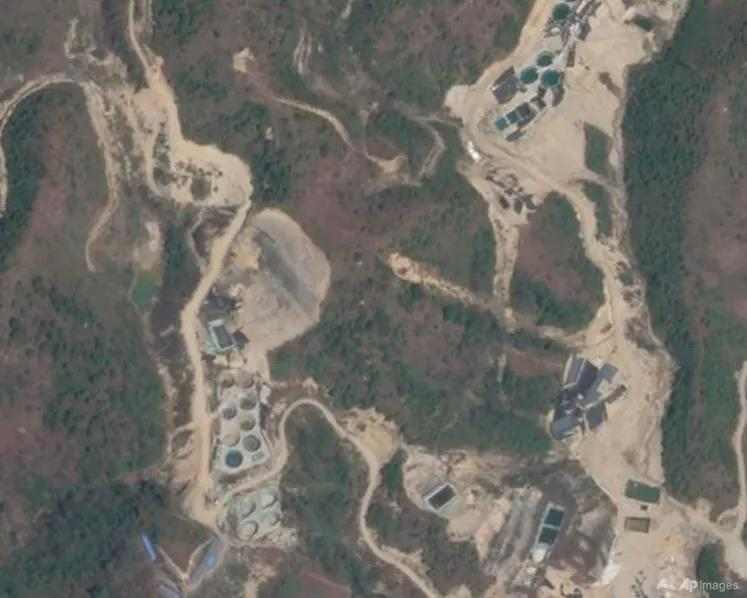
Rare earths explain why a distant civil war has moved onto a supply-chain agenda. The elements are essential to permanent magnets used in electric vehicles, wind turbines, electronics and weapons. China dominates refining and processing, accounting for roughly 90% of global processing by widely cited industry estimates. Myanmar holds major deposits of heavy rare earths, particularly in Kachin State along the Chinese border.
In July, a meeting in Vice President JD Vance's offices — with Castillo present, according to Reuters — discussed pitches involving Myanmar's rare earths. The administration later removed sanctions designations from several junta allies while officials said those delistings did not signal a wider policy change. Taken separately, each event can be explained as casework or a technical decision. Taken together with the Naypyidaw visit, they form a pattern of widening access.
The commercial temptation is obvious: diversify away from China by opening another source. The geopolitical obstacle is just as obvious: many deposits are in territory held or contested by ethnic armed forces, not securely controlled by the central government. A deal with Naypyidaw does not automatically deliver a mine, a road, environmental permission or safe export. It may instead place Washington in the middle of local sovereignty claims and a wartime economy.
There is also a processing trap. Ore is not a supply chain. China possesses the separation, refining and magnet-making capacity that converts mined material into usable industrial inputs. Even if American firms gained access to Myanmar deposits, they would still need reliable logistics and non-Chinese processing. A headline agreement could therefore deliver more symbolism than metal.
Environmental and human-rights costs are not peripheral. AP reporting published by CNA documented polluted waterways, destructive leaching and money flowing through militia-controlled areas. Any Myanmar rare earth deal US officials pursue will be judged not only by whether it reduces dependence on China, but by whether it finances armed actors or replicates the abuses Washington says its sanctions oppose.
Myanmar scam centers are the strongest case for contact
Fraud compounds hit Americans and enslave workers
The most defensible argument for direct engagement is cyber-enabled fraud. Scam compounds operating in and around Myanmar run romance, investment and cryptocurrency fraud targeting victims abroad. Americans have lost billions of dollars to such schemes, according to US officials cited by Reuters. Many workers inside the compounds are themselves trafficking victims held under coercion.
That creates an unusual alignment: Washington wants fewer American victims, neighboring governments want trafficking networks disrupted, and Myanmar's authorities want the international legitimacy that cooperation can buy. The FBI has had direct contact with Myanmar authorities over cyber scams, Reuters reported.
But cooperation must be tested, not assumed. Researchers say some compounds sit in militia-controlled areas and that proceeds can flow toward military-linked actors. A government may close a visible operation while protecting connected networks or shifting them elsewhere. The useful metric is not the number of press conferences or raids. It is the sustained reduction in scam traffic, money movement, compounds and trafficked labor, with independent evidence.
If the channel produces verified closures and rescues, it can save lives and money. If it produces staged enforcement in exchange for diplomatic access, it becomes a laundering mechanism for both crime and politics.
Who benefits — and who pays
The junta gains recognition without conceding legitimacy
Min Aung Hlaing is the clearest immediate beneficiary. He does not need Washington to lift every sanction. He needs to show that sanctions no longer prevent senior meetings. Each encounter weakens the idea that his government is untouchable and helps his campaign to convert battlefield survival into accepted rule.
Rare-earth investors and lobbyists also gain an opening. The possibility of strategic access creates a constituency in Washington for engagement. Victims of scam centers could benefit if law-enforcement cooperation becomes real. The Trump administration gains a story consistent with its foreign-policy brand: concrete deals and American protection over democracy-promotion orthodoxy.
The NUG, resistance and Rohingya accountability lose leverage
The National Unity Government and resistance forces risk losing diplomatic advantage. They have argued that military rule is illegitimate and temporary. Direct talks suggest foreign powers may be preparing for a longer-term accommodation. That can affect morale, fundraising and the calculations of regional governments.
Rohingya accountability also risks becoming a secondary file. Min Aung Hlaing remains under US sanctions tied to grave abuses. When rare earths and scams become the agenda, the burden falls on Washington to prove that genocide accountability, political prisoners and humanitarian access have not become ceremonial talking points.
ASEAN's five-point consensus loses authority if major outside powers bypass its political conditions while seeking bilateral gains. Yet ASEAN itself is divided, and several members already engage Myanmar. Washington is entering a regional pattern it once criticized, not creating that pattern alone.

The timing exposes the moral contradiction
Fewer than two weeks after Vance's visit, Myanmar's military carried out an airstrike on a crowded marketplace in Rakhine State that killed more than 50 people and wounded scores, according to UN human-rights officials cited by Reuters. ASEAN's current chair, the Philippines, expressed concern over the Rakhine airstrikes.
The proximity of the events is not proof that engagement encouraged the strike. It is proof that engagement occurred while the machinery of war remained active. That is the central contradiction Washington must manage: the same government asked to help stop fraud is accused of bombing civilians; the same leader discussed as a gateway to minerals remains sanctioned for past atrocities.
Readers can follow Signal Post News' earlier reporting on Myanmar Junta Airstrike Kills 50 at Kyauktaw Market in Rakhine and Myanmar Airstrikes Kill 8 in Rakhine Displacement Camps. Those incidents are not background noise to the policy shift. They are the test of whether Washington's new channel can impose costs, secure restraint or merely coexist with violence.
What critics say — and where they are right
Representative Gregory Meeks, the top Democrat on the House Foreign Affairs Committee, told Reuters the shift was contrary to US values and interests, arguing that engagement grants international legitimacy while mandated sanctions and democracy funding remain underused. His criticism identifies the strongest institutional objection: the executive branch may be changing the practical policy without asking Congress to change the legal or moral framework around it.
Critics are right that diplomatic photographs have value and that authoritarian governments exploit ambiguity. They are also right that mineral access can create pressure to overlook abuse. Supporters of engagement are right that isolation did not end the war, free Castillo on its own or shut down fraud compounds. The useful debate is therefore not “talk or do not talk.” It is what the United States demands, what it gives and what happens after noncompliance.
A disciplined policy would attach measurable conditions to each track. Scam-center cooperation should require independently verified closures, prosecutions and victim releases. Mineral talks should require supply-chain transparency, environmental standards and consent from local authorities that actually control the ground. Political engagement should preserve sanctions tied to atrocities unless there is documented behavioral change.
What happens next
Scenario one: talks widen into a standing channel
The most likely near-term path is a regular working-level channel covering cybercrime, detainees and humanitarian access, with a special envoy or senior State Department official coordinating policy. Rare-earth discussions could move into technical studies rather than a rapid commercial agreement. This lets Washington claim practical gains while avoiding formal recognition.
Scenario two: another airstrike stalls engagement
A high-casualty attack with clear attribution could make the political cost of contact too high. Congress may demand briefings, funding restrictions or new sanctions. The administration could preserve law-enforcement contact on scams while freezing political and mineral talks. This is the most plausible way the channel narrows without disappearing.
Scenario three: Congress forces a sanctions test
If lawmakers conclude the executive branch is sidestepping congressionally mandated pressure, oversight could become the main battlefield. Hearings would focus on sanctions enforcement, democracy assistance and whether intelligence officials are taking an unusual policy role. That pressure would not necessarily end talks, but it could force the administration to state conditions it now prefers to keep flexible.
Scenario four: a rare-earth announcement outruns reality
A memorandum or access pledge would generate attention, but physical delivery is another matter. Ethnic control of mining areas, Chinese influence, environmental damage and the absence of non-Chinese processing capacity could stall any project. The risk is a deal announced for strategic theater that cannot produce secure supply.
The bottom line
Talking to an adversarial or abusive government is not inherently capitulation. Diplomacy often requires contact with people a country sanctions. But the burden is on Washington to show that access is buying outcomes rather than selling legitimacy cheaply.
The Adam Castillo release is a real result. Shutting down scam centers would be another. A responsibly sourced mineral chain that does not finance armed groups would be strategically valuable, though extraordinarily hard to build. None of those gains requires pretending that Myanmar's war, political prisoners or Rohingya accountability have vanished.
The US reverses Myanmar isolation policy at a moment when Min Aung Hlaing needs outside recognition and Washington wants leverage over crime and China. That makes a bargain possible. It also makes the terms decisive. If the United States can speak to the generals while preserving pressure, supporting non-military actors and measuring performance, the channel may be a tool. If access becomes its own achievement, the generals will have won the most valuable concession before giving much in return.
Sources and methodology
This analysis distinguishes verified events and attributed reporting from projections. Estimates of war deaths and displacement are approximate and may change as access improves.
- Reuters — October 8, 2026 exclusive by Simon Lewis on the direct talks, Michael Vance's role, scams, rare earths, sanctions and congressional criticism.
- Reuters via SRN News — September 17, 2026 report on Adam Castillo's release and the State Department's stated conditions for engagement.
- CNN — September 18, 2026 report on the US delegation and Castillo's detention and release.
- Reuters via WIXX — October 7, 2026 report on Min Aung Hlaing's Malaysia visit, the war toll and ASEAN context.
- Associated Press via CNA — investigation into Myanmar rare-earth mining, militia finance and environmental damage.