Myanmar airstrikes displacement camps
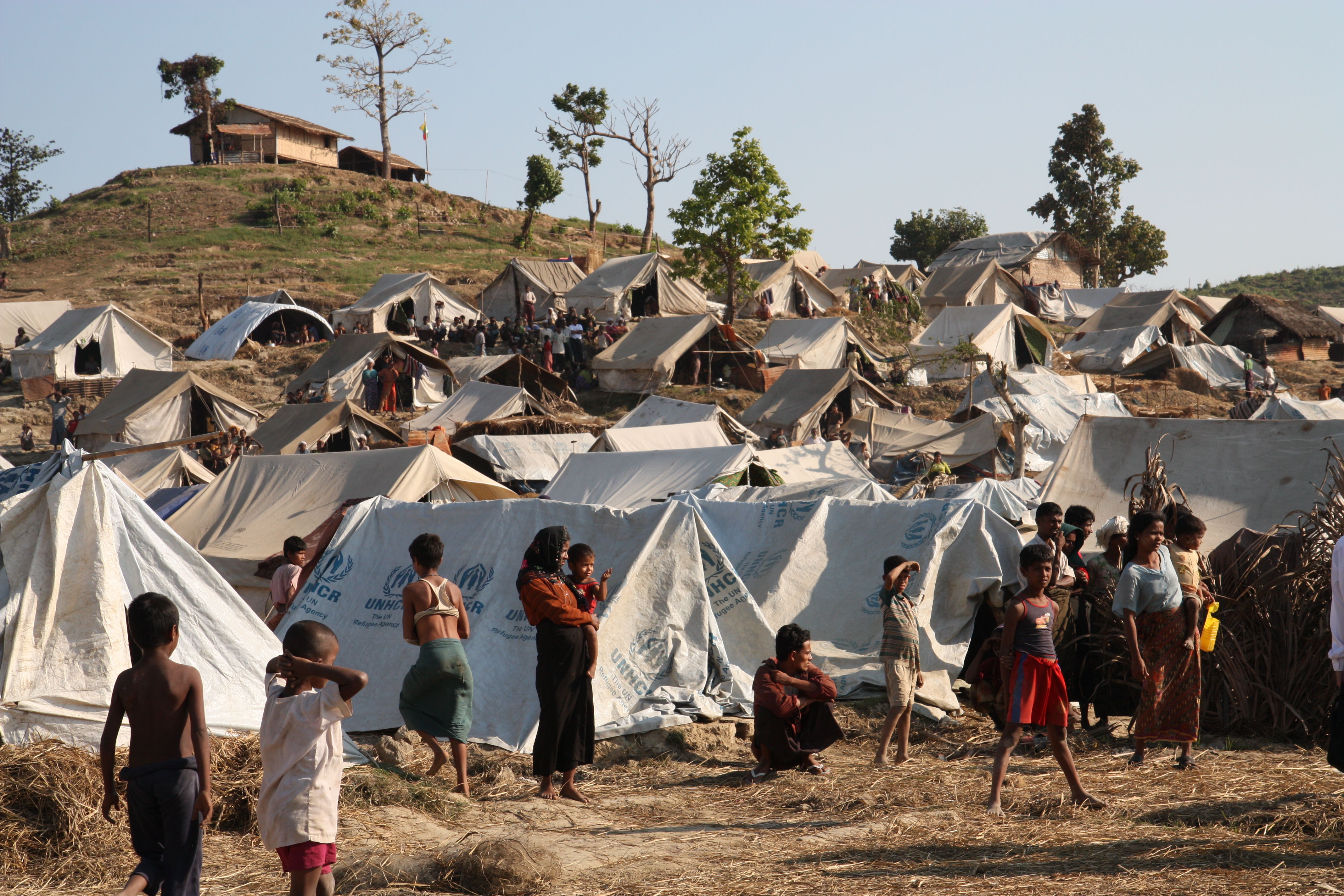
Two successive air attacks on places meant to shelter people already driven from their homes have sharpened the question at the center of Rakhine’s war: where can civilians go when displacement itself offers no safety? Reuters reported that spokespersons for the Arakan Army and the Ponnagyun Youth Association attributed both attacks to Myanmar’s military. Their combined account put the toll at eight civilians killed and 13 injured. Those are claims from parties and local witnesses in a conflict zone, not independently confirmed findings.
The distinction matters. The Arakan Army is a combatant and now controls much of Rakhine State; the military government is fighting to regain ground. Both sides have strategic reasons to shape public understanding of civilian harm. But the inability of independent reporters to reach a strike site does not make a reported attack unimportant. It means the public record must preserve attribution, uncertainty and the government’s response—or lack of one—at the same time.
What happened in Ponnagyun
Ponnagyun IDP camp airstrike: two attacks, two sets of claims
At about 5 p.m. local time on Sunday, October 4, an airstrike hit a camp for internally displaced people in Ponnagyun Township, Reuters reported, citing spokespersons for the Arakan Army and the Ponnagyun Youth Association. The two sources said six people were killed and 11 were injured. Local reporting identified the site as the Yoengu–Byala camp area, where families displaced by earlier fighting had gathered.
On Monday morning, October 5, the same two groups told Reuters that another airstrike hit a second camp in the township. They said two people were killed and two were injured. Referring to residents of both camps, Ponnagyun Youth Association spokesperson Kyaw Win Tun told Reuters: “Everyone there is a displaced civilian.”
A Myanmar government spokesperson did not immediately answer Reuters’ request for comment. The military has previously said it “exercises maximum restraint to avoid civilian harm.” Reuters said it could not independently verify the details of either incident. That caveat governs every number in this report: the camp tolls are attributed accounts, not a final independently established casualty list.
Why this matters
Rakhine displacement camps bombed after a deadly market attack
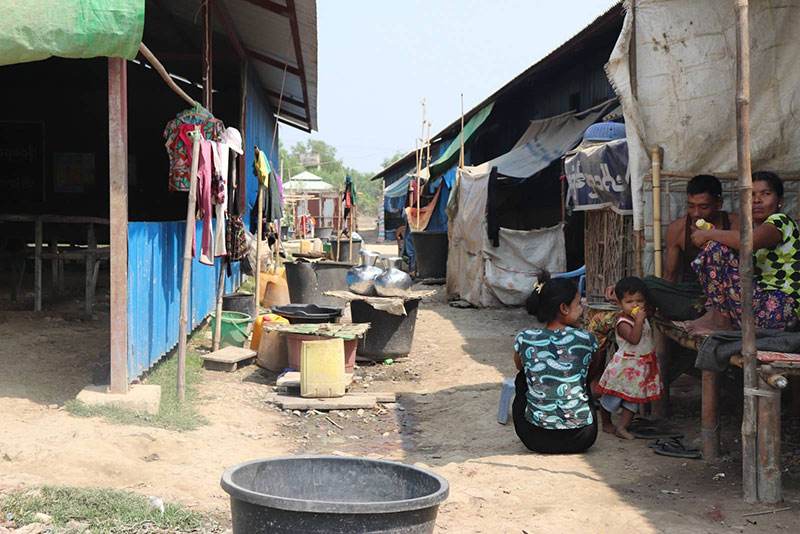
For people uprooted by war, a camp is not merely a collection of shelters. It is the endpoint of a forced calculation: home became too dangerous, the road was survivable, and a crowded settlement appeared safer than remaining near a front line. When aircraft strike such places, the protection logic collapses. Families may have no third destination, no hardened shelter and no reliable warning system.
The reported Ponnagyun attacks also fit a quickening sequence. On September 28, a strike near a market in Kyauktaw killed 50 people and wounded at least 58, according to the Arakan Army and local aid worker Wai Hun Aung in Reuters reporting. The United Nations secretary-general strongly condemned that attack and called on all parties to protect civilians and meet their obligations under international law. Read our earlier report on the Kyauktaw market airstrike.
On October 2, local sources reported another military strike on Aungphyupyin village in Ponnagyun Township as operations widened across Rakhine and into Dawei. Our Rakhine and Dawei escalation report tracks that separate incident. Reuters described the Kyauktaw market bombing as Rakhine’s deadliest air attack since a December hospital bombing that, according to the outlet’s record, killed at least 30 people.
How we got here
Myanmar civil war 2026: a territorial contest turns toward air power
Myanmar’s nationwide civil war followed the military’s February 2021 seizure of power. Reuters estimates that the conflict has killed around 100,000 people and displaced more than 3.5 million. Those national figures describe scale, but Rakhine’s current emergency has its own chronology.
The Arakan Army resumed a major offensive in November 2023, breaking a ceasefire and taking control of towns, bases and border routes across much of the coastal state. Its gains transformed it from an insurgent challenger into a territorial authority responsible for administration as well as combat. The military retained aircraft, naval firepower and fortified positions even as it lost ground.
According to an assessment by the Institute for Strategy and Policy–Myanmar, relayed by Global Arakan Network, the military’s intensified counteroffensive entered a new phase on September 4, 2026. The assessment said seven columns advanced on several routes with naval artillery and air support but had not achieved significant territorial gains by early October. It attributed more than 70 civilian deaths to air and artillery attacks since September 4 and said more than 6,000 people from about 24 villages had been displaced. Those totals are ISP-Myanmar’s assessment, not an official or independently audited count.
The tactical logic is stark. A force that struggles to move the front line on the ground can still use aircraft and long-range weapons to hit far behind it. Air power imposes costs without requiring control of the territory below. Yet when intelligence is weak, targets sit among civilian populations, or precautions fail, that asymmetry transfers risk to the people least able to absorb it.
Who benefits, who loses
Myanmar junta airstrikes civilians cannot settle the political contest
For the military, sustained aerial operations may serve three immediate purposes: disrupt Arakan Army logistics, force fighters into air defense and dispersion, and demonstrate that territorial losses do not eliminate the state’s coercive reach. Even without recapturing towns, the pressure can slow an opponent’s offensive and make governing captured territory more expensive.
For the Arakan Army, civilian casualties can deepen anger toward the junta and strengthen its claim to be Rakhine’s protector. But control creates responsibility. The armed group must explain where camps are located relative to military activity, what warning and shelter systems exist, and how movement restrictions affect people trying to escape danger. Civilian protection is not satisfied by attributing every failure to enemy fire.
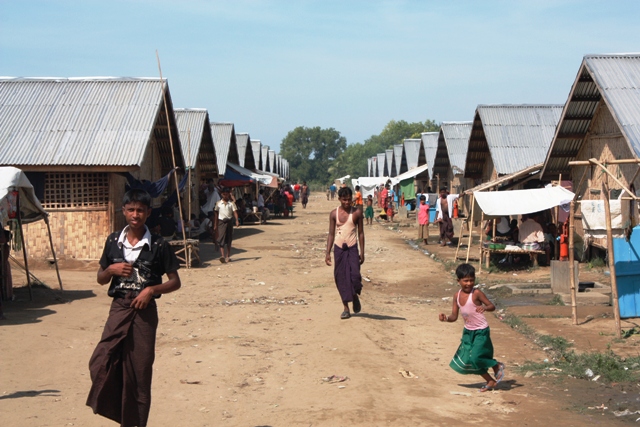
The displaced lose most. They absorb deaths, injuries, interrupted aid, damaged shelters and the threat of repeat displacement. Camp concentration can make food, water and medical care easier to deliver; it also creates a visible population cluster with few ways to disperse quickly. Our analysis of the UN’s Myanmar evidence mechanism and the barriers to safe return explains why Rakhine’s displaced still have no safe path home.
Kyaukphyu interests pull China and Japan toward the crisis
Rakhine also contains interests far beyond the battlefield. China’s oil-and-gas corridor and planned deep-sea port at Kyaukphyu make stability there strategically important to Beijing. ISP-Myanmar’s assessment noted a visit by a Chinese embassy official concerned about Chinese nationals during the fighting. Japan has previously supported informal engagement between the military and the Arakan Army through Nippon Foundation channels.
Neither country benefits from an uncontrolled humanitarian collapse around strategic infrastructure. But their incentives are not identical to those of displaced civilians: protecting nationals, projects and access can favor de-escalation without necessarily producing accountability. ASEAN, including the Philippines as the bloc’s 2026 chair, faces the same test—whether concern turns into practical pressure for civilian access and restraint.
Accusations of war crimes must also be handled precisely. Rights advocates and Arakan Army officials have accused the military of deliberately attacking civilian locations. The government has denied a policy of harming civilians and has invoked maximum restraint. Establishing criminal responsibility requires evidence about target selection, expected military advantage, precautions, weapon effects and command decisions. The reported camp attacks intensify the need to preserve that evidence; they do not, by themselves, complete the legal case.
What the numbers mean
Kyauktaw market airstrike 50 killed: a warning about tempo, not arithmetic
The Sunday and Monday camp accounts total eight people killed and 13 injured, according to the Arakan Army and Ponnagyun Youth Association. The Kyauktaw market account put the toll at 50 killed and at least 58 wounded, according to the Arakan Army and aid worker Wai Hun Aung. The point is not to rank suffering by casualty count. It is to see how the targets form a civilian geography: a market, a village, a hospital and now displacement camps.
ISP-Myanmar’s figure of more than 70 civilians killed since September 4 offers another measure: tempo. If its assessment is accurate, the human cost accumulated in roughly a month while the offensive failed to produce major territorial change. That is the contradiction likely to define the next phase—high destructive capacity, limited control of the ground.
Every early wartime toll is provisional. People may die later from injuries; names may be duplicated or omitted; communications may fail; partisan sources may exaggerate or suppress losses. Responsible reporting therefore keeps attribution attached to the number and updates the record when independent evidence emerges. “Reported killed” and “confirmed killed” are not interchangeable.
What happens next
Three plausible paths for the Rakhine state humanitarian crisis
First, air and artillery attacks could intensify. If military columns remain unable to regain territory, commanders may lean harder on the weapons that do not require holding roads or towns. That would increase pressure on camps, clinics, markets and transport routes even if neither side changes the map.
Second, the front could harden. The counteroffensive may force the Arakan Army to divert fighters from expansion to defense. The military could achieve a limited objective—slowing its opponent—without retaking major ground. A prolonged stalemate would deepen shortages and make emergency access more difficult.
Third, external pressure could open a narrow humanitarian channel. China, Japan, ASEAN and the United Nations have different leverage and interests, but all have reasons to prevent wider destabilization. The immediate benchmark is not a comprehensive settlement. It is sustained civilian access, credible warning arrangements and compliance by all parties with international humanitarian law.
What to watch next
- Whether Myanmar’s government issues a specific account of the Ponnagyun strikes rather than relying on its general restraint statement.
- Whether hospitals, camp committees or independent monitors publish named casualty lists that corroborate or revise the figures.
- Whether satellite imagery or verified visual evidence can establish damage at the Yoengu–Byala camp area and the second camp.
- Whether the military’s ground columns gain territory after the September 4 push, or air power continues to substitute for movement on the ground.
- Whether the United Nations and ASEAN secure access to displaced communities before further relocation or return efforts are discussed.
The central fact is therefore narrower—and more urgent—than a claim about who is winning. Two local organizations say aircraft struck two displacement camps across two days and killed civilians. The government has not provided a counter-account, and independent verification is not yet available. For Rakhine’s displaced, that uncertainty is not protection; it is the condition in which the next strike may arrive.
Sources
Reporting with attribution, uncertainty and civilian protection at the center.