Travel · Business · Airlines
A technology failure stopped United’s departing jets from receiving the weight-and-balance data every flight needs before takeoff — holding aircraft at gates and on tarmacs from Denver to San Francisco for about 90 minutes on Monday before the airline resolved it, leaving 554 flights delayed and 22 cancelled.
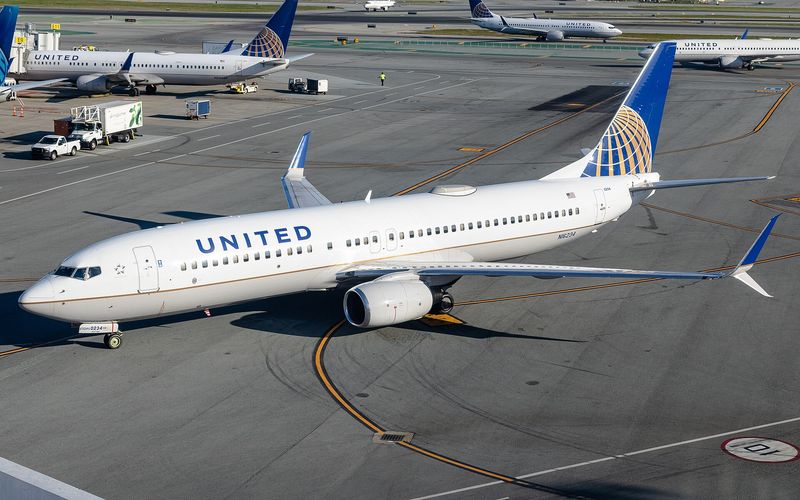
CHICAGO, November 16, 2026 — The United Airlines system outage that froze departing flights across the carrier’s largest hubs on Monday afternoon is over. United said at about 6 p.m. ET that it had resolved the technology issue that had delayed flight departures for roughly 90 minutes, after a failure in the systems that deliver flight-critical data to the cockpit left aircraft sitting at gates and on tarmacs, fully loaded and going nowhere. By 6:10 p.m. ET, FlightAware had counted 554 United flights delayed — about 17% of the airline’s schedule — and 22 cancelled, according to USA Today, though CNN cautioned that not all of the day’s delays were necessarily tied to the outage. The scope of the hold matters as much as its length: it applied to departing mainline flights only. Flights already in progress were not affected, and neither were United Express flights, the airline said in both its mid-outage and resolution statements.
The failure was specific, and its specificity is what made it so disruptive. Departing aircraft could not receive their “takeoff numbers” from dispatch — the weight-and-balance figures and performance data that a crew must have in hand before an airliner is legally and safely able to leave, as NBC Chicago reported via the Associated Press. Without those numbers, a fueled, boarded, pushed-back jet is simply parked. Multiply that by a hub-and-spoke network at the start of the evening departure bank, across Denver, Chicago O’Hare, Newark, Houston and San Francisco, and a data problem in one system becomes a national delay map in under an hour. United acknowledged the problem publicly just before 5 p.m. ET, posting on X: “We’re aware of the widespread system outage, and our teams are working hard to get things back up and running as soon as possible.” About an hour later, it was over — but the delays it created will take the rest of the evening to unwind.
What we know
- What failed: a United technology system used by departing flights. Aircraft could not receive their takeoff numbers — weight-and-balance figures and performance data sent by dispatch — and were held at gates and on tarmacs (NBC Chicago / AP).
- Who was affected: departing mainline United flights only. United said, twice, that there was no impact on flights in progress or on United Express flights.
- Where: United’s hubs bore the brunt — Denver, Chicago O’Hare, Newark, Houston and San Francisco — with radio traffic naming at least 30 United flights across 12 airports (AirlineGeeks).
- How long: the first pilot reports came at about 4:02 p.m. ET; United resolved the issue at about 6 p.m. ET — roughly 90 minutes later.
- The toll: 554 United flights delayed (about 17% of the schedule) and 22 cancelled as of 6:10 p.m. ET, per FlightAware via USA Today — with CNN’s caveat that not all of the day’s delays are necessarily tied to the outage.
- The cause: United has not stated one. A United spokesperson said there is “no indication” the outage was a cybersecurity-related issue. The FAA, via CNN, said the outage was on United’s end — “not an FAA equipment issue.”
How a takeoff number stops a fleet
To understand why a data outage can hold an entire airline, start with what a takeoff number actually is. Before any commercial flight departs, dispatchers compute the aircraft’s weight and balance: the weight of the jet itself, the fuel, the passengers, the bags and the cargo, and how that load is distributed. From those figures come the performance data the crew flies by — the speeds at which the aircraft will rotate and climb, the thrust settings, the flap configuration, the runway length required. These are not formalities. An airliner’s margins are engineered around them, and a flight cannot legally depart without final numbers that reflect the load actually on board. The system is deliberately unforgiving: if the numbers do not arrive, the airplane does not go.
That design is a safety feature on any normal day. On Monday it became the mechanism of a systemwide stop. Because the takeoff numbers flow from dispatch to the cockpit through United’s technology systems, a failure in that chain does not slow departures down — it zeroes them. Pilots could start engines, complete checklists and push back from gates; some aircraft were held on tarmacs with passengers aboard. What they could not do was the one thing that turns a parked jet into a flight: receive and accept the final data. And because United’s network is built around hubs where banks of flights arrive and depart in waves, every held departure also held the aircraft, crew and gate that the next flight in the rotation was counting on. The outage lasted about 90 minutes. The rotations it scrambled will take far longer to reassemble.
The radio traffic: “nothing is transmitting”
The outage was audible before it was official. Recordings of radio traffic, reported by NBC Chicago and AirlineGeeks, captured the failure in the flat language of people working around it. “We are having an outage where nothing is transmitting at this moment,” one transmission said. “It’s a systemwide issue. We don’t have an estimated time to where anything is going to be restored.” At Chicago O’Hare, a ramp controller described an “extreme system-wide outage” that was “preventing us from closing out flights” across “pretty much all of our mainline departures” — a phrase worth holding onto, because it matches the airline’s own scope exactly: mainline departures were the problem; everything else kept moving.
AirlineGeeks reported that radio traffic named at least 30 United flights across 12 airports — a floor, not a count, since it reflects only the flights controllers and crews happened to discuss on recorded frequencies. The first of those reports, at about 4:02 p.m. ET, involved United flight 2787 at Denver, which could not get its final weights. Denver is United’s largest hub by departures in the interior of the country and the hinge between its eastern and western networks; a failure that shows up there first, at the start of the afternoon bank, propagates in every direction at once.
Ninety minutes, in order
The afternoon’s timeline is compact, and its compactness is the story’s one mercy. At about 4:02 p.m. ET, the first radio report surfaced from Denver, where flight 2787 could not obtain final weights. By about 4:39 p.m. ET, user reports on Downdetector — a self-reported signal, not an official count — were climbing as passengers across the network began posting about held flights. Just before 5 p.m. ET, United acknowledged the outage publicly on X and said its teams were working to restore service; its operational statement described troubleshooting “a technology issue affecting departing flights” and stated the scope plainly: “There is no impact on flights in progress, or on United Express flights.” At about 6 p.m. ET, the airline declared the issue resolved, in a statement that repeated the scope word for word: “We have resolved a technology issue that delayed flight departures. While some flights were delayed, there was no impact on flights in progress, or on United Express flights.” Ten minutes later, FlightAware’s snapshot — 554 delayed, 22 cancelled — gave the afternoon its first hard numbers.
Two features of that timeline deserve emphasis. The first is that the flying part of the airline never stopped. Aircraft already airborne continued to their destinations; United Express, the regional operation flown by partner carriers under United’s brand, was outside the affected systems entirely. What stopped was one precise function — dispatch data for departing mainline flights — and it stopped completely. The second is how quickly the airline’s public language matched its operational language. From the first statement to the resolution, United described a departing-flights problem, and nothing in the afternoon’s reporting contradicts that description. In an industry where outage communications often lag and soften the facts, Monday’s statements were unusually exact — and the exactness held up.
Inside the outage: pilot apps, crew messages and a warning not to log out
The fullest account of what failed inside the airline came from the pilots’ union. The Air Line Pilots Association said the outage affected multiple pilot-facing applications, including crew communications and messaging and the systems used to provide final weights, according to CNBC and CNN. An internal United alert told crews not to log out of several systems — a telling detail, because it suggests the failure was of a kind where a live session was worth more than a fresh login: once out, a crew member might not get back in. For passengers, the outage was a departure board filling with delays. For crews, it was the quiet disappearance of the digital thread — messages, weights, closeout data — that connects a cockpit to the airline around it.
One institution was quick to say what the outage was not. The Federal Aviation Administration, via CNN, said the failure was on United’s end — “not an FAA equipment issue.” The distinction matters beyond blame. An airline-side outage is fixed by the airline, on the airline’s timeline, and it does not implicate the national air traffic system that every other carrier depends on. No other airline reported a comparable failure on Monday, and the FAA’s air traffic operation ran normally through the afternoon. This was one company’s technology breaking, in one company’s network, with consequences that stayed — as the delay map showed — almost entirely on that company’s passengers.
What was not affected — and what the evening still holds
Precision about scope is not pedantry; for travellers, it is the difference between a ruined evening and a normal one. If you were already in the air on a United flight on Monday, your flight was not affected. If you were booked on United Express, your flight was not affected by the outage itself — though a regional jet waiting on a delayed inbound mainline connection could still feel the day’s knock-on effects. And if your flight was a mainline departure scheduled during or after the outage window, the resolution at about 6 p.m. ET is the beginning of your recovery, not the end of your delay: aircraft and crews displaced by 90 minutes of held departures do not snap back into place, and United’s evening banks at Denver, O’Hare, Newark, Houston and San Francisco will run late as the network re-sequences itself. The 22 cancellations, meanwhile, strand their passengers outright — for them, the relevant question is rebooking, and the relevant fact is that the airline’s own systems failure, not weather, caused the disruption.

The ripple lands on an industry with little slack in it. U.S. airlines have spent the autumn managing tight margins between record demand and rising costs — the squeeze visible in Signal Post News’ coverage of how Delta missed earnings and cut its profit forecast as fuel costs soared. A 90-minute technology stop does not change that arithmetic, but it consumes the one resource a hub network cannot manufacture on short notice: time in the right place. Every hour of recovery flying is an hour of crew duty burned, and crew legality limits, not aircraft, are usually what finally cap an evening like this one.
A separate shadow: Friday’s FAA ground stop
Monday’s outage arrived three days after another aviation disruption with a similar silhouette and an entirely different anatomy. On Friday, an FAA router fault produced a nationwide ground stop that halted flights across the United States before it was lifted — the event Signal Post News covered in its report on the FAA nationwide ground stop and its lifting. The two events are separate. NBC reported that Monday’s United issue does not appear related to Friday’s FAA fault, and the FAA’s own position on Monday — “not an FAA equipment issue” — draws the same line from the other side: Friday’s failure lived in the government’s systems and touched everyone; Monday’s lived in one airline’s systems and touched only its departing mainline flights. Travellers who lived through both weekends of disruption can be forgiven for experiencing them as one story. Operationally, they are two — and the distinction decides who has to fix what.
Why this matters
Analysis, labelled as such. Monday’s outage is a case study in where modern airline fragility actually lives. It is not in the aircraft, which were fueled, crewed and mechanically ready. It is not in the air traffic system, which the FAA confirmed was not involved. It is in the data layer between an airline’s brain and its fleet — the dispatch systems that turn a load of passengers, bags and fuel into a legal, flyable set of numbers. That layer is a single point of failure by design: weight-and-balance data must be authoritative and singular, because two versions of a takeoff calculation are worse than none. The same centralisation that makes the numbers trustworthy makes their absence total. When the pipe broke on Monday, there was no degraded mode, no manual fallback visible in the afternoon’s reporting — just a fleet holding at gates while a system was restored.
The second lesson is about network geometry. A point-to-point airline loses the flights at the affected stations. A hub-and-spoke airline loses the pattern: each held departure is also a missing arrival, a missing aircraft for the next leg, a crew timing out in the wrong city. United’s five named hubs — Denver, O’Hare, Newark, Houston, San Francisco — are the load-bearing walls of its schedule, and the outage leaned on all of them at once during the afternoon bank. That is how roughly 90 minutes becomes 554 delays by 6:10 p.m. ET — with CNN’s caveat kept firmly attached: a delay count for the day includes delays the outage did not cause, and the final accounting, when it comes, will separate the two more precisely than a 6:10 p.m. snapshot can.
The third lesson is about what the airline did not say. United has not stated a cause, and the only authorised sentence on the darkest hypothesis is its spokesperson’s: there is “no indication” the outage was a cybersecurity-related issue. That formulation is careful, and it should be reported carefully — it rules nothing in and, on the evidence available Monday evening, the cyber question is simply not where the facts point. What the facts describe is a technology failure in pilot-facing and dispatch systems, acknowledged fast, scoped precisely and resolved in about 90 minutes. Airlines earn trust in outages the same way they lose it: on the accuracy of the sentences they issue while the screens are still red. On Monday, United’s sentences matched the afternoon.
What happens next
Three things will complete this story. First, the recovery: watch United’s completion factor through Monday evening and into Tuesday morning, when aircraft and crews that ended the day out of position meet the first departure banks. A clean Tuesday is the real certificate that the outage ended at 6 p.m.; a ragged one would mean the 90 minutes bought a second day of disruption. Second, the final numbers: FlightAware’s 554-and-22 snapshot was taken at 6:10 p.m. ET, minutes after the resolution, and the day’s closing tallies — with the outage-related delays separated from the ordinary kind, per CNN’s caveat — will be larger and more precise. Third, the explanation: United has not stated a cause, and whether it eventually publishes a post-incident account of what failed in its dispatch and crew systems — and what redundancy now stands behind the takeoff numbers — is the difference between an outage that was an accident and one that was a warning. Signal Post News will update this article as the final counts and any United explanation arrive.
Sources
- United Airlines, statements and X post (@united), November 16, 2026 — the acknowledgment (“We’re aware of the widespread system outage, and our teams are working hard to get things back up and running as soon as possible”), the mid-outage statement (“We are troubleshooting a technology issue affecting departing flights. There is no impact on flights in progress, or on United Express flights”), and the resolution statement at about 6 p.m. ET repeating that scope; and a United spokesperson’s statement that there is “no indication” the outage was a cybersecurity-related issue. United has not stated a cause.
- Associated Press, via NBC Chicago and NBC Connecticut / NBC New York, November 16, 2026 — departing aircraft unable to receive their “takeoff numbers” from dispatch (weight-and-balance figures and performance data required before takeoff), with planes held at gates and on tarmacs; and the radio audio of the outage.
- AirlineGeeks, November 16, 2026 — widespread system outage reporting: the first radio report at about 4:02 p.m. ET (United flight 2787 at Denver unable to get final weights), radio traffic naming at least 30 United flights across 12 airports, and the O’Hare ramp controller’s “extreme system-wide outage” description.
- USA Today, November 16, 2026, citing FlightAware as of 6:10 p.m. ET — 554 United flights delayed (about 17% of the schedule) and 22 cancelled.
- CNN, November 16, 2026 — the caveat that not all of the day’s delays are necessarily tied to the outage; the FAA’s position that the outage was on United’s end and “not an FAA equipment issue”; and ALPA’s account of the pilot-facing systems affected.
- CNBC, November 16, 2026 — the Air Line Pilots Association on the outage affecting multiple pilot-facing applications, including crew communications/messaging and the provision of final weights, and the internal alert telling crews not to log out of several systems.
- NBC News, November 16, 2026 — the outage came three days after Friday’s FAA nationwide ground stop (an FAA router fault) and does not appear related to it.
- Downdetector, November 16, 2026 — user reports of United problems from about 4:39 p.m. ET; a self-reported signal, not an official count.
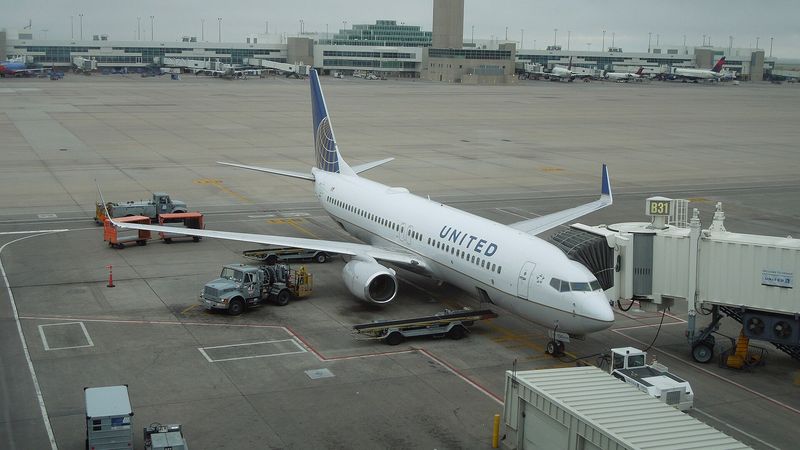
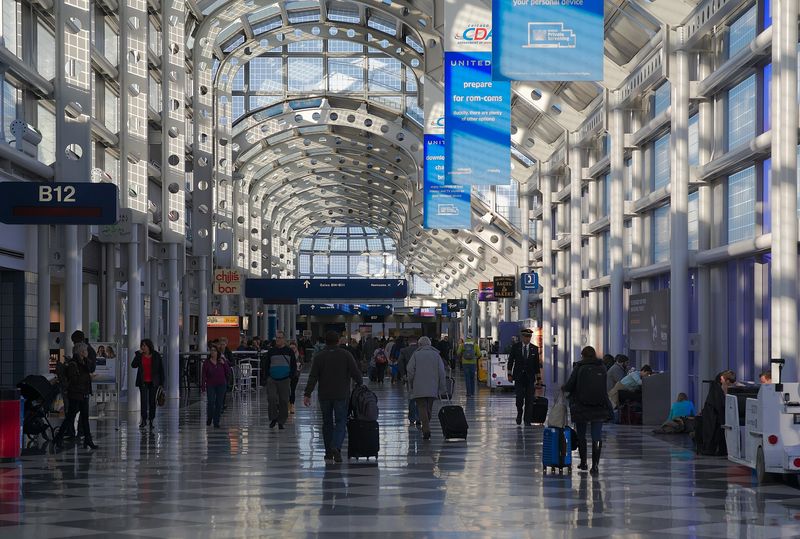
- Photos: a United Boeing 737-800 at San Francisco by JacobAviation (CC BY-SA 4.0), a United Boeing 737-800 at Denver’s gate B31 by DReifGalaxyM31 (CC BY 3.0), Concourse B at Chicago O’Hare by Dllu (CC BY-SA 4.0), and Denver International Airport’s main terminal at dusk by Peterquinn925 (CC BY-SA 4.0), all via Wikimedia Commons — each credited in its caption, and none depicting the November 16, 2026 outage itself.