War · Ukraine · Belgorod
The Belgorod drone strike family killed in Proletarsky — a married couple and their 24-year-old daughter — were the deadliest single loss of a night in which Russia and Ukraine traded strikes across their border, and officials on both sides counted at least five people killed and at least 18 injured by Saturday morning.
Track it live: Ukraine war map · Wars tracker
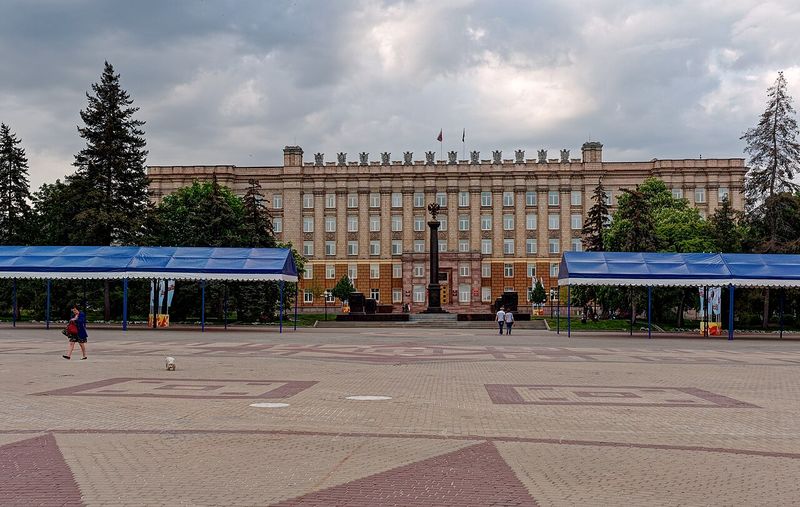
BELGOROD, Russia, November 15, 2026 — The overnight exchange began, as it now almost always does, in both directions at once. Through the night of Friday, November 13 into Saturday, November 14, Russia launched waves of drones at Ukraine while Ukrainian drones crossed into Russia’s border regions, and by morning the two countries’ officials were publishing parallel ledgers of the dead. Taken together, officials on both sides reported at least five people killed and at least 18 injured — a combined toll assembled from statements that no outside observer has been able to check on the ground, and that this article attributes, figure by figure, to the officials who gave them. The single deadliest incident was not in a city or at a military site. It was at a private house in the settlement of Proletarsky, in Russia’s Belgorod region, about 20 kilometres from the Ukrainian border.
A family in Proletarsky
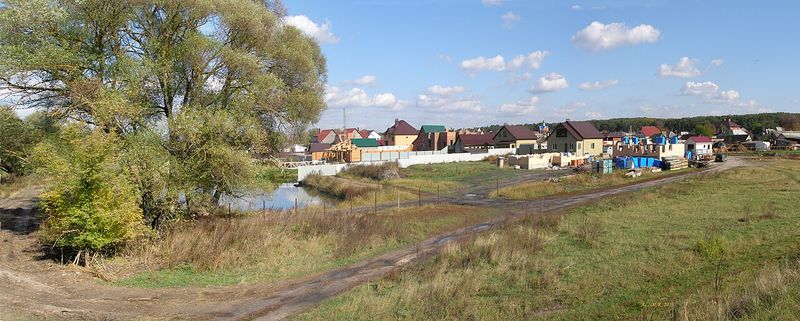
The Belgorod regional operational headquarters said a Ukrainian drone struck a private house in Proletarsky, in the region’s Rakitnoye district, killing a married couple and their daughter, who was 24 years old. One man was injured. The house was destroyed, and a second house was damaged, the headquarters said, in reporting carried by DPA. Read that account slowly, because its details are the whole story of this strike: not a barracks, not a depot, not a headquarters — a family home in a border settlement, hit at night, with three generations’ worth of loss compressed into one official sentence. The daughter was an adult, 24 years old; the couple were her parents. Their names had not been released in the reporting available at publication, and neither side has published an account of what the drone was, what it was aimed at, or whether anything of military significance stood near the house. Those gaps are stated here plainly rather than filled in, because in this war the space around a confirmed fact is where false certainty breeds.
What can be said is where Proletarsky sits. The Rakitnoye district lies in the west of Belgorod region, close enough to the border that its settlements have lived for years inside the geography of this war: within range of drones, artillery and falling interception debris, and accustomed to overnight reports of damage in one village or another. Twenty kilometres from the border is, in the drone era, no distance at all — a short flight for even a small unmanned aircraft. The family were killed, on the Russian authorities’ account, by the kind of weapon that has made the border a front line running through gardens and bedrooms rather than along trenches.
The injured man — whose relationship to the family the headquarters’ statement, as reported, did not specify — is the strike’s surviving witness in the official record, and the second damaged house is its reminder that a drone that destroys one home rarely respects the boundary of a single plot. Beyond those facts, the honest record of Proletarsky on this night is short: three people dead, one injured, one house destroyed, one damaged, in a settlement most of the world had never heard of before Saturday morning.
The wider Belgorod toll
Proletarsky was the deadliest incident in the region, but it was not the only one. Regional reporting counted at least seven to nine further people injured in drone attacks on other Belgorod-region settlements, among them the villages of Pochayevo and Novostroyevka-Pervaya and the settlements of Rzhevka and Shebekino. The range in that figure — seven in some roundups, nine in others — is not an error to be smoothed over; it reflects the timing of the roundups themselves, compiled at different hours from a regional headquarters that updates its toll as hospitals report and as daylight reveals damage the night concealed. This article therefore carries the figure as officials and roundups gave it, attributed and unsettled, rather than picking the number that reads most cleanly.
Russia’s Defence Ministry, for its part, claimed that Russian air defences intercepted 29 Ukrainian drones overnight, including over the Moscow region. That is a Russian claim, stated as the ministry gave it: there is no independent confirmation of the count, and interception claims in this war — by both sides — routinely blend drones shot down, drones suppressed by electronic warfare and drones whose fate is simply asserted. The spread inside the claim is still worth noting: a night on which Moscow says drones were engaged over the capital region as well as the border oblasts is one on which Ukraine’s unmanned campaign reached far beyond the frontier — the pattern Signal Post News documented a day earlier when Ukraine struck the Samara oil hub at Prosvet and the Lipetsk-2 airfield, hundreds of kilometres inside Russia.
The same night, over Ukraine
While Belgorod’s headquarters was counting its dead, Ukraine’s Air Force was publishing the other half of the night. Russia launched 96 drones from Friday evening, the Air Force said, and 81 of them were shot down or suppressed by early Saturday. Ukrainian briefings on the same wave described 61 of the aircraft as jet-powered Shahed-type drones — the faster variant of the Iranian-designed type that has become the workhorse of Russia’s nightly campaign. As with the Russian interception claim, these are Ukrainian figures, given by the service that fought the engagement, and they are reported here as such: the launch total and the interception total are Kyiv’s, and the fifteen or so drones unaccounted for in the arithmetic are the ones whose effects appear, in fragments, in the regional casualty reports that follow.
The night’s Ukrainian toll was spread across the east and south rather than concentrated in one place, and it landed on the same Saturday that brought a second consecutive day of strikes on Zaporizhzhia — the sequence Signal Post News covered in Russia’s renewed strikes on Zaporizhzhia and Pavlohrad. Read together, the two reports describe the exchange whole: a war conducted overnight, in both directions, at a tempo that no longer pauses between one morning’s statements and the next evening’s launches.
Ukraine’s toll, region by region
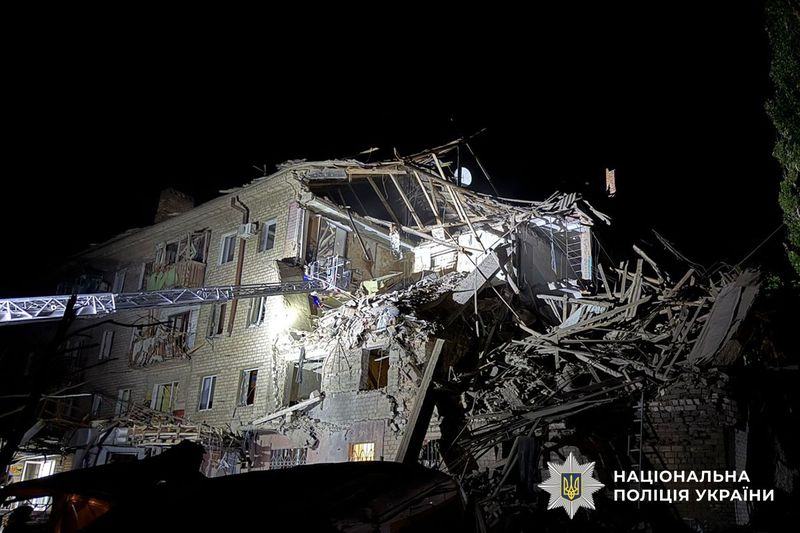
In Donetsk region, one woman was killed in the village of Yasna Polyana, in the Kramatorsk district, the State Emergency Service of Ukraine (SES) reported. Kramatorsk district is the administrative heart of the Ukrainian-held part of Donetsk region — a rear area by the standards of the front line, and a place whose apartment blocks and houses have nonetheless been struck repeatedly through the war, as the file photograph below, from June 2025, attests. The SES account, as reported, gives the death in the spare form these statements take: a woman, a village, a district. Her name had not been published in the reporting available at publication.
In Sumy region, three people were injured in the town of Hlukhiv on Saturday morning, the regional head, Oleg Grigorov, reported. Hlukhiv, like Proletarsky across the frontier, is a border community — Sumy region faces Russia’s Kursk and Belgorod regions, and its towns absorb the northern share of the cross-border fire that Belgorod’s villages absorb from the other side. In Kharkiv region, regional officials reported one person killed and two injured over the past day across seven settlements — a whole region’s worth of villages, each with its own strike and its own damage, compressed by the reporting format into a single line.
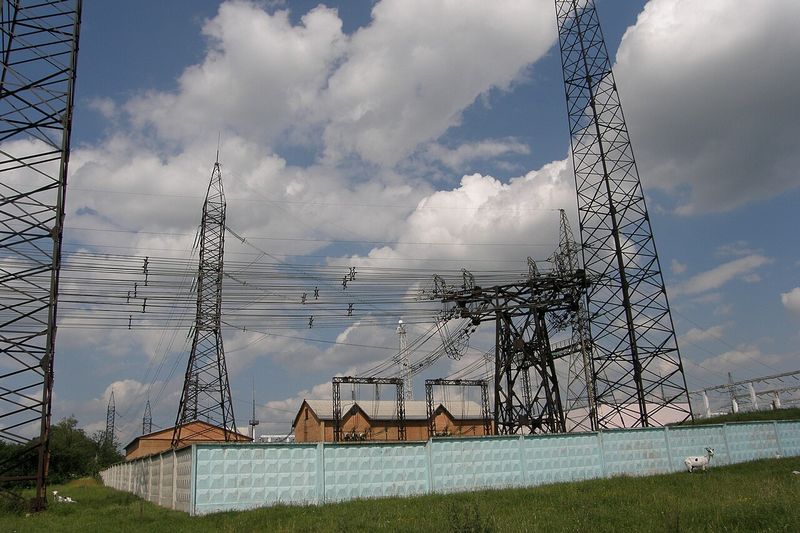
The night’s largest single consequence, measured in people affected rather than people hurt, came in the south. In Odesa region, around 50,000 people lost power after a morning strike on a facility of DTEK, Ukraine’s largest private energy company, the regional head, Oleh Kiper, reported. Fifty thousand people without electricity is not an abstraction as November deepens: it is heating idle in apartment blocks, water pumps stopped and hospitals and schools on generators — the familiar arithmetic of Russia’s campaign against the Ukrainian grid, applied to a Black Sea region whose ports and power stations have been targets since the war’s first winter. How long the outage lasts will be measured by DTEK’s repair crews; neither the company nor the region had published a restoration timeline at publication.
Claims that outrun the evidence
Two further Russian claims belong in the record, labelled with the distance that separates them from verified fact. Russia’s Defence Ministry claimed strikes on an energy facility in Ukraine’s Chernihiv region and on a dry cargo ship at sea that Moscow said was delivering military cargo to Odesa. Both are Russian claims. Neither has been independently confirmed: no Ukrainian statement corroborating a Chernihiv energy strike or a hit on a cargo vessel at sea had entered the reporting available at publication, and the ministry’s account of the ship’s cargo is, by its nature, an assertion about intent and contents that no outside party has inspected. They are carried here because the ministry made them, and because claims of this kind — energy infrastructure hit, military cargo destroyed at sea — shape each side’s domestic account of the night; they are not carried as established events.
That discipline applies to the whole of this report, and the roundup on which it draws states the reason plainly: the claims of both sides could not be independently verified due to the conditions of the war. There are no neutral inspectors in Proletarsky or Yasna Polyana tonight — only regional headquarters, emergency services, air forces and defence ministries, each publishing the night as its own instruments recorded it. Where the two sides’ numbers can be placed side by side, as with the combined toll of at least five killed and at least 18 injured, the result is a floor, not a total: what officials have so far admitted to, on the record, in the first day.
The border-region pattern
Step back from the single night and a pattern stands out. The dead and injured of November 13–14 were not, in the main, soldiers, and they were not in the war’s famous places. They were a family in a Russian border village and a woman in a Ukrainian one; the injured were in Hlukhiv and Shebekino, in Kharkiv-region settlements and Belgorod-region villages whose names recur in these reports because they lie within the band of territory — on both sides of the line — that cheap, numerous drones have turned into a permanent impact zone. Belgorod region has lived this longest on the Russian side: cross-border shelling, drone attacks, evacuations of border districts and a regional headquarters that now functions, in effect, as a casualty bureau. Ukraine’s border regions — Sumy, Kharkiv, Chernihiv — live the mirror image of the same condition, under a Russian campaign an order of magnitude larger in volume.
The asymmetry is real and should not be blurred: Russia launched 96 drones at Ukraine on this one night, by Kyiv’s count, and its campaign against Ukrainian cities and the grid is the war’s largest single source of civilian harm. Ukraine’s strikes into Russia are smaller in number and aimed, on Kyiv’s account, at military and economic targets — but a drone that falls on a private house in Proletarsky does not experience that distinction, and neither does the family inside it. The campaigns are not equivalent in scale or intent, and the civilian cost is nonetheless paid, in the same currency, on both sides of the border.
Why this matters
Analysis, labelled as such. The first reason this night matters is what it demonstrates about the drone war’s geography. Twenty kilometres from the border used to be behind the lines; for a small unmanned aircraft it is a few minutes’ flying, and for the longer-range types both sides field, the whole depth of a border region — and, on Moscow’s own interception claim, far beyond it — is exposed. There is no rear area left in Belgorod, Sumy or Kharkiv regions, and their civilians now live under a risk that is nightly and essentially uninsurable by air defence, because no network stops everything and the arithmetic of cheap drones against expensive interceptors favours the attacker’s volume.
Second, the energy dimension is tightening as winter approaches. Fifty thousand people losing power in Odesa region in mid-November is a data point in a campaign whose strategic question is not whether Ukraine’s grid can be hit — it demonstrably can, repeatedly — but whether repair, imports and air defence can keep the system ahead of the damage through the cold months. Each DTEK facility struck is a test of that race, and each successful restoration shortens the next outage’s shadow. The same logic, inverted, runs through Ukraine’s strikes on Russian oil infrastructure: cumulative, attritional, aimed at systems rather than headlines.
Third, the verification gap is itself a policy problem, not merely a journalistic inconvenience. Casualty figures that cannot be independently checked become instruments: minimised at home, maximised abroad, and impossible for outside governments to weigh precisely when they calibrate support, sanctions or diplomacy. The combined floor for this one night — at least five dead, at least 18 injured, every figure attributed — is what disciplined reading can establish. The true toll will be higher, and the distance between the floor and the truth measures how much of this war is now fought in the dark, in both senses.
What happens next
The immediate watchpoints are the morning statements. Belgorod’s operational headquarters will update its toll as the injured are accounted for, and the range in the villages’ figures — seven to nine — should narrow or be revised; Ukraine’s Air Force will publish the next night’s launch and interception counts, because there will be a next night, and the rhythm of this exchange has not broken for a single week this autumn. Watch, too, for any Ukrainian response to the Russian claims about Chernihiv and the cargo ship: silence, denial and partial confirmation each carry different information, and the claim about a vessel at sea, if pursued by either side, would mark an escalation in the maritime dimension of a war whose Black Sea front has been quieter than its skies.
Beyond the statements, watch the grid. DTEK’s restoration work in Odesa region — how many of the 50,000 are reconnected, and how fast — is the most concrete measure of whether the energy war’s balance is shifting. And watch the border band itself: whether Belgorod’s authorities announce further evacuations, and whether the tempo of strikes on villages like Proletarsky, Pochayevo and Shebekino rises or holds. Nights like this one have become the war’s background rhythm, which is exactly why they deserve reporting at full length: a family dead in Proletarsky and a woman dead in Yasna Polyana are not background. They are the war, arriving at addresses that had nothing to do with choosing it.
Sources
- Belgorod regional operational headquarters, as reported by DPA, November 14, 2026 — the drone strike on the private house in Proletarsky, Rakitnoye district: a married couple and their 24-year-old daughter killed, one man injured, the house destroyed and a second house damaged; and regional reporting of at least seven to nine further people injured in Pochayevo, Novostroyevka-Pervaya, Rzhevka and Shebekino, with counts varying by roundup timing.
- Russia’s Defence Ministry statements, November 14, 2026 — the claim that 29 Ukrainian drones were intercepted overnight, including over the Moscow region, and the claims of strikes on a Chernihiv energy facility and on a dry cargo ship at sea said to be carrying military cargo to Odesa. Each is a Russian claim, carried in this article as such; none has been independently confirmed.
- Ukraine’s Air Force, November 14, 2026 — Russia launched 96 drones from Friday evening, of which 81 were shot down or suppressed by early Saturday; Ukrainian briefings described 61 of the aircraft as jet-powered Shahed-type drones.
- State Emergency Service of Ukraine (SES), November 14, 2026 — one woman killed in Yasna Polyana, Kramatorsk district, Donetsk region.
- Oleg Grigorov, head of the Sumy regional administration, November 14, 2026 — three people injured in Hlukhiv on Saturday morning. Kharkiv regional officials, November 14, 2026 — one killed and two injured over the past day across seven settlements.
- Oleh Kiper, head of the Odesa regional administration, November 14, 2026 — around 50,000 people lost power after a morning strike on a DTEK energy facility in Odesa region.
- International roundup reporting, November 14, 2026 — the combined toll of at least five killed and at least 18 injured reported by officials on both sides, and the roundup’s standing caution, carried throughout this article, that both sides’ claims could not be independently verified due to war conditions.
- Photos: file photos — the Belgorod region administration building (Alexxx1979, CC BY-SA 4.0), houses in Shebekinsky District, Belgorod Oblast (Doctor Panikus, CC BY-SA 3.0), a Kramatorsk apartment building destroyed in June 2025 (National Police of Ukraine, CC BY 4.0) and a high-voltage substation at Lutsk (JonnyBrazil, CC BY-SA 3.0), all via Wikimedia Commons and captioned as file photos in place. No photographs of the November 13–14, 2026 strikes were available on Wikimedia Commons at publish.