Economy · Markets · Wall Street
The S&P 500 lost 1.92% and the Dow fell 739 points in a third straight decline, as chip stocks plunged 5.3%, the 10-year Treasury yield held above 5.1% and December rate-hike fears collided — what Monday's sell-off means for your 401(k), your mortgage and your savings.
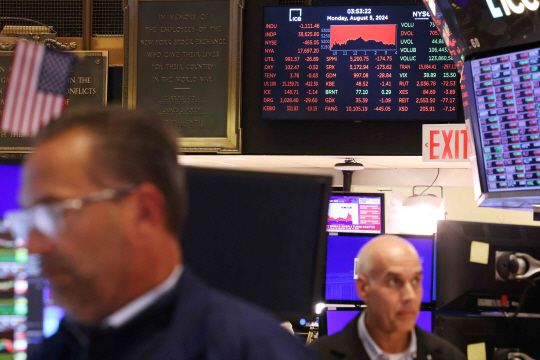
NEW YORK, November 16, 2026 — The stock market today recorded its third straight decline and its most consequential milestone in weeks: the Nasdaq Composite fell 2.49 percent to 24,509.76, a drop that leaves the index more than 10 percent below its October 6 high — the standard definition of a correction, as Reuters noted at the close. The S&P 500 lost 1.92 percent to 7,416.59 and the Dow Jones Industrial Average fell 739 points, as a deepening sell-off in artificial-intelligence and semiconductor stocks collided with a bond market still pricing Treasury yields above 5 percent and a Federal Reserve that traders now expect to raise interest rates in December. Chip stocks plunged 5.3 percent, Nvidia fell again on the eve of its earnings report, and by the closing bell the indexes had wiped out most of last week's gains — gains that had been their best weekly performance in three months.
Track it live: Follow live indexes, Treasury yields, oil, gold and bitcoin on the Signal Post News live markets tracker
The numbers at the close
Monday's scoreboard was red across every major benchmark, and the losses were the third in a row for the S&P 500, the Nasdaq and the small-company Russell 2000. The S&P 500 closed at 7,416.59, down 145.08 points, or 1.92 percent, after falling 0.4 percent on Friday to 7,561.67. The Dow Jones Industrial Average closed at 51,608.17, down 739.38 points, or 1.41 percent, giving back Friday's small gain, when it had risen 0.1 percent to 52,347.55. The Nasdaq Composite closed at 24,509.76, down 626.52 points, or 2.49 percent, extending Friday's 0.9 percent fall from 25,136.27. The Russell 2000 closed at 2,742.94, down 47.55 points, or 1.70 percent.
The market's fear gauge moved the way fear gauges do on days like this. The VIX jumped to about 23.1 from 19.30 on Friday — not panic territory, but a clear sign that investors were paying up for protection against further declines. Put together, the three straight losses erased most of the progress from last week, which had been the indexes' best weekly performance in three months. A market that spent last week recovering its footing spent Monday giving much of that recovery back, and the Nasdaq's slide past the 10 percent threshold turned a bad stretch into an officially labelled one.
Why markets fell
The selling had a centre of gravity, and it was the same trade that has powered — and lately punished — this market: artificial intelligence, and the semiconductor companies that supply it. Investors went into Monday braced for Nvidia's quarterly results, due after Tuesday's closing bell, and they spent the day reducing exposure to the sector rather than adding to it. The anxiety around this particular report runs deeper than the usual pre-earnings nerves. It is Nvidia's first report since chief executive Jensen Huang resigned last week, with chief financial officer Colette Kress serving as interim chief, so Tuesday's numbers will arrive alongside unavoidable questions about leadership and direction at the company that has become the public face of the AI build-out. Nvidia's stock fell 4.12 percent on Monday to $156.14, its lowest close since July 1, 2025, after plunging 13 percent last week.
Monday also needs to be read as the latest chapter of a volatile fortnight rather than an isolated event. The early-November rout, the chip-led rebound attempt that followed and the jobs-report session that reset expectations for the Fed were covered in our report on the stock market on November 6, when chips bounced back after the rout. Since then, the market's problem has compounded: each attempt to stabilise has run into the same combination of stretched valuations in the AI trade, inflation data that keeps coming in hot, and a central bank moving in the opposite direction from the one investors spent most of the year hoping for.
That word — correction — deserves a plain explanation, because it does a lot of work in headlines. A correction is simply a fall of 10 percent or more from a recent high. It is a description, not a diagnosis: it says nothing by itself about what happens next, and corrections are a normal, recurring feature of bull markets as well as a possible way-station on the road to something worse. What makes this one sensitive is the concentration behind it. When an index's level depends heavily on a small group of very large technology companies, a repricing of those companies moves the whole index — and, with it, the retirement accounts of millions of people who may never have chosen to own a single chip stock directly. Our earlier explainer on how the correction took hold is here: the Wall Street rout that pushed the Nasdaq into correction territory.
Layered over the stock-specific anxiety is the interest-rate backdrop. Last week's inflation data ran hot — producer prices rose 0.3 percent in October from the month before and 6.5 percent from a year earlier, a week after a hotter-than-expected consumer price report — and futures markets now broadly price a December rate hike as likely, with CME FedWatch putting the odds of a 25-basis-point increase at about 92 percent. Higher expected rates press on stock valuations mechanically: when safe government bonds pay more, investors demand a bigger discount for the risk of owning shares, and the most richly valued growth stocks feel that arithmetic first. Monday's economic data offered no relief: the New York Fed's Empire State manufacturing index fell to 7.8 in November from 25.5 in October, below expectations — a softer factory reading arriving at the same moment as firm inflation, which is an uncomfortable combination for policymakers and markets alike.
Chip stocks led the rout

Nowhere was the selling heavier than in semiconductors. The Philadelphia Semiconductor Index fell 5.28 percent, and the iShares Semiconductor ETF, known by its ticker SOXX, fell about 5 percent. Intel, Marvell Technology, Micron and Arm each fell more than 7 percent, with Micron down 7.62 percent. Advanced Micro Devices fell 6 percent and Broadcom fell 4 percent. The weakness spread well beyond chipmakers: Alphabet fell about 4 percent, while Amazon, Tesla and Meta each fell roughly 2 to 3 percent. Nvidia-backed Lumentum and SanDisk each plunged more than 8 percent to pace the S&P 500's decliners, Dell Technologies fell 7 percent, and bank stocks also fell — a sign that by the afternoon the selling had broadened from a sector story into a general reduction of risk.
Against that tide, the day's bright spots were telling. Only two S&P 500 sectors finished in the green: consumer staples and utilities, the classic defensive corners of the market, with utilities inching higher. Tyson Foods rose nearly 9 percent to lead the S&P 500's advancers after its quarterly results, and General Mills and Hormel Foods each gained about 3 percent. In other words, the money that stayed in the market on Monday hid in food, household essentials and regulated power companies — businesses whose earnings change slowly whatever the economy does — while it fled the companies whose valuations rest on rapid future growth. That rotation, from growth to defence, is the clearest single picture of the market's mood at the close.
Bonds barely blinked
If stocks screamed, bonds barely raised their voice. The yield on the 10-year Treasury note eased to 5.13 percent from Friday's close of 5.15 percent, as the stock sell-off drew some safety buying into government debt. The 30-year Treasury yield was about 5.46 percent, down slightly from Friday's 5.47 percent, and the 2-year yield was about 4.85 percent. But context matters more than the day's small dip: at 5.13 percent, the 10-year yield remains far above the 4.83 percent level of a week earlier, a jump driven by last week's hot inflation data. Bond investors are not pricing a passing squall; they are pricing a Federal Reserve whose target range already stands at 3.75 to 4.00 percent after its September move, and which the futures market believes will raise that range again on December 9.
There was no guidance from the top to soften that view. Fed Chair Kevin Warsh spoke on Monday about productivity and jobs and offered no hints on the rate path. Treasury Secretary Scott Bessent, for his part, publicly urged the Fed to “look forward, not in the rearview mirror” and to look past oil-driven inflation — a reminder that the politics of a possible hike, in an economy where households are already straining under borrowing costs, will be as charged as the economics.
Why should a household care more about 5.13 percent than about a 739-point Dow drop? Because the 10-year Treasury yield is the benchmark that steers the price of long-term borrowing across the economy. Mortgage rates are priced off it, along with much business and municipal borrowing. A one-day fall in share prices changes the number on a retirement statement; a 10-year yield that stays above 5 percent changes the monthly payment on the next home loan, the cost of financing a car dealer's inventory and the interest bill of every level of government — quietly, and for years. Monday's calm in the bond market was therefore not reassurance. It was confirmation that expensive money is staying.
Oil, gold, bitcoin and the dollar
Energy markets had their own decisive move. December West Texas Intermediate crude settled down 3.2 percent at $85.72 a barrel after the International Energy Agency reversed its earlier deficit forecast, now projecting fourth-quarter global supply of about 105 million barrels a day — roughly 1.7 million barrels a day above demand — as Middle East exports recover. Brent crude fell about 3.7 percent to $92.30 a barrel, from Friday's settle of $95.84. A supply surplus of that size, if it holds, points to continued downward pressure on fuel costs; you can follow the outlook on our oil price forecast tracker.
Precious metals, usually a refuge on days like this, offered only partial shelter. December gold futures settled down 0.8 percent at $3,847.40 an ounce, and spot gold touched $3,830 during the session — its lowest level since October 2025 — while silver fell about 3 percent to around $47. When both stocks and gold fall together, it often means investors are raising cash rather than rotating between havens. Cryptocurrency told a similar story of risk coming off: bitcoin traded around $65,000, down from Friday highs above $70,000 and near its lowest since mid-August, after a sixth straight weekly loss and a drop below $62,000 on Saturday. Ether was around $1,819, and crypto-linked stocks were pressured. The U.S. Dollar Index, by contrast, held above 103.5, roughly steady — the one major gauge that treated Monday as just another day.
What this means for regular people
Most people experience a day like Monday in one place first: a retirement account. The arithmetic is worth doing slowly, because percentages hide it. A fall of 1.92 percent in the S&P 500 trims about $1,920 from a $100,000 balance invested in a fund that tracks that index — real money, and an unpleasant number to meet over coffee, but also the kind of move that broad index funds absorb regularly over long holding periods. That is an illustration of scale, not a prediction and not advice: what any individual should do depends on their own circumstances, horizon and holdings, and this article offers general education only. The broader point stands on the market's own history: corrections of 10 percent or more are a normal feature of investing in stocks, not an exception to it, and the Nasdaq's arrival at that line on Monday is a label for a fall that has already happened — not a signal, in either direction, about the next one.
For anyone connected to the housing market, Monday's most important number was not in the stock tables at all. Freddie Mac's average 30-year fixed mortgage rate was 7.11 percent in its November 12 survey, and the benchmark that steers that rate — the 10-year Treasury yield — ended Monday at 5.13 percent, barely down on the day and far above where it stood a week ago. As long as yields stay in that neighbourhood and the Fed stays tight, meaningful mortgage relief is hard to construct: the cost of buying a home is set in the bond market, and the bond market spent Monday standing still. Savers see the mirror image of the same fact. With the Fed's target range at 3.75 to 4.00 percent and a further hike priced as likely, cash and money-market yields remain attractive by the standards of the past two decades — the one group for whom expensive money is income rather than cost.
And there is one channel through which Monday may yet reach household budgets kindly. Cheaper crude works its way, with a lag, into fuel prices, and there was an early marker of that on Monday: the national average price of diesel in the United States fell below $6 a gallon for the first time since Labor Day, according to AAA reporting. Diesel is the fuel of freight, farming and delivery, so its price is woven into the cost of goods far beyond the pump. If the IEA's surplus forecast proves right and crude stays lower, that relief broadens slowly — the gentlest possible silver lining to a rough day, and a slow one.
What to watch next
The calendar now takes over. Tuesday, November 17, brings October retail sales at 8:30 a.m. Eastern — the first broad reading on consumer spending since the sell-off deepened — and then, after the closing bell, the week's main event: Nvidia's earnings, the first under interim chief Colette Kress, which will test whether the AI trade's leader can steady the sector that dragged the market down. Wednesday brings the minutes of the Federal Reserve's October meeting, which traders will parse for any sign of how the December 9 decision is shaping up, along with the expected pricing of Anthropic's initial public offering — the maker of Claude is expected to be valued above $1 trillion, with trading set to start Thursday on the Nasdaq, in what would be a landmark test of investor appetite for AI at exactly the moment that appetite is being questioned.
Over everything hangs December 9. A market pricing roughly a 92 percent chance of a rate hike is a market that has made up its mind about the Fed — which means the greater risk, in either direction, is surprise. Monday's message was simpler, and it is the one to carry into the week: the correction is here, the chip trade is on trial, and the cost of money, not the level of any single stock, is the number that will decide how this feels by Christmas.
Sources: Monday closing prices and index levels as published November 16, 2026; Reuters on the Nasdaq's fall into correction; CME FedWatch December rate probabilities; Freddie Mac Primary Mortgage Market Survey, November 12, 2026; International Energy Agency supply outlook; AAA fuel-price reporting. This article is reporting and general education, not investment advice.