Economy · Markets · Wall Street
A day after the worst rout in eighteen months, the stock market today steadied on a powerful chip-stock rebound and a jobs report that came in more than twice as strong as expected — but the Dow fell, bond yields rose, and the week's losses stayed firmly in place.
NEW YORK, November 6, 2026 — The stock market today did something it had not managed all week: it took a breath. After Thursday's rout — the worst single day on Wall Street since April 2025, which erased roughly $3 trillion in market value and pushed the Nasdaq Composite into a correction — Friday brought a partial, uneven recovery. The Nasdaq rose 1.09 percent to 24,579.42, led by the same chip stocks that had been at the centre of the selloff. The S&P 500 added 0.32 percent to 7,376.92. But the Dow Jones Industrial Average fell 0.46 percent to 51,286.21, bond yields climbed, and nobody on the trading floors was calling the all-clear: the Nasdaq remains more than 10 percent below its October peak, which is the textbook definition of a correction, and all three major indexes finished the week deep in the red.
Track it live: Live Global Trackers — Markets
The day in numbers
Friday's scoreboard told a story of rotation as much as recovery. The small-company Russell 2000 rose 1.03 percent to 2,757.92, outpacing the big indexes — a sign that some buyers were hunting for bargains beyond the mega-cap names that dominate the headlines. The VIX, Wall Street's fear gauge, fell 12.2 percent to 24.73 from Thursday's 28.18, still elevated but moving in the direction of calm. In the bond market, the yield on the 10-year Treasury note rose 2 basis points to 4.86 percent, and the 30-year yield held near 5.27 percent — levels that matter far beyond Wall Street, because they anchor mortgage rates and business borrowing costs across the country. Oil barely moved: West Texas Intermediate crude settled at $90.68 a barrel, up 0.18 percent, while Brent crude eased 0.5 percent to $97.76. Gold slipped 1.0 percent to $4,074 an ounce, and bitcoin was little changed at $75,781. The dollar index rose about 0.6 percent to roughly 102.2.
Why the chips bounced
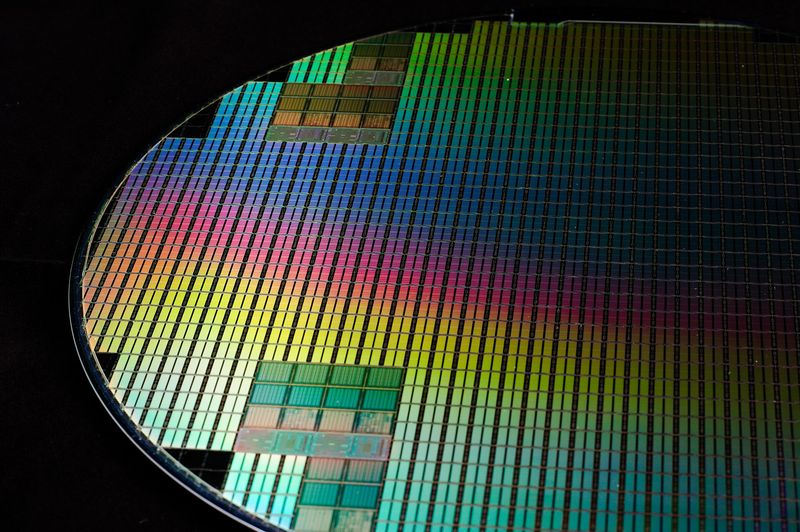
The rebound had a clear engine: semiconductors. The chip sector had been at the epicentre of Thursday's collapse, when the Philadelphia semiconductor index crashed more than 12 percent on fears that a Democratic sweep of Congress would bring tougher regulation of the artificial-intelligence data-center build-out — the spending boom that has powered the market for two years. On Friday, buyers decided the punishment had gone far enough, at least for the companies whose earnings are still accelerating. Advanced Micro Devices jumped about 11 percent to roughly $449, clawing back a large share of Thursday's 17 percent plunge; AMD's third-quarter results, reported Tuesday, showed revenue up 45 percent to $13.38 billion with data-center revenue nearly doubling to about $8.5 billion, and its fourth-quarter guidance of roughly $17 billion gave bargain-hunters a fundamental story to buy, not just a dip. Nvidia, the largest company in the index, rose 3.6 percent to $188.15. Intel gained 7.7 percent to $56.28, and Lam Research surged 12.7 percent intraday. IonQ jumped about 17 percent after raising its full-year revenue guidance to $505–515 million, well above the $456.2 million analysts expected. Technology was the day's best sector, up 1.7 percent, followed by communication services at 1.2 percent and consumer discretionary at 0.9 percent. Thursday's rout, and the correction it confirmed, is covered in full in our earlier report: Nasdaq correction: Wall Street's worst day in 18 months.
The jobs report that rewrote the Fed math
If chips supplied the fuel, the morning's jobs report supplied the plot twist. The Bureau of Labor Statistics reported that U.S. employers added 165,000 jobs in October — more than two and a half times the roughly 65,000 economists surveyed by Reuters had expected. The unemployment rate fell to 4.1 percent from 4.2 percent. The strength was not a one-month mirage: the prior two months were revised up by a combined 84,000 jobs, with September's gain revised to 60,000 from 29,000. Wages rose 0.4 percent on the month and 3.1 percent on the year, taking average hourly earnings to $38.00, while the labour-force participation rate held at 61.9 percent.
For workers, that is unambiguously good news: the hiring engine that many feared was stalling after the midterm shock is still running, and pay is still rising faster than it did for most of the pre-pandemic decade. For investors hoping the Federal Reserve would ride to the rescue with rate cuts, it was the opposite. The Fed held its benchmark rate at 3.75 to 4.00 percent on October 28, by a 10–2 vote. A labour market this firm, with wages growing at 3.1 percent, gives the central bank little reason to ease — and traders moved quickly to price the alternative: the odds of a rate HIKE at the December 8–9 meeting, as tracked by CME FedWatch, jumped to roughly 77 percent from about 70 percent before the report. That shift explains Friday's split personality. Growth stocks with real earnings could rally on the strong economy; the Dow, heavy with rate-sensitive industrials and consumer names, sagged under the weight of higher yields.
Winners, losers, and what separated them
Friday's biggest winners shared a trait: fresh numbers that beat expectations. JFrog, the software supply-chain company, soared 35.3 percent to $100.98 after third-quarter revenue rose 31 percent to $179.2 million, adjusted earnings of $0.32 a share beat the $0.23 consensus, cloud revenue jumped 60 percent to $101.5 million, and the company raised its full-year guidance. Airbnb climbed 12.0 percent to $190.60 on a quarter that beat expectations, with revenue up 19 percent to $4.87 billion and an outlook raised. NRG Energy added 11.5 percent to $89.85, and Tesla rose about 5 percent. The losers were punished for the mirror-image sin. Axon Enterprise plunged 18 percent to $313.69 after missing earnings expectations. Microchip Technology fell 9.3 percent and Insulet 7.3 percent. In the Dow, Salesforce dropped 3.6 percent to $214.36, Nike fell 2.5 percent and Home Depot lost 2.0 percent — a pattern consistent with investors trimming rate-sensitive and consumer-facing names as yields rose. The lesson of the day, traders said, was that in a market this nervous, earnings are the only armour: companies that delivered numbers were rewarded extravagantly, and companies that missed were shown no mercy.
What this means for your 401(k)
Most Americans meet the stock market through a retirement account, so it is worth translating Friday's percentages into kitchen-table terms. A 0.32 percent rise in the S&P 500 adds roughly $320 to a $100,000 balance invested entirely in an S&P 500 index fund; Thursday's 4.36 percent fall took away roughly $4,360 on the same balance. Both moves happened within 48 hours, which is precisely why financial advisers across the political spectrum give the same boring advice after weeks like this one: the money in a 401(k) is usually invested for a retirement that is years or decades away, and the week's damage — the S&P 500 fell 2.7 percent, the Nasdaq 3.4 percent and the Dow 0.9 percent, the market's worst week since June — is the kind of drawdown that long-term savers have historically been paid to sit through. What Friday did change is the near-term risk picture. A correction in the Nasdaq means the index's most popular funds are still down more than a tenth from their highs; a possible December rate hike means bond funds and cash-like holdings will keep behaving very differently from the cut-hopes trade many savers had positioned for earlier this autumn. None of that is a reason, by itself, to buy or sell anything — and this article is not financial advice — but it is a reason to know what you own before the next headline lands.

Mortgages, savers, and the 4.86 percent problem
The number from Friday that will reach furthest into household budgets is not in the stock tables at all: it is the 10-year Treasury yield at 4.86 percent, with the 30-year near 5.27 percent. Mortgage rates in the United States are priced off those yields, so a bond market that is bracing for a December rate hike is a bond market that keeps home loans expensive — a direct headwind for buyers waiting for relief and for the housing market that Friday's Home Depot decline quietly reflected. The flip side belongs to savers: with the Fed's benchmark at 3.75 to 4.00 percent and a hike now the market's base case, money-market funds and high-yield savings accounts are likely to keep paying the kind of interest that was unthinkable five years ago. And energy remains the week's sorest spot: the energy sector was the worst performer of the week, down roughly 11 percent, even as crude prices themselves held near $91 — a reminder that war-driven oil prices and oil-company share prices do not always move together. Gold's slip to $4,074 and bitcoin's flat finish near $75,781 completed the picture of a market that hedged less on Friday than it had on Thursday, but did not stop hedging.
The week in context
Step back, and Friday looks less like a recovery than a pause inside a repricing. The week's story began with Tuesday's midterm elections — the market's Tuesday session, when the Nasdaq first rebounded on chip strength, is covered here: stock market today, November 3 — and turned on Thursday, when the confirmed Democratic sweep of Congress collided with the most crowded trade in the market: the AI data-centre boom. Analysts at Jefferies described Thursday's plunge as "reactionary, not a fundamental reset," and Friday's selective, earnings-driven rebound lent that view some support — investors did not buy everything, they bought proof. But the correction has not been repaired by one good day. The Nasdaq would need to climb roughly another 11 percent from Friday's close just to return to its October peak, and it must now do so against a Federal Reserve that the market believes is more likely to raise rates than to cut them.
What to watch next
Three dates now dominate the calendar. First, Tuesday, November 10, brings the October consumer price index: if inflation confirms the jobs report's message of an economy running warm, the December hike case strengthens and yields could push higher still; a soft print would reopen the door to the rally broadening beyond chips. Second, the November payrolls report on December 4 will test whether October's 165,000 was a trend or a blip. Third, the Federal Reserve meets December 8–9 with the market pricing roughly a 77 percent chance of a hike — an extraordinary position for a central bank that was expected, only weeks ago, to be easing. Between now and then, expect the market to keep doing what it did on Friday: rewarding companies that can prove their earnings, punishing those that cannot, and treating every economic release as a referendum on the Fed. For a market that spent two years climbing on the promise of artificial intelligence, the question has changed. It is no longer whether the technology works. It is what the boom is worth in a world of 4.86 percent money — and Friday's answer was: quite a lot, if you pick the companies that are already cashing it in, and much less if you do not.
Sources: Friday closing prices and index levels as published November 6, 2026; Bureau of Labor Statistics October employment report via Reuters, USA Today and EY-Parthenon analysis; CME FedWatch December rate probabilities; company earnings reports (JFrog, Airbnb, AMD, Axon Enterprise, IonQ) and CNBC sector data. This article is reporting and analysis, not investment advice.