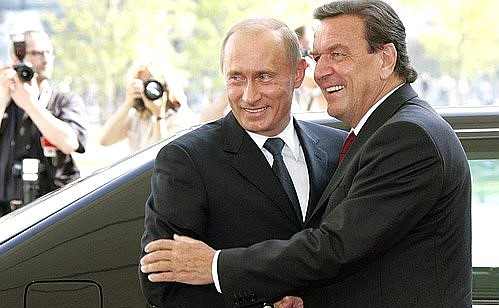
Schroeder Putin birthday outrage spread through Berlin on Friday after Chancellor Friedrich Merz's government condemned former Chancellor Gerhard Schröder for celebrating Vladimir Putin's 74th birthday at the Russian president's home. A government spokesperson said Merz was “deeply outraged” and called attendance at such a celebration “downright immoral,” linking that judgment directly to the suffering caused by Russia's war in Ukraine.
The Kremlin announced the visit on Telegram on Thursday, one day after Putin turned 74. It said Putin learned from morning news reports that Schröder was in Moscow on business connected to the Globus company and invited “his old friend” home. Photographs released by the Kremlin showed both men smiling and shaking hands in a room with an old-style stove and a Russian samovar.
The scene looked informal. The political meaning was not. In Germany, the meeting condensed two decades of controversy into a single image: a former head of government whose post-office career became inseparable from Russian energy companies, again standing beside Putin while the Ukraine war continues.
Gerhard Schroeder Moscow visit began as business travel
Schröder, 82, served as German chancellor from 1998 to 2005. His latest trip was connected to his recent appointment to the supervisory board of Hyperglobus, a Russian company spun off from Germany's Globus Holding. Russian television showed him visiting a Moscow store on Wednesday, where employees greeted him with applause.
According to the Kremlin account, that commercial visit created the opportunity for the birthday meeting. The distinction matters because it allows each side to describe the encounter differently. Moscow can present it as spontaneous hospitality between old friends. Schröder can say he traveled for corporate work rather than political negotiation. German officials, however, judge the symbolism by where he went and whom he honored, not by the purpose printed on his itinerary.
Friedrich Merz outraged: Berlin's clearest rebuke
Merz's spokesperson said Putin alone bears responsibility for the war and that his orders have caused “immeasurable suffering,” including civilian casualties, deaths, injuries and families torn apart. The language was unusually direct for a response to a private citizen's travel, but Schröder is not treated as an ordinary private citizen: former chancellors retain symbolic standing even when they hold no office.
The criticism also came from inside Schröder's Social Democratic Party. SPD co-leader Lars Klingbeil, who serves as finance minister in Merz's conservative-led coalition, called the visit “completely unacceptable” in light of the suffering of Ukrainians, according to the Süddeutsche Zeitung. That cross-party response narrows Schröder's room to claim he is merely facing attacks from political opponents.
Schroeder Russia ties run through Nord Stream and Rosneft
The backlash cannot be understood without Schröder's post-chancellorship. Shortly after leaving office, he became chairman of the shareholders' committee of Nord Stream, the Gazprom-led Baltic Sea pipeline project he had championed as chancellor. He later held senior positions at Russian oil producer Rosneft. Those roles made him the most prominent German example of the close political-business relationship with Moscow that shaped Europe's energy strategy before the full-scale invasion of Ukraine in 2022.
Supporters of that earlier strategy argued that trade and infrastructure could bind Russia to Europe, provide Germany with reliable energy and preserve dialogue during political crises. Critics argued that it increased dependence, gave Moscow leverage and blurred the line between public policy and private reward. The war transformed that debate from a strategic disagreement into a judgment about failed assumptions.
Schröder's Russian business ties persisted after the invasion and after Western governments imposed sweeping sanctions on Moscow. That continuity explains why one birthday visit can provoke such a forceful response: it is interpreted not as an isolated personal choice but as evidence that the break with Russia never happened for him.
Why this matters: Germany is policing the boundary of engagement
The dispute is about more than one former leader's social calendar. European governments still need ways to communicate with Moscow about prisoners, nuclear risk, energy infrastructure and any eventual settlement. The harder question is who has legitimacy to carry those messages.
Earlier this year, Putin said Schröder would be his preferred interlocutor for talks on new European security arrangements. The European Union and Merz's government rejected the idea immediately. Friday's condemnation reinforces that position: personal access to Putin does not automatically translate into an acceptable diplomatic mandate.
That distinction protects elected governments' control over foreign policy. It also carries a cost. If official channels narrow and informal intermediaries are disqualified, fewer people may be able to test ideas privately. The German response suggests Berlin believes the reputational and strategic risks of using Schröder now outweigh any access he might offer.
Who benefits — and who loses
Putin benefits from the imagery. A smiling former German chancellor at his home helps the Kremlin argue that Russia is not fully isolated and that relationships with important European figures endure beneath official hostility.
Schröder preserves access but loses standing at home. The visit demonstrates that he can reach Putin personally, a rare connection in today's Europe. Yet every display of that access deepens doubts in Germany about whether he can act as a neutral intermediary rather than a loyal friend of the Russian president.
Merz and Klingbeil gain a clear line of separation. Their condemnation lets Germany's governing coalition show unity on Ukraine and distance itself from the pre-2022 model of engagement with Moscow. Klingbeil's criticism is particularly important because it comes from Schröder's own party.
Ukraine loses from normalization imagery. Kyiv and its supporters have worked to keep attention on the human cost of the war and to deny Moscow the appearance of business as usual. A celebratory meeting with a former European leader cuts against that message, even if it changes no policy.
German business faces another reputational test. The Hyperglobus connection shows that commercial links continue to create political exposure. Companies operating in Russia may treat appointments and store visits as routine business; governments and voters increasingly read them through the lens of war and sanctions.
What the numbers and history imply
74. Putin's age after his birthday on Wednesday, October 7. The private celebration came at a moment when his rule and the war remain central to Europe's security order.
82. Schröder's age. Nearly 21 years after leaving office, his actions still generate government-level responses because the authority attached to a former chancellor does not disappear with formal power.
1998–2005. Schröder's years as chancellor. His government sat at the hinge between post-Cold War optimism and the energy dependence that later became a strategic vulnerability.
2022. The year Russia's full-scale invasion of Ukraine changed the political meaning of German-Russian commercial ties. Relationships once defended as pragmatic engagement became liabilities that demanded public explanation.
Two governing parties, one rebuke. Merz leads the conservative side of the coalition; Klingbeil co-leads the SPD. Their aligned criticism shows the controversy is not simply a left-right fight. It is a dispute between today's governing consensus and one former chancellor's continued personal course.
SPD reaction to Schroeder raises the party question again
The SPD has spent years trying to separate its current policy from Schröder's choices without erasing a former leader from its history. Klingbeil's response suggests the party sees no ambiguity in this case. Yet the recurring controversy shows why the problem is hard to close: Schröder's biography is woven into the SPD's years in power, Germany's energy model and the architecture of Nord Stream.
Each new Moscow appearance therefore reopens old arguments about accountability. Was the earlier policy a reasonable bet that later failed, a warning ignored, or a commercial project allowed to shape national strategy? The birthday visit does not answer those questions, but it keeps Schröder at their center.
What happens next
Watch for a response from Schröder. He and his wife, So-Yeon Schröder-Kim, did not immediately respond to requests for comment. Any explanation will be judged on whether he describes the meeting as personal, commercial or political.
Watch the Hyperglobus role. The supervisory-board appointment gives Schröder an ongoing institutional reason to travel to Russia. Future visits will test whether the latest backlash changes his public profile or schedule.
Watch Berlin's rule for unofficial diplomacy. If pressure grows for renewed European security talks, governments will need to identify acceptable intermediaries. Merz's reaction makes clear that access alone will not qualify Schröder.
Watch Moscow's use of the images. The Kremlin can continue presenting the meeting as proof of enduring European friendships. The more prominently it circulates the photographs, the harder it becomes for Schröder to frame the visit as private and apolitical.
The core tension will remain. Schröder's friendship may give him a door into Putin's home; Germany's current leaders believe walking through it for a birthday celebration undermines, rather than strengthens, Europe's position. That gap between access and legitimacy is the real story behind the outrage.