War / Middle East
Saudi Arabia said its air defences destroyed Houthi missiles over Riyadh on Sunday — and that the only damage in the capital came from what fell out of the sky afterwards: debris that blew out windows across several floors of the Aramco Tower in the King Abdullah Financial District. No one was killed or injured. Almost everything else about the morning is contested, except the broken glass.
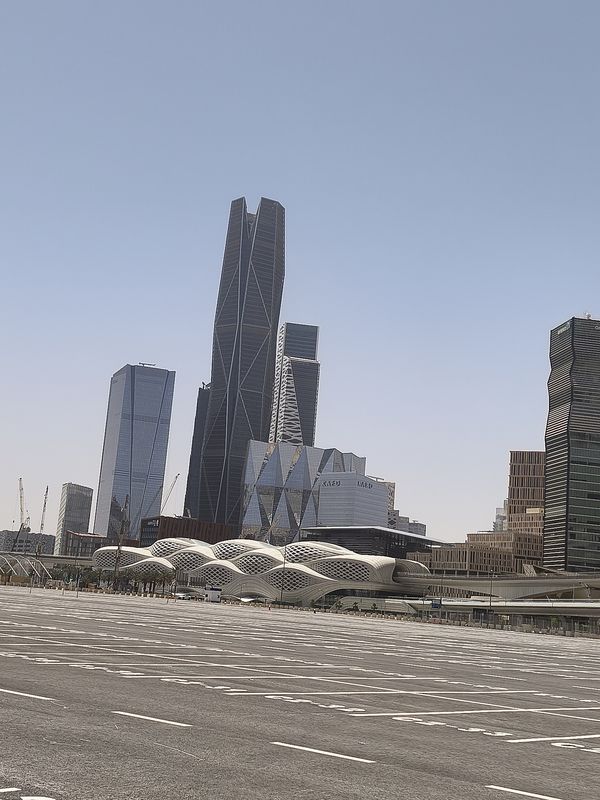
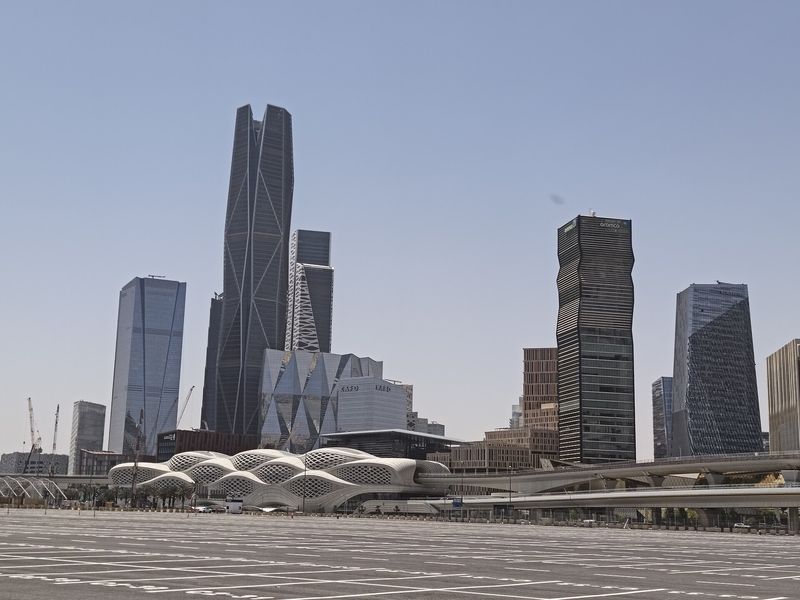
RIYADH, November 8, 2026 — Saudi Arabia’s Energy Ministry said an administrative building belonging to state oil giant Saudi Aramco in Riyadh was damaged by falling debris following an attempted attack on Sunday, as the Saudi-led coalition said its air defences had intercepted and destroyed ballistic and cruise missiles fired by Yemen’s Iran-aligned Houthis toward the capital and other parts of the kingdom. The ministry said there were no injuries or fatalities, and described the damage as limited. A Reuters witness saw blown-out windows across several floors of the Aramco Tower in the King Abdullah Financial District (KAFD), one of the tallest buildings in the capital’s financial district — visible, physical evidence that even a successful interception over a modern financial capital is not a clean event.
The morning’s first public signal was a warning rather than an explosion. Saudi Civil Defense issued an alert in the Riyadh region shortly before loud booms were heard, and authorities later said the danger had passed. That sequence — alert, booms, all-clear — has become the rhythm of the renewed Saudi-Houthi missile war, and Sunday’s iteration reached the capital’s financial core: not because of what the missiles hit, but because of where their wreckage came down.
Track it live: Live wars tracker · Middle East tracker
The interception sequence, as the coalition tells it
The Saudi-led coalition’s account, reported by Reuters, describes two distinct waves. Air defences first intercepted and destroyed two ballistic missiles fired by the Houthis towards Riyadh. Later, the coalition said, air defences intercepted and destroyed two cruise missiles in Riyadh and in the kingdom’s southern region. The Associated Press’s roundup of the day also noted a coalition interception of a ballistic missile targeting the southern region, and warnings issued for the Eastern Province that were subsequently lifted. On the ground, the ministry attributed the tower damage to falling debris, and the Reuters witness’s observation — windows blown out across several floors of the Aramco Tower — is consistent with debris striking a glass facade, the detail that separates Sunday from the many interception announcements that leave no mark at all.
Those numbers — two ballistic missiles towards the capital, two cruise missiles in Riyadh and the south — are the sequence this article uses, because they are the sequence Reuters reported from the coalition on Sunday. They should be read for what they are: the coalition’s account of its own interceptions, published by the side that fired the interceptors. AP and Reuters both reported the official interception accounts and the visible tower damage; neither independently established the full flight paths or the precise interception sequence, and no independent radar track or wreckage survey had been published by Sunday. That is the ordinary condition of missile warfare: the first draft of events is written by the combatants, and corrected, if at all, over days.
The Houthi claim, and the Sanaa context
The Houthis told the morning differently. AP reported on Sunday that Houthi military spokesman Brig. Gen. Yahya Saree claimed in a statement that Houthi forces hit Riyadh’s financial district. Houthi and Tasnim reporting went further, claiming six missile and drone operations against Saudi targets, presented as retaliation for reported strikes near Sanaa on Saturday. Those are claims, and this article presents them strictly as claims. The observable evidence on Sunday — blown-out windows seen by a Reuters witness, a ministry statement reporting limited damage and no casualties — sits between the two narratives and confirms neither side’s strongest version: a Houthi “hit” and Saudi “debris” can produce identical broken glass — a distinction no independently published evidence yet settles.
The retaliation framing has its own attributed context. The incident followed reported strikes near Sanaa on Saturday for which Houthi-run authorities put the toll at 33 killed and 39 wounded. Reuters reported that figure; it was not independently verified, and it is carried here in that form only. But even as an unverified figure it explains the cycle’s mechanics: a strike near the Houthi capital on Saturday, an announced retaliation against the Saudi capital on Sunday, and the standing possibility of a further Saudi response. Each side prices its next move off the other side’s last one.
What is confirmed, and what is not
Confirmed. Saudi Arabia’s Energy Ministry said an administrative building belonging to Saudi Aramco in Riyadh was damaged by falling debris following an attempted attack on Sunday, with no injuries or fatalities and limited damage. A Reuters witness saw blown-out windows across several floors of the Aramco Tower in the King Abdullah Financial District. Saudi Civil Defense issued an alert in the Riyadh region shortly before loud booms were heard, and authorities later said the danger had passed. The Saudi-led coalition said air defences intercepted and destroyed two ballistic missiles fired towards Riyadh and, later, two cruise missiles in Riyadh and the southern region; AP’s roundup also noted a coalition interception of a ballistic missile targeting the southern region and Eastern Province warnings that were issued and then lifted.
Not confirmed. The full flight paths of the missiles and the exact interception sequence were not independently established by AP or Reuters. The damage was attributed by Saudi officials to falling interception debris — the tower was not reported to have taken a direct hit, and readers should not treat Saree’s claim of a hit on the financial district, or the Houthi and Tasnim claim of six missile and drone operations, as established fact; both remain attributed claims. The Saturday toll near Sanaa — 33 killed and 39 wounded — is the figure of the Houthi-run authorities as reported by Reuters, not an independently verified count. And one precision point matters more than any other in this story: the damaged building is an administrative office tower. It is not oil production infrastructure, and no oil supply disruption was reported on Sunday.
Why this matters
A successful interception that still breaks windows
Both halves of the headline are true at once. On the coalition’s account, the shield worked: ballistic and cruise missiles aimed at the capital were intercepted and destroyed, and nobody died. And the financial district still took damage — because an interception is not an erasure. A ballistic missile destroyed at altitude becomes a falling field of metal and interceptor fragments, and over a district of glass towers that field lands somewhere. The Aramco Tower’s windows are the physical receipt for a truth air-defence planners have long stated and financial capitals have rarely had to price: defending a capital converts a warhead’s concentrated damage into a scattered, survivable, but real debris risk spread across whatever lies beneath the intercept point.
An office tower is not an oil field
The second distinction is the one the headline itself invites readers to get wrong. “Aramco” is the most market-sensitive word in the Gulf, and “Aramco Tower damaged” reads, at a glance, like an energy story. It is not one — not yet. The building damaged on Sunday is an administrative tower in a financial district: desks, not distillation columns. No production facility was reported hit, no export terminal closed, and no oil supply disruption was reported. Sunday’s event belongs under the physical security of a financial capital and the economics of missile defence, not under oil supply. Should a future missile — or its debris — reach actual energy infrastructure, that would be a different story, and it has not happened here.
Why the financial district is the message
What the location does carry is signalling weight. The King Abdullah Financial District is the built form of Saudi Arabia’s post-oil pitch: the cluster of towers meant to persuade global banks, funds and firms that Riyadh is a safe, permanent place to put capital and people. An attack whose debris breaks windows in that district is aimed at that pitch. The Houthis do not need to close a single oil facility to raise the perceived risk of doing business in the Saudi capital; they need photographs of a damaged tower in the financial district and an alert on every phone in Riyadh. On Sunday, they got a version of that picture. Riyadh’s counter-claim — every missile intercepted, no casualties, limited damage — is aimed at the same audience. The evidence supports each side’s narrow facts and neither side’s whole story.
Background: a decade of missiles, and the district they fell on
Saudi Arabia has led a military coalition supporting Yemen’s internationally recognised government against the Houthis since March 2015, and cross-border missile fire has been the war’s longest arm ever since. Houthi ballistic missiles first reached the Riyadh region years into the war, and what followed brought missiles and drones against airports and cities, and the 2019 attacks on the Abqaiq and Khurais oil facilities — claimed by the Houthis, attributed by Riyadh and Washington to Iran, and denied by Tehran. A truce later cut cross-border fire sharply and held, imperfectly, for years. Its breakdown has returned the kingdom to something like the old tempo: this autumn alone has brought waves of interceptions toward the eastern and southern regions — covered in our reporting on how the coalition intercepted Houthi missiles and drones toward the eastern and southern regions — and a ballistic missile destroyed on its way toward the Eastern Province, covered in our report on how Saudi air defences destroyed a Houthi ballistic missile fired toward the Eastern Province. Sunday’s salvo is distinguished by its debris landing in the one district Riyadh most wants the world to see as safe.
The King Abdullah Financial District, in northern Riyadh, is a flagship of Vision 2030, the kingdom’s economic transformation programme: a purpose-built financial hub home to more than 140 tenants spanning banks, funds, professional firms and regulators, and to offices of Saudi Aramco itself. Its tenancy is its meaning. Every global firm that signs a KAFD lease is a small vote that Riyadh’s future is investable; every alert that empties its towers on a Sunday morning is a small vote the other way. The Aramco Tower — among the tallest buildings in the district — sits inside that symbolism as well as inside the debris field. The damage was limited, the ministry said, and confined to an office facade — but its audience was every board that has ever weighed a Riyadh headquarters against a Dubai one.
Who benefits, who loses, and what critics say
The Houthis gain the cheapest strategic commodity in this war: demonstrated reach. A movement under renewed pressure in Yemen showed that it can still put missiles over the Saudi capital and damage a signature tower in its financial district — and it framed the salvo as retaliation for Saturday’s strikes near Sanaa, casting itself as answering rather than initiating. Saudi Arabia gains the interception narrative: on the coalition’s account, four missiles across two waves were destroyed and the human toll was zero. But Riyadh also loses something it spends heavily to protect — the atmosphere of untroubled normalcy around its financial project, against which alerts, booms and broken tower glass now arrive on a near-weekly rhythm.
Critics of the coalition make three arguments that Sunday’s facts do not answer. The first is architectural: interception cannot abolish debris, so a defence centred on the capital accepts recurring damage to the capital — the shield leaks by design. The second is cyclical: strikes near Sanaa and salvos at Riyadh now answer each other within a day, and a retaliation rhythm generates its own momentum. The third is distributional: the costs fall on people with no seat in it — Yemenis under Saturday’s strikes, Riyadh residents under Sunday’s alerts — while the gains are claimed by the armed parties. Supporters of the coalition reply, with Sunday as their exhibit, that the alternative to interception is not peace but undefended impacts, and that a defence which holds casualties at zero is performing the only task it was bought for. Both readings fit Sunday’s verified facts; they differ over what the facts oblige anyone to do next.
The numbers underneath: interceptor economics and the debris footprint
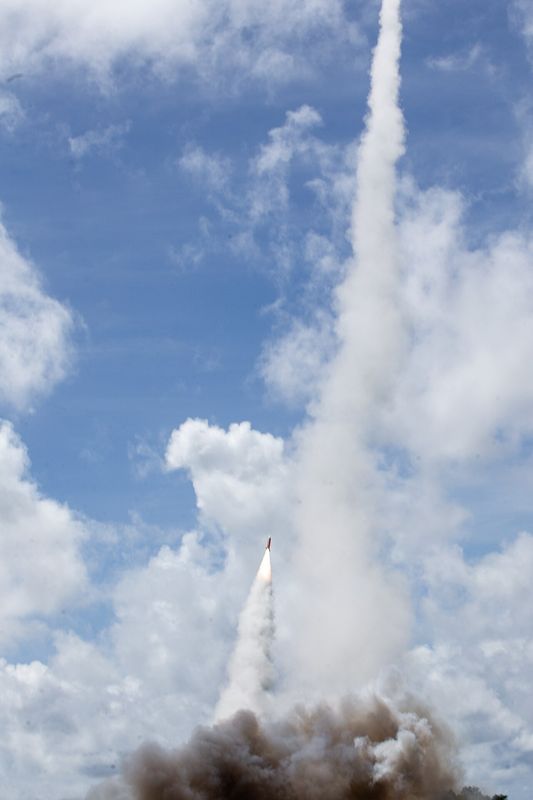
Every interception is also a transaction, and Sunday’s ledger is the war’s standing asymmetry in miniature. The interceptors used against ballistic missiles — Patriot PAC-3-class rounds are the type most associated with the defence of Riyadh — are precision munitions that analysts commonly estimate at several million dollars apiece, and doctrine often fires more than one at a single target. The missiles they destroy are, round for round, far cheaper to build. The attacker therefore chooses the tempo and pays the smaller bill; the defender cannot decline the larger one, because the cost of a single leaked warhead over a capital is measured in lives and in exactly the investor confidence KAFD exists to attract. Stockpiles deepen the problem: high-end interceptors are produced slowly, shared among allies, and drawn down by every defended Sunday.
An interception at altitude does not vaporise a missile; it converts one falling object into many, scattered across an ellipse of ground that can stretch for kilometres. Over desert, that ellipse is a statistic. Over a dense financial district of glass facades and crowded streets, it is a near-guarantee that something will be struck — and the ministry’s Sunday account, debris damaging one tower with no casualties, is close to the best realistic outcome the physics allows. This is why the Civil Defense alert matters as much as the interceptor: the minutes of warning that move people away from windows convert a debris field from a casualty event into a property event. On Sunday, that system performed as designed — with the corollary that “as designed” now includes broken windows in the financial district as a recurring line item.
What happens next
The first question is retaliation, and its clock is short. The coalition’s pattern in this war is to answer attacks on the kingdom with strikes on Houthi launch and storage infrastructure in Yemen. Whether Riyadh responds, and at what scale, will set the tempo for the coming days — and each response re-arms the Houthi justification for the next salvo. The second question is aim: the margin between a debris story and a supply story is where a future missile is pointed and where its wreckage falls. The third is the wider Gulf, where the missile war runs in parallel with the confrontation at sea — U.S. forces enforcing the Iran blockade have disabled vessels including the cargo ship Huda in the Gulf of Oman, covered in our reporting on how U.S. aircraft disabled the cargo ship Huda as the Iran blockade tightened — and escalation on either track raises the temperature of the other.
Oil markets will render their own verdict on Monday’s open, and the scenarios are worth stating without inventing a single price. If Sunday remains what officials say it was — interceptions, debris, an office facade, no supply impact — the market read is likely to be a risk headline rather than a supply event. The scenarios that would move markets structurally are the ones that did not occur: a direct hit on energy infrastructure, damage to an export facility, or a sustained campaign that forces insurers and shippers to reprice the kingdom’s geography. Between those poles sits the slower effect Sunday actually feeds — a cumulative risk premium on the Saudi financial project itself. For now, the confirmed record of November 8 stands where the ministry left it: missiles fired at the capital, missiles destroyed above it, one administrative tower’s windows broken by what fell, no one hurt — and two armed narratives, Riyadh’s and the Houthis’, already flying toward each other over what it means.
Sources: Reuters, November 8, 2026, Riyadh — reporting of the Saudi Energy Ministry statement that an administrative building belonging to Saudi Aramco was damaged by falling debris following an attempted attack, with no injuries or fatalities and limited damage; a Reuters witness’s observation of blown-out windows across several floors of the Aramco Tower in the King Abdullah Financial District; the Saudi Civil Defense alert in the Riyadh region and the later statement that the danger had passed; the Saudi-led coalition’s account of air defences intercepting and destroying two ballistic missiles fired towards Riyadh and, later, two cruise missiles in Riyadh and the southern region; and the Houthi-run authorities’ figure of 33 killed and 39 wounded in reported strikes near Sanaa on Saturday, which Reuters reported and which was not independently verified. The Associated Press, November 8, 2026 — reporting of Houthi military spokesman Brig. Gen. Yahya Saree’s claim that Houthi forces hit Riyadh’s financial district, and a roundup noting a coalition interception of a ballistic missile targeting the southern region and Eastern Province warnings issued and then lifted. Houthi and Tasnim reporting claiming six missile and drone operations against Saudi targets is presented as an attributed claim only. AP and Reuters both reported the official interception accounts and the visible tower damage; neither independently established the full flight paths of the missiles or the interception sequence.