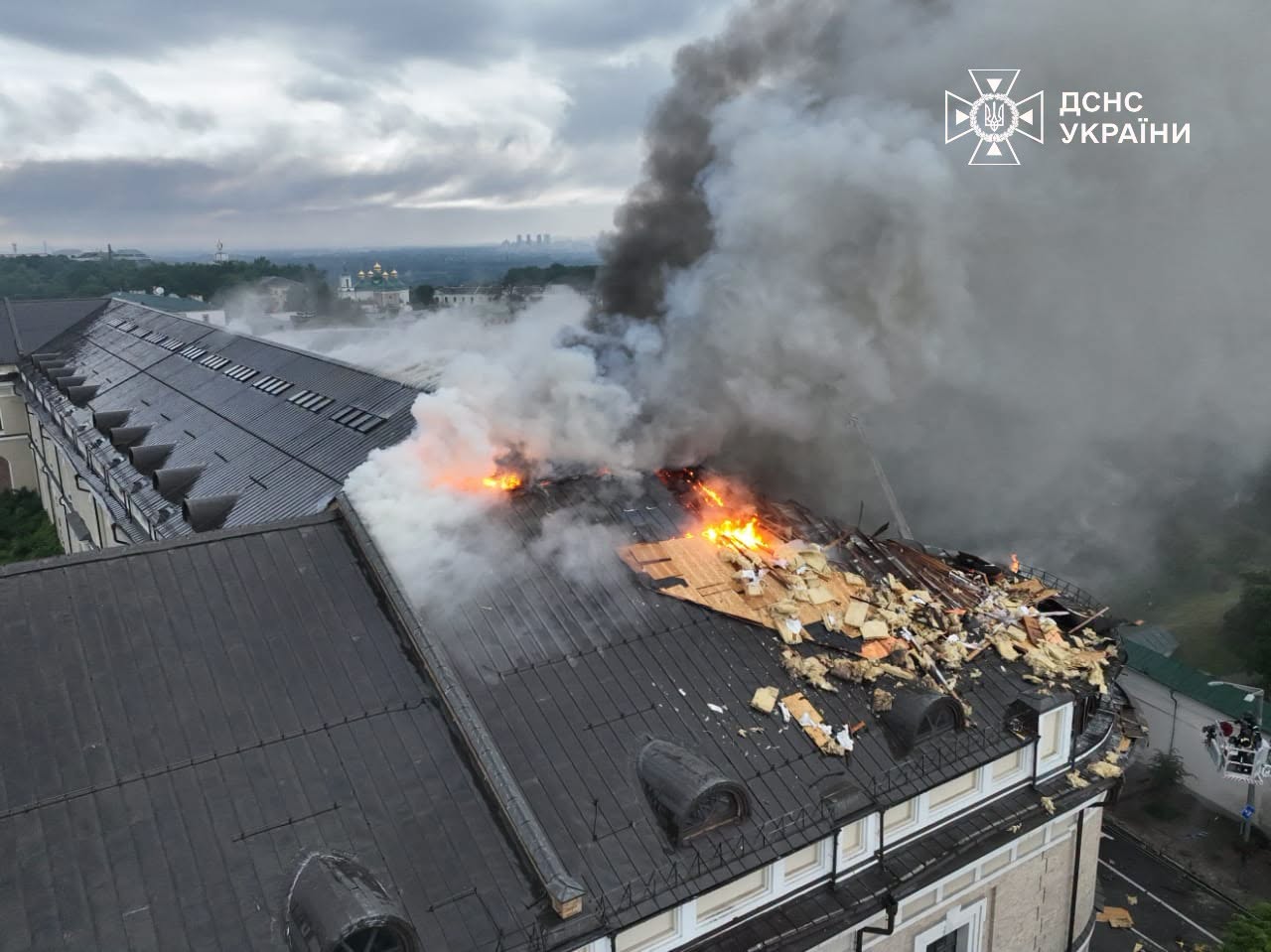
The Russia strikes Kyiv petrol stations September 23 report centers on attacks at two fuel sites in the Ukrainian capital early Wednesday. Kyiv authorities said one person was killed and seven were injured. Reuters journalists heard explosions and saw smoke rising in central Kyiv, while Ukrainian officials reported damage in several districts. Russia had not publicly commented on the specific strikes by the reporting cutoff.
Ukrnafta said one of its petrol stations was hit, describing it as the sixth company facility affected in recent weeks. Mayor Vitali Klitschko said a drone fell on a four-story business center in the Holosiivskyi district near the Ukrnafta station. In Darnytskyi, authorities reported a strike on transport infrastructure; local reports cited by UNITED24 Media said a UPG station on Kharkivske Highway was destroyed.
Rail infrastructure was also attacked. Oleksandr Pertsovskyi, chief executive of the state railway operator Ukrzaliznytsia, said one railway employee was injured. That makes the episode more than a pair of forecourt fires: it linked fuel distribution, urban transport and rail operations in the same attack window.
What authorities reported—and what remains unverified
The casualty count comes from city authorities, and the district-level damage picture combines statements by Klitschko, Ukrnafta and Ukrzaliznytsia with local reporting. Reuters independently observed smoke and heard explosions but said it could not independently verify some of the reported attacks. Signal Post News has not independently authenticated imagery from the affected sites.
The available accounts also changed as emergency crews assessed the scenes. In Holosiivskyi, the first report described a gas-station strike; Klitschko later said a drone had fallen on the nearby business center. In Darnytskyi, official reporting identified transport infrastructure and a roof fire, while local channels described the UPG outlet as completely destroyed. Those details are related but not interchangeable, and the full damage assessment may revise them.
Ukraine accused Russia of deliberately attacking civilian facilities and trying to disrupt everyday life. Moscow did not immediately respond to that accusation or identify the targets it intended to hit. Without a Russian statement or independently verified targeting evidence, intent cannot be established from the timing and damage pattern alone.
Kyiv petrol station drone attack extends a September pattern
Petrol stations in the capital have become a recurring target. UNITED24 Media reported that the first such strike in Kyiv this month came on September 10. Two more stations were hit on September 15 in the Darnytskyi and Holosiivskyi districts, according to city officials. On the evening of September 22, another wave hit fuel-storage tanks and other sites across Kyiv, injuring people before the early-morning September 23 attack.
Andrii Tkachov, acting head of the Kyiv City Military Administration, said 16 petrol stations had been damaged across the capital since the beginning of 2026. Ukrainian reporting has put the nationwide figure at roughly 300 attacked stations, most of them in regions closer to the front. Those are official or media-cited tallies rather than an independently audited database, but they show why Wednesday’s damage is being treated as part of a campaign rather than an isolated accident.
Fuel stations are civilian-facing nodes with an outsized psychological effect. Destroying one outlet rarely determines national supply, but repeated attacks can close neighborhood access points, complicate emergency and commercial transport, raise insurance and repair costs, and create visible signs of insecurity. Kyiv authorities have said they do not expect the recent station attacks to cause a citywide fuel shortage, an important limit on claims about immediate strategic impact.
Jet-powered drones give Kyiv less time to react
Russia has increasingly used faster, higher-flying jet-powered drones against Kyiv and nearby areas. Compared with propeller-driven Shahed-type systems, the newer weapons reduce warning and engagement time and can sit above the most efficient envelope of some mobile gun teams. That does not make them unstoppable, but it can force Ukraine to use scarcer and more expensive interceptors.
For the wider September 22–23 barrage, Ukraine’s air force reported 212 drones. That figure is a Ukrainian military account of the attacking force, not an independently verified count. The scale matters because mass and speed interact: even when defenders intercept most incoming weapons, a few penetrations can reach exposed urban infrastructure.
The tactical shift is examined in more detail in our analysis of jet-powered Russian drones and Ukraine’s air-defense problem. The central economic challenge is unfavorable exchange: Kyiv must protect many dispersed sites while Russia can vary routes, altitude, speed and timing to probe for gaps.
Ukrnafta and Ukrzaliznytsia show the civilian-network risk
The reported Ukrnafta and UPG strikes sit at the retail edge of Ukraine’s energy system. The Ukrzaliznytsia damage shows how attacks can cross into a second critical network. Rail remains essential for commuting, freight, military logistics and evacuation. A single injured worker and a localized facility strike do not imply systemwide collapse, but they demonstrate how overlapping targets can multiply disruption even when each incident is contained.
That distinction is important. A petrol station is not a refinery, and a railway site is not an electricity plant. Yet all form part of the infrastructure that keeps a city supplied and moving. The pattern can therefore pressure the public without producing the kind of headline outage associated with a destroyed power station.
Zelenskyy–Trump energy ceasefire talks frame the timing
The attack came hours after Zelenskyy met Trump in New York on September 22. After the 40-minute meeting, Zelenskyy said Ukraine was “ready for any format” of an energy ceasefire if Russia stopped striking Ukraine’s energy system. He said the discussion did not include a unilateral Ukrainian halt to attacks on Russian refineries.
Secretary of State Marco Rubio had publicly called a mutual halt to energy-infrastructure strikes an “ideal outcome,” while acknowledging that both sides would have to agree. Reports in the Financial Times and The Times said Trump had pressed Zelenskyy over Ukraine’s refinery campaign and the effect on diesel markets. Ukraine views those strikes as one of its few ways to impose costs far behind the front and has resisted surrendering that leverage without reciprocal Russian restraint.
Because the Kyiv strike followed so closely, it can be interpreted as Moscow’s answer to the ceasefire discussion. That interpretation is politically plausible but not verified fact. Russia did not say the petrol stations were struck in response to the New York meeting, and temporal proximity alone does not prove a command motive.
The energy war runs in both directions
Ukraine has expanded long-range attacks on Russian refineries and related oil infrastructure. The International Energy Agency said a Russian refinery was hit on average once every three days in the first eight months of 2026, helping push Russian refining output to its lowest level in more than 20 years. Individual damage assessments are often disputed, and temporary shutdowns do not always translate into permanent losses, but the campaign has affected fuel markets and repair capacity.
Our coverage of the Samara drone strike and disputed refinery footage shows the evidentiary limits that apply on the Russian side as well. Claims of fires, damaged units or production losses require site-specific confirmation; striking a complex does not necessarily mean its whole capacity is offline.
Russia, meanwhile, has repeatedly struck Ukraine’s power, fuel and transport infrastructure. Kyiv says the attacks are designed to degrade civilian resilience, especially before winter. Moscow often says its campaigns target military-linked energy or industrial facilities, but it has not provided evidence for every site hit. The result is a reciprocal energy war in which the two sides describe their own attacks as strategic pressure and the other’s as unlawful coercion.
Winter makes a narrow ceasefire more valuable—and harder
A verified energy ceasefire could reduce danger to Ukraine’s electricity, heating and water systems while limiting damage to Russian refining and export flows. That narrower bargain may be more attainable than a comprehensive ceasefire because it defines a category of targets rather than freezing the entire front.
It is also difficult to police. The parties would have to agree on what counts as energy infrastructure, whether transport nodes serving fuel shipments are covered, how to treat dual-use facilities, and who investigates a violation. They would need a mechanism for satellite evidence, strike attribution and rapid dispute resolution. Without those terms, every incident risks collapsing the arrangement into competing accusations.
The September sequence is a warning. A premature claim of agreement can create expectations that neither military has accepted. Ukraine’s refinery campaign gives Kyiv bargaining power; Russia’s ability to threaten the winter grid gives Moscow leverage. Each side may calculate that giving up its tool first would weaken its negotiating position.
What this means for ceasefire prospects
The immediate losers are civilians, station workers and transport employees exposed to attacks that can arrive with little warning. Kyiv’s government also faces higher defense and repair costs. Russia may gain tactical pressure and public anxiety, but repeated strikes on urban fuel sites can strengthen the international case for more Ukrainian air-defense support and deepen scrutiny of Moscow’s targeting.
Washington’s diplomatic position becomes harder as well. If Trump wants lower fuel-price pressure and fewer infrastructure attacks, he needs reciprocal commitments rather than pressure on Kyiv alone. Rubio’s formulation recognizes that logic. The unresolved question is whether Moscow sees more value in winter leverage than in a limited moratorium.
Zelenskyy was due to address the United Nations General Assembly later Wednesday. The Kyiv attack gives that speech an immediate frame: Ukraine can present the damaged stations and railway site as evidence that restraint must be mutual and verifiable. Russia can reject that framing or offer different target claims, but it had not done so by publication.
What happens next
Investigators and emergency services will refine the casualty and damage record, while Ukrnafta and UPG assess whether the affected outlets can reopen. Ukrzaliznytsia will determine whether the railway strike caused operational disruption beyond the reported injury. Air-defense officials will also analyze flight paths and interception performance for the jet-powered drones.
Diplomatically, the next signal is whether the United States proposes written terms for an energy ceasefire and whether Russia responds. A credible arrangement would need reciprocal scope, a start time, monitoring and consequences for violations. Absent those elements, the New York discussion remains a political proposal rather than an operational ceasefire.
The September 23 strike does not prove that an energy truce is impossible. It does show why verbal readiness is insufficient. For residents of Kyiv, the relevant test is not whether leaders endorse a format, but whether the next drone is launched and whether the systems protecting a petrol station, a railway worker or a winter substation can stop it.
Sources
- Reuters, September 23, 2026: casualties, Ukrnafta and railway reports, eyewitness observations and energy-ceasefire context
- UNITED24 Media via EuropeSays, September 23, 2026: district-level damage, UPG report and 2026 Kyiv petrol-station tally
- The Times, September 22, 2026: reported Trump pressure, Rubio’s energy-ceasefire remarks and IEA refinery context
- Wikimedia Commons: June 15, 2026 Mystetskyi Arsenal file photograph and licensing information
Reporting cutoff: September 23, 2026 at 2:10 a.m. PDT. Casualties and damage are attributed to Kyiv authorities, company officials and Ukrainian reporting. Reuters observed smoke and heard explosions but could not independently verify some reported attacks. Russia had not commented on the specific strikes by the cutoff. The image is a June 15, 2026 file photograph and does not depict the September 23 attack.