Russia Sumy school glide bomb strike

The Russia Sumy school glide bomb strike killed two people and wounded six on Tuesday, September 29, as bombs hit homes and what President Volodymyr Zelenskyy called an “ordinary school” with children inside. Yet everyone at the school survived: teachers and administrators moved roughly 100 students and staff into a shelter before the building was badly damaged, according to Ukrainian officials quoted by Reuters and the Associated Press.
The survival of the people inside the school is the central fact of this attack, but not the only one. Ukrainian officials identified the dead as an elderly woman and a 16-year-old girl; Zelenskyy specifically said a bomb hit a house and killed a woman. Governor Oleh Hryhorov said three children were among those injured. Neither Reuters nor AP independently verified the officials’ battlefield accounts, and casualty totals can change after rescue work.
Why the Sumy school strike matters
For Sumy, a northern regional capital close to Russia, the strike compresses three years of aerial warfare into one block: a standoff weapon released beyond the reach of many short-range defenses, a civilian building damaged during the school day, and a shelter drill that appears to have prevented a much larger loss of life. The outcome is both a success for civil defense and an indictment of the threat that made a school bunker routine.
For Ukraine’s partners, it sharpens an uncomfortable distinction. Ukraine air defenses can shoot down many aircraft, missiles and drones, but a heavy glide bomb is difficult to stop after release. Protecting Sumy therefore requires overlapping measures: long-range systems that push Russian launch aircraft farther away, electronic warfare that disrupts satellite guidance, hardened shelters, rapid alerts and strikes against launch infrastructure. None is a complete answer on its own.
What happened: the timeline and the disputed details
Reuters reported that glide bombs struck homes and a school on Tuesday. Zelenskyy said one bomb hit a house and killed a woman, while another hit the school. Hryhorov placed the toll at two dead and six wounded and said three children were among the injured. He credited school staff with moving about 100 people into the shelter.
AP’s account said teachers and students evacuated shortly before four glide bombs struck while classes were taking place. Early Ukrainian reporting referred to three bombs. The difference — three in early accounts, four in later reporting — is unresolved, so this report does not force the two versions into a false certainty. The same caution applies to timing: children were at school and classes were in the day’s schedule, but accounts differ on whether the evacuation was completed just before impact or while the attack sequence was already under way.
The consistent part is the result. The school building sustained major damage, according to Zelenskyy, but no one at the school was reported hurt. Death and injury occurred elsewhere in the strike zone. That distinction matters because a headline focused only on a “school bombing” can imply casualties inside the building that officials did not report.
How a KAB or UMPK glide bomb changes the defense problem
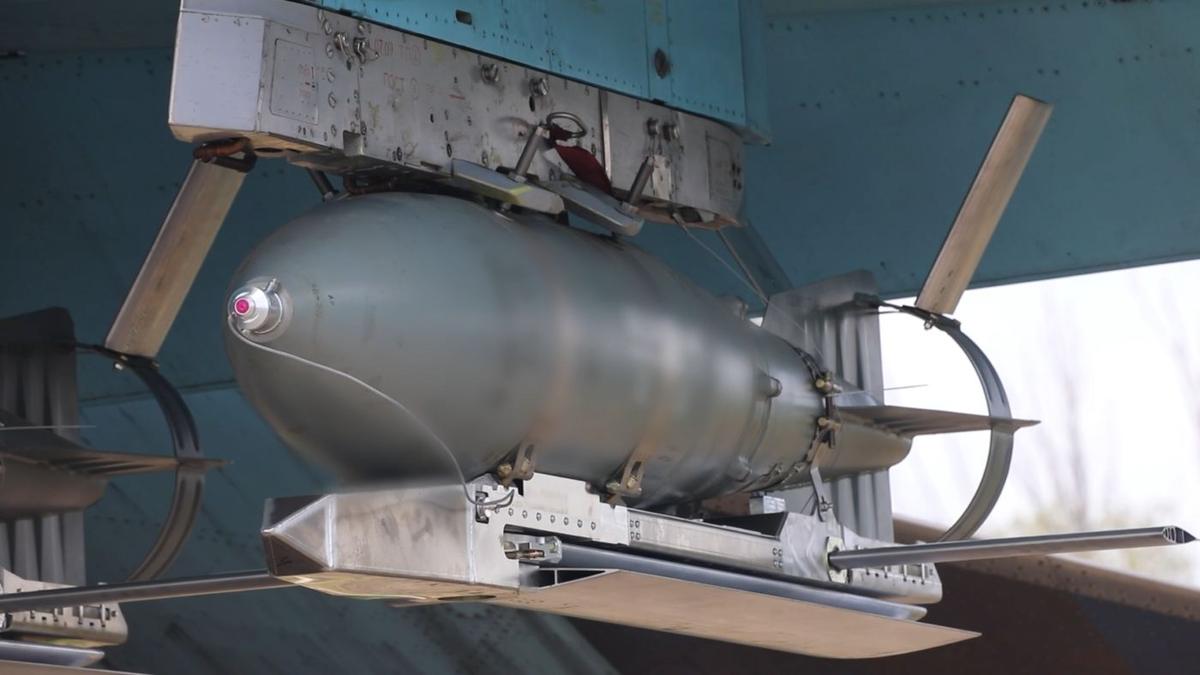
The phrase KAB glide bomb Ukraine is often used loosely for several Russian guided aerial bombs. The core method is simple: folding wings and a guidance package turn an existing gravity bomb into a stand-off weapon. A fighter-bomber can release it tens of kilometers from the target instead of flying directly overhead. Newer versions add longer wings or a small engine, pushing the launch aircraft farther from defended airspace.
A 2026 NATO-affiliated Joint Air Power Competence Centre review describes UMPK kits as relatively inexpensive, usually guided by satellite navigation backed by inertial navigation, and commonly released by Su-34 aircraft. The review says electronic warfare can degrade their accuracy, but intercepting the bomb itself is difficult and using scarce high-end missiles against every release is economically punishing. Open-source range estimates vary by bomb, altitude and kit generation; interested-party claims should not be treated as precise performance guarantees.
That economics is why the weapon has become central to Russia’s campaign. A converted stockpile bomb can carry far more explosive force than a one-way drone without the price of a cruise missile. The trade-off is lower precision, especially when guidance is jammed. In or near a city, that combination — heavy payload, imperfect accuracy and repeated volume — shifts risk onto schools, homes and public infrastructure even when a military target is claimed nearby.
Sumy’s geography and Russia’s buffer-zone campaign
The Sumy buffer zone Russia debate is not abstract. The city and region sit beside Russia’s Kursk and Belgorod areas, making them both a route for Ukrainian cross-border operations and a recurring target of Russian fire. Moscow has said it wants a “buffer zone” along the frontier. Ukraine describes that language as a pretext for taking and depopulating more of its territory.
The military logic is reciprocal and grim. Russia wants to push Ukrainian forces and launch points away from its border. Ukraine wants to keep Russian troops and aircraft far enough back that Sumy is not exposed to short-warning attacks. Civilians lose under either geometry: the closer the launch line comes, the shorter the warning and the greater the pressure to evacuate; the farther it is pushed through offensive action, the more settlements become battle space.
The near miss: what about 100 people in a shelter tells us
Around 100 people survived because the warning, the school’s procedures, staff decisions and the shelter all worked in sequence. This was not luck alone. It is evidence that drills and hardened space can convert a direct strike from a mass-casualty event into a destructive near miss.
But survival should not be mistaken for safety. A shelter protects against blast and fragments only if it is accessible in time, structurally sound and supplied for repeated alerts. It does not replace the classroom, repair trauma, restore a damaged building or protect families in neighboring homes. The Ukraine school evacuation bombing pattern also creates inequality: schools with modern underground classrooms or basements can reopen; schools without them close, move online or expose families to a choice between education and risk.
That is why the disputed bomb count does not change the policy lesson. Whether three weapons or four were released, the relevant statistic is that one school contained roughly 100 potential casualties and recorded none. Officials should publish the shelter’s condition and evacuation timeline once rescue work ends, not to create a victory narrative but to identify which design and operating choices can be reproduced.
A wider day of missiles, jet drones and long-range strikes
The Sumy strike was not isolated. AP reported ballistic missiles and dozens of jet-propelled drones Kyiv residents had to endure during another extended attack. Ukrainian authorities said apartment buildings, a house and public transit were damaged in the capital and one person was wounded. Ukraine said it intercepted two ballistic missiles; that claim was not independently verified. Officials also said jet-powered drones fly too high and fast for many ground teams, while Ukraine is developing faster interceptors.
Odesa authorities reported eight people wounded and damage to homes, civilian infrastructure, a school, an animal shelter and port facilities. Russia’s Defense Ministry said its forces hit data-processing centers and other facilities supporting the Ukrainian military. That is a Russian claim and could not be independently verified. Both Russia and Ukraine deny targeting civilians.
Kyiv has answered with long-range attacks on Russian missile and drone plants, launch sites and oil refineries, according to Ukrainian officials. Those are Ukrainian claims. The exchange shows why one strike cannot be read separately from the contest over production and air defense: each side is trying to reduce the other’s ability to sustain the next wave while preserving its own launch capacity.
North Korean troops and the war’s expanding manpower pool
Zelenskyy also said another 10,000 North Korean troops Russia could receive were on their way, on top of 8,000 already there. AP reported the statement, but the numbers and movement were not independently confirmed in the reports reviewed for this article. Pyongyang’s support matters less to the mechanics of the Sumy strike than to the endurance behind it: outside manpower and materiel can free Russian resources for other fronts and lengthen the war’s horizon.
For Ukraine, the parallel shortages are ammunition and people. Every Patriot interceptor committed to a ballistic missile, every mobile team sent after a fast drone and every electronic-warfare unit assigned to a glide-bomb corridor is unavailable somewhere else. Russia benefits from forcing those choices. Ukraine benefits when one defense — such as a school shelter — protects many people without consuming an interceptor.
Who benefits, who loses and what critics argue
Russia’s military benefits from a low-cost way to pressure a border city while keeping aircraft at standoff distance. Critics of Moscow’s campaign argue that repeated use of large bombs around populated areas makes civilian harm foreseeable, regardless of the stated target. Russia says it strikes military and military-supporting facilities and denies targeting civilians.
Ukraine’s government gains a vivid case for more air defense and shelter funding, and the successful evacuation supports its investment in civil protection. Critics of Kyiv’s approach argue that scarce high-end defenses cannot cover every border school and that public messaging can blur confirmed facts with battlefield advocacy. That makes transparent after-action reporting essential.
Families and educators absorb the clearest loss: disrupted schooling, damaged homes, injury and grief. Even a technically successful evacuation imposes a cost on children who must learn that the route from desk to bunker is part of an ordinary school day.
What happens next
Air defense: Ukraine will press partners for more Patriot ammunition and layered systems, but glide bombs are likely to keep driving investment in electronic warfare, fighter interception and attacks on aircraft and airfields. Faster interceptors for jet-powered drones will compete for money and industrial capacity.
Schools: Sumy authorities will have to assess whether the damaged building can reopen, whether students should move to underground or remote classes, and whether other schools can reproduce the shelter procedures. The most useful public metric is not merely the number of shelters but how quickly occupied classrooms can reach them.
Diplomacy: the strike will strengthen Kyiv’s argument that negotiations without enforcement leave border cities exposed. Moscow can point to military-support targets elsewhere and its buffer-zone rationale. The space for talks narrows when attacks on schools and homes dominate the evidence seen by the public.
Verification: investigators should reconcile the bomb count, map the impact sites and document the dead and injured without exposing children. Until then, the soundest conclusion is limited but consequential: bombs hit a Sumy school and homes; two people were killed, six wounded, and sheltering prevented casualties inside the school.
Sources
- Reuters, “Russian bomb attack kills two in Ukraine’s Sumy, officials say” (September 29, 2026) — casualties, school damage, shelter and buffer-zone context: reuters.com
- Associated Press, “Russia’s ballistic missile and jet-propelled drone blitz keeps Kyiv on edge” (September 29, 2026) — evacuation sequence, four-bomb account, Kyiv and Odesa attacks, air defense and North Korean troop claims: apnews.com
- Joint Air Power Competence Centre, Journal Edition 41 (2026) — UMPK design, launch geometry, guidance and countermeasure analysis: japcc.org
Casualty figures and operational details are attributed to Ukrainian officials as reported by Reuters and AP. Russian targeting claims and Ukrainian long-range-strike claims are labeled as claims. Early reports gave different bomb counts, and the reports reviewed did not independently verify battlefield assertions. Both sides deny targeting civilians. File images are identified as such and do not depict the September 29 impact sites.