War · Ukraine
Hours after Zelenskyy warned that Russia was preparing to strike energy sites, Dnipro bridges and civilian infrastructure, ballistic missiles did exactly that — three waves on Kyiv, a bridge closed, a kindergarten wrecked, a whole city dark, three days before Abu Dhabi talks.
Track it live: Live Ukraine war map · Live war tracker
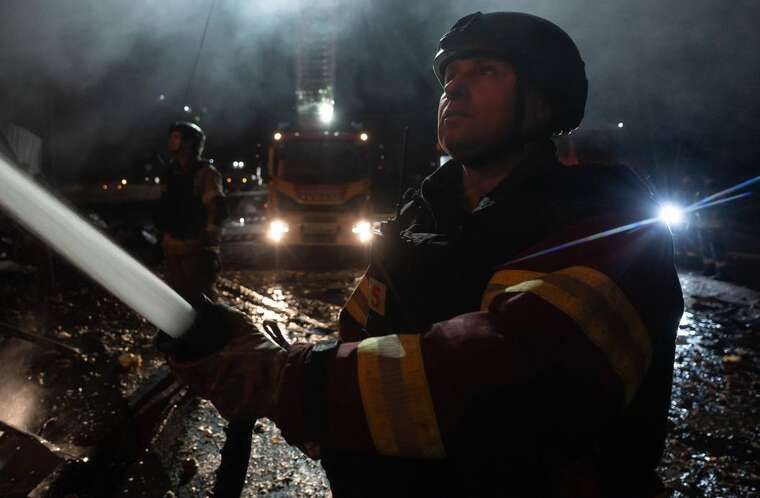
KYIV, November 7, 2026 — Russia attacked Kyiv with ballistic missiles three times overnight, hours after President Volodymyr Zelenskyy had warned in his nightly address that Ukrainian intelligence showed Moscow preparing strikes on energy sites, on the bridges across the Dnipro and on civilian infrastructure. The warning and the attack can be laid side by side almost line by line: missiles struck the Pivnichnyi (Northern) Bridge and closed it in both directions, a two-storey kindergarten building in the Solomianskyi district was destroyed, five-storey apartment buildings were damaged, five people were injured in the capital including a 14-year-old, and the northern city of Chernihiv was left completely without power. Ukraine struck back the same night, with fires reported at the Saratov oil refinery and at a military electronics plant in Oryol. All of it landed three days before US-led trilateral talks open in Abu Dhabi on November 10-11 — the first such meeting since February.
What happened overnight
The first wave came shortly before 11 p.m. on Friday, when Ukraine’s Air Force reported at least six ballistic missiles launched toward the capital within a few minutes. Mayor Vitali Klitschko wrote on Telegram: “Explosions in the Kyiv suburbs. The enemy is hitting infrastructure with ballistic missiles.” Reuters, whose witness heard powerful explosions in the capital, reported debris striking a five-storey apartment building in a western district and damaging the facade of another. A second wave followed around 1 a.m., aimed, Klitschko said, at infrastructure facilities in the suburbs, and a third swept the capital around 3 to 3:30 a.m. Across the country, the Ukrainian Air Force counted multiple Iskander-M, Tsirkon, KN-23 and S-400 ballistic missiles alongside 172 attack drones of various types.
The Kyiv City Military Administration first reported two people injured and a damaged kindergarten building; the State Emergency Service (DSNS) then gave the fuller Solomianskyi picture: the facade of one five-storey building partially destroyed, windows blown out in three more, a two-storey building on the kindergarten’s grounds destroyed, and a truck and a non-residential building set on fire before crews extinguished it. Klitschko later updated the toll to five injured in Kyiv, including a 14-year-old, with two people taken to hospital. Outside the capital, a Russian jet-powered drone destroyed a private home in Bohdanivka in the Brovary district, injuring residents and leaving rescuers to pull a man from the rubble. No deaths in Kyiv had been reported as officials continued to assess damage on Saturday morning, and casualty figures in a developing attack should be read as provisional.
A bridge shut, a city dark
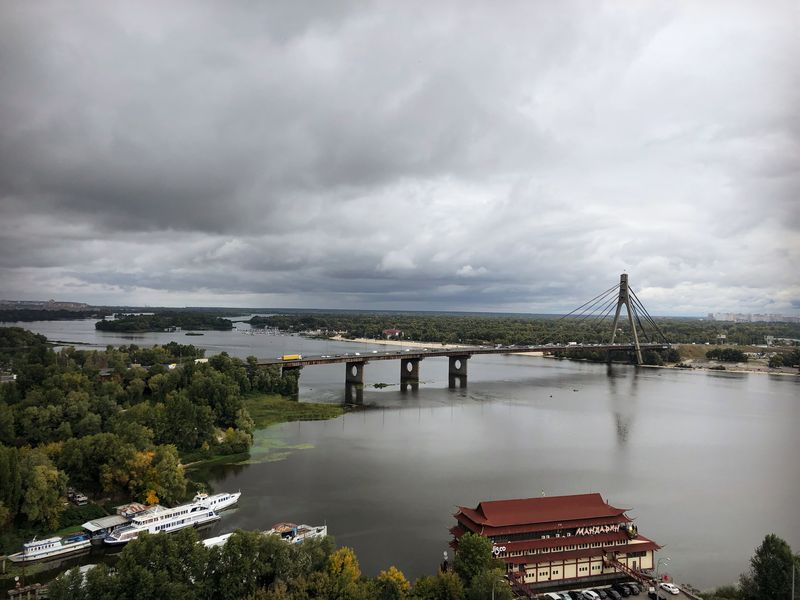
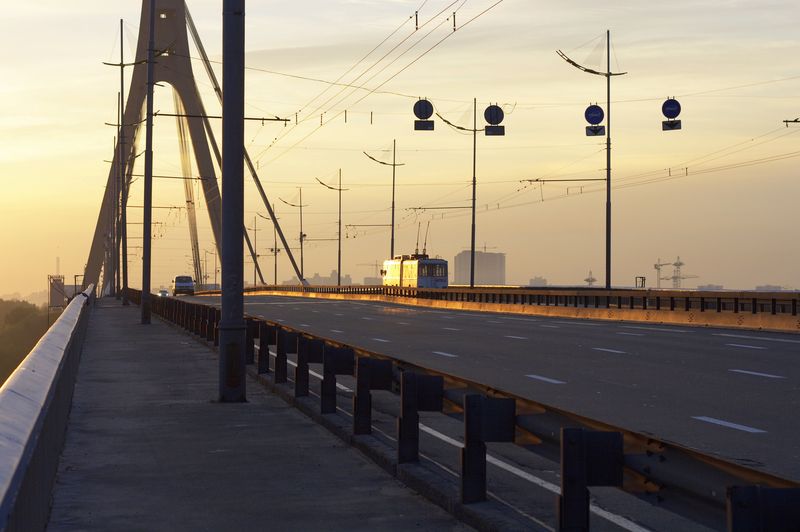
The most consequential single hit may prove to be the one Kyiv had been explicitly warned about. Several missiles struck the Pivnichnyi Bridge, damaging the road surface, the trolleybus overhead wires and a power transmission line, Klitschko reported; the bridge was closed to traffic in both directions. The Pivnichnyi is not a minor crossing: the 816-metre cable-stayed bridge, opened in 1976, links the left-bank districts of Troieshchyna, Voskresenka and Obolon with the right-bank government centre and forms part of Kyiv’s Small Ring Road. Further north, Chernihiv was left completely without electricity after the overnight drone attack, its city council reported, with electric public transport suspended. DTEK reintroduced emergency power outages in the Kyiv region, and officials described the capital’s power supply situation as “extremely challenging” after strikes on energy facilities in the Kyiv and Zhytomyr regions.
Ukraine strikes back the same night
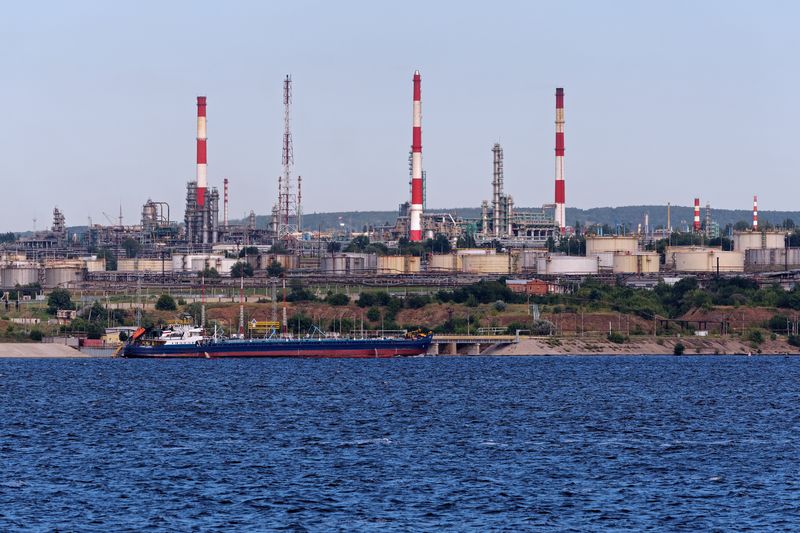
Kyiv’s answer arrived in the same hours. Ukrainian drones struck the Saratov oil refinery, more than 1,000 kilometres from the border, and monitoring channels and video geolocated by OSINT analysts reported fires at the Rosneft plant, which processes about seven million tonnes of oil a year into petrol, diesel and aviation fuel; Saratov’s governor reported casualties and damage to civilian infrastructure from the drone attack. In Oryol, the regional governor Andrei Klychkov confirmed a production building at a business in the city’s Sovetsky district was damaged in a missile attack without naming the company; OSINT analysts identified it as the Proton-Elektroteks plant, which produces electronic components used in Russian military equipment including systems associated with Iskander-M ballistic missiles and Pantsir-S1 air defence. A large fire was also reported at a warehouse in Rostov-on-Don. The Kyiv Independent noted the details of Ukraine’s overnight strikes could not be immediately verified, and that caution applies here: the Saratov and Oryol reports rest on monitoring channels, regional officials and open-source analysts, not yet on a Ukrainian General Staff confirmation.
Why this matters
Analysis. Start with the sequence, because the sequence is the story. On Friday night, Zelenskyy’s warning that Russia was preparing strikes on bridges and energy named the target set — energy, Dnipro bridges, civilian infrastructure — and appealed for Patriot interceptors, the only systems in Ukraine’s arsenal that can reliably engage ballistic missiles. Within hours, ballistic missiles hit a Dnipro bridge, homes and a kindergarten, and drones blacked out a regional capital. That does not prove every element of the warning was a prediction of this specific night; Ukrainian officials had not confirmed the connection. But it demonstrates the operational reality Kyiv keeps describing: ballistic attack arrives in minutes, interceptor stocks are finite and slow to replace, and a strike wave is therefore a contest of arithmetic as much as of aim — six missiles in a few minutes against however many interceptors are loaded and within range.
The bridge is the second layer of significance. Since October 1, Russian drones have repeatedly hit Kyiv’s Pivdennyi and Pivnichnyi bridges, and Russia’s General Valery Gerasimov reported to President Vladimir Putin that Russian forces began specifically targeting strategic bridges, railway infrastructure and data centres on October 16 — a targeting policy Moscow has acknowledged itself. A damaged power station can be bypassed and repaired; a closed bridge severs movement itself — supplies, reinforcements, evacuation routes and the daily functioning of a capital of millions. Saturday’s closure of the Northern Bridge in both directions is that policy producing exactly its intended effect, at the start of the heating season, while Chernihiv sits dark and Kyiv’s grid operators describe an “extremely challenging” supply situation.
Context: an infrastructure war, escalating in both directions
Saturday’s exchange is the latest round of a reciprocal infrastructure campaign that has defined this autumn. Russia’s mass strikes on power generation and transmission — Russia’s 310-drone barrage on Kyiv and Zhytomyr power stations on November 4 among them — aim to make Ukrainian cities cold and dark through winter. Ukraine’s deep-strike campaign against refineries and military industry, which Zelenskyy confirmed on Friday is continuing, aims to raise the cost of the war inside Russia: Saratov has been hit repeatedly this year, and Kyiv says its strikes had knocked a large share of Russia’s refining capacity offline by late September. Each side describes its own campaign as retaliation for the other’s, and each new round is larger in geographic spread — Saturday’s map ran from Chernihiv to Saratov, over a thousand kilometres apart.
Fairness requires stating both sides’ framings without adopting either. Moscow frames infrastructure strikes as military targeting of logistics and dual-use systems — bridges, energy storage and transport that move troops and materiel as well as civilians. Russia’s Defence Ministry said its overnight strikes hit an energy-storage facility in Bila Tserkva and a dry-cargo vessel in Odesa; that is a belligerent’s official account, not independently verified. Kyiv and its allies frame strikes that wreck kindergartens, apartment facades and city power as attacks on civilian life support. That darkness has already become a political fight in the capital, in the blame exchange between Zelenskyy and Klitschko over Kyiv’s darkness. What is not in dispute is the documented damage in Solomianskyi, the closed bridge and the darkened city — or that both capitals chose the same night to hit the systems the other needs to function.
What happens next
Diplomacy now runs on a three-day clock. US special envoy Steve Witkoff has announced trilateral talks between Ukraine, Russia and the United States in Abu Dhabi on November 10-11, and Zelenskyy, speaking in Berlin this week, said he hopes the adviser-level meeting “will open the way to a trilateral format at the level of leaders” — including a meeting with Vladimir Putin. Germany’s Chancellor Friedrich Merz, standing beside him, said Russia is yet to engage seriously in peace efforts. Attacks timed around negotiations are a familiar pattern in this war, and both readings will be made of Saturday night: pressure before talks, or proof that talks are theatre. The practical questions are nearer at hand: how fast engineers can reopen the Northern Bridge, whether Chernihiv’s power returns before temperatures bite, whether Patriot interceptor deliveries accelerate, and whether the Abu Dhabi delegations arrive on Tuesday talking about the strikes — or past them.
Do you think the Abu Dhabi talks can still open a path to a leaders’ meeting after a night like this — or have the strikes already decided what the talks can achieve? Follow Signal Post News for continuing coverage of the war in Ukraine, the Abu Dhabi talks and the air-defence race above Kyiv.
Sources
- Reuters, “Russian forces launch missile attack on Ukrainian capital Kyiv, mayor says” (November 7, 2026)
- The Kyiv Independent via EuropeSays, “Russian ballistic missiles slam Kyiv, injuring 3, including child, after Zelensky warns of mass attack” and “Five people injured in Russian attack on Kyiv, including teenager”
- Liveuamap, Klitschko reports on the Pivnichnyi Bridge strikes, the Air Force tally and the Chernihiv blackout
- AnewZ, “Russian missiles hit Kyiv ahead of Abu Dhabi peace talks”
- The Kyiv Independent via EuropeSays, “Ukraine strikes Saratov Oil Refinery in mass attack on several Russian regions, reports say”
- Al Jazeera, “Ukraine’s Zelenskyy hopes Abu Dhabi talks will open path to Putin meeting”