War · Ukraine
Ukraine’s president says intelligence points to a new Russian strike wave aimed at the crossings that hold Kyiv together and the power grid that keeps it warm — four days before talks resume in Abu Dhabi, and as Kyiv confirms its own campaign against Russia’s refineries will go on.
Track it live: Live war tracker

KYIV, November 6, 2026 — President Volodymyr Zelenskyy used his nightly video address on Friday to warn that Russia is preparing a new round of strikes on Ukraine’s energy system, on the bridges across the Dnipro river and on civilian infrastructure, saying Ukraine’s military was braced for what he called a tough mission ahead. The warning, reported by Reuters, was unusually specific about targets: not power stations alone, but the river crossings that connect the two halves of the capital and carry much of the country’s east-west logistics. In the same breath, in a separate statement issued on Telegram after receiving a military command report on deep strikes, Zelenskyy confirmed that Ukraine’s campaign against Russia’s oil refining industry is continuing — a deliberate pairing that frames the next phase of the war as an exchange of infrastructure campaigns, each side striking the systems the other needs to keep functioning.
What Zelenskyy said
Zelenskyy stated it plainly in the nightly address, as reported by Reuters on November 6: “We have intelligence at this time that Russia is preparing new strikes on energy, on bridges across the Dnipro, on civilian infrastructure.” The precision of that sentence matters, and this article will preserve it: on the Ukrainian account, these strikes are planned — a warning about what intelligence indicates is coming, not a report of damage already done. Zelenskyy said the military is braced for a tough mission in defending against them. Warnings of this kind serve more than one purpose at once: they prepare the public and emergency services, they put air-defence partners on notice, and they create a record — if the strikes come, Kyiv can say the intent was declared in advance; if they do not, the warning itself will be debated, a question this article returns to below.
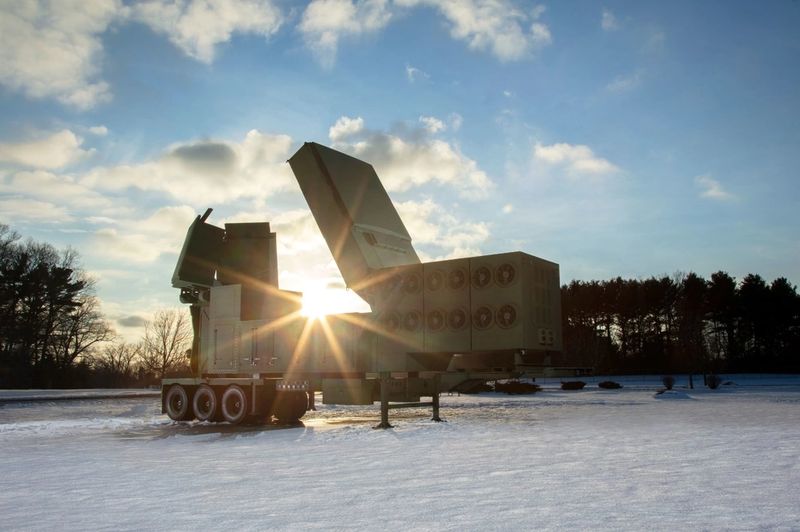
The president also repeated his calls for allies to supply missiles for the US-made Patriot air-defence systems quickly, so that Ukrainian cities can be defended against ballistic attack. The emphasis on speed is not rhetorical decoration. Patriots are the only systems in Ukraine’s arsenal able to reliably intercept ballistic missiles — the class of weapon that arrives too fast for Ukraine’s other defences to engage with confidence. Interceptor stocks are finite and slow to replace, production lines are measured in hundreds of missiles a year rather than thousands, and every ballistic missile fired at a Ukrainian city poses the same arithmetic: an interceptor expended, or a target exposed. The speed of resupply — not just the number of launchers Ukraine fields — therefore decides how much of a strike wave gets through, which is why a warning about bridges and power stations arrives, in Kyiv’s telling, stapled to a request for Patriot missiles.
Why the bridges matter
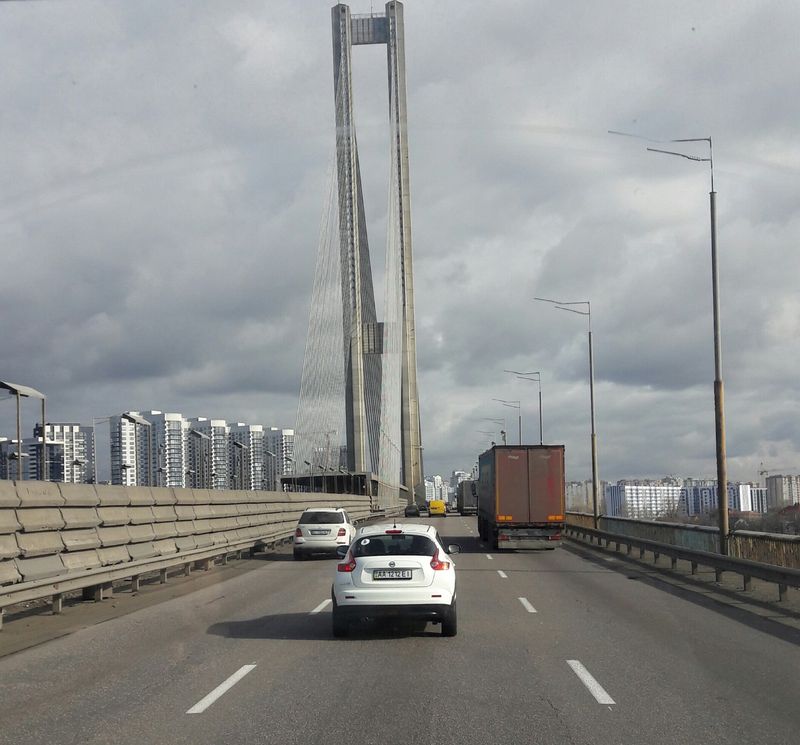
The Dnipro divides Kyiv and much of Ukraine. The river is wide — hundreds of metres across in the capital — and a small number of road and road-rail crossings carry what a divided city and a country at war cannot move any other way: commuter traffic, freight, military supply routes toward the east, and the metro and road links between the left-bank districts and the government centre on the right bank. Dnipro bridges and why they matter for logistics is, in the end, a question about chokepoints. A country can reroute around a damaged power station, and often does; it cannot reroute around a river except across the bridges that span it, and in Kyiv those bridges can be counted on two hands.
Bridges are also hard targets in a specific and cruel sense: long, exposed, and difficult to protect along their whole span. Air defence can cover a point; a bridge is a line. And the damage need not be fatal to be effective — a strike that wounds a span, or even one that forces a closure for inspection, can sever a route for days while engineers assess what missiles began. A campaign against crossings aims at movement itself: supplies, reinforcements, evacuation routes and the daily functioning of a capital of millions. Military analysts note that bridges also carry symbolic weight beyond their tonnage: striking them signals an intent to isolate, not just to damage — to tell a city that its two halves can be prised apart. That signal is part of what Kyiv’s warning is asking its citizens, and its partners, to brace for. The crossings do not stand apart from the wider strike campaign: they are one layer of the same pressure Ukraine has absorbed in waves this autumn, including the mass drone attack Signal Post News reported in Russia’s 227-drone strike and the power outages that followed.
A campaign Moscow has already acknowledged
Friday’s warning did not arrive in a vacuum. Since October 1, Russian drones have repeatedly hit Kyiv’s South (Pivdennyi) Bridge and later the North Bridge — the Pivdennyi Bridge drone strikes Kyiv has been absorbing for five weeks amount to the first sustained targeting of the capital’s river crossings in the war. More remarkably, Moscow has said the quiet part aloud: Russia’s General Valery Gerasimov reported to President Vladimir Putin that Russian forces began specifically targeting strategic bridges, railway infrastructure and data centres on October 16 — Russia targeting bridges, on Gerasimov’s October 16 account, is a targeting policy publicly acknowledged by Russia itself, not merely alleged by Kyiv.
That acknowledgement frames the dispute, and fairness requires stating both sides’ positions without adopting either. Moscow frames infrastructure strikes as military targeting of logistics and dual-use systems — bridges, railways and data centres that move troops and materiel as well as civilians and commerce. Kyiv and its allies frame the same strikes as attacks on civilian life support — on the heat, light, water and movement that a population needs to survive a winter. Those framings are not reconcilable, because they rest on different claims about intent and proportionality that neither side’s statements can settle on their own. What can be settled is narrower: the crossings have been hit since October 1, Russia’s own chief of the general staff has described bridge targeting as policy since October 16, and Ukraine’s president now says intelligence points to more of it, widened to energy and civilian infrastructure. Readers can weigh the framings; the sequence is a matter of record.
The energy war underneath it
Beneath the bridge story runs the older and larger campaign against Ukraine’s power system. Overnight on November 2–3, Russia launched one of its largest energy attacks of the war, according to grid operator Ukrenergo, knocking three DTEK thermal power plants offline and forcing emergency blackouts across Kyiv, the Kyiv region and Dnipropetrovsk. The Ukraine energy attacks and blackouts of November 2026 are not an abstraction in the capital: they are the context in which, as Signal Post News reported this week, Kyiv’s blackouts have left millions in the dark and set the president and the mayor against each other over who bears responsibility for the city’s defences and repairs.
The seasonal logic is stark. Strikes land as the heating season begins, when lost generation is hardest to replace and most keenly felt: a power plant offline in May is an inconvenience; the same plant offline in November is cold apartments, strained hospitals and water systems running on generators. That timing is why Kyiv treats each successive wave as more dangerous than the last even when its size is similar. And it is why the repair race has become a front of its own: Ukraine’s ability to restore capacity between waves — cannibalising equipment, importing transformers, working crews around the clock under air-raid alerts — is now as important as its ability to intercept during them. A warning of new strikes on energy is therefore also, implicitly, a warning about the arithmetic of repair: capacity restored since November 2–3 is capacity that can be targeted again before it has paid back the effort of restoring it.
‘The operation against the Russian oil refining industry continues’
The second half of Friday’s message was aimed in the opposite direction. In a statement on Telegram issued after receiving a military command report on deep strikes, Zelenskyy wrote: “The operation against the Russian oil refining industry continues — in response to Russian strikes on Ukrainian energy facilities.” Ukraine refinery strikes, in other words, continue — and Kyiv is explicit about their stated rationale. Zelenskyy said new countermeasure targets had been determined, that Russia has refused de-escalation steps and is counting on further strikes of its own. Russian officials, for their part, have reported strikes on oil targets in Samara, Yaroslavl and Ryazan in the past week — reports that, whatever their precise damage assessments, confirm the campaign is landing on Russian soil on a continuing basis.
The context gives the statement its edge. President Donald Trump has previously asked Ukraine to halt refinery attacks over their effect on diesel prices, and Zelenskyy has said Ukraine would stop if Russia halts its energy strikes — an explicit conditional linkage Kyiv repeated in Friday’s framing. Refinery strikes are presented by Kyiv as retaliation and leverage, not an end in themselves: a meter that runs while Russia’s energy campaign runs, and stops when it stops. Whether Washington reads Friday’s confirmation the same way — as the working of an announced condition rather than defiance of an American request — is one of the quieter questions the statement poses, and it lands, like everything else in this story, in the shadow of next week’s talks.
Who gains, who loses
If the warned strikes land on bridges at scale, Kyiv loses mobility and faces repair burdens under fire — bridges to patch while the campaign that damaged them continues — while Russia gains pressure without occupying ground. If Patriot interceptors arrive fast, the strike wave’s value falls sharply; air-defence supply is, on inspection, the cheapest variable in the whole equation, the one input that can be changed by a signature in Washington or Berlin faster than any bridge can be rebuilt or any refinery repaired. Ukraine’s refinery campaign costs Russia refining capacity and export revenue, but it risks friction with Washington over fuel prices each time diesel markets move. Civilians on both sides of the Dnipro, and Russian motorists facing fuel disruption, bear costs that neither capital counts publicly. And through every scenario run the same unglamorous figures: energy workers and bridge engineers, the people who restore what missiles break, emerging as a decisive front in a war increasingly fought against the systems that keep societies running.
Four days before Abu Dhabi
The warning lands four days before US–Russia–Ukraine talks resume in Abu Dhabi on November 10–11 — the Abu Dhabi talks of November 10–11 are the first such meeting since February, and they convene with both sides publicly committed to infrastructure campaigns against the other. The timing invites interpretation, and this article will offer the readings without asserting a motive as fact: strike warnings before talks can be read as pressure, as expectation management, or as genuine intelligence shared to prepare the public — and each capital will read the other’s infrastructure campaign through the talks, whatever the intent. If strikes land during the Abu Dhabi window, the talks’ already narrow space narrows further; if they do not, Kyiv’s warning will be debated as deterrence that worked or intelligence that overstated, a judgement that will say as much about the debaters as about the intelligence. What to watch: Patriot resupply announcements; Ukrenergo’s emergency measures; bridge closures in Kyiv; and any Russian statement responding to the refinery-campaign confirmation. The answers will arrive, one way or another, before the delegates do.
Do you think the Abu Dhabi talks can survive another exchange of strikes on bridges, power plants and refineries — or is the infrastructure war now the real negotiation? Follow Signal Post News for continuing coverage of the war in Ukraine, the Abu Dhabi talks and the air-defence race above Kyiv.
Sources
Reuters, November 6, 2026 (two reports: Zelenskyy’s nightly-address warning of planned Russian strikes on energy, Dnipro bridges and civilian infrastructure, and the refinery-campaign statement issued on Telegram after a military command report on deep strikes), corroborated by europesays and Kyiv Post reporting of the same statements; Ukrenergo and DTEK for the November 2–3 energy attack details. Photos: Wikimedia Commons, as credited in the captions.