War / Ukraine
Russia hit two power stations in the Kyiv and Zhytomyr regions overnight in a 310-drone barrage that knocked out electricity and water across the Ukrainian capital for hours — the newest turn in an autumn campaign against Ukraine’s energy grid that is intensifying a week before US-brokered talks in Abu Dhabi.
Track it live: Live Global Trackers — Wars
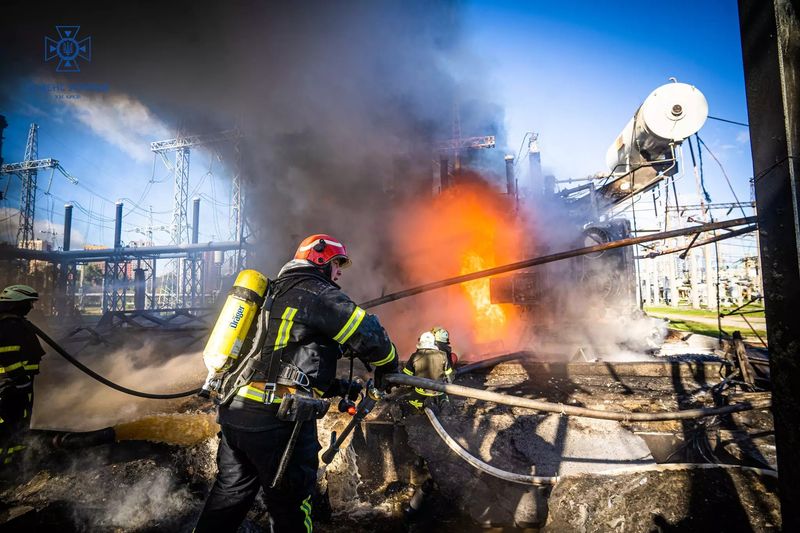
KYIV, November 4, 2026 — Russia strikes Kyiv power stations again: Russian forces hit two power stations in Ukraine’s Kyiv and Zhytomyr regions overnight, Russia’s Defence Ministry said on Telegram on Wednesday, in a barrage of 310 drones that Ukraine’s Air Force said left hits recorded at 19 locations and cut power and water across the capital for hours. The ministry said the strikes kept up a pattern of nearly daily attacks on Ukrainian energy facilities as temperatures fall, while Ukrainian officials described a night spent defending the grid — and a morning spent restoring it, days before US-brokered talks aimed at ending the war.
Ukraine’s Air Force said Russia attacked overnight, between Tuesday and Wednesday, with 310 drones, 81 of them jet-powered, and that air defences downed or suppressed 272 of them. Even at that interception rate, enough drones got through to register impacts at 19 locations, with falling debris reported at 15 more, the Air Force said. In Kyiv and the surrounding region, the strikes on critical infrastructure triggered hours-long outages of both electricity and water on Wednesday, the Associated Press reported, in the second consecutive night of large-scale attacks on the power system.
What happened overnight: a 310-drone attack on Ukraine’s energy grid
The shape of the attack, as Ukrainian officials described it, was familiar from the campaign of the past six weeks: waves of long-range drones launched overnight, mixing propeller-driven strike drones with a growing share of faster jet-powered models that compress the reaction time of the gun teams, mobile fire groups and electronic-warfare units assigned to stop them. Eighty-one jet-powered drones in a single night is a substantial fraction of the total — more than one in four — and it reflects how the Russia 310 drone attack on Ukraine was built not only to saturate defences but to outrun the cheapest layer of them.
The geographic spread was wide. Beyond the two power stations in the Kyiv and Zhytomyr regions that Russia’s Defence Ministry named, Ukraine’s emergency service and local officials reported strikes in the Poltava, Dnipro, Kirovohrad and Rivne regions, Reuters reported. The Russian ministry also said its forces targeted a cargo vessel at sea near Odesa, the Black Sea port city whose grain and cargo terminals have been attacked repeatedly through the war. Ukrainian officials had not, in the initial reporting, published a full region-by-region damage ledger for the night, and neither side’s operational claims could be independently verified in full.
Kyiv power outage today: hours without electricity and a Kyiv water outage
For residents of the capital, the night translated into the two failures that define the energy war at street level: the lights went out, and the taps ran dry. The Associated Press reported that the overnight attacks on critical infrastructure caused hours-long power and water outages across Kyiv and surrounding regions on Wednesday. City residents were urged to use public drinking-water fountains, and emergency centres were set up in the worst-hit areas, offering hot tea and phone-charging points — the now-standard municipal choreography of a capital that has learned to organise daily life around the grid’s condition.
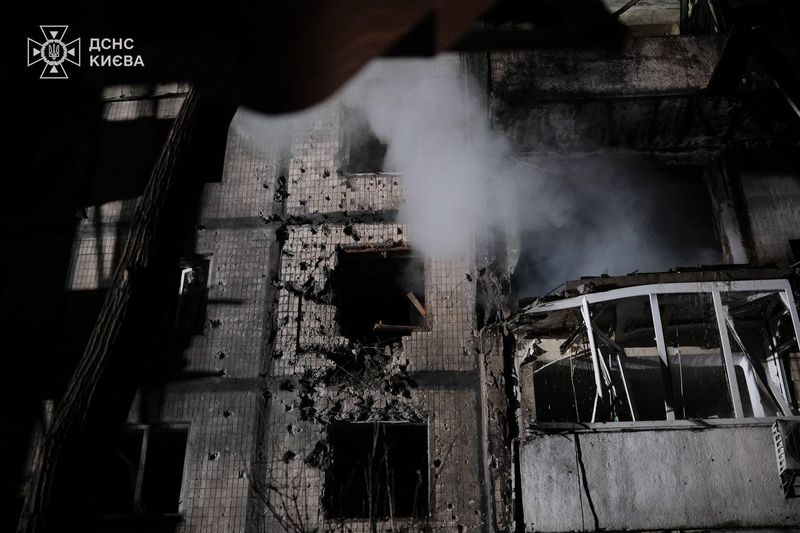
The recovery, by the standards of this autumn, was comparatively fast. Kyiv’s water utility later said water supplies had been restored, and DTEK, Ukraine’s largest private energy company, said emergency energy shutdowns in Kyiv had ended after repair teams stabilised the system. That sequence — strike, blackout, emergency shutdown, stabilisation — is the rhythm Ukrainian grid operators now repeat several times a month. It is also, officials in Kyiv argue, cumulative: every emergency repair draws on finite stocks of transformers, switchgear and crews, and stabilising a damaged system is not the same as restoring it to its pre-strike strength.
President Volodymyr Zelenskyy said on Wednesday that he had held a coordination call on addressing the aftermath of the strikes and restoring power, writing on X that Russian strikes continue virtually every day and that repair work continues around the clock. The post framed the night as one episode in an unbroken sequence rather than an isolated escalation — a characterisation the preceding 24 hours supported.
Post: @ZelenskyyUa via X
The night before: Ukrenergo counts 20 strikes in 24 hours
Tuesday’s attack, on November 3, had already been one of the largest of the autumn. A large-scale strike on power plants and substations across nine regions knocked out power in several areas in and around Kyiv, the Associated Press reported, and Ukrenergo, the state grid operator, said Russia had struck energy facilities more than 20 times in 24 hours. Read together, the two nights describe a deliberate cadence: a nine-region attack on power plants and substations, a single day of repairs, and then a 310-drone follow-up aimed at two named power stations and at least four further regions — a tempo designed, Ukrainian officials say, to keep repair crews permanently behind the damage.
The numbers: 310 launched, 272 downed, 19 locations hit
Four figures define the night, and each needs its context. The first is 310: the total number of drones Ukraine’s Air Force says Russia launched overnight, including 81 jet-powered drones. It is not the largest single-night total of the war — Ukraine reported 433 drones in one night at the start of November — but it sits in the upper band of a campaign in which three-figure launches have become routine rather than exceptional. The second figure is 272: the number the Air Force says were downed or suppressed, an interception rate of roughly 88 percent. By the standards of mass drone warfare, that is a strong defensive performance. The third figure is the one that qualifies it: hits at 19 locations, plus debris at 15 more. Against targets as concentrated and fragile as power stations and substations, the roughly one drone in eight that penetrates can matter more than the seven that do not.
The fourth figure belongs to the day before: more than 20 strikes on energy facilities in 24 hours, by Ukrenergo’s count. That number reframes the other three. A single night’s barrage can be absorbed; a barrage every night becomes a war of attrition against equipment and repair capacity. Ukrainian officials say energy facilities have been struck hundreds of times since the start of autumn. Russia’s Defence Ministry, for its part, presents the strikes as operations against energy and military infrastructure, and both Russia and Ukraine deny deliberately targeting civilians — the two standing positions that frame every competing account of nights like this one.
Why this matters
An energy war timed for winter
The calendar is the first reason this barrage matters. Early November is when Ukraine’s heating season hardens from preparation into necessity: overnight temperatures fall, heating systems run continuously, and electricity demand rises just as daylight shrinks. A power station knocked out in September is a repair problem; the same station knocked out in November, with a second and third strike following within days, is a heating problem for every apartment connected to it. That is why Ukraine’s autumn argument — made by Zelenskyy, by Ukrenergo and by DTEK in near-identical terms — is that strikes on generation and transmission in the weeks before winter are aimed at the civilian experience of the cold season itself. Russia’s stated position is different: its Defence Ministry describes the targets as energy facilities and military-linked infrastructure, and Moscow denies deliberately targeting civilians. The physical facts on the ground — power stations hit, water pumping interrupted, emergency centres handing out tea and charging phones — are not in dispute between the accounts; the intent assigned to them is.
Leverage before Abu Dhabi
The second reason is diplomatic. The strikes landed a week before the United States is due to bring Ukrainian and Russian delegations together in Abu Dhabi on November 10–11 to discuss ending the conflict, postwar security agreements and de-escalation, according to US envoy Steve Witkoff, Reuters reported. Negotiating leverage in this war has repeatedly been built in the days before talks, and both capitals know it. A Kremlin aide said last month that Moscow’s attitude toward three-way talks would depend in part on whether Ukraine launched a large-scale attack on Russia’s National Unity Day — November 4, the very day the latest barrage was announced. Kyiv, meanwhile, has kept its own long-range campaign against Russian energy infrastructure running in parallel, and Zelenskyy has publicly linked Ukraine’s restraint to air-defence supply, offering to pause strikes on Russian refineries in exchange for accelerated deliveries of Patriot interceptors. Each side therefore arrives in Abu Dhabi holding a version of the same card: the demonstrated ability to hurt the other’s energy system, and a price at which that ability might be traded away.
Grid resilience versus the repair race
The third reason is the race underneath the headlines. Ukraine’s grid has survived three autumns of this campaign not because the strikes fail, but because repair has so far been faster than destruction at the level that matters: emergency shutdowns end, water returns, substations are patched or bypassed. Wednesday followed that pattern — by the time DTEK announced the end of emergency shutdowns in Kyiv, the system had been stabilised again. But stabilisation consumes spares. Large power transformers are custom-built, slow to manufacture and hard to transport; every strike that destroys one narrows the margin for the next. The question the 310-drone night poses is not whether Ukraine’s grid can survive a barrage — it demonstrably can, at a cost — but how many barrages per month, sustained across a winter, the repair race can absorb before temporary outages become structural ones.
Context: Russia’s autumn energy campaign
The overnight strikes are the latest chapter of a campaign that Ukrainian officials date to late September 2026, when Russia resumed systematic attacks on energy facilities ahead of the heating season. The pattern has escalated in steps: single-region strikes became multi-region waves; the nine-region attack of November 3 was followed within a day by the 310-drone barrage; and Kyiv-region generation has been targeted repeatedly, including the 433-drone night at the start of the month that cut power to hundreds of thousands. The front lines and strike reports behind this campaign can be followed on the Ukraine war map, which tracks the conflict’s geography alongside the energy war being fought over it.
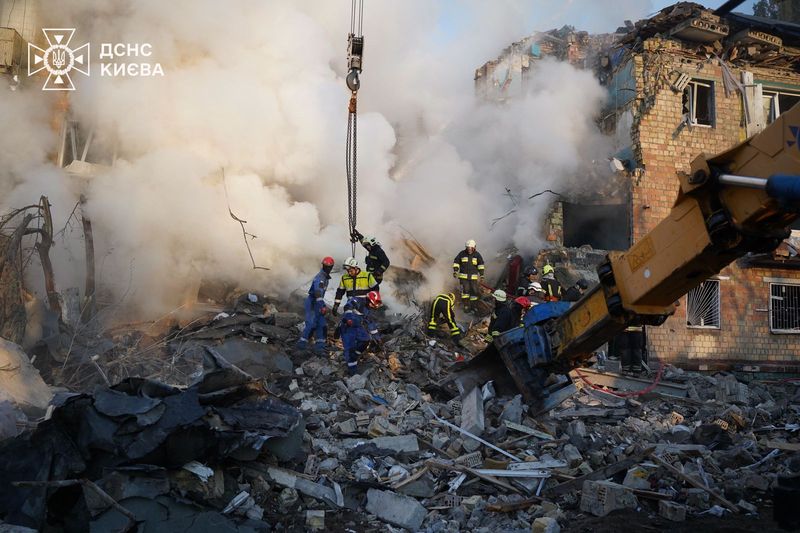
In a separate development in the same news cycle, the toll from the Russian strike on the aid distribution point at Komyshuvakha, in the Zaporizhzhia region, continued to rise. Officials said the confirmed death toll had reached 37, according to regional official Semikin, as reported by Reuters and the Associated Press. The number of people unaccounted for was given separately: Zaporizhzhia regional governor Ivan Fedorov said on Telegram that 59 people were missing, Reuters reported, while the Associated Press reported that about 38 people were possibly still trapped — two separately attributed figures, reflecting different counts by different authorities as rescue work continued, and they should not be merged into one. The Komyshuvakha strike, on a centre where civilians had gathered for aid, has become one of the deadliest single incidents of the autumn and a central Ukrainian exhibit in the argument over what the campaign is actually hitting.
What each side says
Russia’s account, issued by its Defence Ministry on Telegram, is operational in tone: Russian forces struck two power stations in the Kyiv and Zhytomyr regions and a cargo vessel at sea near Odesa, as part of continuing strikes on energy facilities. Ukrainian officials describe the same night from the receiving end: critical infrastructure hit, power and water interrupted in the capital, residents sent to public fountains, and a grid operator counting more than 20 strikes on energy facilities in a single day. Both Russia and Ukraine deny deliberately targeting civilians, Reuters notes — a symmetry of denial that has held through four years of war even as the physical evidence of each strike is documented by the other side. Signal Post News attributes each claim to its source; neither account is endorsed here.
What happens next
The immediate test comes on November 10–11 in Abu Dhabi, where the United States will host Ukrainian and Russian delegations for talks on ending the conflict, postwar security agreements and de-escalation, per envoy Steve Witkoff. Energy is expected to sit near the centre of that table: a pause on strikes against power infrastructure is the single measure that would most visibly change civilian life this winter, and it is also the measure each side has the clearest demonstrated ability to grant or withhold. Watch, in the days before the talks, for the tempo of the nightly barrages themselves — a quiet week would be a signal; another 300-drone night would be a different one.
The second test is meteorological. If temperatures fall sharply before or after Abu Dhabi, every damaged substation and every deferred repair becomes more consequential, and the emergency-centre network Kyiv operated on Wednesday — hot tea, charging points, public water fountains — shifts from an emergency measure to a standing feature of the winter. The third test is industrial: whether replacement equipment, air-defence interceptors and repair capacity reach Ukraine faster than the strike campaign consumes them. On Wednesday, at least, the repair side won the day: water restored, emergency shutdowns lifted, the system stabilised. Winter will ask that question several dozen more times.
Related coverage
Russia Fires 433 Drones in One Night, Cutting Power to Hundreds of Thousands Across Ukraine
Oleshky Ceasefire Ends as Russia Refuses Extension and Kherson Braces for Fighting to Resume
Zelenskyy Offers Trump a Swap: Patriots for One Month, and Ukraine Pauses Refinery Strikes
Sources
- Reuters, November 4, 2026 — Russia hits power stations in Ukraine’s Kyiv and Zhytomyr regions; Defence Ministry statement, strikes in Poltava, Dnipro, Kirovohrad and Rivne regions, the cargo vessel near Odesa, and the Abu Dhabi talks.
- Associated Press via Leigh Journal, November 4, 2026 — Russian strikes disrupt water and power in Kyiv as rescuers continue searches; Air Force drone figures, the Kyiv outages and emergency centres, the November 3 nine-region attack and the Ukrenergo count.
- Reuters, November 4, 2026 — Dozens dead and missing after the Russian strike on the Ukrainian aid centre at Komyshuvakha.
- Official sources as attributed in the text: Ukraine’s Air Force (overnight drone totals and interceptions), Ukrenergo (strikes on energy facilities), Russia’s Defence Ministry via Telegram (power-station and vessel strikes), DTEK and Kyiv’s water utility (restoration statements), and President Volodymyr Zelenskyy on X (@ZelenskyyUa).